Sunday Wednesday

Being busy people, it took us a couple weeks to watch the eight episodes of Tim Burton’s Wednesday, and I think he’s really outdone himself.  As I mentioned before, I was never a great fan of The Addam’s Family, but I watched it often enough to know the characters and their quirks.   I wasn’t quite sure what to make of the television show.  It had monsters, but nothing really scary.  It was funny but some of the humor seemed beyond me.  I watched it anyway.  I didn’t bother with the movie when it came out.  Then on a rainy weekend afternoon I watched episode 1 of Wednesday and I was hooked.  For one thing, this is dark academia personified.  Exclusive, gothic, school, dark mysteries, secret societies.  It’s all there.  And for another thing, it’s well written and the acting is very good.  And then there’s Poe.

Image credit: Chainwit. This file is licensed under the Creative Commons Attribution-Share Alike 4.0 International license.

(On a side note: I recently found another review of Nightmares with the Bible.  It is my most reviewed and least successful book.  The reviewer agreed with other reviewers that the Poe angle didn’t convince them.  As I told one critic, the Poe angle is a personal one.  Poe was a man, a sin of which I’m also guilty.  And men of a particular stripe feel protective of women.  Maybe it’s one of those biological things we should just get over, but Poe felt that it was poetic and, being a far less intelligent experiencer of that same disposition, I feel it too.  I think Tim Burton might also, for Wednesday seems full of that as well.)

At Nevermore Academy, the morbid, anti-social loner Wednesday learns to accept a kind of friendship from other outcasts.  There’s a town vs. gown aspect as the residents of Jericho don’t exactly love the academy, but they appreciate the money it brings in.  The founding pilgrim, Joseph Crackstone, was a hater of those who were different and tried to rid the world of others not like him (this is important).  Over eight episodes this backstory interrupts into the present and threatens the very existence of Nevermore.  What ties it all together, of course, is Wednesday.  Nearly as gothic as Sleepy Hollow, this Netflix series showcases the aspects of Burton’s vision that I find most compelling.  And the first season was nominated for quite a few awards.  A second season has been approved and I’ll be watching that one, down the road.  I can’t get enough dark academia these days, no matter the day of the week.

Betelgeuse

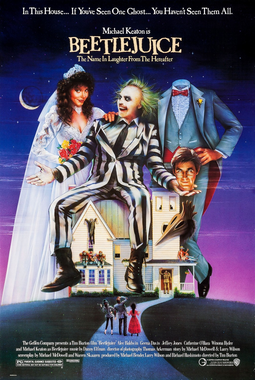
So let me see… from 1988 to 1992, what was happening?  Hmm.  I was getting married after moving halfway across the country in a rented car, moving to Edinburgh with no money, and working on a doctorate.  I guess I was pretty busy.  I missed Beetlejuice in 1988 and confused it in my head with Death Becomes Her (1992), which I may or may not have seen.  Some time ago I felt that I really should watch the former, not because of the sequel.  I may have seen bits of it over the years, but I wasn’t impressed with what I remembered.  Maybe part of the draw—the movie did quite well when released—is how different it was then from many things that came after.  Now that I’ve finally watched it, I can see it has some charms but I felt rather like the critics who noted the Betelgeuse subplot seems dissociated from the rest of the movie.

Michael Keaton as Beetlejuice is fun to watch, no doubt.  He doesn’t have much screen time, though.  His backstory, which seems important to explaining why he is how he is, feels shortchanged.  It also doesn’t really explain why the other characters dislike him so much.  When he’s released to save the Maitlands, he does, yet all they want to do is banish him.  I know better than to look for a coherent set of character motivations in such a movie, but for all the fronting of Beetlejuice, the story is really the Maitlands coming to grips with being dead and having other people move into their house.  The Others, while straightforward horror, handles this dynamic a bit better.  Of course, Beetlejuice is a Tim Burton movie, and that comes with a certain inherent quirkiness.

I had a mixed reaction, it’s fair to say.  Part of the problem may be that I’ve seen some of Burton’s better work, which came after Beetlejuice, before seeing the movie.  And other movies have done quite well in the weird category (Parasite, Everything Everywhere All at Once, Poor Things), making Beetlejuice feel its age.  Or maybe it’s all the build-up to Betelgeuse and then giving him so little time for his antics.  Perhaps it was the title of the film, or its confusion in my brain with another dark fantasy comedy, but it just didn’t press all my buttons.  Seeing it in the context of its Zeitgeist may have helped, but I was rather busy then and that part hasn’t really changed since.


Why Weenie?

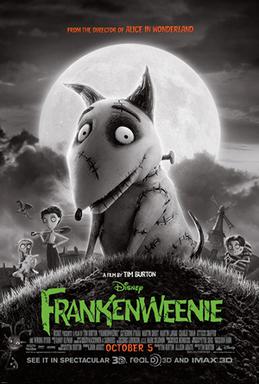
Often I ponder how incredibly influential Frankenstein has been.  Even those who don’t care for horror instantly recognize the creature and what he represents.  (At least partially.)  Tim Burton thought of tying Mary Shelley’s story to a pet dog in Frankenweenie.  This was a black-and-white, live-action short released in 1984.  It wasn’t aired much before being locked in Disney’s famous vault.  It wasn’t really what Disney was known for.  Ironically, then, in 2012 Disney released a feature-length version, also black-and-white.  This one was stop-motion animation, however, inspired by Burton’s Corpse Bride characters, at least to a point.  At its core the story of a bereft boy bringing his dog back to life, the original showed the mayhem introduced by crossing the border between life and death.  Not too different from what Shelley was intimating some century-and-a-half before.

The remake, or reboot, was feature length and had to develop the plot a bit.  Along the way there are numerous nods to other horror films.  Critics have noted that horror is an amazingly self-referential genre.  Comedy horror delights in parody.  So, as a Vincent Price-like science teacher inspires Victor with the concept of reanimation via electricity, the boy decides to resurrect his pet.  Other school children find out about the undead Sparky and decide to make their science fair projects reanimated pets.  Or sea monkeys, in a clever take-off on Gremlins.  Naturally, the other pets lack Sparky’s good will, not raised out of love, but out of a desire to win a competition.  One student’s resurrected turtle becomes a Godzilla-like kaiju, allowing for winks at Jurassic Park.  The cat-bat reminded me, anyway, of Gremlins 2.

Ultimately, the story comes to the same resolution as the original short.  Of course, this isn’t scary horror.  Comedy horror is an odd genre.  It permits darker-themed elements to play against fun and fantasy.  Frankenweenie isn’t really laugh-out-loud material, and if you’ve seen the previous version the story arc is already known.  Still, it’s an effective movie.  Although it made millions at the box office, it wasn’t as many millions as Disney has come to expect.  But it is quintessential Burton.  It also has a moral attached—that even scientists need to pay attention to love and the motivation for learning.  The parents at the PTA meeting are scandalized by what science does, in a bit of real-life parody as well.  So Frankenweenie came across as pretty good to me.  I like monster movies.  It did lack, however, the emotional impact of the original.  Of course, the tale of a boy and his dog is its own kind of archetype, I suppose.


Dark House

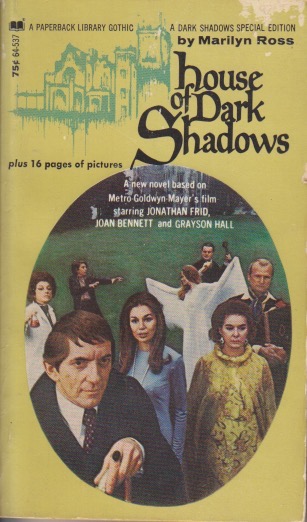
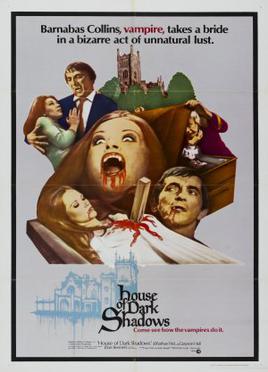
Last year I completed an odyssey that began over a decade and a half ago.  I finished reading the Dark Shadows serial novels by Marilyn Ross.  Not because they were great literature, but because they were an important part of my childhood.  Slowly, over the years, I regathered the books and read them until the whole series was done.  One of the used book sellers was offering a collection of the books, and although the collection had some duplicates of what I’d already found, it contained some of the more difficult to locate titles.  When it arrived, I found it also included House of Dark Shadows.  This novelization wasn’t part of the series, and like most things in my life, I can’t claim to know everything about Dark Shadows.  As a child I didn’t know there had been a movie, let alone a novelization.  (I bought the books as I happened to find them, at Goodwill and watched the TV show.)

In the present, I’d just finished Octavia Butler’s Parable of the Talents and felt that I needed something lighter for my next fictional project.  House of Dark Shadows proved a better read than most of the series books, perhaps because it was based on a movie script written by the screenwriters.  Marilyn Ross was actually William Edward Daniel (W. E. D.) Ross, and he wrote more than 300 novels.  His Dark Shadows oeuvre became repetitious in its dialogue, across the series.  His characters always seem to say “at once” instead of “immediately” or “right now.”  I’m pretty sure the word “mocking” appears in each of them—certainly the latter ones—multiple times.  Having the script must’ve really helped keep those trademarks to a minimum.

Of course, now that I’ve read the novelization I need to go back and watch the movie again.  It’s been almost two years and some of the details escape me.  It’s largely because the movie goes “off script” from the long-running daily show (and the other novels).  I also realized that Tim Burton’s Dark Shadows movie was really a kind of reboot of House of Dark Shadows, unfortunately screen written by Seth Grahame-Smith as a comedy.  I’m no expert on Dark Shadows, just a reasonably enthusiastic fan in search of a lost childhood.  The movie makes the premise of the series untenable—both can’t exist in the same world, so it’s kind of a Dark Shadows multiverse, rather than a simple universe.  And it’s very complex.  I’d need to start again at childhood to become an expert in it, but at least now I’ve read all the books.


What People Like

It must be like showing up at a party wearing a flashy shirt that somebody else is also wearing.  Embarrassing, no?  A few years back I read Brian Jay Jones’ biography of Washington Irving.  As you may know, I recently finished Andrew Burstein’s.  The two were published within a year of each other, but both after a seven-decade gap in such biographies.  I suspect the renewed interest in Irving sprang up in the surge of public interest after Tim Burton’s Sleepy Hollow appeared.  Movies have power.  Books, especially big books, take a long time to write.  I don’t know if Jones and Burstein were aware of each other’s efforts or not.  Both are quite good, but they do stand as a testament to how fame can be fleeting.  Irving is infrequently taken as a genius writer today but he started more than one big thing.

What I’m particularly interested in is how Burton’s film seems to have kickstarted a new millennium interest in this old story.  I recently had a discussion with a couple of folks who felt that movies were too manipulative to be enjoyable.  Of course, nobody forces you to watch a movie, but I have found that they are powerful ways of influencing people.  And society.  Movies have been one of the more impactful forms of fiction media, spawning ideas that can change society.  Indeed, they may be modern mythology.  I wouldn’t yet make that exalted claim for Sleepy Hollow, but for those who follow such things, it has influenced the way we look at things.  And we can learn something from paying attention to them.

The Headless Horseman Pursuing Ichabod Crane by John Quidor

I suspect that is one of the perennial mistakes of higher education.  Assuming that something is popular means that it shouldn’t be worthy of scholarly attention.  If we want to understand what it means to be human, rather than just raping and plundering our planet until we choke it to death, we need to consider what it is that appeals to people.  What are the Classics if not the popular literature of antiquity, dating back to the time before most people could read?  What do we lose by trying to understand what motivates others?  There are those who spend their money on such things, after all.  Consider game developers.  They rake in the money because that’s what people like to do.  We don’t mind being manipulated, as long as we do so voluntarily.  We’ve wandered away from Irving at this party, but it does seem that Burton’s movie kickstarted our interest in America’s early wit again.  We ignore what interests hoi polloi at our peril.


Life Lessons

Most of us know a bad movie when we see it.  Some of us walk away.  The rest of us linger and wonder.  Some weeks ago now I watched Ed Wood’s Plan 9 from Outer Space.  “So bad that it’s good” is the mantra often chanted about it.  I lingered because of Ed Wood.  While it’s somewhat fictionalized, Tim Burton’s Ed Wood is itself an odd movie.  It performed poorly for a Burton film starring Johnny Depp.  Critically, however, it was praised and it eventually became a cult film about a cult film.  Or films.  Mainly, I suspect, because Ed Wood is such an interesting figure.  He was a man who wanted to make movies—knew he was meant to make movies—but never got the backing he needed to make them.  He did it anyhow.

Ed Wood starts with Glen or Glenda.  Written and directed by Wood, who also starred in it, this movie was about cross-dressing.  In real life Wood’s mother used to dress him up as a girl and although he was heterosexual, Wood became a transvestite.  This was, of course, in the days when such a thing was scandalous.  Making all of this surreal, and poignant, Wood had befriended an unemployable Bela Lugosi—known to be a drug addict—and had him star as God in the movie.  The next film Ed Wood focuses on is Bride of the Monster.  Again starring Lugosi, this one has a giant octopus in it and heads toward horror territory.  The film about a filmmaker ends with his notorious Plan 9 from Outer Space, the last film in which Lugosi appears and which was financed by a Baptist church.

Ed Wood ends before Wood becomes a poverty-stricken alcoholic and dies in his fifties.  There is a poignancy both to the stories of Wood and Lugosi that also applies to many people in life.  People who know, without a doubt, what they should be doing with their time on earth but who are kept from it by those, who like Lugosi’s God, pull the strings.  We all have limited time and as we grow older we realize that spending it doing a job that’s a drudgery is really a kind of crime.  Would Ed Wood have become a famous director if he’d been backed by the money to produce the movies he wanted to?  We have no way of knowing.  What we do have, however, is a tribute by a talented film maker to a fallen colleague, and that, it seems is the best part of human nature.


Novelization

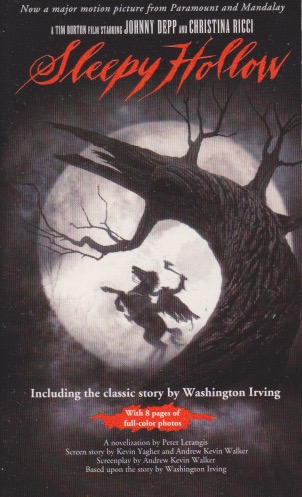
It must be both difficult and easy writing the novelization of a movie.  I suppose it depends on the movie as well.  Sleepy Hollow is a film based on a story already, but Washington Irving’s tale isn’t a novel and the movie was a collaboration between Irving’s original, re-envisioned by Kevin Yagher, Andrew Kevin Walker, and Tim Burton.  The novelization was done by Peter Lerangis and it, naturally enough, follows the movie.  As a novelizer, however, you need to try to make sense of some scenes where a film only implies what’s going on.  Now, in this case I’ve seen the movie many times and any deviations come across as “that’s not the way it goes” moments.  Still, it’s competently done.  It  even helped me make sense out of some things that had me puzzled since the start of the millennium.

In the “book or movie” debate I tend to think a book should be read first.  Sometimes it should go the other way around.  Novelizations are, of course, intended to increase the profits for a film.  You’ve got the box office take, and if there are advertising tie-ins or other merch, you can add to the haul.  A novelization can also help.  In this case, the movie has a somewhat complex plot with revenge and double-crossing, and so a novel helps to make all that clear.  However, when the novelist asks you to accept what a character is thinking you may have already come up with your own ideas on that point and any postmodernist would tell you that your opinion is just as valid as that of the writer.

Movie scripts tend to be a bit short for novels—if the movie isn’t based on a novel, of course—and sometimes extra material is needed.  This novelization includes the public domain story by Irving as well, even though the movie completely recasts all the characters into unfamiliar roles.  Brom, for example, is a minor part, whereas Katrina is a witch and Ichabod a constable from New York City.  All of that having been said, there really aren’t many surprises here.  I read this because I’m interested in the life of “The Legend of Sleepy Hollow.”  Its many retelling and re-envisionings.  The original story was published less than fifty years after American independence and has memories closer to the time.  It tells us something of what it was like in those early days.  And this novel both retells and redacts a movie already a couple decades old itself.


Pitfalls

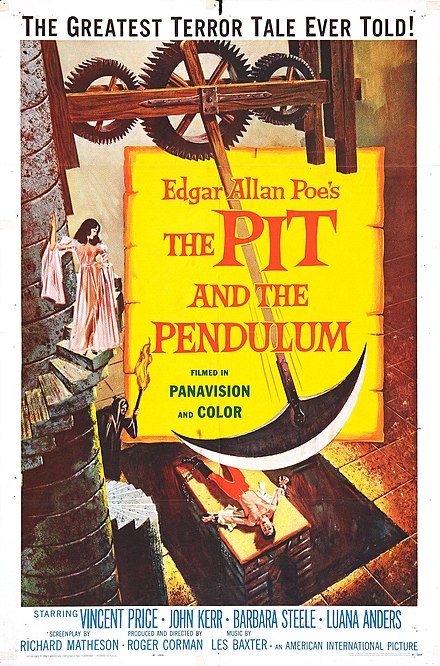
While watching Roger Corman’s The Pit and the Pendulum, it occurred to me that these movies have improved with age.  The series of American International Pictures’ Corman Poe productions do manage to capture a mood.  One of the reasons, I suppose, is that Vincent Price was an able, often underrated, stage performer.  No, these aren’t like modern movies.  They’re clearly fictional and the backdrops are pretty obviously fake and it always seems to be thunder-storming outside. They are going for a mood, and for those who watch films for the feelings they generate, this can work.  Although based—very loosely—on Edgar Allan Poe, The Pit and the Pendulum was screen-written by Richard Matheson, an able novelist in his own regard.

The Poe story hinges on the terror of the slowly descending pendulum and it has been used and reused in various guises over the years in everything from horror films to James Bond movies.  Corman’s Poe movies often set trends.  For example, in the backstory to Pit and the Pendulum, Nicholas’ (Price) father was a member of the Inquisition.  He kept a personal torture chamber in his basement—well, he lived in a castle, after all.  One of the victims of his father was Nicholas’ mother, an event the young Nicholas witnessed.  A very similar scenario, with even some similar shots, occurs in Tim Burton’s Sleepy Hollow.  I’m sure it must occur elsewhere as well, but in making a narrative of the story, this is my own unprofessional observation.

Yes, Corman is often over the top.  His films know they’re for entertainment purposes.  He’s not above camp and gimmicks.  The strange juxtaposition, in my own case, is that movies are meaningful.  Ninety-minutes to a couple of hours relieved from the constantly pressing demands of work and trying to maintain some sort of social life.  (And yard work.)  In ancient times, I suspect, myths served a similar purpose.  They still do.  Our myths have become more Technicolor over the years and have evolved from celluloid to pixels.  Their function has also evolved from escapism to a location of meaning.  On a recent weekend on my own I ended up watching five movies, feeling guilty between times for not painting the porch or doing that plastering that’s requiring attention in the attic.  The movies, however, give meaning to these other more mundane tasks such as work or housekeeping.  They’re not literally true, I know, but we need not disparage Roger Corman for stating the obvious.  Myths entertain as well as inform.


The Burton of Thought

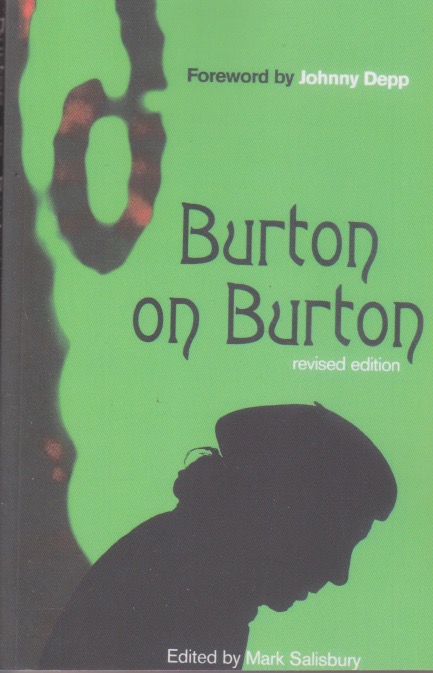
I haven’t seen all of his films.  Some of them I have seen I didn’t really like.  When Tim Burton does strike a chord, however, he does so hard.  Burton on Burton is one of a series of books of interviews with directors.  This one covers all of Burton’s films up to Corpse Bride with free-ranging answers to what are really more remarks than questions.  (The book is edited by Mark Salisbury.)  Although I’ve not experienced his entire oeuvre, it’s pretty clear that I share quite a few sensibilities with Burton.  He expresses that what he’s looking for in movies is feeling.  A good plot helps, but it’s the emotion he’s after.  And he knows that the dark isn’t bad.  At many points I had to shake my head and say, “I thought I was the only one who thought like that.”

This memoir is also full of information on the way movies get made—not the technical side, but from the studio or creative side.  Someone has an idea.  It may be original or it may be an adaptation of a well-known tale.  Sometimes, especially in Burton originals, they begin as a series of sketches.  Anybody who’s watched DVD extras knows about storyboarding.  A movie is sometimes laid out in a series of cards that show, step-by-step, the action.  Before that, or maybe during, a script is written.  In order to get funded—for all this costs money—a studio or production company has to pick up the concept.  The person pitching it might be a screenwriter or a potential director.  And, as in every avenue of life, money talks.  Once you’ve had a breakout success they start to pay attention to you.

Although Burton and I grew up with similar outlooks, he notes that he never did like to read.  Being a visual artist (he got his start at Disney), that’s perhaps no surprise.  You start to realize, once you get a sense of the number of people involved, why film credits go on and on.  It takes a village to make a movie.  Not only that, directors may be involved with several projects simultaneously.  That’s not so different from being an (unofficial) writer, I suppose.  At any one time, from my experience, I’ve got at least a half-dozen projects going.  Some will never be finished, most will never be published.  And who knows?  Maybe someday one of my fiction stories might catch a sympathetic (or perhaps simply pathetic) director’s eye?  In the meantime, we go on creating.


Shadowy House

The more you learn the more you realize just how little you know.  The House of Dark Shadows was like a key, a missing puzzle piece for me.  Dark Shadows has been on my mind quite a bit lately.  I’m the first to admit that I’m no expert.  I never saw the whole series on television—I saw many episodes once, during my childhood.  Enough to know who the characters were—especially Barnabas—but when I stopped watching it (when? Why?) I started reading the novels by Marilyn Ross.  Clearly the soap opera was gaining enough ratings to merit the building of a franchise.  But the thing was, there is so much in life that I never concentrated on it.  I read the novels occasionally, and I never saw House of Dark Shadows when it came out in 1970.  Not, in fact, until 2022.

Since I was only eight when it came out, even though it was rated PG, I would’ve had neither the means nor the money to get to a theater.  I had, in fact, never even heard of it.  Having been raised a Fundamentalist, I have a tendency to believe there is just one way a story goes.  I know there are variations—they occur in the canon of Scripture, even—but something deep-seated tells me it should go this way.  House of Dark Shadows (which explains a lot of Tim Burton’s decisions for his movie reboot) has a different story line.  Given that it was 1970 it would have been in the midst of the initial series broadcast.  The movie was quite successful.  Still, Barnabas ends up victimizing Carolyn (which in the novels he is reluctant to do), and Roger, and outright killing a number of people.

I spent the movie trying to process how the story should go.  Of course, I haven’t seen the soap opera enough to know.  This Dark Shadows franchise is episodic and it doesn’t add up.  The film was shot quickly and leaves gaps in the story.  It certainly doesn’t track well with the tale of the Maine family who knows about “cousin Barnabas”and that he visits Collinwood from time to time.  Our course, between the series and the novels there are many, many avenues to select.  When Tim Burton got the idea to make a movie he had an abundance of stories from which to choose.  The House of Dark Shadows isn’t a great movie.  It is gothic and moody and a standalone story.  And it has me wondering about what other dark shadows conceal.


Gothic Tales

Each year when autumn worms its way into my consciousness, I begin looking for the ideal gothic book.  I can test this by looking at the Goodreads lists of best gothic novels and noting how many of them I’ve already read. The thing now, since I’ve already covered much of the canon, is to discover modern writers who can still evoke that feeling I seek.  This is all complicated by the subjective nature of what readers term “gothic.”  Many of the books on the lists don’t fit my own working connotation, so I keep looking.  One recommended title was Jennifer Giebrecht’s debut novel The Monster of Elendhaven.  I’m still trying to decide whether it is gothic or not.

It’s a little hard to classify, actually.  It certainly has some gothic elements, as well as some horror.  There are secrets and plagues and gruesome murders.  There is a monster from a polluted sea, but not quite your grandfather’s monster.  A human monster.  Or at least partially.  The tale is written with some tongue in some cheek.  There are funny elements and there are many serious moments.  There’s magic and mayhem.  If I were to try to characterize it the closest I might come would be a Tim Burton treatment of horror.  Like Burton, Giesbrecht creates a Halloween mood, but sometimes the humor undercuts it.  This makes it difficult to pin down the work as a whole and figure out if this is the gothic I’ve been seeking.

Set in a time difficult to define and in a fictional nation, it is the kind of novel that can be read without much consequence.  The references to the Allfather make comparison with Nordic regions natural, and there is perhaps a touch of Beowulf here.  In crafting the monster Giesbrecht has made a pretty unlikeable character.  He is a monster, after all.  But not a sympathetic one.  As in other modern treatments he is a stand-in for chaos.  There’s also an environmental sensitivity here.  The monster arises from a polluted sea that derives from, of all things, human greed.  So maybe there’s a parable here.  A short book, it doesn’t take too much of a time investment, but it may leave you wondering what exactly it is that you just read.  It is dark, and gritty, and fun.  A nice combination for an October night.  Is it gothic?  That one’s a little harder to answer.  It depends on how I’m defining it on any particular day.


Southern Turn

In America’s ever roving commercial eye, Día de Muertos has become an extension of Halloween.  Retailers have realized that people will spend a lot on their fear, and the autumnal holidays delve into that primal territory.  Since the Day of the Dead, being a mix of indigenous Mexican religions and the Catholic celebration of All Souls’ Day, comes two days after Halloween why not blur them together with greenbacks?  So capitalist thinking goes.  While certainly not free of monied interests, the Disney/Pixar movie Coco has the virtue of addressing Día de Muertos as the separate holiday that it is.  A form of ancestor worship—a religion extremely common around the world—the thought-world of the film shares in common with Tim Burton’s Corpse Bride this idea that the afterlife is colorful, if not joyous.

I realize I’m jumping the gun here, but I just saw Coco for the first time over the weekend.  Not just a culturally sensitive treatment of an indigenous holiday, it is also a celebration of music.  In a very real sense, music is life in the film, and even the dead continue to thrive in its presence.  Again, the connection with Corpse Bride suggests itself.  The key difference, from a religionist’s point of view, is that Coco is based on, to an extent, actual religious traditions.  An irony of this is that, together with the worship of Santa Muerte, the focus on death sometimes makes the Catholic Church nervous.  Focus should be on resurrection, not death.  But what if death isn’t seen as evil?  Where is thy sting?  This can be a real challenge when your organization is offering escape from death.

The fear of death is natural enough.  It’s the ultimate unknown.  It fuels both religion and horror.  In that sense films like Coco that show a joyful aspect of the hereafter do an end-run around traditions that base their wares on ways to avoid the consequences of death.  Hell becomes a threat to be avoided—the forgotten dead in Coco face annihilation, a fate that Héctor notes comes to everyone eventually.  Eternal torment isn’t in the picture.  I have to wonder if this view doesn’t present a form of salvation that is unwelcome among rival religions.  Although Catholics don’t have the hostility toward Halloween that many Evangelicals display, there is a challenge of rival faiths here.  Stores have already begun offering this year’s Halloween wares, and increasingly among them are Day of the Dead decorations.  The holidays are quite distinct, although related, and movies like Coco suggest what we fear may be more a matter of perspective than of the decree of an angry deity.


The Big Shill

Once in a while I have to shill. As an erstwhile academic I’m aware of the cachet my employer bears for colleagues and the elite among the general public. Still, I find articles on the Oxford Dictionaries blog irresistible. I don’t work for the Dictionaries division, but I sometimes wish I did. A recent post by guest blogger Rebecca Teich discusses pulp fiction neologisms that have made their way into mainstream vocabulary. It’s not so much the individual words that interest me as much as does the phenomenon itself. Pulp fiction is antithetical to the sophisticated literature of the cultured class. Yes, there is status snobbery involved in such an assessment—we know those who find anything “common” to be vulgar and indicative of a lack of good breeding. The fact, however, that pulp fiction words make it to the mainstream belies the singular direction of cultural influence.

Many of us who grow up in working class families aspire to better things. We see (or used to see) on television and in movies how other people live. They have things and experiences that we covet. We work hard for many years to try to get there, often being kicked back down the stairs along the way. And yet we find some of our cheap, common vocabulary creeping into the consciousness of those who can afford better. There’s even a phrase for it. Guilty pleasures are those enjoyable books or other media that are really “beneath us,” but which we secretly enjoy. I post once in a while about Dark Shadows novels which are, quite literally, among the pulp fiction I grew up reading. They reached cultural cachet with a decidedly disappointing Tim Burton movie based on that universe, but regardless, they reached mainstream respectability.

Respectability. I suspect that’s what it’s all about. We want to be shown that our dirty collars and rolled-up sleeves mean something in this world of billionaire playboy presidents and congress that aspires only to greater wealth for itself. My first job, which I started when I was 14, involved physical labor. Brooms, paint rollers, and sledge hammers. I spent my evenings watching television and some of my weekends writing fiction. Pulp through and threw. Part of me finds its bliss in knowing that other rough-hewn writers have stamped their hallmark on the literary world by pounding out gritty stories of authentic human experience. Yes, I may be a corporate shill in this respect, but then, the shill is a respected member of the pulp fiction community.


Hollow, Sleepy Hollow

Legend_of_Sleepy_Hollow_U.S._Stamp

It was recently announced that Fox has renewed Sleepy Hollow for a fourth season. Please! No spoilers in the comments (as if)! I’m running a season behind so I want to protect my innocence. The announcement coincided with the happy news that my article on the Bible in Sleepy Hollow has been accepted for publication in the Journal of Religion and Popular Culture. I’m irrationally chuffed about this since my past publications have been primarily textual explorations of documents in languages nobody reads any more. Having something contemporary accepted for publication felt—dare I say it?—cool. As if I were part of the supernatural television crowd. It also affirmed my decision for which book to pursue next. When I say “pursue” I mean “write.”

You see, as a young scholar I struggled trying to decide what direction my research would take. After writing my book on Asherah, I was a bit sated with Ugaritic goddesses, although I started a book on Shapshu, goddess of the sun. The sun gave way to the weather and I wrote Weathering the Psalms. I lost my job in the midst of my revision of that project and it has taken a decade to find my way back to academic publishing. Research, however, takes on a vastly different form when you’re not hired to do it. Colleagues say, “I can get you access to my university library.” Such a kind thought, but my mind always says “when?” When would I have time to visit a library? I get up at 3:30 for my commute and get home in time to go to bed so that I can wake up again at 3:30 the next day. Research reading on the bus is dicey at best. Weekends are for getting the things done that are neglected all week long. Research has to be squeezed into the interstices.

That’s why I’m pleased about Sleepy Hollow. Watching television, even if on DVD, can be research. I’ve got decades of backlogged reading upon which to draw. When my tastes for light horror integrate with what I’m interested in researching it is a happy day. “The Legend of Sleepy Hollow” captured my imagination as a child. It was probably based on the Disney version, but even so, I never lost the fascination. Tim Burton’s Sleepy Hollow is still one of my favorite movies. Watching the episodes of the Fox series takes time, but now I know that time is not just simple relaxation. No, it’s research. Now to find the time to write that book that’s brewing in my head. Inspired, perhaps prophetically, by a Headless Horseman.


Look Both Ways

Like many kids of the sixties I grew up watching Batman. I mean Batman—the campy, goofy, live-action version of the caped crusader that was must-see TV for young boys and other hero wannabes. This was all hung upside-down, as it were, by Tim Burton’s reboot of the troubled crime-fighter. Then came Christopher Nolan’s canon. The Dark Knight remains one of my favorite movies as it seems unstintingly honest. We are all part Joker and part Batman. Neither is ideal. More than that, this movie was my first introduction to Harvey Two-Face Dent. You see, I didn’t grow up reading Batman comics, and the television adventures never featured him. At least not as far as I can remember. Two-Face is a fearful foe because you can never tell when he’s telling the truth. That can be very scary.

The other day I asked my mother about someone I remembered from church growing up. This was a woman I hadn’t seen since the Nixon Administration and I was curious how she was doing, and even if she was still alive. My mother told me she was still around, but she doesn’t talk to her any more because the friend is “two-faced.” Among evangelical Christians this is one of the most feared of epithets. Telling different “truths” to different parties is a certain way to demonstrate want of moral fiber. Hypocrisy. It’s also a non-refundable ticket on the bus heading south, if you get my meaning. Christians want to be thought of as honest, if nothing else. Harvey Dent would’ve had real trouble being an evangelical (with some noteworthy exceptions).

JanusVatican

Businesses, however, are disciples of Janus. I often ponder the sheet number of items that companies classify as “public facing.” What, I wonder, is the antonym? I’ve even heard of corporations that will take legal action against former employees who honestly admit how business is done. No one is permitted to speak of what happens in the entrepreneurial boudoir. Corporations, under the law, are persons. They are afforded the secret inner life of real individuals. There was a “naked business” craze in early in the millennium, but that petered out. We have a public facing face and a reality that no one is allowed to know. Trade secrets. Information that only one corporation may have. Over in Gotham, Two-Face slips into a dark alley and escapes. In little white churches across the country, those who speak different truths are shunned. In the corporate high-rise, businesses are now people. They are, however, two-faced. I miss the Batman of my youth.