Roman Women

This week’s Life section of Time magazine features an issue that yet again raises the questions of definitions and who decides on correct religion. The feature by Tim Padgett entitled “Robes for Women” demonstrates the conflicted nature of religious authority. With the Vatican claiming women have never been priests, but historians questioning the assertion, the salient point is who has the right to decide. And what is lost, if such a change were to take place. Tradition is not threatened by change – it always stands sentinel over the past, but no religion remains unchanged for any length of time. It is not biblical authority that is lost either. Any religious body whose scriptures state, “call no man on earth your father,” yet which addresses its clergy by the title “Father” clearly possesses the casuistry to get around other biblical injunctions. What is lost is male power.

No matter how vociferous theologians may be concerning the genderlessness of God, the default male image seems deeply embedded in the human psyche. One of the most ancient and pervasive of mythological themes is the search for the father. The loving mother is the one who stays near and raises the child while the father leaves to make provision, or for reasons less wholesome. At some level we know that the deity portrayed by Scripture and tradition is male, a father who is difficult to find at times, particularly times of need. This archetypal image is not an excuse not to re-envision a genderless deity, but it underscores what generations of human experience has taught us. Referring to God as father and mother only complicates the matter by throwing into the mix all aspects of gender complications. Can humans even truly worship a god without gender?

If the Womenpriests movement succeeds, as no doubt it should, there will always remain a group who will not accept their authority. My experience at Nashotah House taught me that some prejudices are so deeply rooted that they are no longer even recognized by those who hold them. Wild examples of theological gymnastics were paraded before me as to why women should not hold priestly office. And like Nashotah House reveals, if women are finally accepted by Rome, others will split away and both sides will lay claim to the true faith. There will be no convincing either that the other is correct. The history of Christianity has taught us this sad truth. Current estimates suggest there are some 38,000 different Christian denominations. This is the common fate of all religions who claim to have exclusive access to the single, unambiguous truth.
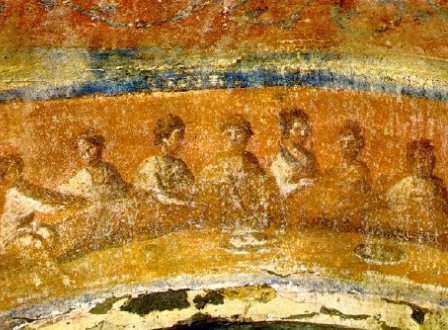
The secret of the catacombs


I Think, Therefore I Believe

This week in Time, an article by Jeffrey Kluger explores the intelligence of animals. Quite apart from many examples of how bonobos can string together relatively complex concepts using symbol cards (thus evidencing more intelligence than New Jersey’s current governor), the article demonstrates that many animal species display what we would recognize in other humans as intelligence. The article then develops the corollary that if animals think then perhaps they sense emotion as well. Having raised my daughter on Kratt’s Creatures and Zoboomafoo, none of this was new to me. I may be no scientist, but watching closely how animals behave, it has always been obvious to me that we are more like points on a continuum rather than a “special creation.”

Not to put too fine a point on it, this is what lies behind the human obsession with its non-animal status. As Kluger states, “For many people, the Bible offers the most powerful argument of all. Human being were granted ‘dominion over the beasts of the field,’ and there the discussion can more or less stop.” Unfortunately for our animal companions, the use of the Bible to repress others does not stop at human beings who don’t share your religious views. Many use the Bible as an excuse to do as they please to creatures who demonstrate similar emotional responses to people in similar situations and who, increasingly we realize, also think. Kluger’s article opens with an interview with Kanzi, a bonobo. One of the inevitable conclusions is that this great ape is able to think ahead and make plans. Evolution on this point has apparently skipped many Neo-Cons.

For years I have been telling my students that animals display behaviors that we label as “religious” in humans. The difference is that we are able to ask other humans what they are thinking and thereby gain somewhat direct access to their thought process (if they are telling the truth). Because we fail to share language with animals, we assume we are superior thinkers. To me this does not stand to reason. Animals are as fully members of this planet as humans are. Our desire to exploit them is more a reflection of human dominionist tendencies than a reflection of their lack of intelligence. We may even have animals to thank for the basic tenets of religious thought since religions are better described as evolved than revealed.

Maybe not the best sign of animal intelligence, but consider the Neo-Cons...


Life in the Laboratory

Nancy Gibbs’ essay “Creation Myths” appears in this week’s Time. Leaping off from Craig Venter’s “creation of life” in the laboratory, Gibbs asks who the final arbiter might be in this world we’re creating in our own image. The more I ponder the question, the more I realize that no person really decides how far we will go and the implications will only grow more and more unanswerable. We all attempt to construct the world according to our idea of how it should look; it is not a question of if we create the world in our image as much as it is whose image will prevail. As I noted in a recent post, no one person has all the answers. What each of us does impacts all the others just as a wave influences everyone in the sea. We fear science taking the prerogative of creating life because we are fully capable of imagining where it might go, but we just don’t know.

As an individual who has often been on the receiving end of other people’s visions of how this or that institution or company should look, it is my humble assessment that we have already lost control. We never really had control in the first place. At the end of the day, who will really be able to prevent another Gulf oil spill from occurring? Make what laws we will, other creators will find ways around them. And as in Gibbs’ article, the rest of us will simply have to react. No one is really in control.

Perhaps this is the real reason that religion is so appealing. It is terribly, terribly convenient to have an omnipotent divine entity on whose anthropomorphic shoulders we might cast our worries and burdens. Whether we believe in predestination or not, it is comforting to suppose that when it is all over God will somehow sponge up all that oil (preferably squeezing that sponge back out into BP’s great, sturdy tankards of crude), or stop that evil clone we’ve engineered, or stomp out that hyper-aggressive virus we’ve unleashed. We may make laws against creating life or human clones in the laboratory, but it will happen nevertheless. Gibbs wonders if scientists are about to cross some moral Rubicon. My answer is simple: we crossed that Rubicon long before the river itself flowed, when we first put our webbed feet out onto dry ground and began our still uncertain journey to the future.

God exits, stage left


Monday Morning of the Soul

Western society is much indebted to the Hebrew Bible and the culture it has engendered. Nowhere is this more evident than the now hallowed concept of the weekend. Most of our time increments are determined by the movements of celestial bodies – the sun marks our days and years, the moon keeps our months rolling along. But the seven-day week is a bit of an anomaly. We know that the ancient Babylonians experimented with the seven-day idea, but it was the Hebraic concept of the Sabbath that provided us with a regular day off.

Ancient agrarian societies knew no “days of rest.” The old saying, often attributed to nineteenth-century American farmers, states that your cows require milking, even on the Lord’s day. Life in ancient times, for most individuals, was a daily slog, repetitive, long, and repetitive, of struggling to survive. The idea that you could take a break from survival to relax and not work simply did not equate. A break from survival is the same as death. When ancient priests – city-dwellers, no doubt – decreed that Saturday was a special day because even the Almighty needs a little Miller-time, well, the idea caught on. Society, once it had become sufficiently urbanized, could allow one day off a week.

Fast forward to the Christian contribution. Early followers of Jesus were Jewish and therefore already sold on the Sabbath concept. The resurrection, they asserted, took place on Sunday, so it was appropriate to worship on that day as well. A two-day worship minimum had been established. To many ancient folks this looked like laziness with a religious blush. Nevertheless, it caught on. Now many of us in a leisure-based society, with white-collar work that usually can handle being put off a couple days without immanent starvation or over-lactation, live for the weekend. Constraints of doing it for “the man” are off, we are free to be who we really are. Two-sevenths of the time, anyway.

Religions have given the world special gifts. As another dreadful Monday morning forces us out of bed early and focuses our eyes on a distant Friday afternoon, we should remember to thank Judaism and Christianity for their combined worshipful sensitivities. If it weren’t for them, we would have endless weeks of Mondays.


Be Careful Little Hands

“Time is always against us,” Morpheus informs Neo in The Matrix. Of course, this is a paradigm for life spinning out of control, an allegory of having been taken over by forces against which there is no defense. It surprises no one that as time continues its inexorable march there will be generations that see the same phenomenon in very different ways. In last week’s Time, Nancy Gibbs’ essay addresses the differences between the millennial generation and those of us who are, well, not to put too fine a point on it, older. Her observation on their religious sensitivities is worth noting: “millennials” are just as religious but less conventional, with 1 in 4 having no religious affiliation. They nevertheless remain a deeply spiritual bunch.

Neurologists continue to study the “hardwired” aspect of religious belief, finding that human brains possess a genuine need to believe in something. Why not god? It is, after all, our cultural matrix. As I read this I reflected on ancient religion. Often students ask me what ancients believed. We don’t really know. Religion as a belief system only arises when monotheism emerges: if only one religion is correct, then it is possible to believe in the wrong one. There is no empirical way to test religious claims (yet) and so modern people equate religions with belief systems.

Ancient folk were much more practical. Religion was a matter of praxis, not belief. If you did what your local gods demanded, you’d get along for another day. Modern people peer deeply into the divine realm and make long-term plans based on the assurance of correct belief. Neither method, however, ultimately works. The millennial generation may be on the right track back to that old time religion. According to Gibbs what they’ve lost is faith “in the institutions that claim to speak for [God].” The idea of an all-powerful guy out there purposefully keeping us guessing while refusing to demonstrate the truth plainly for all to see is strangely outmoded. Religion becomes a matter of correct practice, as the old children’s song goes, “Be careful little hands, what you do – for the father up above is looking down in love, be careful little hands, what you do.” Millennials may rightfully wonder who this “father” is, but there is no question that there is someone out there watching what they do. Or else our own neurons conspire against us. The more we learn about the nature of religion, the less we know.


Sky God Redux

This week’s Time magazine includes the periodic feature of the 50 best inventions of the year. Flipping through the pages looking at techno-gadgets that leave me vacantly spinning in my office chair, I was surprised to see that invention number 49 is the work of our hypothetical sky gods. The undulates asperatus cloud has been receiving high profile attention of late, and now it is seeded on Time’s greatest inventions list! When I last posted on undulates asperatus, it had been written up in Wired. Prior to that I had seen a feature on the cloud in the New Jersey Star-Ledger some months back. Having written a(n unpublished) book on weather terminology in the Bible, I have had my head in the clouds for several years now. To find the humble collections of condensed humidity making the news is a strange but welcome validation of my work.

Undulatus_asperatus

Undulatus asperatus from Wikipedia, by Agathaman

Time resists bringing the divine into the description of the cloud, preferring the more neutral term “ominous” to describe undulates asperatus. After having spent several days under the blanket of a nor’easter here in New Jersey with its impenetrable gray clouds, I can appreciate how ominous thick clouds can be. The more I study ancient religions the more I am convinced that major gods primarily reflect the content of the sky. After all, gods were seldom seen in the fields and cities of antiquity, but the sky holds endless possibilities.

Perhaps some editor somewhere will stumble across my conviction that weather matters in the biblical world and will want to take a look at my book. If not, no worries. I’ll just be looking at the sky.