
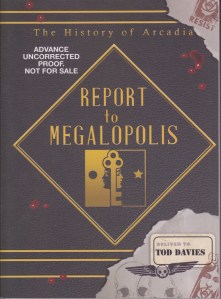
 Power isn’t what you think it is. That’s something autocrats never really learn. Tod Davies explores this tale of our times in Report to Megalopolis, the fourth book of the History of Arcadia series. The world is taken over by a single-minded dictator who discovers power isn’t what it seems to be. Assuming power will bring fulfillment, the antagonist gets what he wants, but he doesn’t know what he wants. (Like a certain rich fool whose name we can’t help but hear daily.) Wanting for wanting’s sake, and refusing to be denied. In that sense it’s a simple tale, but as with all of Davies’ stories, it’s more complex than it seems. The message of resistance comes through loud and clear.
Laying out the groundwork for the tale, she describes, among other things, the religion of Arcadia. Writers unafraid of reality will note that people have religious beliefs, no matter whether the narrator—or author—shares them. Worlds without religion are fantasy worlds, or those of cyborgs; they’re difficult to accept. To be human is to believe. Not just that, however, but to believe in something more than one’s own wants. There’s a basic morality to it. And Report to Megalopolis is a kind of morality play in that it has a lesson that should be learned. For those who won’t or can’t read, having the humility to admit your own insecurity might well save the world from nuclear holocaust. If, like Pavo Vale, the antagonist, you insist that your own desire is entitlement, then the only option for all others is to resist.
Back when the harsh reality of Trump’s lackluster “win” became clear, among the artistic community there was discussion of how, from now on, creative expressions of the truth would take on a new urgency. Songwriters, poets, painters, and novelists have been able to see what the feeble eyes of the GOP cannot—we are in trouble. Deep trouble. Elected leaders, caring more about their own wants than the wishes of those who elected them, power ahead to destroy the democracy that gave them power. As Davies suggests, they have mistaken power for right. We reach the end of Report to Megalopolis not knowing the end of the story. We know that things are bad and they have the potential to tip either way. We, the readers have a choice to make—remain silent and allow all that our founders worked to achieve pass away, or, as even as the cover states directly, resist.

 Steve A. Wiggins