Following Irving

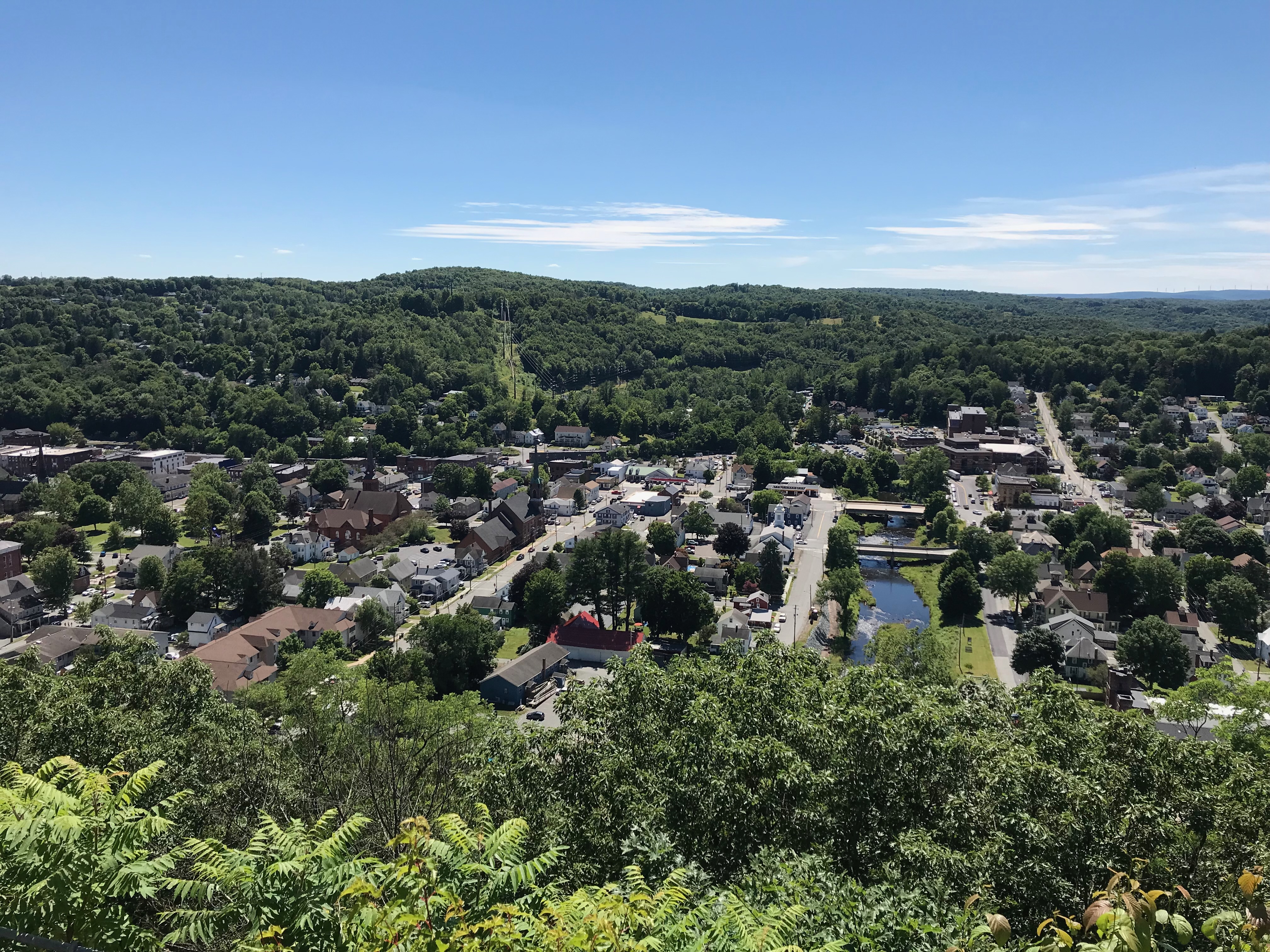
I’m growing fond of staycations.  Maybe it’s because I’ve become such a creature of habit that major disruptions seem daunting, but I still like a change of scenery with my family.  We settled on the Poconos because of, well, a chocolate factory.  More on that anon.  In any case, said location was near Honesdale, Pennsylvania.  Before setting out we learned that Honesdale is one of those quaint downtowns that has made it an island of culture in a sea of red, if you get my drift.  While researching things to do we learned about Irving’s Cliff.  This is an overlook of the town from a bluff atop one of the many hills.  What really caught my attention is that the Irving was none other than Washington Irving, the author of “The Legend of Sleepy Hollow.”  This cliff was a view he enjoyed, so it was named after him.

The view from Irving’s Cliff

Honesdale is a small town.  Less than 5,000 people call it home.  Growing up in western Pennsylvania I heard about more affluent people going to “the Poconos” out east.  It was a “romantic” getaway for some lucky high schoolers while the rest of us had to use our imagination regarding what such a place might be like.  Of course, living just south of the Poconos now we’ve driven through them many times, but we never stopped to linger here.  As I tried to commune with the spirit of Irving on his cliff, it occurred to me that he had been a world traveler.  Nipping across the border from his native New York to Pennsylvania must’ve been no big deal.  Still, he wrote incessantly and the locals obviously appreciated that a famous writer had tarried in their town.  Standing here, I knew the view he took in was quite different.  The hills would’ve been here, but a much smaller town and, above all, no cars.

My forthcoming book on Sleepy Hollow will have a thing or two to say about Washington Irving, of course.  It’d be a fool’s errand to try to follow in his footsteps, just as it would be to try the same for his namesake George Washington.  Besides, I was born in a western Pennsylvania town visited by our first president.  Although we couldn’t afford accommodation in Honesdale itself (it is a quaint town), we checked into our hotel knowing that “Washington Irving slept here.”  And when you’ve spent a few years writing a book about a guy’s work, well, a staycation to a place where he had one is worthy of comment.


Personal History

Being an historian by disposition has its own rewards.  I relate to the chronicling monks of the Middle Ages and their eagerness to record things.  On a much smaller scale, I try to keep track of what has passed in my own small life.  As we all know, most days consist of a stunning sameness, particularly if you work 9-2-5.  Although your soul is evolving, capitalism’s cookie-cutter ensures a kind of ennui that vacation time, and travel in particular, breaks.  Travel is expensive, however.  A luxury item.  It’s also an education.  My wife and I began our life together overseas, living three years in Scotland.  We traveled as much as grad students could afford.  Gainfully employed in the United States, we made regular summer trips to Idaho, and often shorter trips closer to home in Wisconsin.

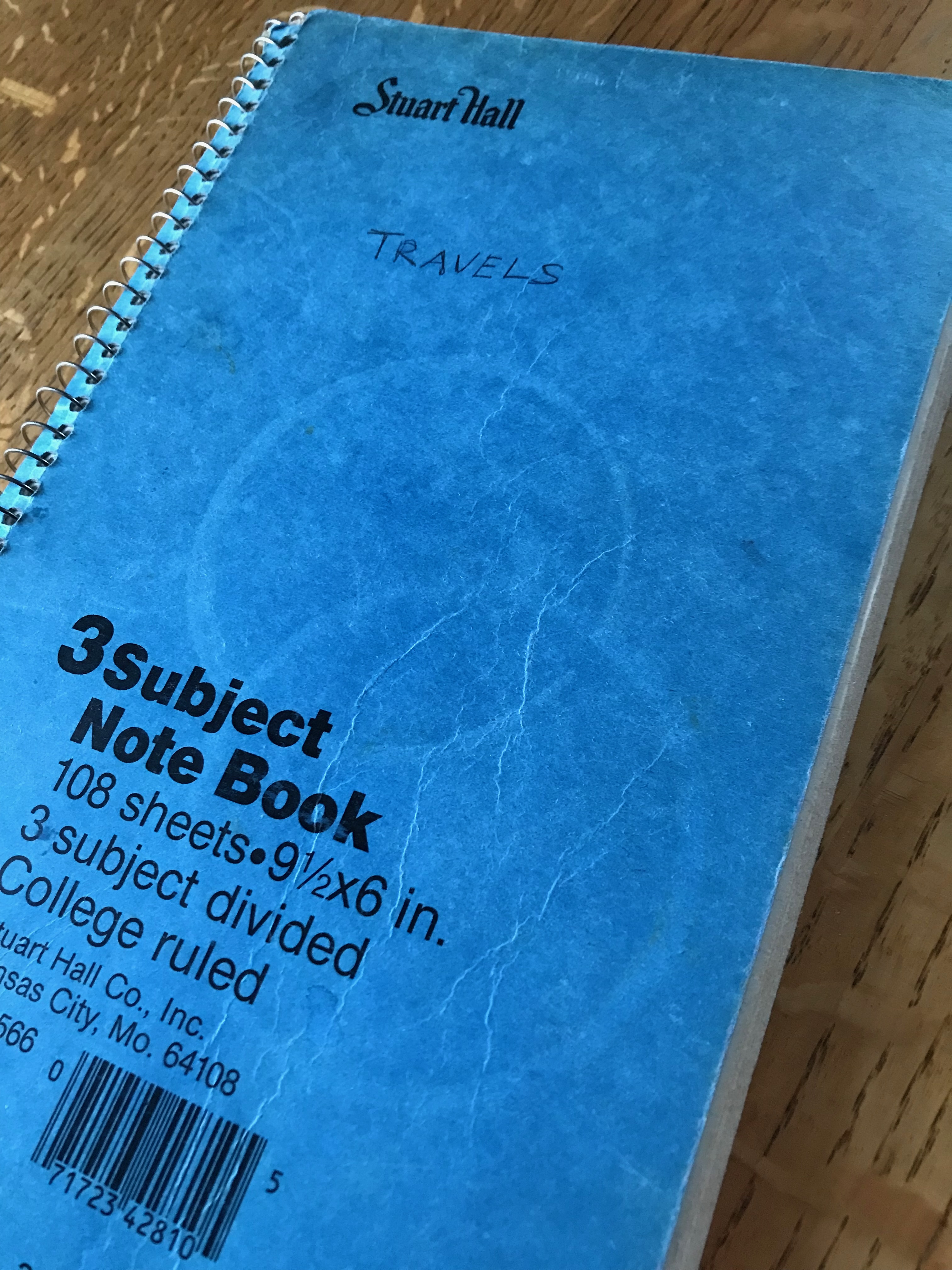
We repurposed an old, spiral bound, three-subject notebook to record our adventures.  It spanned twenty-two years.  When we moved to our house in 2018, this notebook was lost.  (A similar thing happened with an Historic Scotland booklet where we’d inscribed all the dates of properties visited.  It vanished somewhere in central Illinois in 1992.)  Recently, looking for an empty three-ring binder for my wife to use, I unexpectedly came across our old three-subject notebook.  The relief—maybe even ecstasy—it released was something only an historian could appreciate.  Here were the dates, times, and places that I thought had been lost from my life.  In that morass of years after Nashotah House my mind had gone into a kind of twilight of half-remembered forays to bring light to this harsh 9-2-5 world.  I carried the notebook around with me for days, not wanting to lose sight of it.

Those of us who write need to record things.  I’ve never been able to afford to be a world traveler.  The company’s dime sent me to the United Kingdom a few times, but overseas after Scotland has been more a reverie than a reality.  But now, at least, I could remember our domestic trips.  The notebook included ventures I’d forgotten.  You see, when you get back from a trip you have to begin the 9-2-5 the very next day, particularly if your company isn’t fond of holidays.  (This explains why I write so much about them.)  Pleasant memories get lost in the mundane cookie-cutter problems of everyday life.  And yet I could now face them with that rare joy known to historians.  I had a notebook next to me, ready for transcribing.  It was going to be a good day.


Downtowns

I recently wrote about the movie Peeping Tom.  I mentioned a scene, particularly creepy, where a news agent sells a girl a candy bar after selling an older man pornography.  Writing about this reminded me of my own youth.  After we’d moved to Rouseville, the nearest town with shops in western Pennsylvania was Oil City.  It had a reasonable downtown then—a couple of blocks with a Woolworth’s, Thrift Drugs, a movie theater (the lamented, lost Drake), stationary stores, and the like.  By the time I was in fifth grade I’d begun to discover books.  (Ours was not a reading family, being much more of the television crowd.)  Finding books in Oil City was a bit of a challenge.  There wasn’t a bookstore.  The nearest regular bookshop was all the way over in Meadville, and Mom didn’t want to drive that far too often.

I’ve noted before that I bought used books at the Goodwill up in Seneca (where we bought clothes and household items as well).  If you stayed downtown in Oil City, though, you could find books for less than a dollar in a bin at Woolworth’s.  (I still have a few of those cheaply printed and bound “Easy Eye” editions on my shelf.)  There was, however, just a door or two down, a mysterious shop where I’d spied a rotating wire rack of paperbacks.  I was curious and although Mom never forbade us to go in, she certainly didn’t encourage it.  I was a tween ravenous for new reading material.  This shop also sold magazines and tobacco products.  Some of the magazines had their covers obscured, and although on the cusp of puberty, I was really only after books.

One time I went in to give the wire rack a whirl.  I seem to recall that the owner gave a rather wry look when a minor, myopically focused on books, wandered in.  The fare there was not what I was used to.  There was a novel about Bigfoot, I recall.  I thought maybe that would be of interest, but I didn’t buy it.  When I walked out, I had that creepy feeling that seedy places seem to leave palpably on your skin.  I guess it might’ve been the feeling of that innocent little girl wandering into a shop selling nudie pictures to buy a candy bar—probably because it was the closest shop to home.  Such downtowns, and undoubtedly, such stores still exist.  They’ve become rare.  Downtown Oil City is no longer recognizable when I go there.  Now, it seems, there’s nowhere to buy books at all.


Places and Books

I recently had the opportunity to travel to a new town and spend the night there.  This is a rarity in the days of pandemic and I’d forgotten the magic of waking early in a new place and looking out the windows at the deserted, artificially lit streets.  It’s so peaceful and full of wonder.  The place we were staying was next to a public library and I noticed that there was a light on in the cupola in the pre-dawn hours.  I like the idea of books watching over us in the night.  Often when I’ve traveled to conferences I’ll arise early and look out on that orangey, artificial light while most other people are still asleep.  Even the city in pre-dawn can be a peaceful place.  This is a pleasant displacement since it’s only temporary.

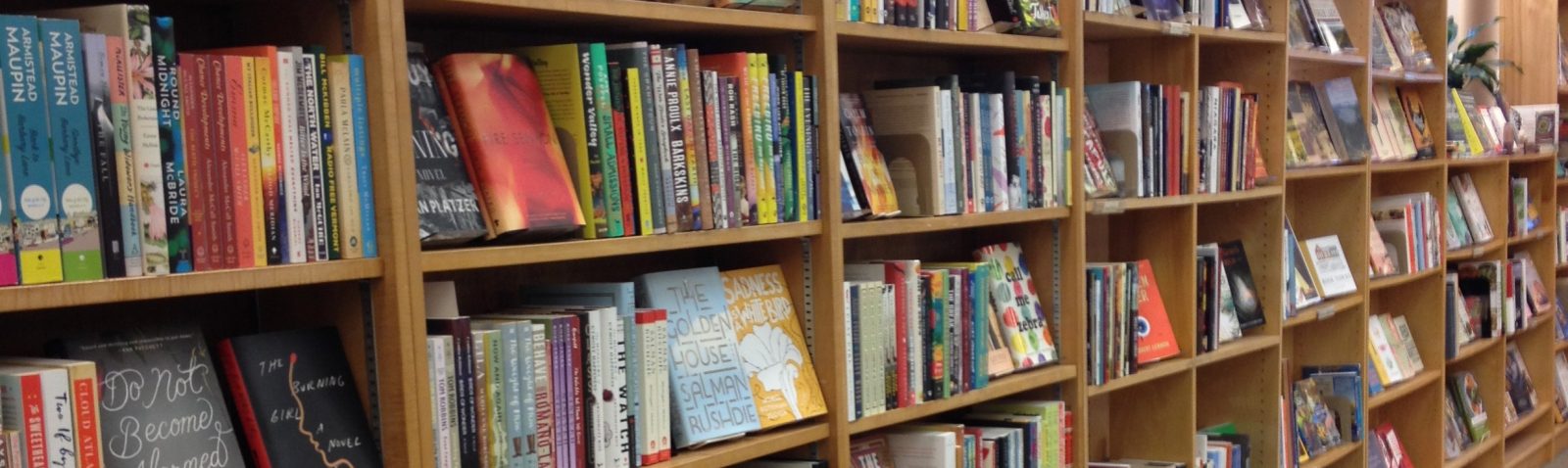
One of the things about the pandemic is that it has accustomed us to life just so.  The controlled environment of home.  There’s a comfort to routine, but there’s wonder in breaking it as well.  When it’s not a conference and still a new city, I begin to look for a bookstore.  One of the common misconceptions—perhaps bolstered by the cookie-cutter experience that has been Barnes and Noble—is that bookstores are all the same.  They aren’t.  Each reflects the minds of the owners.  They reflect their knowledge of their public.  New ways of looking at things.  I suppose this fascination with books has been enhanced by my starting to read some Jorge Luis Borges again.  Those of us who read for pleasure are in the minority and we find the open book to be open arms welcoming us in.  Welcoming us home.

I always travel with books.  My travel bag carries my laptop and my reading.  New technology having to learn to adjust to the old.  I’m not a particular fan of technocracy.  I’ve always preferred paper to plastic.  In a new town I look for authenticity.  We lived for many years in Somerville, New Jersey and one of my concerns was that it couldn’t seem able to support a bookstore in the shadow of that equalizing Barnes and Noble.  The new owner, James Daunt, believes that bookstores should reflect local interests.  His own stores in Britain are cathedrals to books.  Unlike other industries, bookselling isn’t all about the business.  Much of it is about the place.  We travel to see new places, and we read to visit them as well.  And perhaps to reflect in the artificial orange glow before the city awakes.


Travel Ban

I’m not at home.  I know in the current crisis that sounds like heresy, but I can honestly say that getting out of the usual routine where COVID-19 is all you hear about feels right.  More and more organizations are instituting work from home policies—many of them mandatory.  I’ve worked from home for going on two years now.  You need to get out a bit.  I know travel isn’t recommended, but I’m really not afraid to die.  Besides, I put a box of latex gloves in the car and when we stopped for a restroom break, wore them until they could be safely removed.  Exposed surfaces in the rest area were being continually wiped down.  Don’t get me wrong—for an introvert like me working at home is fine.  It’s just the idea of feeling like this virus is some zombie apocalypse happening just outside my door that I needed to dispel.

When I told a friend I was no longer going to be commuting on a regular basis he said if it were him he’d only ever buy sweatpants again.  Now that my reality is life with my wife being the only person I regularly see, I’m beginning to realize just how much our clothes purchases are for impressing others.  My haberdashery is akin to that of Henry David Thoreau; I wear clothes until they’re no longer functional.  They can be badly out of date but they still work.  The fashion industry is built on pride.  To put it in the words of my old friend Qohelet, vanity.  We want others to see what we’re wearing.  If we’re still donning last year’s gay apparel we’re not playing the game.  Never mind those of us whose wardrobes could be carbon-dated.  The pandemic can be revealing.

So I’m away from home for what is really the first time in months.  I had to stop in the grocery store for a few things.  Only one person I saw was wearing a mask, but I was wearing prophylactics, so who’s going to cast the first stone?  Many shelves were bare.  The CDC has become our new gospel provider.  I’m limiting my outside exposure.  Driving door to door, greeting no-one along the way (that actually is the gospel, but substitute the walking for the driving part).  I know when this weekend’s over I’ll be back to my cloistered existence as the rest of the world tries to get used to the loneliness of the sweatpants crowd.  If you’re one of them take it from me—the rest of the world is still out there.


Slow to Travel

A family friend recently died.  I was in New York City when I received the news, and I mused how recent a phenomenon this speed of information is.  The news wasn’t necessarily a shock—this friend had been experiencing failing health, he was a close friend of my grandfather—but for some reason Samuel F. B. Morse came to mind.  The story goes that Morse invented the telegraph because of his experience of being away from home when his wife died.  By the time he received the news and was able to get home by the conveyance of the day, she’s already been buried.  He set his inventive mind to improving the speed of communication over a distance.  In these days of receiving texts mere seconds after something momentous happens, it’s difficult to imagine that for the vast majority of human existence, personal news traveled slowly.

Feeling in a reflective mood I recalled how when I was in college I wrote letters home.  Yes, the telephone existed by then—don’t be so cynical!—but long distance bore a cost and college students find ways to save their money for girlfriends or spending a weekend in Pittsburgh.  News traveled more slowly.  Back before Morse, the swiftest option was the letter.  The death of a friend might take days or weeks to reach those close.  Distance in time, as well as space, may not have lessened the shock, but the immediacy of a text wasn’t there.  The death had occurred days or weeks ago.  There was nothing left to do but grieve and get on with life.  Like Samuel Morse—perhaps the only point of comparison between us—I was unable to get away immediately.  New York City isn’t easy to escape quickly.

We move swiftly and slowly at the same time.  I know news moments from the event, but this physical mass I inhabit is sluggish takes some time to get around.  Manhattan’s an island, and although it’s not Styx we’re crossing, the Hudson creates barriers enough.  Now my journey includes crossing the entire state of New Jersey before I can even reach home.  Were I to drive back to my original home, it would add another five hours at least in the car.  Sometimes I wonder if the immediacy of knowing is a blessing or a curse.  The shock is immediate and visceral.  But like an injection, the sharpness is quickly over and the dull ache sets in.  Our family friend had been suffering for some time.  Now he’s at peace.  I like to think he’s with my granddad, and that the two of them together won’t judge me too harshly for moving so slowly.


Final Leg

Travel is a form of education.  You won’t get college credit for it (unless some administrative footwork is involved), but it is a means of learning.  One of the things you pick up flying coast-to-coast is how exhausting a day on a jet can be.  Quite apart from jet lag itself, the weariness of occupying your minuscule allotted space in a pressurized cabin can be intense.  And like ocean travel by ship, you have to dock at a distance to use smaller and smaller forms of transportation to reach your destination until at last you walk inside.  This was the first year that such a trip ended by returning to a house rather than somebody else’s rental unit.  It’s an odd feeling.

Work starts again tomorrow, and since I’ve been pretty much unplugged for an entire week, I know chaos awaits.  I also have the task of learning what has happened in this off-kilter world for the last week.  And then I have to make an inventory of the books that were ruined in our own personal Noah event just days before our flight.  The changing of scenes feels rather like a jump-cut in a movie.  Suddenly you find yourself somewhere different, with circumstances that have their own set of parameters.  Vacation time, in a sense, is like a dream sequence.  None of the episodes from back home can reach your sleep-addled mind.  And then you wake up.  Bills are due.  The lawn wants cutting.  The unpacking must continue.

For all that, it feels as if something transcendent happened.  Like Elijah being whisked away in his own personal whirlwind, I was on a plane that took me to a different plane of existence.  A place where no matter what decisions were made the outcome would be pleasant.  Coming home involves what theologians like to call “metanoia,” a sense of transformation—memories that give you strength to carry on the quotidian tasks that make up the vast bulk of our lives.  Lakes in the mountains are all fine and good, but society demands its pound of flesh, and the way they get it is through productive employment.  Tomorrow it’s back to work, a chance to test just how successful the metanoia might’ve been.  This is the reason we traveled on a Saturday, for the sabbath should be a day of rest.  No one knows where that whirlwind set Elijah down, but it’s virtually certain that he had plenty to do once he got there.


Traveling Unplugged

Those who pay close attention, or who have nothing better to do in July, may have noticed that I missed a day posting on this blog on Saturday.  That hasn’t happened for a few years now.  I think maybe I ‘m growing up.  Or learning to resist.  Saturday was a travel day—the first I had to make from Pennsylvania, back to Newark in order to fly to Washington state and drive a few hours to the lake.  All in all, it turned out to be a long day in which I didn’t even notice that I was unplugged.  I had a book that I read along the way.  Although it’s against my religion—(call it Moby)—(but I jest)—I even fell into a cat nap or two on the plane.  I didn’t have a window seat and strangers don’t like you staring in their direction for five hours at a time.

Upon awaking, eyes refusing at first to work in tandem, in the chill mountain air, I realized I’d spent the entire day off the internet.  We had to pull out at 2:30 a.m. to meet TSA requirements, and you have to pay for the privilege of connecting to the web in airports and on board jets.  I’ve become so accustomed to being wired that I feel I have to explain why I wasn’t able to post a few thoughts when circumstances were so adverse to getting tangled in the world-wide web.  Yes, it still has a few gaps where one might buzz through without being caught.

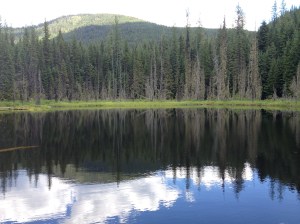
It was remarkably freeing to be unplugged.  I believe Morpheus may be correct that they want us to believe reality is otherwise.  I feel guilty for not checking email manically.  What if someone requires something right away?  Some sage response to a communique that just can’t wait until I’m back from vacation?  Some reason that I must ask to be inserted back into the matrix if just for a few moments, to hit the reply button?  We’ve perhaps been exposed to what The Incredibles 2 calls the Screenslaver, the force that draws our gaze from even the beauty of a mountain lake to the device in our hand, whining for attention.  We have wifi here, of course, for the fantasy of living raw is sustainable for only a few hours at a time.  Reality, as you know if you’re reading this, is electronic.  But until I have to reinsert myself at the cost of my soul, I think I’m going to take a dip in the lake.


Nothing Better

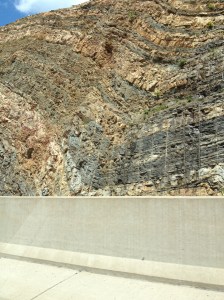
While it may seem that the largest challenge on a blog like this is writing all these words every day, that’s often not the case. Early on in my blogging life, I learned that images draw readers in. That may no longer be the case, but I do try to ensure that my posts have apt illustrations. Due to the fact that I can’t keep up with technology, I no longer know where these images are even stored, so when I was seeking a picture—amid thousands—that I had saved on my backup drive, I came across a series of photos taken in central Pennsylvania. These showed some road-cuts with obvious and impressive folding of geological layers characteristic of orogenous zones. Geologists only discovered the earth was ancient in the nineteenth century, and evangelicals have been disputing it ever since.

Genesis, so the spotless thinking goes, says the world was created in six days. So, by God, in six days it was created! When Darwin simply put the pieces of the puzzle together, evangelicals objected loudly. They started electing US presidents in the next century—a blink of the eye in geologic terms. They don’t dispute non-biblical dinosaurs, however. Their kids would object. The impressive sedimentary layers (or for that matter, igneous or metamorphic) were, they claim, made by God to look old. To fool us. That’s the kind of deity he is. So I got to thinking of a “to do list” for a God with nothing better to do than to oversee intricate and complicated layers of rock that make sense in geological time, but which, apparently, are only planted here to test the faith of brand-spanking new Homo sapiens.

One thing such a deity might do is take care of social injustice. Since he is a father, I suspect we ought to listen to his son, my evangelical friends. Jesus of Nazareth seemed pretty set on helping other people and everyone loving one another. This was, of course, between stints of helping make the planet look older than it actually is so that sinful scientists could trick their compatriots into going to Hell by believing false evidence. There are so many things you could do if you had the time to make such intricate traps. Why not write another book, for example? The Bible could use a good sequel. But no, it is far better to spend divine time making a world look older than it is. And if I had been able to save the time looking for that image that took over half an hour to find, a post such as this would’ve never been created at all.


Spinning Wheels

That warm, secure feeling of being home for the holidays never goes away. Admittedly Thanksgiving takes on a different cast for those of us who are vegetarians becoming vegan, but it’s not about the food, really. It’s never been only just about the food. Thankfulness as a way of life seems to hard to obtain when your own government has turned against all the principles that once made America a wonderful nation in which to have been born, but it doesn’t mean you can’t be grateful. As a commuter, I’m especially thankful for time. Each day’s normally spent riding a bus, working, and riding again. Over the past several days I took a train to Boston for the AAR/SBL annual meeting, and then a long train ride back. Followed by a single-day drive to Ithaca and back. I’m thankful for a little time not to be on the move.

Among the many memories for which I’m grateful is a mountain road that divides Glen Kinglas and Glen Croe in Scotland. Known for its splendid view, it’s one of many places that I have had the privilege of visiting. Although sitting still, here in my chair, I recall yet another busy day of driving with friends. Poor graduate students all, we nevertheless knew the value of good company and taking little for granted. As someone who grew up poor, I had managed to move to Boston, travel to Israel and work on a dig, and now I was living in Edinburgh, working toward a doctorate in one of the world’s great universities. That afternoon, however, I was out viewing what the wider world had to offer. The name of the viewpoint on the A83—from which that world all seemed visible—was “Rest and Be Thankful.”

The name speaks volumes. New Jersey certainly isn’t Scotland. My job is not that for which I trained. I continue to live as if I were a graduate student while friends have purchased houses and furnished them nicely. Today none of that matters. I’m not on a bus, train, or plane. I’m not glued to my seat in an automobile. I’m thankful to have some time to sit and reflect. Catch up, perchance, on a little bit of sleep. Unstructured time is perhaps the rarest commodity in a capitalistic society. Today I have it in relative abundance. No turkeys have lost their lives on my account and I’m able to rest and be thankful. There’s still a long way to go, but for today I’ll enjoy family and stillness. And I am thankful.


Might As Well Read

During my recent travels I had a layover at Sea-Tac Airport. Since I don’t get out much, I always find a walk through the airport a way of measuring what other people find important. At least in a circumscribed way. When you’re traveling you’re limited in your options. Most airlines have addressed passenger ennui by offering devices with electronic entertainment. Instead of an in-flight movie, you’ll have choices of what you want to do, courtesy of the endless magic of in-flight wifi. So the thinking goes. Airports, it would stand to reason, will offer plenty of travel-size diversions. The kinds of things you’re allowed to take onto a plane but which won’t or can’t be used to harm others. A sign at Sea-Tac reads “Books. Food. And yes, beer. Just ahead.” An interesting choice of offerings.

I was strangely heartened by the pride of place given to books. Yes, people still find the book on a plane satisfying. Stories have a way of drawing us in. Making us forget that we’re in a cramped space filled with strangers and recirculated, pressurized air. Books have the ability to take us far away. It’s a magic that movies can’t always achieve. Books leave more to the imagination. I recently rediscovered this on a solo trip across the Atlantic. I used the opportunity to read a novel cover-to-cover. The impact was incredible. For those six hours I was on the ground, following the adventures of young people caught up in the liminal zone of adventure and love. It was a powerful experience.

On my daily commute I tend to read non-fiction. Perhaps it’s the result of earning a doctorate, or perhaps it’s the stigma of enjoyable reading being “fluff.” The great majority of books I read this way teach me a lot. I read about many different subjects, and have recently learned to make commuting time a type of research exercise. But then, a cross-country plane ride is different. While an evening commute from New York City can stretch to three hours or more, that’s fairly rare. Instead, air time is unbroken time. I look forward to it with the prospect of a good novel. Airports are one place where hoi polloi don’t mind hanging out in a bookstore. Yes, the fare will be mostly bestsellers, but anything that gets people to read is a good thing. And, of course, if that doesn’t work for you there’s always beer. Just ahead.


News Pause

One of the benefits of “getting away from it all” is the blessed respite from news. Given the political situation these day I suppose that’s a rather risky proposition since the government is now based on presidential moods rather than any kind of policy or strategy. I worried as I got onto the plane home whether regulations might have changed when I was in the air and whether I’d be landing in the same country as the one from which I’d taken off. Maybe it was more than just time zones that we were changing. Being a child of the ‘60s I couldn’t help thinking about the Twilight Zone—getting onto a plane and then something happens. Quite a few episodes deal with that theme. Only now it’s real time. Real fear.

I have to wonder about the impact of constant news. Since November I’ve been obsessed with frequent updates—scanning headlines for any sign of hope that what began as a joke might have finally reached its punchline. Instead, the press has fallen into normalizing Trump, writing and reporting as if this is what happens in a democracy. It should be illegal to elect a dictator. It’s one of those logical conundrums, but it is a real one. Democracy shouldn’t be just those people who feel like they should getting out to vote. It should be a legal obligation. We know that if votes were counted straight up Trump could not have won the election. Since politicians like to play games we now live in the Twilight Zone of government. Every day Trump is allowed to remain in office the more credibility in government erodes. The knock-on effect will continue for years.

Since stepping off that plane I’ve been wondering what has changed over the past week. Has some basic fact of life been overturned by a presidential temper tantrum? Is what I’m doing now illegal? Has a horse been made a senator? Anything is possible. When I last paid attention it seemed we were well on our way to becoming the United States of Russia. I’m afraid to look at the headlines. The glow of getting away from it all hasn’t faded yet. It’s a hazy, dreamy reality that makes government seem like a bad dream. What would happen if they privatized air traffic control when I was in the air? The results are just to scary to contemplate. I think I need a vacation.


Day Labor

It’s difficult to believe in Labor Day. Don’t get me wrong—I’m glad for the day off. It’s just that I don’t think people really believe in the idea any more. It’s hard to take professed goodwill for workers seriously in a plutocracy. Especially when money’s a fiction. When pay was in coin, although abstracted, you were literally handed something of value for your work. Now technicalities and loopholes and utter abstractions make some—including would be and actual politicians—wealthy. These are all tricks on paper, affirmed by accountants, and we watch like the audience of a magic show as the improbable is made out to be actual fact. And these who hold this imaginary wealth control the lion’s share of the waking hours of the rest of us. We’re given Labor Day off with a pat on the head and we’re told to go enjoy ourselves before summer is up and we really have to get back down to work.

DSCN5084

Many of us—I know because I can see the cars—use the holiday to travel. It’s not really so much a day of rest as it is a day of trying to get back home so we can be to work bright and early tomorrow. Since it’s the last break before Thanksgiving you’d better enjoy it. If there were really money in that pay envelope—not even real envelopes are used any more—it might be easier to buy the illusion. Like Amazon I take a small cut of the transactions between employer and debts I owe just to live near where I work, which isn’t really so near but as close as I can afford. At least today I can not go into the office. I can spend the day getting home instead.

I often wonder why we’ve let ourselves be fooled by a system that will only ever allow the very few to truly find financial independence. Like lemmings we run right after them, thinking that just beyond that cliff true prosperity lies. A chicken in every pot. A car in every garage. Right now all those cars are actually out on the road—I can see them—and they’re not really paid for because they cost too much to buy outright. Most of us need them to get us to and from work. Or to and from vacation. Summer’s winding down. Hurricanes are already spinning away in the Atlantic. I’ve grateful for the day off. I really am. I only wish I could believe that it meant something deeper about human nature.


Paradise Lost

Reentry is never easy. I’ve just been on a vacation in the woods of the northwest and yesterday marked, via eight hours of air travel and airport waiting, my trip home. Tomorrow work begins again and I hope for the ability to adjust quickly into some kind of routine. Humans are creatures of ritual. We may call it religious or secular, but we draw comfort from knowing what to expect. Vacation disrupts with its mandate to relax and be among loved ones, and with its low level of demands. It can be time to think clearly instead of being harried and harassed and hurried all the time. Today I have to remember how this is done. How east coast time works. What the bus schedule is and how to enslave myself to it once more. I think of how being in a cabin in the woods felt like a restoration of my soul. In fact, it can feel quite a bit like a religious experience.

Silence, for one thing. In a world of constantly competing noises it’s easily forgotten what a commodity quiet can be. The silence of the woods is restorative. Although it was occasionally abused in my days at Nashotah House, quiet was often enforced as spiritual discipline. Nature, in a way that’s hard to appreciate so near to New York City, can be supremely tranquil during the night. Darkness as deep as the silence reminds us what night was meant to be. No priest needs to direct meditations since the soul is already attuned to the divine in such situations. Awaking to the chatter of a red squirrel rather than the rumble of a bus can remind one of what is truly important. When we value our vacation over our vocation there is a message hidden in plain sight.

Today I glance ahead to an unbroken string of work days and the premature end of summer. The hot days can be uncomfortable and that rush of everyone toward the water can lead to endless crowds and congestion. Still, I empathize with those seeking a break from the routine. We are all souls seeking respite from days programmed by others so that the Trumps of the world can reap the rewards of other’s labors. Bleary-eyed from the time change of three zones’ difference, I’ll go to work tomorrow with twigs in my hair, sand in my shoes, and a kind of private paradise in my head. I’ll soon be cured of that as the secular routine takes hold once again.

IMG_2891


Nature Worship

IMG_2383

Here I am in a natural setting, with nature close at hand. From these windows I can see mountains, a mercury-smooth lake with fish breaking its silvery sheet, and trees aspiring for the sky. I hear a red squirrel chattering from one of those trees, and the call of a lonely osprey looking for its morning meal. It took a day of arduous travel to get here, and I am staring at a computer screen as nature puts on her show for me. I think, “it’ll still be there when I get done.” Then I think about what I think. Will it be there? This world we’re creating in our own image demands more and more of the planet we inhabit. To which we feel entitled. As I stood at the airport staring at the monitor, I couldn’t believe that my flight had been cancelled. What? I arrived at the airport at 5 a.m., flew countless miles, only to have you tell me my flight has been cancelled? Am I not owed better than this?

This attitude, I reflect, may be what brought us to such a place to begin with. This incredibly beautiful world was never ours to own. We’re guests. Invited perhaps, but guests nevertheless. And we all know that guests are supposed to be gracious and to act as if they wish to be invited back. So why am I rudely sitting here, ignoring my host? We are part of nature, but we tend to think of those closely attuned to nature as “uncivilized.” They don’t dress like city dwellers. Their hair is worn differently. They value things money can’t buy. They don’t play the entrepreneur’s game.

I travel to “get away from it all.” That which I’m getting away from is my life every other day of the year. How did we come to call this “civilized”? There’s no denying the creature comforts of a place to call home and a routine that seldom varies. But sitting here, amid nature, I realize the tremendous cost. Even as soon as it began to warm up in New Jersey we tried to carve out the time to explore local parks. To be outdoors among nature before heading back to the office on Monday. The whole point of worship is to break the flow of everyday time. To stop and think of the good that we have been invited to enjoy. I find myself amid this splendor, and I sit at my computer while nature awakens around me.