Retro Fear

Maybe I shouldn’t have started.  This was, however, a recommendation from a friend, so I watched Fear Street 1994.  I say maybe I shouldn’t have watched it because I then learned that it’s a trilogy and I’m not sure that I want to watch the other two parts.  Not because the movie was poor, but because of time.  That, and I’m not a slasher fan.  At the same time, this movie does address the issue of class disparity.  The story begins in 1666 (the satanic number is intentional, of course) when a minister became a mass murderer.  This was because he was possessed by a witch and that witch comes back every few years in a new possessed person who kills several people.  In 1994 she possesses a mall worker who kills his friend and several others before being shot dead by the local police.  Class enters into it because the bad stuff takes place in Shadyside, a town right next to Sunnyvale, which is affluent and crime free.  Shadyside is where the poor live, work, and go to school.
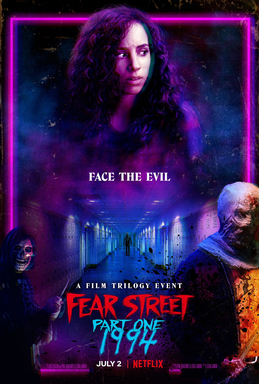
A set of five friends band together to try to figure out what’s happening after the dead murderer starts pursuing them.  It turns out that two of the past murders, also undead, have converged on Shadyside to kill a girl who disturbed the witch’s grave, accidentally.  It’s also a love story but it leaves the situation unresolved because, well, part 2.  The problem with this kind of movie is that you don’t know if the unanswered questions you have will be addressed in the other two parts or not without watching them.  Since I’m not really fond of slashers and I’ve got other things to see and do, I’m not sure that I’ll get the answers.  And I don’t want to cheat by reading up on it.

Was Fear Street worth watching?  I’d say yes.  Despite the gaps, perhaps holes, it was nevertheless not a bad film.  It is very full of action and twists.  Some of the tropes are well-trod territory—adults never listen to teens, the killer can’t be stopped, an ancient crime keeps recurring—but there is enough new here to keep a viewer interested, at least through the first installment.  It is a little distressing to see the nineties being referred to as “retro,” but then again, 1994 was over thirty years ago.  And something about watching young people so alive (until they end up dead) does have a way of providing a bit of a thrill to even a guy my age.  But I’m not sure I should’ve started something I may not finish.

Breakage

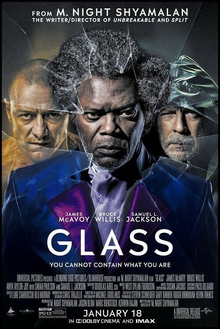
Glass makes me wonder; can any member of a trilogy really stand alone?  As someone who consumes fiction, the question always arises as to who really controls the meaning of individual units.  Scholars have given us reader-response theory that posits meaning rests with the reader (viewer, listener, etc.) rather than with the creator.  Being on an M. Night Shyamalan kick—I was brought in through his horror movies—I watched Unbreakable.  I vaguely knew it was a trilogy, but when I saw Split I was caught off guard.  Unbreakable was a super-hero movie.  Split was a horror film.  I knew Glass brought them together, but I wasn’t sure which way it would break.  It turns out the trilogy is a horror sandwich on super-hero bread.  It’s also surprisingly thoughtful.  And over two hours long.  There are horror elements, but it made me wonder since Split is horror, could it stand alone without the other two.

Having read about the development of this a little bit, Unbreakable could have stood alone.  It did for sixteen years.  Split could also, but for the reveal in the last few minutes.  And Glass manages to pull the whole thing off with a characteristic Shyamalan twist ending.  I’ve written about the other two movies in their own posts, but I really don’t want to give any spoilers for the last one.  I can say it ends with a message that is worthy of the Matrix.  It shows what movies can do.  Or at least it was taken that way by this viewer.

Given what movies are, and what they represent, I have to wonder if there’s not a good dose of racism in the criticism of Shyamalan’s work.  His movies are intriguing, without fail.  I haven’t seen all his films, but I have watched eleven of them now.  Some multiple times.  Here’s a guy with stories to tell.  I know, as a fiction writer who has trouble selling anyone on my vision, that a story can take over your life.  And you want to tell that story and see if it resonates with anyone else.  Those of us who make up tales generally recognize when something we write isn’t good.  My list of unfinished or unpursued stories dwarfs the stack of those I’ve had published, or tried to.  When you release a story out there in the world, you hope that others will get it.  I trust certain auteurs.  Even if not all of their films appeal to me, I like to think I see what they’re getting at.  This trilogy is well worth watching through to the end, even if it isn’t horror.