
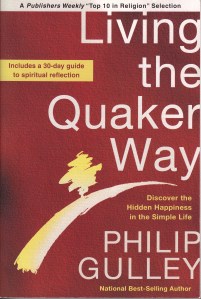
 Doctrine can be an immense stumbling block. As a person who’s been involved with many churches in my life, the virtue of virtues often seems to be sacrificed on the altar of doctrine. If you don’t believe X, you’re not one of us. It was a great delight, therefore, to read Philip Gulley’s Living the Quaker Way. Having grown up in Pennsylvania, you might think I’d know a great deal about Quakers. I never met any, however, when I lived in the state. And I really didn’t know much about their beliefs. I knew they called themselves Friends, and I knew “Quaker” was originally a derogatory title, like “Methodist,” “Jesuit,” or the near homonym, “Shaker,” later reappropriated as a name for the group. I also knew that numerically they were on the smaller end of the religious demographic. Reading Gulley’s insightful little book was an epiphany.
I learned of Calvinism at a Presbyterian College. There I was taught TULIP: Total depravity, Unconditional election, Limited atonement, Irresistible grace, and Perseverance of the saints, the first three of which struck me as dangerous and unholy. What a beaming of light to read instead of SPICE: Simplicity, Peace, Integrity, Community, and Equality. This acronym is Gulley’s shorthand for what defines the Religious Society of Friends. Doctrine is nowhere on the list. A deity who creates people just to throw them into Hell is also missing. As is Transubstantiation. And religious violence in the name of spiritual purity. There is an awful lot to be learned from the simple message of people who understand that they are people and every other person is too. Gulley is not naive; he knows Quakers aren’t perfect. What he does show, however, is that those who are willing to relinquish self-assured self-righteousness make far better neighbors who resemble what Jesus taught than do many who would rather destroy the livelihoods of those with whom they disagree.
The beauty of what this book describes is that one need not be a Quaker to live this way. Not being doctrinal, a Quaker wouldn’t insist on that and still be true to the ideals of the Friends. If we could learn to want less, to get along with those with whom we disagree, be honest, welcome others, and treat all people as if they had a bit of God inside them the world would be a better place. There can be no doubt about that. One might say, “that’s just common sense.” I would guess that most Quakers would agree. Religion, freed from platitudes, could be a viable and valuable way of being in the world.

 Steve A. Wiggins