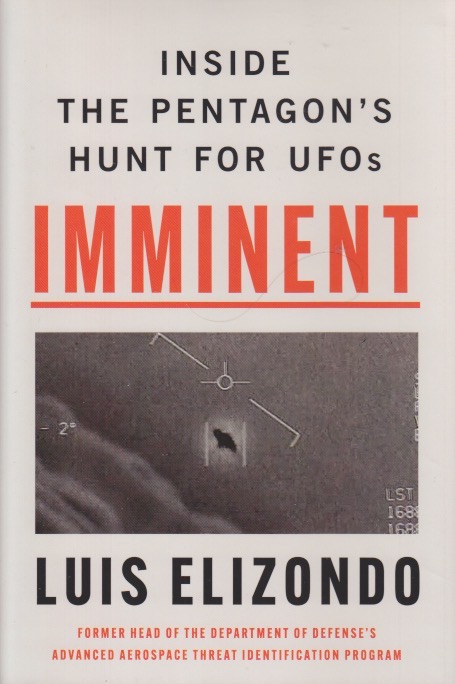
Staunching Stigma

Independence Day is not a great movie.  As my readers know, that doesn’t stop me from watching.  I’ve seen it a few times.  Watching it post-UFO/AUP disclosure via the New York Times, I was struck by something.  Even in the diegesis of the movie, where alien craft, clearly visible, hover over major cities, when Russell Casse tells the military he’d been abducted, people roll their eyes.  Of all the stigmas our culture has invented that of the “crazy people” who see “flying saucers” is one of the deepest and most persistent.  Even after the Times, and the US Navy admitted they were real, and their tech is not of human origin, people refuse to believe.  I’ve followed this for some time.  I read a book by Donald Keyhoe before I was old enough to drive.  Like most thinking people on the topic, I kept quiet about it.  Stigma.

When I received Luis Elizondo’s Imminent for a Christmas present, I was secretly very pleased.  You see, the evidence has been in plain sight (Poe nods knowingly) for decades, for those who don’t accept ridicule as an immediate response.  The Keyhoe book I read was published in 1955.  It was my grandfather’s book.  For sure, the stories casting doubt on Elizondo’s reputation and sanity began almost immediately after he cooperated with journalists in 2017 when a fraction of the truth made the New York Times.  Between Keyhoe and Elizondo, many insider, “death bed” books had revealed that this was something we should pay attention to.  People laughed.  Oh, we love to laugh.  Imminent, however, is quite a sobering book.  I’m not sure full disclosure will ever happen, but it’s trickling out and a finger in the dam can’t hold forever.

Stigma as a means of social control is unfortunately effective.  I’ve always felt that mocking what you don’t understand is a poor way to get smarter.  Still, for those willing to consider the evidence over the years, there’s been plenty to study.  Either there’s something to this or our government and military are filled with pathological liars (outside the Oval Office, I mean).  It seems far more reasonable to examine the evidence, when it becomes available.  There are contractors in the military-industrial complex (Eisenhower warned us about this decades ago) who benefit from keeping secrets.  Imminent is an eye-opening book.  Hopefully it will be widely read and the implications taken seriously.  It’d be too bad if a catastrophe were necessary to stop the stigma, after it’s too late to do anything about it.


Revisiting Witch Mountain

Suspension of disbelief is essential for many movies.  When a friend pointed out that Disney had rebooted Witch Mountain, of course I suspended.  Recast as a new millennium-style action sci-fi movie, it really didn’t rock the critics, but there’s a lot going on in it.  Shall we start at the beginning?  The opening credits sympathetically establish the reality of UFOs as alien visitors to Earth.  In other words, we know from the beginning that the kids are aliens, not witches.  And the chasing begins immediately and doesn’t let up.  Not only is the government after the kids, so is a “bounty-hunter”/“terminator” from their home planet.  A body-building cab driver and an ostracized academic (with you there!) work to get the kids back to their ship, which is being held by said government in Witch Mountain.

In a nod to the original an RV is thrown in, and the setting at a Los Vegas UFO convention ads a kind of surreal twist. That’s what was kind of disturbing, in my experience—the blending of “nut job” UFO enthusiasts and the reality aspect prompted by the prologue.  UFOs, like most things in American culture, have become extremely divisive.  With nods to everything from The X-Files to Close Encounters, and many enthusiastic high-fives to Star Wars, there are mixed messages and there’s too much going on.  It’s difficult to process.  The cameo by Whitley Strieber was a nice touch.  Long gone are the locals with shotguns trying to find witches.  Witch Mountain itself is a government facility more secure than Area 51.

The reimagining of the story is signaled by the change of title to Race to Witch Mountain.  So the story seems to have gone off the rails at some points.  I always find movies where people faced with the obvious “supernatural” simply refuse to believe, fascinating.  It is, after all, about belief.  The plot, with its “our planet is dying—yours is too” message, is a bit tricky to decipher.  There are those convinced that we need to abandon Earth to other worlds where we can continue our acquisitiveness unhampered, and those who believe we should repair the damage here.  As I say, everything is divisive.  Overall, the movie seems to say that the system kinda works, so let’s keep with it.  And wreck lots of stuff along the way.  I couldn’t help but notice the borrowed trope from Pirates of the Caribbean, “You’re a good man, Jack.”  It seems Jack is a favored protagonist name.  And strange things like that happen on planet Earth, at least seen through the Disney lens.


Religion and Its Objects

UFO religions—or should they now be called UAP religions?—have long been of interest to scholars of religion.  A recent piece on Religion Dispatches titled “With Release of Pentagon Report, UFO Narrative Belief System Is Suddenly Supported by Military Witness Testimonies,” by Diana Pasulka, explores this.  Anyone following mainstream media is perhaps experiencing a bit of whiplash on the topic since, prior to admission of interest by the government, the official stance was to ridicule the entire topic.  That’s the reason what were long known as Unidentified Flying Objects now have to be called Unidentified Aerial Phenomena.  Since a government can never admit it made mistakes, it simply changes the terminology.  My interest here, however, is in the connection with religion.

I’ve explored the connection between horror and religion from time to time—ahem—and so it is natural enough to wonder about the relationship between religion and UAPs.  (Or should I stick with UFOs?)  The two have some commonalities.  Initially, both deal with the unknown.  Indeed, the word monster comes from a root denoting an omen, or a revelation.  Something isn’t a revelation unless it’s been keep hidden.  So with UFOs.  The government’s long interest, which had been somewhat successfully hidden, allowed for a reveal.  Religions, however, tend to thrive on hidden things.  The monotheistic religions, for example, claim to inform us about what God has chosen to reveal about (generally) himself.  Even today when pushed into a theological corner, believers will appeal to mystery.  Both monsters and UFOs live in mystery.

Science prefers things out in the light.  Is it any wonder that scientists are reluctant to apply themselves and their hard-earned credentials to the UAP problem?  Those of us in religious studies generally have little to lose.  It’s not like we’ve got prestige on our side, or some billion-dollar grant riding on our reputation.  We can afford to take a look and monsters and other unknowns and see how they trigger the religious impulse.  Pasulka’s article has more to do with credibility.  UFO religions have long struggled with being considered outsider belief systems.  UFOs were publicly ridiculed, so any religion that focused on them was, by extension, laughable.  I’ve long believed that ridicule serves little purpose when it comes to belief systems.  Making fun of a mystery is less common than shaming those who believe in what we’ve been told definitely isn’t real.  Until suddenly it becomes real.  Is there any question why religions develop when mysteries remain?


Laugh Out

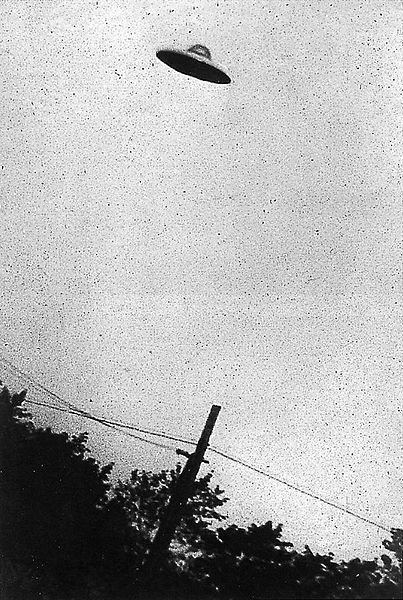
Is it safe to discuss this now, or are people going to laugh at me?  That’s the feeling that has attended any talk of UFOs until recent days.  Ironically, if the Ancient Astronaut people are right, we may’ve been visited from elsewhere ever since we’ve called this planet home.  In any case, now that UAPs are out of the bag, some are beginning to discuss how they might impact religion.  (Yes, “impact” can be a verb.)  Thus I came across a story titled “If UFOs are real, how would they impact our faith?” on Times NewsKingsport Times News, based in Tennessee, ran this as an opinion piece.  While not deeply probing, it did raise the question of how all the recent UFO news affects people’s religious outlooks.

Image credit: George Stock, via Wikimedia Commons

As a country we’re both deeply religious and in denial about the fact that we’re deeply religious.  I’m convinced that this is behind the political woes we face: the educated have become more secular and religious literalism is considered laughable.  Yet it’s clearly there.  Ironically, UFOs were considered laughable until the US Navy admitted that they were real and had no idea what was going on.  Laughing at something we don’t understand is hardly ever a step towards enlightenment.  So the article concludes that even if aliens are here, things will be fine if we continue to go to church as normal.  Any extra-terrestrial visitors change nothing.  Strangely, one of my earliest memories is of attending a rural church service one evening where the program was on flying saucers and Christianity.  This was entirely in earnest, and nobody in the congregation was laughing.

Others interested in the topic have discussed religion and UFOs over the years, but perhaps the answer is yet another of those unknowns.  Religion is a remarkably adaptive phenomenon.  Scientists suggest it’s hardwired into our brains, even as those same brains give us evidence that some of those beliefs are misplaced.  What we can’t do is stop thinking about it.  As I watch politics continue to tear this country apart, I realize it’s not really politics we’re talking about after all.  It’s religion.  Meanwhile people are learning that the government has been keeping secrets about what’s up there in the heavens.  There are elected and appointed officials who’ve gone on the record saying they believe UFOs are demonic.  While that hardly seems like a scientific approach to something truly unknown, it is a religious one.  Only those who laugh rather than listen will find this news at all.