Natufia to Say

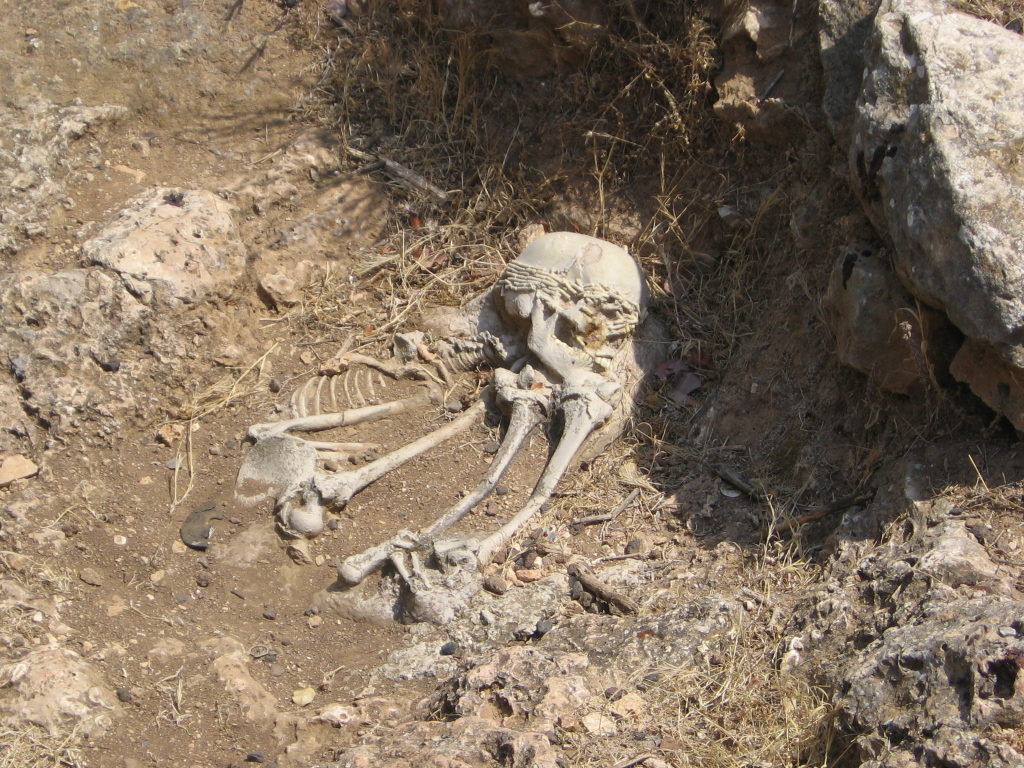
The Natufian culture predated the Israelites by millennia. They were gone by at least 7000 years by the time Israel appeared. The Natufians seem to have been the first permanent residents of a hotly disputed piece of real estate: Israel/Palestine. On Monday MSNBC reported on the archaeological find of a feasting hall among the Natufians. The story reminded my wife of similar stone-age sites that we visited in the Orkney Islands several years ago. What the story reminded me of, however, was the marzeah. The Natufian site features two activities: feasting and burial. The article notes the coincidence of 28 human burials, including one shaman, and the unmistakable signs of feasting. Bring them together and its sounds like marzeah time to me!

Natufian burial, from Wikipedia Commons

The marzeah is an imperfectly understood social institution from the ancient Levant. It is mentioned in the Bible as well as in the Ugaritic texts. Although plausibly reconstructed by modern theorists, we simply do not have a complete record of what the marzeah entailed. Two of the key elements seem to have been feasting and a funerary nature. Monotheistic religions tend to downplay the role of the dead as influential entities since they interfere with a monistic view of the divine. The two Hebrew Bible references (Amos 6.7 and Jeremiah 16.5) do not speak highly of the practice. The Ugaritic material suggests drinking may have been involved as well, further problematizing the ritual.

Now here is where the ambiguity of archaeology is thrown into sharp relief. The fact is we do not know what the Natufians were doing when they buried or feasted at this site. The Hilazon Tachtit Cave does not seem to have been a regular occupation site, and we do not have any reason to connect the burials with the feasting. Beyond a hunch. The hunch is the incredible urge to bring like things together. People excel at pattern-recognition. When I read of funerals and feasting my mind leapt to the marzeah. There seems to be no organic connection between the Natufians and Israelites (or Ugaritians), but the continuity of cultural concepts seems to strong to dismiss. Were ancient people toasting their dead with feasts that were remembered down into the Late Bronze and Iron Ages?


Everything but a Name

As we once again near the Ugaritic session of Ancient Near Eastern religions, I ponder the strange wonder that the city has all but completely escaped modern notice. As far as ancient city-states go, Ugarit had it all: drama, sex, violence, everything but a memorable name. Many ancient sites capture the imagination by their names alone: Nag Hammadi sounds exotic, the Dead Sea Scrolls bespeak a hidden mystery. Even Nineveh and Mari suggest hidden riches, but Ugarit? How short-sighted our ancient founders of civilization could be!

To begin with, nobody knows how to pronounce a word that begins with “u.” Vowels are notoriously amorphous, but never more so than when initiating a word. Is it “Yu-” or “Oo-”? The name then launches into the morass of uncertain syllabification. We moderns like to stress the first syllable of a word. Ancient Semitic language speakers tended to throw the emphasis back a syllable or two. How to say “Ugarit” with emphasis on the last syllable without sounding utterly pretentious and affected? Many of my colleagues pronounce the word with an emphasis on the penultimate syllable, “Harvard style.” To me this smacks of a pointy-nosed fish.

In a society that prefers the quick and superficial, stopping to think about pronunciation before barreling ahead into the substance of the matter is a decided detriment. If that ancient society provided us with our earliest complete alphabet and the nearest analog to stories from the Bible, well, it would gain some notoriety if it had a recognizable name. The Israelites forever changed the world that followed their appearance in the Levant. They borrowed concepts, characters, and ideas from their neighbors. Their associates to the north, gone by the time the first Israelite appeared, had chosen a forgettable name and have quietly fallen by the wayside until somebody unafraid of initial “u”s might come along and resurrect them.


Artificial Ugarit

Yesterday a friend pointed me to an article in the MIT News entitled “Computer automatically deciphers ancient language.” The language in question is Ugaritic. The article, by Larry Hardesty, narrates how three computer scientists have developed a program that may potentially decipher as yet non-readable languages. Ugaritic was chosen as a test-case because it has already been decoded and since it meets the specific criteria needed for the program to work. Results from the program could be measured against the standard translations already produced by specialists. Perhaps Ugarit will have another day in the sun.

The larger issue, of course, is technology and its role in understanding the human endeavor. Written texts are an extension of the human mind and those of us who practice it copiously know that the written piece is a piece of the author. Ancient texts may not suffer the same burden of individuality – some undoubtedly were rote pieces set to clay only after a lengthy oral life – nevertheless they participate in the constant paronomasia that is the human psyche. We invent the myths that Ilimilku and his colleagues inscribed so carefully over three millennia ago. Computers may indeed aid us in unlocking their often obtuse forms of expression, but how close will they put us to laughing at Ilimilku’s jokes or wondering deeply at his profundities?

Having been involved in a research project involving computerization and the Ugaritic texts (I was an editor in the now defunct Ugaritic Tablets Digital Edition) I am very aware of the benefits that technology brings to the table. As a sometime writer, I am also aware of the ironies involved. Our ancient predecessors, humans like ourselves, wrote texts that they considered worthy of preservation. Their civilization collapsed. Their language died. We rediscovered it and eagerly wanted to know what they had to say. We, however, have lost the ability to understand. Computers have taken on a dominant role in disseminating the written word. They daily participate in the human experience. Perhaps some day it will be AI that is scrutinizing our whimsical words and trying to decipher what in the world we meant. When they succeed they will find we are not that far from where Ilimilku began.


On the Origins of Goddesses

In what is fast approaching two decades ago, I was facing the prospect of meeting a thesis approval committee at the University of Edinburgh without a solid proposal. I’d meant to focus on Dagon, but the committee felt there was too little information on that deity to fill the requirements for a doctorate. I’d long been fascinated by the role of goddesses in ancient religion and their rather sudden disappearance – more properly sublimation – in what was becoming a male-controlled official religion. (Private religion could have been quite different, as it still is, from official theologies.) It was then that my attention was drawn to the, at that time, relatively understudied Asherah. Apart from having avoided excessive attention, Asherah was also the chief goddess of Ugarit, and possibly other cities.

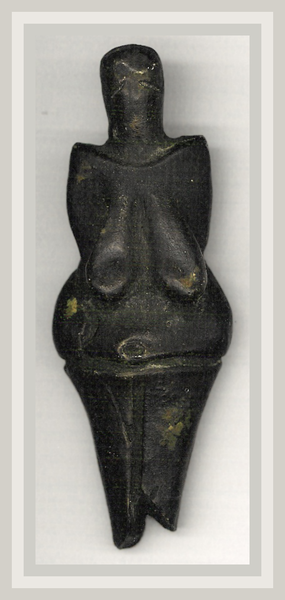
Turning the hands even further back, into prehistory, we find that goddesses seem to have been a natural part of human psyches of antiquity. Few things are as fundamental to human experience as the complementarity of the sexes; why would there be gods without goddesses, and vice versa? Prehistory is excessively difficult to read, existing as it does without written records to interpret artifacts. The discovery of Paleolithic female figurines, however, would seem to suggest that the female divine was a powerful force. The “Venuses” of Willendorf, Hohle Fels, Dolni Vestonice, Tan-Tan, Brassempouy, Galgenberg, Lespugue, Laussel and others demonstrate the acknowledgement of feminine mystery, if not divinity. With the advent of monotheism, one sex would have to accept subordinate status. A sexless divinity is simply too difficult to imagine.

Western religions thus began their descent into the omnipotent masculine. Even the Classical Greeks with their gender-mixed pantheon had to acknowledge the superiority of Zeus. In a monotheistic world, worship of the female divinity became heterodox, heresy, and “pagan.” There it has stayed for millennia, only to reappear in the cults of Mary and other chaste saintesses, clearly beneath the authority of Him. The origins of goddesses? They have been with us from the beginning. The real mystery is not where they came from, but whither have they gone.

Wiki-commons' Venus of Dolni Vestonice


Paul Does the Classics

I first became aware of Greek mythology in fifth grade. My teacher in an industrial, rough and yet rural school, believed in the benefits of teaching aspiring drug addicts and laborers the stories of gods and heroes. I immediately adored the stories we heard and read. Raised in a religious household, however, I feared enjoying the tales of what were admittedly pagan gods after all, too much. In the educational topography of my youth, we were on the brink of this brave new electronic world we’ve entered, and mythology was not considered a terribly useful part of the curriculum after that. I left the gods behind. In a class on the Christian Scriptures in college, however, my instructor suggested we all go see Clash of the Titans (the 1981 version) for its appreciative (if a little hokey) presentation of the Greek world. I enjoyed the movie and even took a class in the literature department on mythology.

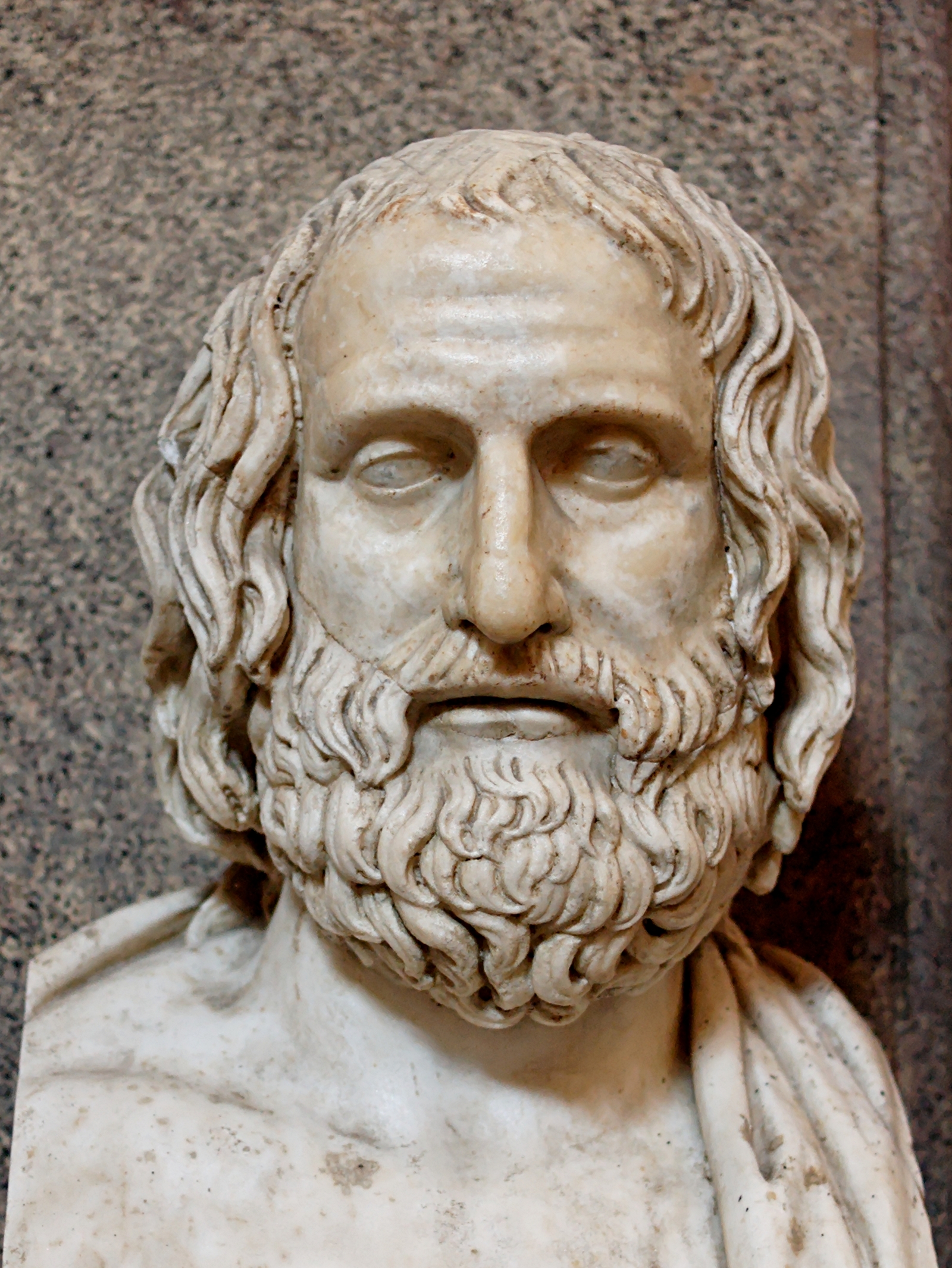
Over the years I have touched and gone on Greco-Roman mythology while specializing in the mythology of Ugarit. Now that I’m teaching a course on mythology, I’m going back to my classical roots and rereading the stories of times not quite so ancient as the fertile crescent civilizations’, but older than what is considered practical nowadays. While rereading Euripides’ play The Bacchae, the concentration of images, concepts, and actions that recur in the Bible stood out in chiaroscuro. Especially noticeable were references to Paul in the book of Acts.

Like Paul, Dionysus comes to be imprisoned. Not recognized as a divine figure, King Pentheus of Thebes locked him in chains until he could demonstrate that Dionysus is just the wild imaginary figure of repressed women. An earthquake, however, soon rattles the city and Dionysus emerges, chains shed, to the astonishment of Pentheus. The scene reads like Paul and Silas’ escape from jail in Philippi (Acts 16). Admittedly this could be coincidence. A few lines later, however, Dionysus, free from prison, tells Pentheus, “Don’t kick against the goad – a man against a god,” (Act 3, Paul Roche’s translation). Even so, Paul on his way to Damascus sees a vision of a god and is asked, “Why are you persecuting me? It is hard for you to kick against the goads” (Acts 26.14). Perhaps Luke had read his Euripides?

Now I’m no scholar of the Christian Scriptures (although I have taught courses on them a time or two), but when obvious parallels exist it is incumbent upon modern readers to pay attention. The parallels of Dionysus and Jesus were evident to early Christians, so what I noticed was nothing new. When the followers of Dionysus, however, strike a rock with their sticks and water flows out, I wondered if Euripides had read his Torah!

Paul's bedtime reading


Neo-Canaanites

The world of religious studies is full of surprises. Since people are forever seeking new forms of fulfillment, the endless variety of religions itself comes as no surprise, but the results of religious experimentation sometimes lead into uncharted waters. One of my students at Rutgers recently pointed me to a new religion called Natib Qadish, “the sacred path” in potentially vocalized Ugaritic. (Ugaritic, like most ancient Semitic languages, was written without vowels. Some modern scholars, basing their reconstructions on likely vocalizations known from other Semitic tongues, have tried to give voice to this dead language.) I have no idea how large a following this religion has, but it does maintain a substantial website explaining its core beliefs — the modern worship of the Ugaritic/Canaanite gods.

Unsatisfied with the tradition monotheism that eventually drowned out polytheistic voices in western religions, followers of these reconstructed religions are looking back to something more ancient, more primal, and perhaps, more human. What strikes me as odd concerning all of this is that religions such as Natib Qadish are based on extremely fragmentary understandings of ancient religions. We have perhaps a 101-level understanding of Ugaritic religion; some parts are very well attested, but there are huge lacunae that confuse the overall aspect. As I tell my students, ancient religion was based less on belief than it was on practice. Belief-centered religion is a relative newcomer on the historic scene. Ancients inherited their “religions” without question, based on where they were born. Tess Dawson, the founder of Natib Qadish, writes: “I have yet to find any word that means ‘religion’ in any of the ancient texts.” I would argue that it is because the concept of religion itself is a modern one.

Humans seem to have believed in gods from very early times. If gods are there, they must be placated. This is not religion; it is commonsense. Not to placate gods is to invite disaster. In Ugarit these gods included Hadad (Baal), El, Asherah, and Anat, among a host of others. These were the gods people “discovered” as they tried to fumble their way through a difficult existence. And gods like to eat meat, they learned. Sacrifice was born. What is a feast without ceremony? Ritual must emerge. I know this is overly simplistic, but belief doesn’t really enter into this scenario until late in the game. Heterodox belief was normative until Christianity assigned eternal consequences to correct belief, and now we are free to believe whatever we will.

As far as I can tell, Natib Qadish does not actually involve animal sacrifice to the gods (although it is based in Chicago, long known for its slaughterhouses). Like many modern Christians, the followers of this religion wish to reach back to a more pure form of ancient belief. It is an exercise in futility, however, in many respects. The framework has changed beyond recognition and we have no way of knowing what any ancient god would require of us in an internet age.

SAWHadad

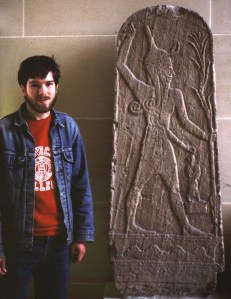
A young Dr. Wiggins meets Hadad in Paris


God’s Wife

Podcast 13 follows up on the previous two posts concerning Asherah. Here a little more background is provided on the discussion/debate concerning the goddess. I trace the origins of Asherah, best attested at Ugarit, and explain why this should be our primary source of information about the character of the goddess. I consider the 40 biblical passages briefly before moving on to the Mesopotamian, Hittite, and Epigraphic South Arabian material. Clearly the most important evidence for the debate on whether Yahweh was wed or not is the set of inscriptions from Kuntillet Ajrud and Khirbet el-Qom. I examine these bits of evidence as well, explaining why I doubt that they intend to portray a divine couple. The podcasts closes with what I believe to be the way forward — a clear understanding of Asherah based on Ugarit and read without a scholarly agenda (yes, they do exist!).


Banned Bible?

Florian b.'s 2005 image

Florian b.'s 2005 image

It’s Banned Book Week again. Each year the American Library Association promotes free thought by raising awareness of books that have been, or currently are, banned. Having just exited ABE books’ Weird Book Room (among the currently featured: Paint it Black: A Guide to Gothic Homemaking, The Bible Cure for Irritable Bowel Syndrome, and Is Your Dog Gay?), it is easy to see how the morally squeamish might wish that some books had never been written, but being a firm believer in personal expression, I give them a rousing cheer. Odd ideas are also among the Lego blocks that build our world.

I also ponder the texts with which I have spent so much time, and wonder what the ancient censors would have done with the great classics of antiquity. History’s first great novel, the Epic of Gilgamesh, would certainly have been on their crushed clay list. On only the second tablet we read, “Enkidu sits before the harlot. The two of them make love together… For six days and seven nights Enkidu came forth, mating with the lass. Then the harlot opened her mouth, saying to Enkidu: ‘As I look at thee, Enkidu, thou are become like a god” (Speiser’s rather tame translation). A sex scene with the first woman Enkidu ever met? We can’t have our kids reading that! Where do you put the V-chip in this tablet?

Perhaps the people of ancient Ugarit would have fared better? Their epic tale, the story of the trials and ultimate triumph of Baal, includes his unfortunate defeat at the hands of death. Baal is ordered to the underworld. “Mighty Baal obeyed. He loved a heifer in the pasture, a cow in the steppes of death’s shores, seventy-seven times he laid with her, she let him mount eighty-eight times.” Whoops! Hope the kids weren’t reading that. Surely this is some kind of sacred marriage ritual with Anat and not a cow? Good thing we never figured out where KTU 1.10 fits into the cycle! There’s another one for the rock crusher.

It’s a good thing the Egyptians were more civilized. Their culture would never allow for such liberal, naughty writing, would it? Well, maybe if we ignore the Memphite Theology. Not for the shy, here we are told how Ptah brought the Ennead into being using just his fingers.

I started reading the Bible as a child. To my surprise, it would not have gotten away with a G rating either. It seems to me that books deal with the greatest complexities human beings face. Sacred books as well as secular delve into the darker grottoes of the mind, and here the Bible is clearly among them. If we had systematically destroyed all written work that had offended others throughout history, we wouldn’t even have the Good Book left to argue about.


Shades of Asherah

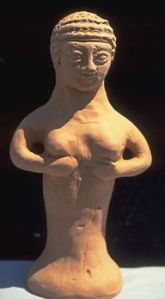
When my book on Asherah was first published in 1993, some reviewers criticized my humble effort to sort out the identity of this goddess without resorting to iconography. As I had anticipated this, in the text itself I provided what I thought was a reasonable rationale for my decision. It is a sad fact that ancient polytheists seldom captioned their imagery. Some images so clearly resemble the character of deities described in the myths that correlations are almost certain. Asherah, alas, lacks that privilege.

Could be anybody's mommy

Could be anybody's mommy

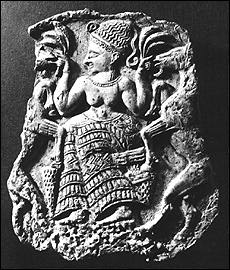
No item from ancient West Asia has yet been recovered that bears an inscription identifying the portrait as Asherah. We simply do not know what the ancients believed she looked like. This hasn’t prevented modern scholars from assigning an Aserah value to certain favored artifacts with a great deal of certainty. So much certainty, in fact, that we don’t know which certainties to trust. If iconic emblems for Asherah existed, that might provide a way of connecting images to the goddess. Unfortunately, snakes, lions, and “twigs” — the usual suspects — could fit just about any goddess with a little twisting. So we are forever left with iconic ambivalence.

May be Asherah, but what's with the goats?

May be Asherah, but what's with the goats?

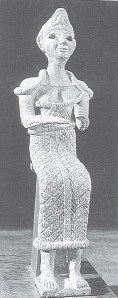
Of all the artifacts recovered from the Levant, where Asherah was actively worshipped, only one, it seems to me, is a potentially clear match. Not as alluring as the Asherahs of popular imagination, she is actually described as a matronly figure, the consort of patrician El. The El images that seem beyond question illustrated him comfortably seated on his throne of state, hand raised in a sign of blessing (or waving good-bye). One image found at Ugarit presents a feminine counterpart in posture and pose. This is likely the image of Asherah. Younger, sexier goddesses need not apply. This one instance reminds us of just how little we know of the immense divine world of Ugarit. If we are careful in our explorations, however, there is much to be learned.

Like hubby like wifie

Like hubby like wifie


Drunken Moonshine

As I learn in wonder that several of my favorite public personalities are suddenly, in fact, younger than I am, Time sends an issue broadcasting that the first moon landing occurred 40 years ago. Ouch! I remember watching it on our snowy black-and-white television the size of a washing machine. There is some comfort, however, in knowing at least some people out there are as fond of outer space as I am. I have proudly told younger co-workers that I watched the original airings of the first real Star Trek, and I confess to having been a Lost in Space junkie.

Ancient peoples used a different set of lenses when they looked up into their pre-Galileoan skies. Those tiny dots of light in the sky at night actually move across the sky as any ancient insomniac knew. They had to be alive, that stood to reason — they must be gods. And that “big shiny one, right there,” as Donkey calls it, the moon, presided over them all. In many an ancient divine magisterium the moon reigned supreme. Its light wasn’t reflected, it was self-generated.

At Ugarit one of the deities associated with the moon was Yarikh. Unfortunately tablets relating his exploits are rare, but one such tablet (fancy title KTU 1.114) relates a frat party on Mount Saphon (an ersatz kind of heaven). As the gods are drinking themselves senseless (how else can the latest Bush administration be explained?) Yarikh, the moon-meister, begins crawling under the table like a dog and begging for a joint of meat. His advances are greeted with a divine stick-whacking to send him yowling back home. It is probably a good thing that the moon sobered up before we landed there. The imagination runs wild at what could have been so much worse than landing on a pile of green cheese!

Innocent nursery rhyme or Yarikh on another drunken exploit?

Innocent nursery rhyme or Yarikh on another drunken exploit?


Sects and Violence

Religion-sanctioned violence has a long (overly long) pedigree. Early myths going all the way back to the Sumerians incorporate violence on the part of the gods. Depending on one’s school of interpretation, this could be seen as “form following function” — people saw the violence inherent in nature and projected its causation onto the source of nature, namely, the gods. Ancient people did not perceive of the world in terms of natural phenomena. “Nature” behaved the way it did with will and reason, the will and reason of the gods.

The stories preserved from ancient Ugarit stand as witness to this conceptual world. In one story, Kirta by title, the eponymous king Kirta seeks a family and has his wish granted by El and Baal. Hedging his bets, he makes a vow to Asherah that he forgets to fulfill. Asherah sees to it that Kirta’s divine gift comes undone. More obvious is the tale of Aqhat, another divinely granted child. Aqhat is given a bow by the craftsman god Kothar-wa-Hasis, only to have it coveted by Anat. When he refuses to release it to the goddess he is unfortunately pecked to death in a hitchcockian demise by a swarm of buzzards with attitudes. Violence is introduced into the human realm by the gods themselves.

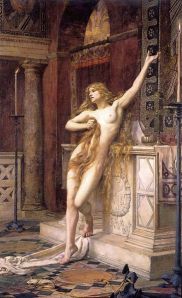
Today, some 3,000 years after Ugarit, we still find ourselves living with violence sanctioned by religion. Whether it is as obvious as extremist factions of a religion calling for outright attacks on others, or as subtle as self-professed righteous believers destroying a colleague’s career in the name of Jesus, religion is used as a mental crutch for striking others. While I can not walk all the way with Christopher Hitchens, I do have to acknowledge that when it comes to human-on-human violence religion is a socially accepted motivation, no matter how pure its original intentions.

Hypatia, a scholar-martyr due to religious violence

Hypatia, a scholar and martyred victim of religious violence


What’s a Ugarit?

Self-knowledge for any society begins with a knowledge of its past. We identify ourselves with where we have come from and what we have experienced. As denizens of a highly technological world in which change occurs rapidly, it is easy to forget that in ancient times technology progressed at the rate of centuries, or even millennia. The rapidity of cultural change is closely linked with the efficiency of communication with large groups of people over great distances. Working together we build on the many stories already built below us, we begin on a higher level than those in the stories below us did.

When we think of the Middle East, named from the western penchant for placing itself at the geographic center, we think of it as a region of perpetual conflict. Looking beyond our accustomed frame of reference, this region of the world is also where western civilization itself began. It was here that written communication itself was conceived. Ancient Egypt and Mesopotamia have often captured the western imagination. When enumerating the important archaeological discoveries of this region, most informed people would easily tick off the Rosetta Stone, King Tut’s tomb, and the Dead Sea Scrolls. Missing from most rosters would be Ugarit, an ancient city of incomparable importance among the lower stories of the tower of our society.

The great founding nations of civilization grew along the banks of west Asian rivers. Apparently developing independently, Egypt flourished along the Nile and the nations of Mesopotamia along the Tigris and Euphrates. The Euphrates was the quintessential waterway of the ancient world, known by many as simply “the River,” just as the Mediterranean was “the Sea.” Early in human history the city-states of Mesopotamia coalesced into united ventures recognizable as nations. The same unification occurred in Egypt and among the Hittite peoples of what is now Turkey. The basic unit of civilization, however, tended to be the city-state.

(Please see the Full Essays page for the remaining text of this essay.)