Breakage

Glass makes me wonder; can any member of a trilogy really stand alone?  As someone who consumes fiction, the question always arises as to who really controls the meaning of individual units.  Scholars have given us reader-response theory that posits meaning rests with the reader (viewer, listener, etc.) rather than with the creator.  Being on an M. Night Shyamalan kick—I was brought in through his horror movies—I watched Unbreakable.  I vaguely knew it was a trilogy, but when I saw Split I was caught off guard.  Unbreakable was a super-hero movie.  Split was a horror film.  I knew Glass brought them together, but I wasn’t sure which way it would break.  It turns out the trilogy is a horror sandwich on super-hero bread.  It’s also surprisingly thoughtful.  And over two hours long.  There are horror elements, but it made me wonder since Split is horror, could it stand alone without the other two.
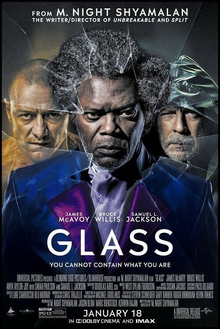
Having read about the development of this a little bit, Unbreakable could have stood alone.  It did for sixteen years.  Split could also, but for the reveal in the last few minutes.  And Glass manages to pull the whole thing off with a characteristic Shyamalan twist ending.  I’ve written about the other two movies in their own posts, but I really don’t want to give any spoilers for the last one.  I can say it ends with a message that is worthy of the Matrix.  It shows what movies can do.  Or at least it was taken that way by this viewer.

Given what movies are, and what they represent, I have to wonder if there’s not a good dose of racism in the criticism of Shyamalan’s work.  His movies are intriguing, without fail.  I haven’t seen all his films, but I have watched eleven of them now.  Some multiple times.  Here’s a guy with stories to tell.  I know, as a fiction writer who has trouble selling anyone on my vision, that a story can take over your life.  And you want to tell that story and see if it resonates with anyone else.  Those of us who make up tales generally recognize when something we write isn’t good.  My list of unfinished or unpursued stories dwarfs the stack of those I’ve had published, or tried to.  When you release a story out there in the world, you hope that others will get it.  I trust certain auteurs.  Even if not all of their films appeal to me, I like to think I see what they’re getting at.  This trilogy is well worth watching through to the end, even if it isn’t horror.

Not Fragile

One of the problems with auteur theory is that you cast directors into an expected genre in your mind.  Or at least I do, and that is unfair to directors since they, like those of us who write, sometimes explore different genres.  My first exposure to M. Night Shyamalan was The Village.  Next was Signs.  And finally, The Sixth Sense.   (I was one of those creeped out by the “I see dead people” of the trailer for the latter, and it took several years for me to get over that.)  These were enough to solidify Shyamalan as a horror auteur in my mind.  I think the other films of his that I’ve watched, The Happening, Knock at the Cabin, have all been horror as well.  While some have classified it that way, many consider Unbreakable to be a thriller instead.  These two genres are very closely related, in any case, and I’d been wanting to see it.

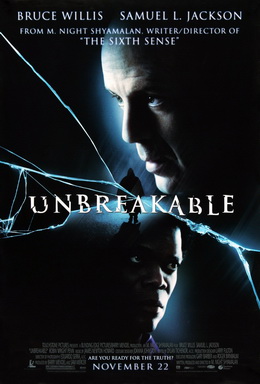
Unbreakable is a movie to get you thinking.  It’s old enough that I’m not going to worry about spoilers here, so be warned.  David Dunn, after surviving a train wreck that killed everyone else, runs into Elijah Price, an art dealer and comic book aficionado, who is, literally fragile.  A rare disease renders his bones weak and since his childhood love of comic books informed his outlook, he wants to find a hero.  Dunn seems to be the man.  Never sick in his life, he survived a car crash with no injuries and his only weakness seems to be water (he nearly drowned as a child).  Price tries to convince him that he is indeed a superhuman, but his partially estranged wife disagrees.  Their son, however, believes.  The twist ending has us realize that Price has been conducting terrorist activities in order to find a hero and he “confesses” once he’s certain Dunn is real.

There are definitely some very tense moments in the film.  There aren’t any monsters, and Shyamalan wanted this to be known as a comic book hero movie (which it is).  He has directed some others in this genre as well, none of which I’ve seen.  I watch hero movies now and again, but they often lack the depth of good horror.  Unbreakable, however, does have depth.  At least it makes you think.  Is the good of convincing a hero that he can help people worth the hundreds of deaths it took to find him?  Price’s motivation seems pure, but his methods are evil.  These kinds of dilemmas are inherently thought-provoking.  But I will still probably continue to think of Shyamalan as a horror director.  Maybe that’s just wishful thinking.