Escape Room

I didn’t go out looking for horror films in 1979.  I knew about Alien, of course.  Everyone did.  Even in a small town.  I didn’t see the movie until many years later, though.  I was still in high school and money was scarce (college was all either scholarship, loan, or work-study money).  If Tourist Trap ever came to town I didn’t know about it.  In fact, I didn’t know about it at all until reading Stephen King’s Danse Macabre.  Enough time has passed that the movie is now streaming for free and, indeed, it is David Schmoeller’s first film.  Critics didn’t love it, but King thought it had some appropriate eeriness, so why not?  It isn’t horrible—I’ve definitely seen worse.  And movies with animated mannequins hit that uncanny valley at just the right angle, even if poorly written.
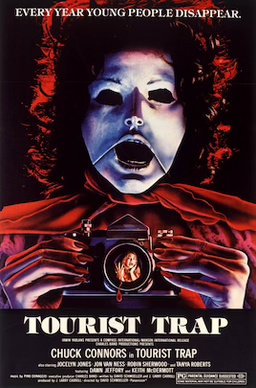
The story’s a bit convoluted.  Five young people are on vacation and get drawn into, well, a tourist trap.  There’s a fair amount of psychokinesis that goes on, and the tourist trap is Slausen’s Lost Oasis, which is filled with animated wax-work figures/mannequins.  These are what make the film creepy.  As the plot unfurls, the kids get killed off, one-by-one, as horror viewers come to expect.  There is a bit of a “reveal” toward the end, so I won’t spoil it.  It is fair to say that insane antagonists were fairly common by 1979 and that the blurring of real people and manufactured ones is a bit unnerving.  There are some questions of motivation, and many times the characters don’t take the obvious steps to help themselves.  Still, the movie isn’t too bad.

I was drawn to it, having seen Schmoeller’s real groaner, Netherworld.  And King’s recommendation.  There is something about movies that are lacking in undefined ways that keeps you watching.  I was curious how Tourist Trap was going to end up.  There were several points at which I thought I’d figured it out, only to be told, “but wait, there’s more!”  The more wasn’t always really worth waiting for, but the ending has a bit of a payoff.  There is some slasher aesthetic here, but it’s unconventional enough that you may at least be kept guessing.  The thing that the movie gets right is that human figures that aren’t human are scary.  Many films play on this, of course.  Even if you’ve seen others, it still tend to ramp up the shudder factor a bit.  It only took four decades for me to stumble into this tourist trap, and it was a reasonable brief vacation from reality.


Loving It

Given my remarks on occasion, some readers may conclude I dislike science. Nothing could be further from fact. Ever since I was a child I’ve been fascinated by science and secretly—or not so secretly—wanted to be a scientist. Complex mathematics, however, has always been beyond me. My brain simply doesn’t think that way. My gray matter is more inclined towards literature and abstracts, ideas. I am, it is true, distressed by a type of science that starts making philosophical claims as dogma: materialism. Those who make this claim have no scientific basis for doing so—it is a belief. They are entitled to their beliefs, of course, but to belittle those who suggest that maybe we don’t know everything there is to know about the unseen world seems poor sportsmanship to me. Case in point: IFL Science is a fun website. I enjoy the articles I read and it is refreshing to have those who stand up to creationists and other posers get such limelight. Interestingly, a recent article strayed into the uncanny valley.

Clown

Leading with the questions “Why Are So Many People Afraid of Clowns?” the article is categorized The Brain. Or psychology. This is one of those fields where we’re really out of our depth. We don’t understand the way that we think, and even raising the question of clown phobias seems a little odd. History can help to answer some of the questions, but IFL Science does a nice job of suggesting a scientific approach. Historically clowns were outcasts. They are liminal figures who create unease by their very existence. Those who didn’t feel accepted came to do what those who don’t feel accepted often do: try to get others to laugh at you. Sad comedians are more than a stereotype. Those who’ve clowned already know that.

Since I was a clown in college, I’ve read quite a bit about the history of the craft. Clowns were a way of laughing at misery, but also of gaining some sympathy. By exaggerating human features, they become caricatures. We aren’t allowed to discriminate against those who are different, but clowns exist to be excoriated. And deep inside, I think we all know, that those who are ill treated will eventually demand payback. It is a lesson that the world could stand to learn even today. Of course, we don’t want to be told that those who are different share something as personal and important as human feelings. Clowns make natural targets for our fears because they represent something that we know shouldn’t exist—inequality. If you can’t get accolades through hard work, making others laugh provides its own reward. The phobia may arise, I suggest, because we know that every laugh comes with a price.