Stop for a Bite

Universal does monsters right.  I’m no movie maven but I don’t know why the whole Dark Universe thing didn’t work out.  These movies are good!  Abigail recently came to one of the streaming services I use and I watched it right away.  (There’s sometimes a delay between when I write about a movie and when it appears on this blog.)  There will necessarily be spoilers here.  I write this as someone who doesn’t watch trailers if I can help it, and who tries not to read about movies before watching them.  So be forewarned, if you are, by any chance, like me.  In case you’re bowing out now, this is a very good flick.
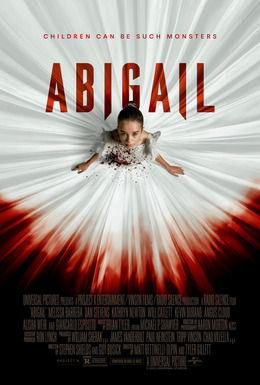
So, this is one of those spates of recent vampire movies where you go for quite a while before realizing it is a vampire film.  Set as a taut thriller, a group of six criminals who don’t know each other kidnap a twelve-year old ballerina.  She’s being held for ransom and the kidnappers have to keep her in the mansion for 24 hours, after which they each will receive their share of $50 million.  What they don’t know is that Abigail is a centuries-old vampire who likes to play with her food.  Suspecting they’ve been set up, the criminals speculate that the girl’s father has set his most vicious killer on them.  Modern, educated people, they don’t believe in vampires (there’s quite a bit of shading from Dusk Till Dawn in here) but they have to figure out how to defeat one.  Like Dusk Till Dawn, they ask themselves what they know about vampires, trying to come up with a plan to survive the night.  As you might expect, a bloodbath ensues.

If you’re the kind of person who reads about movies first, you’ll know, as I didn’t, that this was planned as a remake of Dracula’s Daughter.  It’s been so many years since I saw “the original” that I scarcely remember it.  (So you know what’s coming, eventually.)  I’ve watched many monster movies—like the books I’ve read, it’s so many that I lost count long ago.  Many of these films are pretty good.  And, of course, there are many I haven’t seen—that depends on money, time, and circumstance.  I do have to note, however, that coming up on the centenary of Universal monster movies, they haven’t lost their touch.  I have no idea what happened to their Dark Universe, but I do get the feeling they maybe gave up on the idea a little too soon.
Like Father

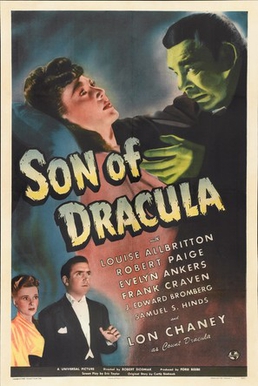
There’s just something about old movies.  After Universal discovered that Depression-Era people would still pay to see scary movies, they made a kind of industry of filming new monsters (for them) or spinning off of their successes.  Several years ago, when Universal was selling collections of their famed monster line up on DVD, I bought a few.  I realized recently that I had never watched Son of Dracula, included in the Dracula DVD set.  While it’s not a great movie, it’s by no stretch a bad one.  The story is complex and soulful, and even though Bela Lugosi’s not in it, the film participates in the ever-growing vampire lore.  It also introduced the world to Alucard, a character that would take off in Japan as a vampiric character in video games and manga.

Katherine, a well-to-do southern belle, met a Count Aculard while traveling in Eastern Europe.  He’s now visiting her in America, much to her fiancé’s chagrin.  A local doctor and friend of the family comes to expect that Alucard, Dracula spelled backwards, of course, may be a vampire.  He brings over a professor acquaintance from Hungary to test his hypothesis.  Meanwhile, Alucard, Dracula’s son, marries Kay and in so doing inherits her estate.  She becomes a vampire, which was her plan all along.  She, however, plans to turn her fiancé into a vampire, after they kill Alucard, so they can spend eternal life together.  The doctor and professor figure out what’s going on, but the local police don’t believe them and are ready to commit the doctor as insane.  Frank, the fiancé, refuses to go along with Kay’s plan, so he kills the Count by destroying his coffin before daybreak, and then also immolates Katherine as well, ridding the New World of vampires.

This is definitely a period piece, but it manages to have a southern Gothic appeal.  The black folk are all servants, and the Hungarian doctor sounds just like Peter Lorre, but the story is complex enough to retain interest.  Lon Chaney, as Alucard, doesn’t have as much screen time as you might expect, but there’s a lot going on in various subplots.  The movie was released in 1943, when there was still a ban on horror movies in war-time England.  The concern about invading foreigners is pretty clearly spelled out but the story is fairly well-told, even with some small holes remaining in the plot.  All of this makes me think I’d better check my other Universal monster DVDs.  There may be some other good bits that I’ve been missing.


Outside Invisible

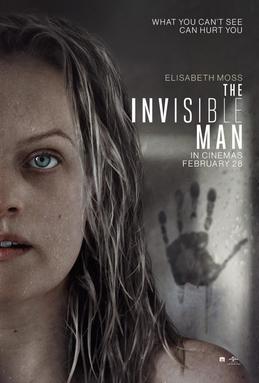
Some of us are fated, it seems, always to be outsiders.  I have no inside knowledge of the film industry.  I barely keep up with the movies I want to see.  Although I write books about horror films, the main players in the field don’t know those books.  It’s like being invisible.  I had hoped to see The Invisible Man some four years ago.  The reboot, I mean.  And having finally caught up, I was impressed.  This is a scary movie that hits all the right buttons.  Most of us, by cultural assimilation, know the bare bones of the story.  A guy has figured out invisibility.  What does he do with this?  Uses it to assert his will over everyone.  In the original, the monocaine made Dr. Jack Griffin insane.  In the remake, an already controlling, self-centered millionaire (Adrian), unknown to anyone but his brother, perfects an invisibility suit.  When his girlfriend (Cecilia) leaves him, he uses it to try to destroy her.

Everyone believes she’s insane.  More than that, criminally insane.  Cecilia knows he was an optics genius and he leaves her subtle clues that he knows where she’s hiding.  He hurts those close to her and they assume Cecilia is causing the harm.  Then it escalates to murder.  Placed in an institution for the criminally insane, she knows Adrian is there with her.  Nobody will believe her, however, since, well, he’s invisible.  This is a movie nearly as harrowing as The Dark Knight.   An unstable genius with unlimited resources and the ultimate alibi forces his abused ex to suffer for ever having loved him.  It’s pretty incredible.  (Has to be seen, I’m tempted to say, to be believed.)

Now, I’m no insider so I didn’t realize that Universal had been attempting to build a Dark Universe franchise based on the original Universal monsters.  I had completely missed that Dracula Untold was the first of the reboots.  I did watch it but fell asleep.  (Hey, I was watching with friends who started it too late for my outsider schedule.)  I never got around to seeing it with my eyes fully open.  Although it made money, it wasn’t, I hear, very good.  Then three years later, The Mummy bombed.  I confess that there’s so many Mummy movies that I’ve lost track of them and I didn’t know this one existed.  Or flopped.  Invisible Man was intended as the third and the movies were to be interlaced into a Dark Universe.  Plans for that franchise have been dropped, but individual movies will continue to be made.  I guess I need to go back to the beginning again.  It only took me a decade to learn this, as is the way with outsiders.


Invisible Again

Sequels are a fact of life.  Movies, although some of us look to them for profundity, are made for selling.  (I guess my writing for so long with no profit from it has skewed my view a bit.)  Still, The Invisible Man Returns isn’t too bad.  In my mind, there were a set of six canonical Universal monster movies: Dracula, Frankenstein, The Mummy, The Invisible Man, The Wolf Man, and The Creature from the Black Lagoon.  In reality, each of these successful films was followed by a clutch of sequels, filling the thirties and forties—into the fifties—with monster movies.  I never really bothered with the sequels, but some of them are pretty good.  And I still haven’t seen the more recent Invisible Man, which I hear is quite good.

When I was a kid, Vincent Price represented horror like no other single person.  He had developed a persona that was lucrative and that influenced other monster boomers as well.  He was a relative unknown when he was hired for The Invisible Man Returns.  His face only appears in the last minute of the film and his voice had not yet settled into its characteristic menace tone that would make him a genre icon.  Still, the story has a typical plot for the period.  Sir Geoffrey Radcliffe is set to hang for killing his brother—they own a coal mine.  Dr. Frank Griffin, a friend of the family and brother of the original Invisible Man, believes him innocent and makes Radcliffe invisible so that he can escape the gallows.  As we all know, the problem with the invisibility drug—here duocaine rather than monocaine—is that it causes insanity.  Radcliffe discovers the real murderer before going insane, all the while being chased by police.

These “invisible” films demonstrated what special effects could become.  Shot in black-and-white, “black screen” technology was used to make Radcliffe appear headless and handless.  In fact, this movie received an Oscar nomination for the effects.  It’s not a scary film, but it’s a reasonably told story.  And the special effects really were cutting edge for 1940.  Probably somewhat scandalous for the time, Radcliffe has to undress in front of his fiancée at one point, leading the men who discovered her fainted to suppose that seeing a naked, if invisible, man could do it.  There is a subtle humor here.  Other films followed but they veered into the comedy realm.  Until the recent remake.  I guess I’ll need to add that one to my ever-growing list of must-see movies.