
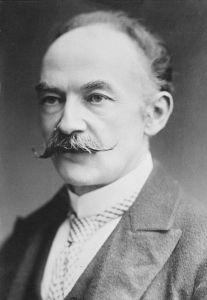
There are days when the quote from an author is the best thing to happen to me. You probably know those kinds of days—days when there’s nothing really to stay up for so you go to bed early. Lengthy days when your Muse wins easily any game of hide-and-seek. You see, I save most of my fiction reading for bedtime. If I turn in soon enough I can read quite a bit before falling asleep. Not to sell you a false bill of goods, but that’s not the source of the quote. It actually came to me from an unrelated email about the Bible. The quote, while lengthy, comes from Thomas Hardy:
By the will of God some men are born poetical. Of these some make themselves practical poets, other are made poets by lapse of time who were hardly recognized as such. Particularly has this been the case with the translators of the Bible. They translated into the language of their age; then the years began to corrupt that language as spoken, and to add grey lichen to the translation; until the moderns who use the corrupted tongue marvel at the poetry of the old words. When new they were not more than half so poetical. So that Coverdale, Tyndale, and the rest of them are as ghosts what they never were in the flesh.
This comes from a letter to Professor D. A. Robertson of the University of Chicago, dated to February 1918. Hardy was a known critic of religion, but like most writers of his day he knew the Bible. Now, I’d never generally put myself on the same page with Hardy, but something similar to this thought had occurred to me long before I saw this quote. We treasure ancient writing simply because it has survived. This should be a sobering thought to any of us who try to forge our thoughts into words. We have no way of knowing if, at the time, an author was considered great. Merely the passage of time can make writing unfashionable in its age appear brilliant. Like rocks tumbling over each other at the base of a cataract, they find polish over time.
My particular context for receiving this emailed quote was the King James Version of the Bible. Often considered sacred in that translation, it was not uniformly well received when first published. There had been English Bibles before, and since the Good Book is the foundation of western literature, a new translation commanded attention. It had its critics, but over the centuries the translation itself became holy, whether it deserved it or not. Similarly, Martin Luther’s translation of the Bible helped to codify the German language. We shouldn’t be too quick to dismiss Scripture, not for its theology, but for its immense influence on western thought. As Hardy noted, it may be the passage of time that makes writing great. Even so we might be wise to pay attention.

 Steve A. Wiggins