
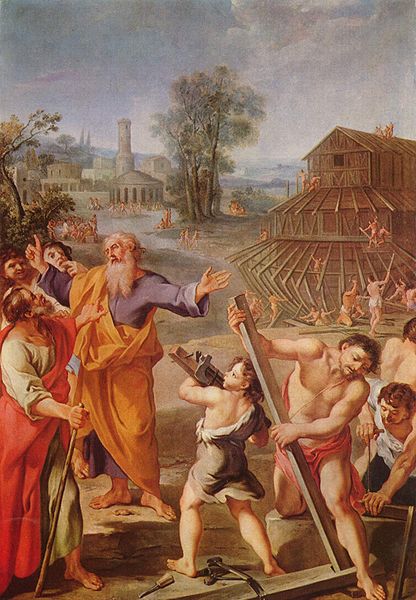
Noah seems to have found a renewed audience these days. Nothing like a major motion picture to make even one of the most famous biblical characters even more notable. And the spin-off stories are now considered news as well. One of the many impossible stories of the Bible, the ark, as scholars have long known, would not have been a physical possibility. Quite apart from the building in days before metal smelting was invented, there was the problem of volume. Since evolution is ruled out de rigueur, each separate species had to have been represented, since no changes are allowed from that time to this. The sheer number of them, especially since new ones are being discovered even now, was deemed impossible to fit on an ark of even biblical dimensions. Add in the food necessary for 150 days, especially considering the carnivores, and the human-power required to care for all those beasts (only eight are permitted by Genesis, and Noah was 600 years old at the time) and you get the picture. Then Mesopotamian flood stories even older were discovered. It was quickly recognized that this was a myth with a larger message to tell.
Now, according to geobeats, and to the relief, I’m sure, of Russell Crowe, physics students at the University of Leicester have calculated that the ark could have floated. The story, in a one-minute sound bite, is a little shy on details. The students used the biblical cubit, and figured there were 35,000 distinct species at the time. I’m not sure where that number originates, but it doesn’t take into account how Noah got the koala’s to swim from Australia. According to present evidence, the earth is home to about eight-million-seven-hundred-thousand different species. And since they can’t evolve, that’s an awful lot of swimmers.
According to the university website, this was not intended as an exercise in biblical literalism. “The aim of the module is for the students to learn about peer review and scientific publishing. The students are encouraged to be imaginative with their topics, and find ways to apply basic physics to the weird, the wonderful and the everyday,” according to Dr. Mervyn Roy, the instructor. The students, working the math angle, didn’t expect the results to work. That they did surprised everyone. Except Noah, one presumes. The story makes clear that the number of animals was used to calculate mass, not dimensions, so squeezing all the beasts in might have been quite another chore altogether. Miraculous, one might say. As for me, I am waiting to see that pair of koalas swim from Darwin to the Persian Gulf, and then back again once the waters finally recede.
Don’t forget to see the movie!
 Steve A. Wiggins