Gallows Hill

Over the past couple of weeks it has been in the news that the site of the “witch” hangings in Salem, Massachusetts has been identified. The actual site had long been suspected, and it was only recently confirmed by a group of historians using the empirical evidence available to historians. Although my interest in the Salem trials pre-dated my wife, nothing brings you so close to history as being a part of it. Descended from the brother of three of the women accused of being witches at Salem, my wife brings a sense of reality to the tragic accusations of three centuries ago. Although toyed about in the media (an episode of Sleepy Hollow, “Spellcaster,” in season two, featured an actual Salem witch) the fact is that nineteen innocent people were executed for a fanciful belief that the Devil was roaming about New England, and when you can’t catch the Devil, you have to use a scapegoat.
DSCN0518

One of those investigating the location of Gallows Hill was Benjamin Ray of the University of Virginia. I’m sure Professor Ray wouldn’t remember me, but one day as I was doing a campus visit for Routledge, I had taken AmTrak to Charlottesville to visit the religion department. Many of the faculty declined to see me, and as I sat on a bench in the hall (one of my academic dates had stood me up), Dr. Ray walked up to me and asked me if he could help. I explained who I was and he invited me to his office where we talked about Salem. I told him was wife was related to Rebecca Nurse, Mary Eastey and Sarah Cloyce, the two former, as he knew, executed for an imaginary crime, and the third accused. A strange quiet settled over the office. He told me his interest began because he too had descended from a Salem family. His ancestor, however, had been an accuser rather than a victim. It was a strange rapprochement. Opposite sides brought together in scholarship.

What truly frightens me about Salem is that we have not outgrown it. Presidential hopefuls spew the same fear and hatred toward Muslims, the hispanic immigrants who make our economy possible, and women (this should sound familiar) trying to “take the place of” men. And the crowds cheer, as crowds will do. Even though Donald Trump cussed twice in his Liberty University speech (an infraction for which a student would have to pay), President Jerry Falwell, Jr. (typing that makes me shudder) shrugged it off saying that we’re all sinners. Some sinners, however, carry a wicked, knotted rope with them while other sinners try to eke out a living in a nation where some can get rich by owning casinos while others frantically spend their inadequate cash hoping to win Powerball. We now know where innocent people accused of witchcraft died, but have we learned anything from it over these past three centuries?

Time in a Bottle

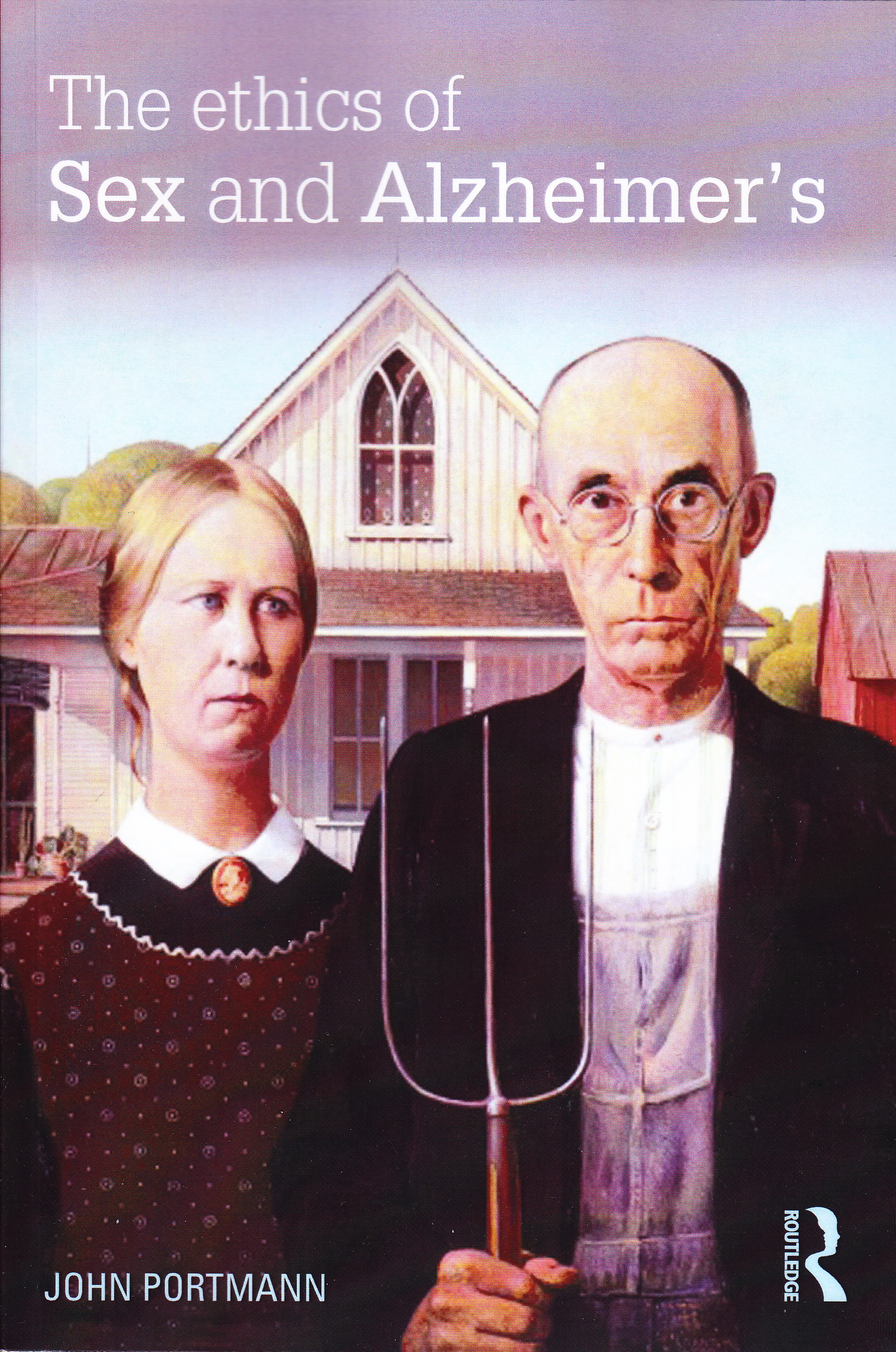
Portmann On of the intangible tangibles of my humble job is seeing a book move from an idea to a published product.  A little bit of joy rained down on my day yesterday as my first Routledge book appeared.  It also helped that this is an important book and no matter what the reader feels about the conclusions, it will be crucial in getting the question out in the open.  John Portmann’s The Ethics of Sex and Alzheimer’s places a face squarely on an issue that will only increase as time without a cure for Alzheimer’s grows.  As a culture, we don’t like to acknowledge aging.  We know it’s happening constantly, but we somehow think if we avoid it long enough, it might somehow, miraculously, disappear.  Portmann, an ethicist and religious studies scholar at the University of Virginia, puts the question boldly: what happens to marriage when one of the partners no longer recognizes the other?  This is a thorny issue.  And that’s an understatement.  We are conditioned to assume that wedding vows, with their origins in an era before people lived long enough for Alzheimer’s to become a plague, must still apply.  Portmann isn’t so sure.

I won’t spoil the book for you by giving away the conclusions of his carefully argued case, but I would like to consider for a moment the importance of ethics.  The religion in which I was reared knew little in the way of uncertainty about right and wrong.  Gray areas were scarce, and often diabolical.  I’ll never forget when I took my first ethics course as a religion major.  It was if someone had thrown open a door to a sunny Arctic day while I was seated in a warm, dark den.  It was blinding.  And disorienting.  I hadn’t thought of issues in that way before.  Simple answers wilted and died by the thousands.  Figuring things out, ethically, was costly and required an awful lot of mental energy.  No matter which answer I chose, there was a good case for an alternative choice to be made.  Morality is seldom black and white.  That’s why when Dr. Portmann pitched me his book, he had my attention from page one.

Ethics is the process of trying to figure out the best way to decide on the right course of action, given any alternative.  Little ethical issues crop up constantly: should I pretend I didn’t see that homeless person stealing an apple?  Should I tell that person who got the job that I wanted when he’s got a mustard splotch on his beard he can’t see?  Should I hold the elevator for that woman down the hall when I really want to get to work a few seconds early today?  Issues-issues everywhere!  Alzheimer’s forces the issues.  We know it is right and good to continue to care for the sufferer.  It’s no sin to forget who you are or when you are.  But what of the partner who’s not ill?  Immediately our moral sensibilities kick in.  And with a population rapidly aging (I know I’m doing my part in that department) the question will likely continue to press on our collective consciences.  Ethics reaches its fingers into those dark spaces we’d rather not put our hands.  There might be spiders in there, or bugs.  It might be something far worse.  Not everyone will agree with Portmann’s answers, but I think we can all agree that he has raised a very necessary, if prickly question.


Poe

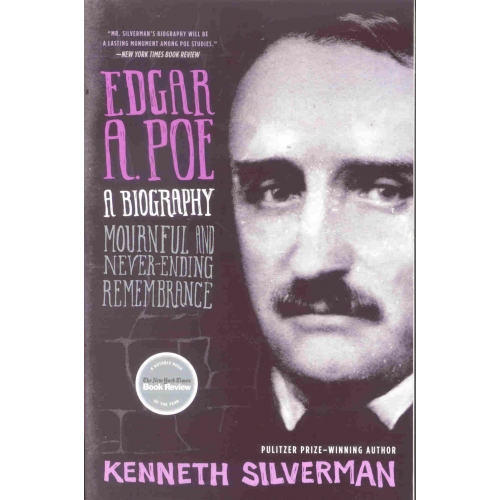
PoeSilvermanOn his birthday I began reading a biography of Edgar Allan Poe. The last biography of Poe I read, I’m embarrassed to admit, was in high school. To me Poe is like music: deeply appreciated and therefore taken in rare doses. The biography this time was Kenneth Silverman’s Edgar A. Poe, A Biography: Mournful and Never-Ending Remembrance. I picked this book up last time I was on the University of Virginia campus, just after I stopped by to gaze wonderingly into Poe’s room. Like most biographies these days, Silverman’s account is hardly a hagiography. Poe was a perfect man only in his embodiment as a man of sorrows. In the days when “writer” was not really a profession, Poe nevertheless recognized what his strengths were and persisted to try to make a living following those assets. A poverty-stricken living much of the time, but an honest one. It is not pleasant to have a hero’s foibles exposed, but Poe was all the more admirable for having been fully human. We have all experienced arrogance and humility in turns. Poe was a man who knew sorrow from his youngest years, and that cloud stayed with him until his death just forty years later. A personal tempest.

Poe, not a conventionally religious man, nevertheless recognized and drew upon religious imagery. In his poem “Ulalume—A Ballad” Astarte’s ghost appears. Astarte remains a goddess poorly understood, but Poe was likely drawing on her association with Venus. She fails, however, to lead to Heaven. Silverman points out how “Ulalume” was followed closely by Eureka, Poe’s only sustained attempt at metaphysics. Poe came to the conclusion that upon death we become part of the all-encompassing God. This daring deduction cost him friends and supporters, but it also led to a rebuttal by a seminary student. Poe’s reply to his criticisms remains apt, as Silverman quotes him, “‘God knows what’—he cared very little what he was called ‘so it be not a “Student of Theology.”’” Amen, Mr. Poe.

Some lives, like those of Job, seem fated to loss and suffering. Yes, there have been those who lost more than Poe, or even Job, but this is no contest to see who might bear the most weight before being driven to his or her knees. Poe felt it deeply and expressed it eloquently. He recognized, as most writers do today, that business models resent an honest voice. Those who sell are often those who pretend. I’m sure that Poe would nevertheless give a wry smile of irony if he knew how multiple editions of his works, long in the public domain, flow from the presses of publishers hoping to make a dollar or two on his now stellar reputation as a writer and, in full recognition of the paradox, a prophet. Like his raven, Poe could see beyond the confines of this world and paid the price for his vision. Obviously he was no student of theology.


The Idea of a University

I have to admit that my sense of justice has been a bit offended by the loss of reputation of my chosen field. Seeing how universities are fast becoming job-training institutes, I fume about what once had been and no longer shall be. History is the lens through which I view the world (a subject many industrialists consider “useless,” but to their cause actually “dangerous”). Historians dispute which university was the earliest, although something similar to the idea of a university was developed in Bologna, Italy, around 1088.  The University of Paris was also very early, as were Oxford and Salerno.  While “business” as it was then known could be studied to some degree, a primary function of early universities was the training of clergy. No doubt, paranoia concerning heterodoxy and heresy helped spur on the idea that future clergy required extensive training. As universities caught on, many centers for the studying of theology (indeed, a branch of religious studies) sprang to life.  It could be argued that this was a “trade mentality,” but very quickly this became an academic point.  Who else but a theologian would every worry about how many angels could dance on the head of a pin?

Science was incorporated into theological studies from the beginning.  We all know about the antagonistic relationship between the Church and Galileo, but less often do we hear about the religious thinkers who were trying to put it all together into a workable system.  Often the university was among the few places where such abstract and critical thought could occur. Some of the great universities in the United States began as seminaries: Harvard, Yale, Boston University—they started as places to train clergy. How often do graduates of the Harvard Business School toot that particular horn? Permit me the privilege of a mournful sigh as I watch the torch pass from abstract thought to the abstract symbol of the gold standard. Money only possesses the value we assign to it.  Currency can be measured in less material avenues as well—the ability to think clearly and precisely and compassionately; these abstractions, I would lament, have inherent value.  Alas, the heart of the university has gone another direction. I have undergone the heartache of breakups before, and always one needs a little time to adjust to the loss.

The University of Virginia’s recent object lesson to higher education should perhaps serve as a warning tap on the brakes to those who would see higher education kneeling abjectly before the towering statue of commerce with its head of gold.  Maybe there is more to life than money?  Maybe education for its own sake is what sets civilization apart from life in the savage jungle.  Those who castigate our great institutions of learning seldom turn down the offer of an honorary degree.  While these academic niceties require neither coursework nor dissertation, they do offer a kind of credibility that the rich seldom find on their own.  So what is the idea of a university? Is it a place to learn a trade?  Sometimes.  The humble request those of us deemed useless make is that the university not forget its humble origins as a place of speculative thought in the service of religious thinking.  Critical thinking. Otherwise it will be more than irony that the city that gave us higher education is also the one that also gives its name to baloney.

from Wiki Commons


Jefferson’s Legacy

With the gears grinding in the political machine and candidates for the GOP nomination each trying to show they are more righteous than the others, the name of Thomas Jefferson gets used quite a bit. Jefferson’s famous Bible, literally cut-and-pasted together by one of our better presidents, removed miracles from the picture, and Jefferson’s writings leave open the question of whether Deist or Atheist is a more accurate description. I’m in Charlottesville, Virginia right now, home of that paean to Jefferson, the University of Virginia. For a state university, UVA has perhaps the largest religion department in the country. I noted with some irony, that the religion department is housed just above the political science department in Gibson Hall. While waiting for my first appointment, I sat in an alcove where two students began talking about politics. (This was in the religion department.) My chagrin grew as my grin faded with their lament about how poor the Republican candidates are, “but we have to get Obama out of the White House.” In order to do so, they’d elect a man whom they believe unqualified for the office.

Winston Churchill is often quoted as saying a person who doesn’t start out as a liberal has no heart, but who remains a liberal as an adult has no brain—or some such nonsense. The fact is, compassion never should go out of style. It seems to me that somebody changed the terms and what they mean. “Conservative” used to equate to a fiscal position that, while it favored the wealthy, still had sympathy—or even empathy—for those less well-off built in. Now it has come to define “selfish disregard of those different than me.” We see it all the time, not just in political speeches, but in acts passed in the name of Christianity. Jefferson’s Bible is being trampled underfoot. And we are told repeatedly that America was founded as a Christian nation. Of the students discussing politics here, the more conservative of the two was the woman.

Does she not realize that without the liberalizing tendencies of the suffragettes her own future would be limited? That does not excuse in any way the patriarchy that made suffrage necessary in the first place, but it does speak to how quickly we are taught to forget. Even in the land of Jefferson, there are those who would protect privilege and call it divinity. “It does me no injury for my neighbor to say there are twenty gods, or no god. It neither picks my pocket nor breaks my leg.” The words of Thomas Jefferson. In our great universities those who actually do learn are sometimes taught that empathy is weakness and fiscal gain is god. Unless it’s an election year. With great wealth going into the carnival we call the nomination process, we might legitimately ask what’s to become of us if those with no empathy are elected. After all, what are we, apes?

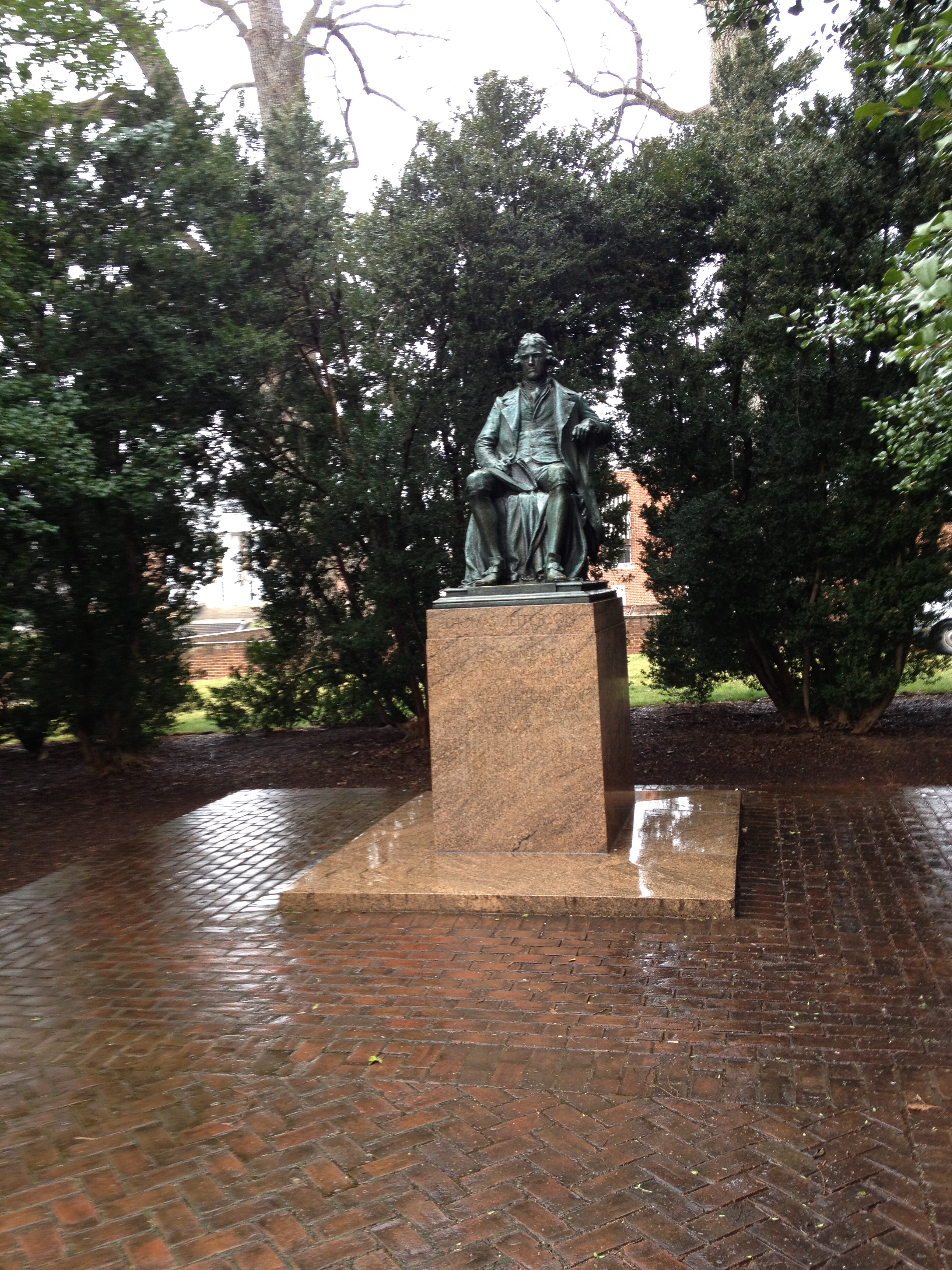
One of the few presidents worth casting in bronze