Trouble on Campus

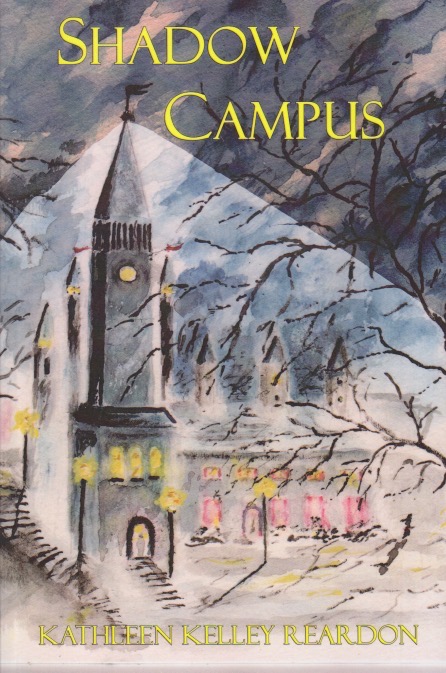
I know what it’s like to have a story living within you.  Academics writing novels don’t always qualify as Dark Academia, but Kathleen Kelley Reardon’s Shadow Campus does.  Continuing my current kick of that genre, I eagerly read of the skulduggery taking place at the fictional Pacific Coast University and found myself nodding with recognition.  Higher education is highly political.  I have to wonder if where two or three are gathered politics will inevitably be in their midst.  Perhaps thus it has always been, but it seems to me that when universities decided to model themselves on corporations, it grew much worse.  In any case, Meghan Doherty is a business professor up for tenure.  Her only family is an estranged brother in Connecticut.  Then one night someone attempts to murder her on campus and make it look like a suicide.

Shamus, her brother, flies to California to see her in the hospital and soon begins to suspect things are not as they seem.  I don’t want to give away too much here, in case you want to read it too.  I can say that sometimes life on campus is like this.  I’ve made the claim to have lived Dark Academia, and I’ll stand by it.  After the unpleasantness at Nashotah House, I was hired for a year as a replacement professor at the University of Wisconsin Oshkosh.  I really enjoyed teaching there, apart from having to leave my family in Oconomowoc; I stayed with a former Nashotah House student to whom I’m eternally grateful.  The department chair and colleagues liked me.  I was a good fit.  There was talk of making this a full-time position for which I’d be the inside candidate.  Then one of the other professors began to dislike me (long story).

I was called into the department head’s office and told that my eight courses for the next year had been reduced to one.  Permission to hire had been granted, but it had to be a specialist in women’s studies.  I was welcome to stay on as an adjunct, of course.  I’m a blue-collar guy and I recognize a boot when I see one.  And that was only the second time something similar had happened to me, and it wasn’t the last.  I’ve paid my dues to academia and yes, it is often dark.  So I enjoyed reading Reardon’s fictional account of underhanded dealings at Pacific Coast.  In my own experience guns were never brandished, but then, you can’t have it all.


Life Semesters

Some people have a school calendar in their blood.  For me, that was one of the great appeals of the teaching profession.  I worked a lot during summers—class prep and research take a lot of time and the two go naturally together.  I didn’t mind the ten hour days, and more, during the semester either.  When you’re doing something you love, you become your job.  It was quite a shock when the job counselor at the University of Wisconsin Oshkosh told me that I had to separate myself from my job.  The two were one.  I would sit in that Oshkosh office researching for classes I’d never taught before.  My first year at Nashotah House I was writing 90 pages of class notes per week.  Anxious, but loving it.  There was so much to learn!  But that calendar has some natural breaks.

Academic careers involve sprinting that goes on for about four months straight.  Then you get a break of a month or two before sprinting again.  For those of us with my mental condition, that way of living just fits.  The 9-2-5 job is parsimonious second-pinching.  I’ve talked to other professionals in the field and they say the same thing—when your job involves thinking, there are no such things as fixed hours.  When I’m out on my jog before work and my mind comes up with a solution for that intractable problem that awaits me once I fire up the laptop, I’m working.  It’s just not “on the clock.”  It’s gratis.  Part of the problem is I don’t cotton onto sitting in front of a computer all day. Being “in the office” ironically hurts productivity.  In the teaching world you walk around and talk to people.  Summer days are spent with your nose in a book.  What’s not to like?

Not everyone, I know, is stimulated by that kind of lifestyle.  For me, it just works.  Some years I’m able to carve out a week’s vacation in the summer.  I try to save up enough vacation days, however, to get the week between Christmas and New Year’s off—a mini semester break.  When a person’s mind works in a certain way, finding employment that coincides with it is important.  Many people like the structure of a work day.  It tells you when to sign in and when to knock off.  It tells you when to eat lunch and when to take breaks.  Others prefer alternative work arrangements.  The 9-2-5 has never sat well with me.  It’s because the school calendar is in my blood.


Learned Ghosts

For one memorable year of what I call a career, I taught at the University of Wisconsin Oshkosh.  One in a series of near misses, this came close to becoming a full-time job.  Apart from a couple of rather humorless colleagues, the department was welcoming and an enjoyable place to be.  I even got to know the dean, now elsewhere, and planned on working on a project with him.  It was a memorable year in many respects.  One was its inherent strangeness.  I was living away from home while teaching there, and saw some odd things on my drives through the Wisconsin countryside.  It also happened to be at Oshkosh that I first discovered H. P. Lovecraft, so the weirdness was, in a word, enhanced.

Students like to tell ghost stories.  A recent article by Jocelyne LeBlanc on Mysterious Universe caught my eye because it tells of students in Oshkosh that live in a haunted dorm.  These kinds of stories are ubiquitous and Oshkosh is in no way singular here.  Students, whose brains haven’t yet ossified, are often open to new experiences.  Most of them, however, don’t possess the research skills to get behind the origins of some such tales.  Sometimes there’s an explanation.  Other times there’s not.  At Grove City College, when I was there, students told of a haunted playing field.  It was the site, it was said, of a former gymnasium.  What made it haunted was the death of a basketball player who’d smashed through a glass gymnasium door during a game and bled out before help could arrive.  It sounds improbable and I never had time to research it.

We all, I suspect, have a longing for the supernatural.  We want to believe that there’s more to this world than physics and earning money.  And strange things do happen.  I never saw any ghosts in Oshkosh, but the things I did see helped to make up for that particular lack.  Edinburgh, where I studied for my doctorate, is widely rumored to be among the most haunted cities in the world.  Although I saw no ghosts there, people flock to the ghost tours.  In fact, one stopped right below our first apartment’s window every night during the tourist season.  By the time we moved out we had every word memorized.  The haunted dorm story is a revered tradition.  Thinking about it makes me wish I could afford to be a student again.


Cthulhu You Knew

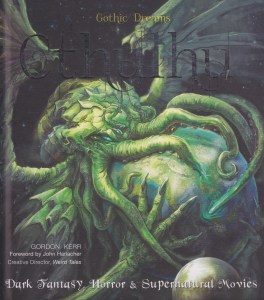
Humans tend to be visually oriented.  Arresting images stop us cold, causing us to focus on what we’re seeing.  As a tween I could be transported by large, lavishly illustrated, full-color books of other worlds.  While these went the way of Bradbury, I still sometimes recollect scenes that stopped me in my young tracks, making my juvenile mind wonder, what if…?  As an adult I realize “coffee table” books are heavy and a pain when you’re moving.  Printed on specialized paper, they have more heft than your mass-market paperback, or even most academic tomes.  Nevertheless, Gothic Dreams Cthulhu was a book that carried me, like a time-machine, back to my younger years.  Unlike in those days, however, I read the text as well as lingered over the images.  And I wondered about Cthulhu.

You see, I didn’t know about Lovecraft as a child.  The only reading regularly done in my family was Bible-oriented.  I discovered science fiction and gothic literature as a tween and, living in a small town, had no one to guide me in my choices.  Rouseville (the town pictured in the background on this website) had no public library.  My reading was left to my own, uninformed devices.  I discovered Cthulhu through my long fascination with Dagon.  I’d pitched Dagon as my dissertation topic, but settled on Asherah instead.  While teaching religion at the University of Wisconsin Oshkosh, I discovered Lovecraft, and Cthulhu, through Dagon.

Gordon Kerr, the author of Gothic Dreams Cthulhu, might be forgiven his hyperbole about H. P. Lovecraft.  Lovecraft was not a great writer—that’s not intended as any kind of slight, I hasten to add.  Classically, however, he didn’t have the level of literary finesse of Edgar Allan Poe, for example.  Still, Lovecraft created credible worlds.  His was a life of imagination—one might almost say divinity.  He was a creator.  Cthulhu has become a cultural icon.  With the magic of the internet bringing a writer still obscure to international attention, many people who never read horror fantasy nevertheless know who Cthulhu is.  Or they think they do.  As Kerr explains, the descriptions by Lovecraft himself are spare, thus the variety of ideas represented in the delicious artwork on every page of this book.  As Lovecraft earns more academic attention, surely others will notice the religious potential of the Great Old Ones that were, in their time, gods.  A guilty pleasure read, to be sure, Gothic Dreams Cthulhu fits well into this serious world of chaos we’ve created for ourselves.


Paper or Plastic?

Perhaps the most frequent topic on this blog is books. I don’t discuss every book I read, but most end up here. I can’t help but be pleased then, that recent polls show the number of people reading books is rising. Not only that, but that paper is back. We all appreciate new things. In fact, our economy would grind to a dead stop if it weren’t for new things that keep us buying. Ebooks were a new thing. Sometimes they’re even convenient things. If you’re going on a trip and you tend to travel with lots of books, like I do (who knows what mood you’ll be in when you get there? You’ve got to be prepared!) then an ebook reader can save stress on your back and luggage capacity. But I still prefer to zip open my bag and see four or five books smiling up at me. Visitors (rare, but not completely fictional) sometimes ask why I keep them all. I must restrain myself from retorting “why do you keep all your children?”

img_2945

Books—print books—represent so many things. Yes, they often contain knowledge. But they also contain memories. The contain emotions too. I remember that book that I saw in the library window at the University of Wisconsin Oshkosh book sale display. I was only at Oshkosh one year, but I recall seeing the book that my advisor had recommended a decade and a half earlier. I was so excited I called the librarian to ask if it could be put on hold. He allowed as it couldn’t but if I were to pay in advance perhaps another book could be substituted in the display. I remember having my worldview torn open by books—that January that I read three books that changed my outlook on life almost completely over Christmas break. How can I bear to let any of them go?

I suspect ebooks were a fad. They are still useful and they still sell. But is there any feeling like taking a book, closing the back cover, setting it on your lap, and thinking about what you’ve just seen? I know nothing like it. Of the many books I’ve written, only two have been published. In some sense, those two are the only two I’ve done. I keep trying with the others, but meanwhile out there in a few select libraries people can find bricks of paper with my name on the outside. It wouldn’t been the same if the publishers had said, “it will only be an ebook.” I know that it shouldn’t make a difference if its paper or plastic, but it does. It makes all the difference in the world. No matter if it means having to build more bookshelves. They make excellent insulation.


UCB

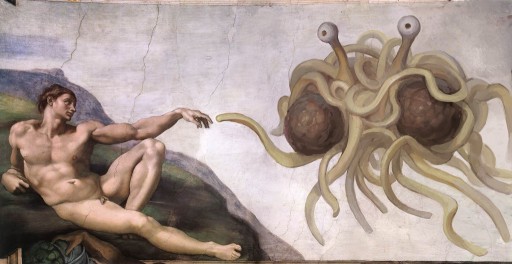
The Flying Spaghetti Monster came onto my radar while teaching at the University of Wisconsin, Oshkosh. I was teaching a course entitled The Bible and Current Events and the controversy over teaching Intelligent Design had been gaining steam. As I addressed the evolution section of the course, I became aware of the Flying Spaghetti Monster and his noodly appendages. The Jesus fish had recently evolved to a Darwin fish, and the Darwin fish was being eaten by a Jesus shark, then I finally saw the Flying Spaghetti Monster on somebody’s bumper. I looked it up online and discovered a whole mythology had been developed to go with this parody of a religion. It was lighthearted and funny and had an obvious purpose—to challenge the equally bogus claims that creationism is science. Now, I don’t try to change anyone’s religion. If someone finds creationism comforting, well, the United States is based on freedom of religion and who am I to dictate what someone else believes? The problem is creationists often don’t share that courtesy and try to get their religion taught in public schools as science, which it isn’t. The Flying Spaghetti Monster was their nemesis.

Over the weekend, when I actually have time to do a little surfing, I came across the United Church of Bacon. Noticing the similar food-based theme as the Flying Spaghetti Monster, I decided to check it out. It seems to have become a cottage (cheese?) industry to start your own anti-religion. A look at the United Church of Bacon’s website reveals it to be the brainchild of Penn Jillette of Penn and Teller, and friends. As usual, the voice of Teller is not heard. This is a legal church which performs many of the services of traditional religions, but without the belief. Bacon, it seems, is the ultimate reality here—to quote the church on a billboard: “Because bacon is real.” They have nine bacon commandments and an impressive list of charitable works.

Looking over all of this material, I wonder what the mainstream churches might take away from all of it. For one thing, the obsession that Christian denominations have had for centuries with correct belief has become a kind of albatross. Petty differences in theology tend to lead to hatred in the name of the prince of peace. Another is the repeated emphasis on giving has taken its toll. The United Church of Bacon openly advertises that they give money, they don’t take it. While few clergy become fantastically wealthy, it is no surprise that most bishops or those of equal rank never seem to go hungry or drive cheap cars. If entertainers are rich, it is because they offer something worth paying for. And for those of us who are vegetarians, the UCB offers the alternative of praising vegetarian bacon. You are, after all, what you believe.

Heretic?

Heretic?


Truly Educated

Binghamton University looms large in my consciousness, for rather obvious reasons. Although it sits in a small corner of upstate New York not particularly near anything famous, it has its own culture. Having taught at several schools, and having studied at many along the way, I’ve always been particularly struck by the genuine nature of Binghamton. For example, it is the only school—apart from a hazily recalled “Bible Study” led by the then president of Grove City College—at which the president has made himself available to be met and chatted with by hoi polloi. I’ve met and talked with him twice, and although I taught a phenomenal number of courses at Rutgers, and conveniently solved a crisis in the religion department for a year at the University of Wisconsin Oshkosh, I never found a time or place when the president was available to the likes of mere mortals. Not only that, but at a time when other universities are cutting whatever faculty they can to make more administrative posts, Binghamton is actually hiring faculty and expanding. I feel renewed when I visit the campus. You can tell they care about people.

A story in the Washington Post underscores this. One of the graduation speakers at the Watson School of Engineering is an Orthodox Jew. His commencement ceremony fell on Saturday—the sabbath. According to the dictates of his faith, speaking through a microphone system that passes through a soundboard is considered work, and could not be done on the sabbath. In today’s climate, I would expect most universities to say, “too bad.” Religion is not to be taken seriously, right? So just get over it. Here’s where Binghamton, however, shines. They taped the address beforehand, allowing the speaker to take the stage and have someone else broadcast his speech. This isn’t about picking apart the logicality of anyone’s personal Torah, it’s about recognizing the human.

DSCN4915

Our very religious society has a way of compartmentalizing religion so that we can still get away with what we want to do. We can be religious when our clergy so dictate, but otherwise we’re pretty much free to look out for number one. This story is one that makes me proud to have once been a part of a system that includes a school that can truly lay claim to the designation “higher education.” We learn about the world to become, ideally, better citizens of it. Any university that is able to take what might seem to be a petty problem and recognize its human dimension deserves to have our admiration. It restores my faith in the future. At least in a small corner of upstate New York.


Fleeting Meaning

Just a year before I had been unceremoniously dismissed from a fourteen-year teaching job at Nashotah House, devastating everything I thought I knew. I’d found a temporary job at the University of Wisconsin, Oshkosh and the head of the department encouraged us to go see the mandala that some Buddhist monks were constructing in Oshkosh one weekend. My family came up and we breathlessly watched as the orange-draped, shaven monks meticulously tapped brightly colored sand into an intricate pattern of incredible beauty. My daughter, quite young at the time, wondered what they would do with it when they were done. We’d been told, in the department, that the sand would be safely flushed into a local waterway, as Buddhism teaches about the transitory nature of life. My daughter was upset at the thought of such a nice piece of art being destroyed. But that’s part of the point of a mandala. As the Buddhists say, too many people concentrate on the hand pointing at the moon rather than on the moon itself.

Photo credit: Kamal Ratna Tuladhar, WikiCommons

Photo credit: Kamal Ratna Tuladhar, WikiCommons

I’m no expert in Buddhism. It is a complex way of thinking, and, like many religious systems, it is not unified into one particular thought-structure. Nevertheless, one of the main teachings of Buddhism is that life is, pardon the crass translation, suffering. We experience desire and we will continue to experience desire until we die. Then we’re reborn to experience desire all over again. Those who are enlightened may break out of this system into Nirvana, or a kind of non-existence where desire can no longer afflict us. There is an appeal to this way of thinking in a universe that science tell us will eventually burn out so that we’re all just a bunch of cinders in infinite, but expanding space. Almost Buddhist in its conceptualization, actually.

So when this morning’s New Jersey Star-Ledger had a front-page, below-the-fold, story of a mandala incident in Jersey City, I had to read. This entire past week, three monks have worked on a mandala at City Hall in Jersey City, for up to ten hours a day. Having watched this work, I know it can be backbreaking, and it is incredibly meticulous. Yesterday, after four days of work, a three-year old, while his mother was distracted, jumped on and ruined the mandala. A mayor’s aide, horrified, had to show the monks what had happened. A mandala is all about the transitory nature of life. Its fleeting moments are, after all, suddenly swept away. Despite the drama, the monks repaired the mandala and one of them quipped that perhaps the child’s action had underscored the lesson the mandala was intended to teach. Indeed. Many religions recognize that children know something about life that most adults simply forget. It’s the moon that’s important, not the hand.


Dagon Cthulhu

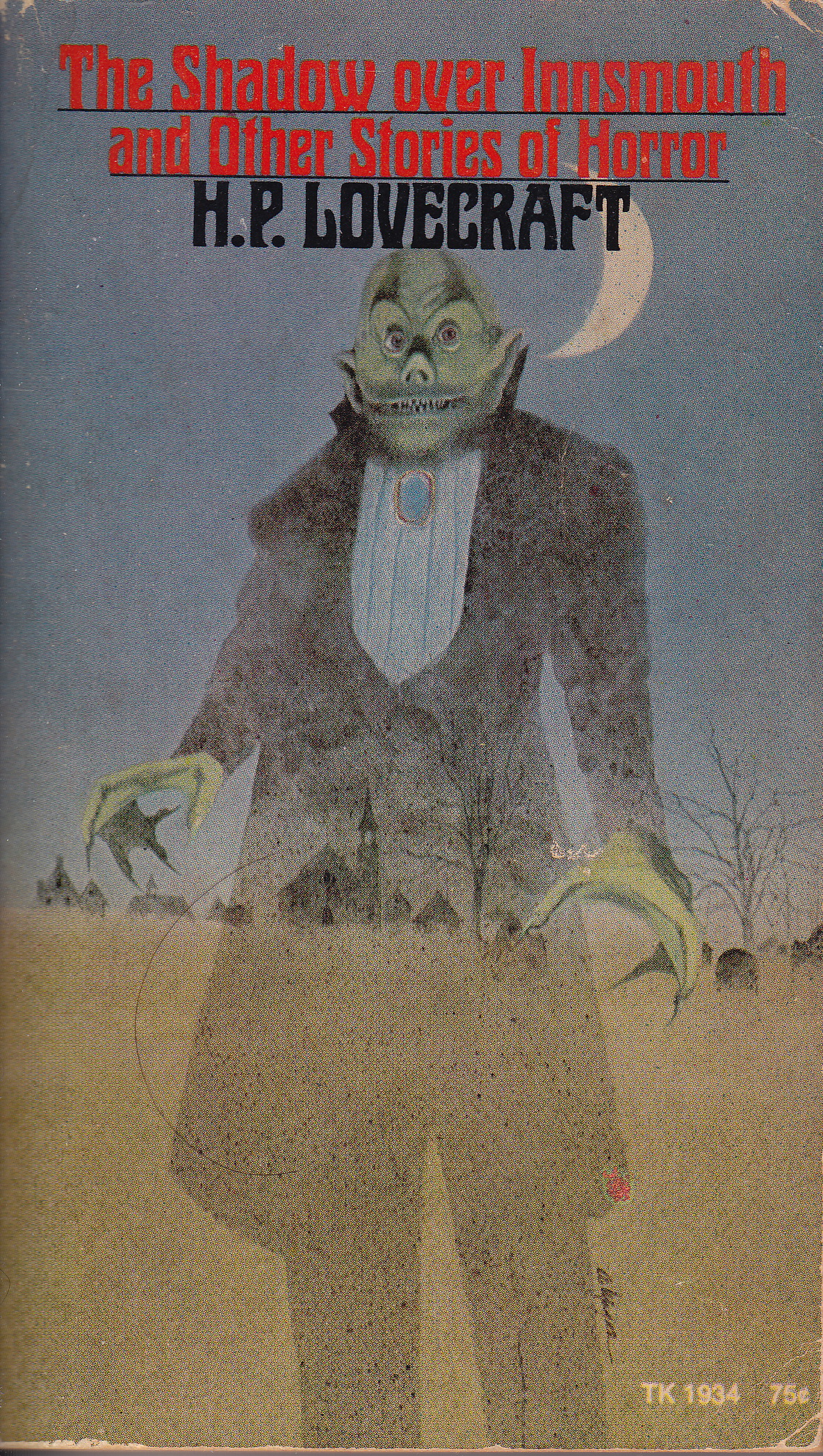
Cthulhu has taken over the world, thanks to the internet. I wonder what H. P. Lovecraft thinks as he lies dead, but dreaming under the loam of Providence. A lifetime of struggle to gain recognition as a writer left him without much of a following, relegated to pulp magazines for low brow and Innsmouth-dwelling mentalities. Now everywhere from Davy Jones’ face in Pirates of the Caribbean to car bumpers in any parking lot, Cthulhu has awakened. My wife sent me a photo of a couple of such bumper-stickers recently: “Arkham’s Razor,” reads one, “The Simplest Explanation Tends to Be Cthulhu.” “Nyarlathotep is my co-pilot” reads another. I first discovered H. P. Lovecraft through bumper-stickers.

Lovecraft

Back in my post-graduate days in Edinburgh, I had decided to write my dissertation on Dagon. This seemed a reasonable topic as no serious, book-length treatments of this elusive, Mesopotamian deity existed. My advisors talked me out of it, however, noting that material on Dagon was so scarce that it would be extremely difficult to scrape enough together to call it a dissertation. A few years later, it turns out, an academic book on Dagon finally appeared, but the fact remains that he was, and is, a major deity who somehow mostly disappeared from the ancient records—the victim of chance finds and perhaps more aggressive gods. For my birthday one year my wife bought me a bumper-sticker with a “Jesus fish” that had the word “Dagon” inside. I posted it on my office door in Oshkosh and the department chair asked me what the tentacles were meant to represent. An web search indicated that the Dagon was not the biblical “fish god” but the Lovecraft reincarnation. I had experienced an epiphany.

Lovecraft, although an atheist, knew his Bible. I once wrote a scholarly article on the Dagon story in 1 Samuel 5 where the Philistine statue of Dagon falls down, decapitated, before the captured ark of Yahweh. This is the sole narrative involving Dagon in the Bible, and it concludes by saying only Dagon’s “fishy part” was left intact. Lovecraft took this obscure Bible story and built an entire mythos from one of its characters. Cthulhu, Dagon, Nyarlathotep, Shub-Niggurath, and their companions have risen from the deep, and encircled the world in an electronic web. The fact that kids who’ve never read Lovecraft can identify Cthulhu at a glance, attests to his power. Even Batman fans who cite Arkham without knowing that it was originally Lovecraft’s creation keep the master alive beyond the grave. Isn’t that what resurrection is really all about? Even if a writer has to be discovered through bumper-stickers.


God has Left the Theater

When teaching religion at the University of Wisconsin Oshkosh, I realized that an effective way to engage students was through popular culture. I could assign them just about any choice of movie and have them look for the religious themes of whatever class in it for a short paper. Of course, most went for the low-hanging fruit, over my teaching years, and I eventually had to ban movies with obvious religious themes or premises. One of those movies was Bruce Almighty. In a fit of nostalgia, I recently rewatched it. Never a big Jim Carrie fan, I nevertheless always enjoyed Bruce Almighty—it was such an improvement over those truly dreadful Oh, God! movies that were so popular in the late 70’s and early 80’s. I never found George Burns funny, and he made for an awfully feeble God. Everyone was buzzing in the new millennium when God was portrayed by a black man, Morgan Freeman. Still, we await a director who dares cast a female God. Patriarchy runs deep.

BruceAlmighty

One of the features that movies portraying God run up against is showing a believable omnipotence. The powers granted to mortals always seem so petty. Theodicy is always raised in these kinds of movies—why people suffer if God is good and all powerful—and since movies rely on directors and writers rather than theologians, they often leave the answer at the doorstep of free will. Human suffering is our own fault. In our society we can’t have a movie that actually pins the blame back on the divine, because that wouldn’t be funny. And movies where people meet God are almost always comedies. But Bruce Almighty is actually a bit more sophisticated than it seems at first. That is best seen in the outtakes perhaps, where Morgan Freeman seems to care more about people than George Burns did. Of course, my memory on the older movies is hazy. They were considered slightly blasphemous three-and-a-half decades ago. Today they seem tame.

OhGod

Why do movies with God in the cast rake it in at the box office? A couple of reasons suggest themselves. As humans, we like to place ourselves in the role of the divine to consider what we would do with unlimited power. Who wouldn’t, like Bruce Nolan, at least include their own satisfaction in the package? I think, however, there is a deeper, more serious reason. We do genuinely wonder about God’s motivation. Most of us don’t have the training to know how to grapple with the often incomprehensible arguments that theologians make. Even when we do, they still make no sense. Our movie gods appeal to us because they are so terribly Freudian—made in the human image. We can’t conceive of a god who’s not like us, so we at least make the situation funny. If we can’t achieve omnipotence, at least we can hope for a few laughs.


Religious Aliens

While surveying books purchased as texts in religion courses (something that an editor sometimes does), I came across a book called Interdimensional Universe by Philip Imbrogno. As I’ve often suggested on this blog, the study of the paranormal is related in people’s minds with the study of religion. I suspect a large part of it is because both deal with matters that go beyond mundane, daily experience. Indeed, the tiresome caricature of those interested in the paranormal is that they are individuals dissatisfied with their lives who project their disappointments into bizarre beings or situations to make up for the emptiness. Sometimes the same thing is said of those who are religious. What is really lacking in both fields, it seems to me, is people with strong critical thinking skills who remain open minded. There are serious scholars who study the paranormal—not many of them—and it is clear from the market-informed choices that Hollywood makes, people are intensely interested. So I decided to read Interdimensional Universe.

On the bus, however, I fidgeted to find ways to hide the cover and contents of the book. I don’t want some urban, Manhattan sophisticate seeing the letters U-F-O in my reading material. Still, like most honest, open-minded people, I have to admit curiosity. After a couple of chapters Imbrogno’s work appeared to be a standard UFO book. Then it started to get weird when he suggested that angels and jinn are, like aliens, interdimensional beings. He went from citing declassified Air Force and FBI documents to quoting the Bible. And not just quoting. He assumed the historicity of biblical accounts that scholars have extensively exegeted (oh, that word!) and demonstrated to have more plausible explanations. For the jinn he draws extensively on Islamic lore, believing that they are responsible for much of the trouble in the world, tricksters like the Marvel Universe’s Loki.

I put the book down disappointed. I still consider myself open minded. I admit to not knowing what is really going on with paranormal phenomena. If the number of reports alone are anything to go on much of the human race is either insane or is seeing some unusual things. The subject requires some real academic consideration. When self-proclaimed experts, however, veer into mythology to start explaining the unknown, we are getting no closer to finding the truth that, as Fox Mulder assures us, is out there. At the University of Wisconsin Oshkosh I taught a course entitled Myth and Mystery. It was some of the most fun I had in the classroom. It was also one of the most difficult classes for which I’d ever had to prepare. Is there intelligent life in outer space? I don’t see why not—the universe is awfully big to rule it out categorically. Are there jinn literally lurking in the closet? For that I’m afraid for that there is a much more prosaic answer.


Do Unto Others

Having just finished my first week as Religion Editor at Routledge, I have learned many things. The lengthy commute into New York City is filled with many lessons along the way and working for a publisher of some distinction is a privilege. My working life began with the work of a common laborer at 14. Conditions weren’t bad although the work was hard—we have laws to protect minors against exploitation. Funnily, after people reach a certain age exploitation is freely allowed, as long as someone benefits from it (not the one doing the labor). Being from a working class family, I gravitated towards dirty jobs. My college career was supported by many long hours in the dishroom, washing the cups and plates sent back by kids whose parents could foot their bill. I didn’t complain—physical work has always been relaxing to me. Mind work is much harder.

The majority of my adult life has been whiled away under the Damoclesian stare of religious institutions or individuals. Christians don’t make good bosses. My years at Nashotah House felt like some combination of Alcatraz and Bedlam. Under the authority of the religious I was taught to quake and fear. After over a dozen years of this, released into an empty academic void, I found a job with a Christian publisher who once again lived to dominate. I try hard to believe it is not inherent in religion itself, but often those who wish to bend others to their whim have some sacred sanction. For a brief respite I had a wonderful experience at the University of Wisconsin Oshkosh. My boss was secular and very caring. The same applied at Rutgers University. When Gorgias Press tired of my efforts, the secular academy came to my rescue.

Routledge once again reinforces that paradigm. For the first time in my professional life I feel that I am truly valued. As a rule, adjuncts are like Kleenex—there when you need them, but disposable after used. The university people were kind but could offer little. Now I am accepted among the secular and the little knowledge I’ve gained over the decades is appreciated. The scars, however, still show. The fear of long years of subservience are not easily dismissed. It is my hope that some day they may become effaced enough that the terrors wielded by the religious might be only nightmares recalled vaguely in the full light of day. If such deliverance comes it will have been because of my non-religious bosses. Such a parable should teach us about what religion has become in this “Christian country.”

No mean city.


Religion Al Dente

I first learned of the Flying Spaghetti Monster while teaching a course on the Bible and Current Events a number of years ago at the University of Wisconsin Oshkosh. Being freed from the confines of my humorless seminary teaching post, I was free to explore innovative ways to approach my subject matter. When discussing evolution, it was helpful to bring in Pastafarianism as an example of how some highly intelligent—and very creative—people deal with the ridiculousness of Creationism. Lest I be accused of unfairness here, Pastafarianism is also ridiculous. That is precisely the point. The Church of the Flying Spaghetti Monster (FSM) was formed to demonstrate that any inane idea might pass as a religion and should be given equal time with those who use ultra-conservative views on the Bible to effect public policy.

A friend sent me a link to a BBC story of an Austrian man who has finally been successful in his attempt to wear a pasta-strainer on his head in his driver’s license photo. Claiming the headgear to be demanded by the Flying Spaghetti Monster, Niko Alm wished to have his official ID photo taken with the symbol of his faith. I sense an evolution taking place here. The Church of FSM has gone mainstream in many respects; there is a Bible available, you can buy a bumper-magnet to rival a Jesus fish, adherents have designed a slick website, and it boasts many, many followers. While the website of the Church of FSM defiantly refuses to be taken seriously, it makes legitimate claims—religions do not require literal belief, and therefore Pastafarianism is a true religion with believers not being held to any particular doctrine.

The outcry against the FSM movement (which began roughly early in the new millennium) demonstrates its effectiveness. Are there really people who believe this religion? A tour of the website should be proof enough. The claims made by the group have analogues in traditional religion; many major religions teach events and doctrines that are equally unbelievable in the confines of the physical world in which we find ourselves. It is difficult to believe that Niko Alm actually takes this seriously, but who are we to judge? The FSM has moved from making fun of Intelligent Design to casting the very definition of religious belief into sharp relief. Who’s to say we haven’t all been touched by his noodly appendage?

Touched by his Noodly Appendage


Ipse Dixit Dragon

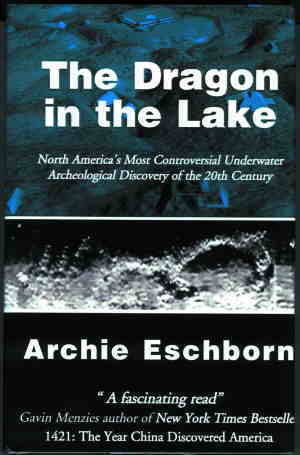
Confession time: I have little patience for scholars who have already made up their minds before examining the evidence. Anyone who has put themselves through the ordeal of reading my academic publications will know that I do not advocate sloppy research or slipshod thinking. Nevertheless, if we are to be honest about our world, we must follow the evidence. It is for this reason that I sometimes read unconventional material. I am well aware that untrained amateurs sometimes misinterpret what they see (so do trained professionals), but when evidence exists, why deny it? I just finished reading Archie Eschborn’s The Dragon in the Lake. Chalk this up to my having lived for many years in southern Wisconsin, and maybe a touch of nostalgia. I first learned of Eschborn’s book while teaching for a year in the Anthropology and Religion Department at the University of Wisconsin, Oshkosh. The chair of the Anthropology Department had me in his office one day and showed me this book by a “crackpot” amateur underwater explorer who really believed the claims that Rock Lake – between Madison and Milwaukee – actually housed underwater Native American structures.

I visited Rock Lake during my years in Wisconsin, along with the nearby prehistoric site of Aztalan State Park. There is no doubt that Aztalan was a major settlement of Native American mound builders. The structures there, while not quite rivaling Cahokia in southern Illinois, are quite impressive. Aztalan is three miles east of Rock Lake. Rumors of “pyramids” in Rock Lake have circulated for many, many years. The lake, however, is clouded with marine growth and sediment, and although there are undoubtedly underwater features the official line is that they are glacial artifacts rather than human constructions. Eschborn’s book is an attempt to demonstrate the artificial nature of these features. At his own expense and effort, the author built up a small research society, purchased a boat, and spent several early springs and late falls (when the water is clearest) sending divers and sonar scanners into the water to document what is there. While the book was self-published (and could have used some professional editorial attention) it nevertheless lays out solid evidence that Rock Lake does house a mystery worthy of exploration.

While I can’t accept all of Eschborn’s conclusions, I would insist that his evidence demands the attention of those who deny it is even worth investigation. This is less a struggle of evidence versus absence of evidence than it is a struggle against academic arrogance: professionals know better and need not be bothered with evidence. I have personally witnessed this in my own field many, many times. It is what Eschborn calls “ipsi dicit” [sic]; ipse dixit, “he himself said it,” is the assumption that a well-respected authority may be accepted as uttering the truth in principle, based on reputation. Many professionals in this country make their living based on this faulty premise. Eschborn died prematurely shortly after his book was published, before he could launch the next phase of his investigations. While his interpretation of the data may reach too far, the world suffers for the loss of a truly open mind, and the establishment ruling, as usual, still stands.


Delicate Matters of Faith

Friday’s New Jersey Star-Ledger ran an op-ed piece by Phyllis Zagano entitled “Teaching how, not what, to think.” The essay concerns a tale of two professors, one at the University of Illinois and one at Seton Hall. Both have come under fire for teaching on the issue of gay marriage, one from, one against, a Catholic viewpoint. Zagano’s point of view, evident from her title, is that professors should teach students how to think, but not what to think.

This is one of the most difficult aspects of teaching religious studies. I am in my eighteenth year of teaching in the field. In that time I have taught at both religious and secular schools and, in both settings, presented the material objectively. There are those in both settings who complain. Students at Nashotah House frequently wanted me to bend the Bible to fit conservative Anglo-Catholic teaching. Under immense logical pressure to accept what reason told them of the world, they wanted an authoritative book to back them up in a pre-decided outlook. A theological ace of spades to trump the uncomfortable conclusions of rationality. At the University of Wisconsin Oshkosh and at Rutgers University students frequently want to know my religious outlook so that they might know how to categorize what they are learning: is it sanctioned or is it anathematized? We need to know who you are so we can evaluate your authority in such delicate matters as faith.

I frequently ponder the issues raised by Zagano. I know of no other field of study where the stakes are so high, with the possible exception of political science. Religion is an all-encompassing phenomenon. All of life must conform to religious teaching, often with eternal consequences. It therefore makes an enormous difference what you are being taught. Like Zagano, I try to teach students to think for themselves. Both at the seminary and university I refused to reveal my personal outlook on the issues; I try to kick-start the thinking process. I have paid the price for this in the past, but it is a non-negotiable component of education. If the truth is uncomfortable, it is always possible to let someone else do the thinking for you.