
While poking around the internet last night to take my mind off the heat and humidity surrounding me, I stumbled across an article entitled “The Religious Struggle over Cryptozoology” on a site called Science and Religion Today. The piece was written by Joe Laycock, a doctoral candidate at one of my alma maters, Boston University. Having just finished Bruce Hood’s Supersense, there was a pleasing euphony in the coincidence. Cryptozoology is the study of unknown animals, and is not necessarily based on the supernatural (although it may fall within Hood’s definition of it). Laycock notes that two religious elements in society have latched onto this study: New Agers and Creationists. Creationists, it seems, see in certain cryptids, such as the Loch Ness Monster, hold-overs from the Mesolithic Era that prove the Mesolithic Era never existed. God can still make dinosaurs today, therefore the Bible (which doesn’t mention dinosaurs at all) must be true.
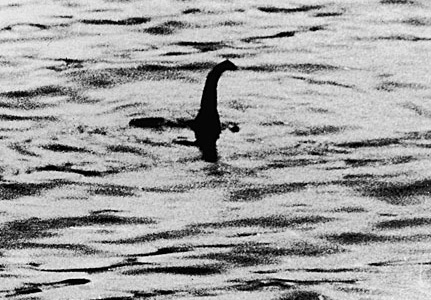
The draw of the unknown
One of the most welcome parts of Hood’s thesis was its consonance with Stephen Asma’s On Monsters, a book I’ve posted on before. Both authors explore how the human psyche reacts against what it perceives to be “strange mixes,” beings that cross-over between readily defined categories. Hood addresses this by tackling the concept of “essence” while Asma notes a dread accompanied by a sense of wonder. Hood demonstrates that from a scientific point of view, there is no such thing as the “essence” of a person, object, or living thing. Such ideas are the cling-ons from the era of souls and radically distinct species and genders. Closer observation has taught us that many such things are more of a continuum than a series of sharply defined types. Religions prefer to have fixed categories. Religious ethics often depend on them.
Laycock suggests that both New Ageism and Creationism “can be read as a religious response to the cultural authority of science.” Religions fear that which can be empirically demonstrated since it throws the god-of-the-gaps into the dryer and he comes out smaller each time. This is so, despite the fact that Creationists crave scientific respectability. While teaching my course on Myth and Mystery at the University of Wisconsin Oshkosh, I dwelt on cryptids for a few sessions. They are indeed often surrounded with a religious mystique. I wouldn’t necessarily dismiss the possibility of undiscovered species, many new ones are described by science every year. Nor would I say that they are supernatural. Nature has ways of surprising us still, and as Asma clearly demonstrates, we still have a need for monsters.
 Steve A. Wiggins