Classic Fiction

The Epic of Gilgamesh is one of the ancient documents still widely recognized, at least by name. Many introductions to literature, or the western canon, refer to it. It is, in some senses of the phrase, the world’s first classic. I’ve read Gilgamesh enough times not to know how many times it’s been. During my doctoral days I was focusing on the literature of neighboring Syria (long before it was called “Syria”). As an aside, Syria seems to have gotten its name from the fact that non-semitic visitors had trouble saying “Assyria” (which was the empire that ruled Syria at the time). Leaving off the initial vowel (which was actually a consonant in Semitic languages) they gave us the name of a country that never existed. In as far as Syria was a “country” it was known as “Aram” by the locals. Back to the topic at hand:

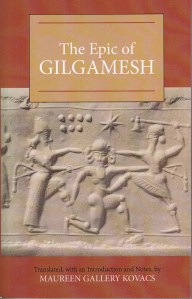
Although the story of Gilgamesh may be timeless, translations continue to appear. It won’t surprise my regular readers that I’m a few behind. I finally got around to Maureen Gallery Kovacs’ translation, titled simply The Epic of Gilgamesh. Updating myself where matters stood in the late 1980s, it was nevertheless good to come back to the tale. For those of you whose Lit 101 could use a little refreshing, Gilgamesh was a Mesopotamian king who oppressed his people. (And this was well before 2017.) The gods sent a wild man named Enkidu as a kind of distraction from his naughty behaviors. In an early example of a bromance, the two go off to kill monsters together, bonding as only heroes can. They do, however, offend the gods since hubris seems to be the lot of human rulers, and Enkidu must die. Forlorn about seeing a maggot fall out of his dead friend’s nose, Gilgamesh goes to find the survivor of the flood, Utnapishtim, to find out how to live forever. He learns he can’t and the epic concludes with a sadder but wiser king.

The fear of death is ancient and is perhaps the greatest curse of consciousness. When people sat down to start writing, one of the first topics they addressed was precisely this. Gilgamesh is still missing some bits (that may have improved since the last millennium, of course) but enough remains to see that it was and is a story that means something to mere mortals. Ancient stories, as we discovered beginning the century before mine, had long been addressing the existential crises of being human. Thus it was, and so it remains. No wonder Gilgamesh is called the first classic. If only all rulers would seek the truth so ardently.

Ham’s Ark

Noah and his ark have been in the news quite a bit over the past several months. A friend recently shared a story on American News X about Ken Ham’s Ark Encounter, soon to open in Kentucky. It may be open already, but I haven’t been down yonder lately. I’m not going to attempt to match the well-deserved snark of Thomas Clay’s article, but I did find the design of Ham’s ark worthy of comment. I’m afraid I’ll have to wait while you check the article since photographs are covered by copyright and, well, I haven’t been down yonder. What first strikes me about Ham’s ark is that it has a rudder (as well as a keel). The Bible does imply that this was the first boat built, but then it also states the plans, like the Bible itself, came directly from God. The Almighty surely understands fluid dynamics, but I was wondering what the rudder was for. Did Noah plan on going someplace? Presumably in his flat world he’d have wanted to just stay afloat over the same place since, to quote another scripture, “there’s no place like home.”

Genesis doesn’t say anything about a rudder. In fact, apart from the inexact measurements in cubits, all we know about the ark are the following features:

•its dimensions (300 cubits by 50 cubits by 50 cubits; RMS Titanic, by comparison, was approximately 548.5 cubits long)
•it had three decks
•it had a door
•it had a window.

The Ham-style ark design is based on that advocated by Sun Pictures some years back as being especially seaworthy. Nobody knows what gopher wood is, but there was plenty of it around since all the plants were considered expendable in the face of a flood that would kill everything. But a rudder?

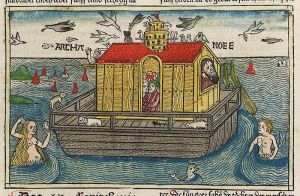
The biblical ark took its cue, somehow, from the much older tale of Utnapishtim. There are even earlier versions than that in the Gilgamesh Epic, but the parallels between Gilgamesh and Genesis have been known for well over a century now and are pretty remarkable. The original ark, however, was a cube. It had six decks. Now a cube of wood—even gopher wood—would sink like, well, a cube of gopher wood. Such a ship wouldn’t require a rudder to help it find the bottom of the New World Ocean.

Before my academic career took a tumble I was slated to write a book on Noah. Too bad that never happened, what with all the interest these days. A cottage industry in making arks has been launched. As modern-day arks sail, or at least get towed, through the present-day oceans, or are built high on dry ground, we can be glad for a rudder in the prescient mind of the sender of all floods.

Photo credit: Centre for Research Collections University of Edinburgh, via Wikimedia Commons

Photo credit: Centre for Research Collections University of Edinburgh, via Wikimedia Commons


Floods and Fairytales

Never mind that the Bible gives only a cursory description of “Noah’s ark.” Never mind that the story in Genesis is clearly derivative from Mesopotamian originals such as the epics of Ziusudra, Atrahasis, and Gilgamesh (the Utnapishtim version). Never mind that all species of animals cannot survive within a single, extremely limited biosphere without evolving afterward into the diversity that the world currently hosts, even counting extinctions. Never mind that not enough water exists (with apologies to Kevin Costner) to cover all landforms without every mountain being pounded flat and stacked neatly on top of the ocean floor. In short, never mind reality—people will continue to build replicas of Noah’s ark. As a literary trope the ark has proved invaluable; many of my posts demonstrate how it appears and reappears in books and movies as a symbol of human irresponsibility. And yet, in order to demonstrate the veracity of an ancient myth, we continue to build fundamentalist arks.

Yesterday my wife pointed me to a msnbc story of an ark being built—and sailed—in the Netherlands. Certainly those in the “low countries” have global warming to deal with more immediately that those on higher (geologically, not morally, speaking) ground, and the engineer of this particular ark does not strike the viewer as a rabid literalist (he is a little too unkempt for that, and his shirt is not white and he wears no tie). John Huibers, however, worries about a more localized flood in the Netherlands. The ark may be overkill since polar bears, koala bears and panda bears are rare in Amsterdam, at least when one is not medicated. Arks, however, make great tourist attractions.

In Hong Kong the Kwok brothers built an ark replica in 2009. Greenpeace has one in Istanbul. A Christian theme-park featuring a full-size ark is under development in Kentucky, and just two years ago I drove past a roadside ark being built in Maryland. Most of these arks, interestingly, follow the design in the Sun Pictures’ production In Search of Noah’s Ark rather than the more traditional, mythic design in my children’s Bible. It is a natural human tendency to mistake form for substance. The story of Noah is a cautionary tale that has taken on daunting real-life implications in our treatment of our planet. Water is the signature of life, but for us land-dwellers too much is not a good thing. Thankfully, should a flood come, there will soon be enough arks around the world that would-be Noahs may find themselves in a buyers’ market.

Still my favorite ark