Old Vampyr

Early movies are fascinating.  I learned of Vampyr, a 1932 production by Carl Theodor Dreyer, from Raymond T. McNally and Radu Florescu’s In Search of Dracula, where they praise it.  I’d never heard of it before.  There are probably a few reasons for that.  One is the movie was considered not very good when it was released, and it never garnered much of a reputation.  Another is that the original prints, including the soundtrack, had been lost.  Three language versions had been shot—German, French, and English.  Since this would obviously lead to lip-syncing problems, there is very little dialogue.  The movie as it exists today is accessible in the German version, and it tends to fall into that category that includes work by directors such as Ingmar Bergman and Stanley Kubrick.  It has art house elements and the story requires some pondering.  It isn’t bad, although in today’s viewing culture, it might seem dull.
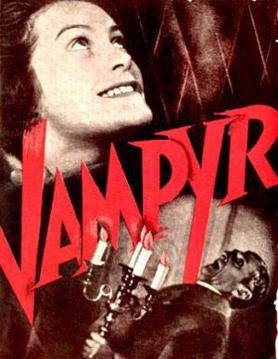
It is a vampire story based on the works of Sheridan La Fanu.  The star, and also financier of the movie, was an actual Baron from France (in real life), Baron Nicolas de Gunzburg.  He plays a student of the occult who happens upon a gentry-class family plagued by a vampire.  Interestingly enough, this kind of character is distinctly Lovecraftian, and there is a passing resemblance between de Gunzburg and H. P.  The acting isn’t great, but the story is good.  It includes shadow people who assist the vampire—a female, in this case—and a kind of mad doctor who helps her reach her victims.  The occultist and the household servant of the gentry family locate the vampire’s grave and stake her.  And in a scene that may have inspired Witness, they suffocate the mad doctor in the bin of a flour mill.

Like many vintage movies, Vampyr has received a more positive reevaluation over time.  While some consider it great, the consensus seems to be more at the “very good” level.  It is an early vampire movie, apparently filmed before Tod Browning’s Dracula.  While not scary by today’s standards, there are some definitely creepy scenes.  Particularly when the elder daughter of the gentry family begins to become a vampire, leading to some quite effective facial expressions.  McNally and Florescu weren’t film critics by any stretch but they felt that, up to the early seventies, this was the best vampire movie made.  I might not go all the way with them, but I would suggest it is certainly worth viewing by those who like old cinema, and who appreciate vampire stories.
Black History

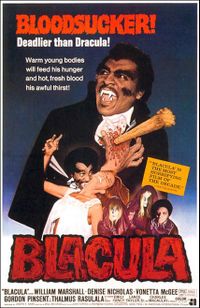
The first of the “blaxploitation” movies, Blacula is a period piece.  In 1972 vampires were still all the rage, following from Dark Shadows and the continuing Hammer hammering of the monster.  They even produced Dracula AD 1972, not to put too fine a point on it.  American International Pictures wanted in on the action and produced the first Black vampire in cinematic history.  Rather than a remake of Bram Stoker’s novel with a Black cast, the story begins with Mamuwalde, an African prince, entreating Dracula (whom he doesn’t know is a vampire) for help ending slavery.  Instead, Dracula turns Mamuwalde into a vampire that he names “Blacula,” and places him under a curse.  In the seventies, a homosexual couple purchases Dracula’s castle, intending to sell the contents on the antique market.  One of those antiques is a locked coffin.

Once he’s freed in America, Blacula quickly runs into Tina Williams, the spitting image of his long-deceased wife.  Meanwhile Tina’s friend Dr. Gordon Thomas, suspects that there is a vampire on the loose in LA.  Although the opportunity for camp is clearly present, this movie is played straight.  Mamuwalde is a monster—he kills several people—but his real motivation is to regain his dead wife, whom, he is convinced, is Tina.  When Tina is shot by a trigger-happy cop in the tunnels below a chemical plant, Blacula turns her into a vampire.  When she is staked, Mamuwalde tells the doctor that he need no longer pursue him.  He voluntarily climbs into the sunlight and dies.

Now, this wasn’t a great movie but it does seem to have a reasonable bit of social commentary.  It was the seventies, but racial and orientation slurs were still widely accepted.  And people dressed like, well, it was the seventies.  The Black characters, however, are portrayed with dignity, and Mamuwalde is presented as nobility.  Perhaps more importantly, this movie opened the doors for further horror films featuring African-American lead characters and plots.  A few decades later Blade, based on a comic book hero, would once again foreground a Black vampire who’s on the side of good.  It’s still some distance from Black Panther, but the process had to begin somewhere.  Watching Blacula was like watching history, and I suppose viewing movies is like a selective piece of history.  By this point AIP was well established, and influential in its own way.  I’d heard about Blacula since childhood, but until streaming it never really came across my screen.  Nevertheless it remains an important piece in this country’s ongoing vampire mania.


Light Shadows

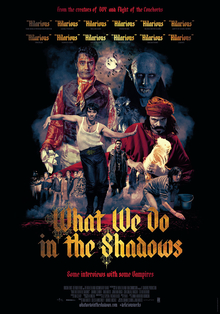
I often do things backwards.  It’s not really intentional.  You see, I’m busy with my day job and something most people may not realize is that researching and writing are also a full-time job.  Only they don’t pay well, unless you’re a professor.  In any case, I find out about things in odd ways.  A friend got me watching What We Do in the Shadows, the current FX television show.  I then realized it was based on a movie so I decided I should see that before going any further.  The movie is funny, but the television show develops some of the same bits so really, it is best to see the movie first.  It turns out that while I’ve been busy working, and writing books on other types of horror movies, this franchise has been developing.  So what’s it about?  Vampires unliving together.

One of the contradictions about vampires, as the undead, is that they live by certain rules that make them distinct.  Going back to Bram Stoker’s Dracula, they don’t always live alone.  In fact, three female vampires live in Castle Dracula (although the Count moves to England without them).  What We Do in the Shadows is based on the premise of vampire roommates in contemporary housing.  How would they get along as roommates?  Many of us have experienced roommates and we know the kinds of conflicts that normally arise.  Would the undead have some other complications?  In case you haven’t gathered so already, this is comedy.  There are a few vampire chase scenes and a hilarious interaction with werewolves, all filmed as a mockumentary.  It’s pretty funny stuff.

There’s nothing too serious here, but there is bloodshed, of course.  And the developing of different characters for the undead and putting them together in one house does lead to all kinds of situations, some of them adult.  The television show is binge-worthy, if you’ve got the time and if you like vampires.  If you want to start from the beginning, the movie sets the premise well.  Vampires are so well established culturally that there’s plenty of room to fly.  Comedy horror has really come into its own.  Vampires have been culturally ascendant for quite some time now.  They are yet another thing I was fascinated by as a child that later became cool.  I wrote one of my senior term papers on vampires in high school, before college convinced me such things were puerile.  Now I’m finding that the culture has gone after them.  As I say, sometimes I do things backwards, even on a large scale.  


Old Dracula

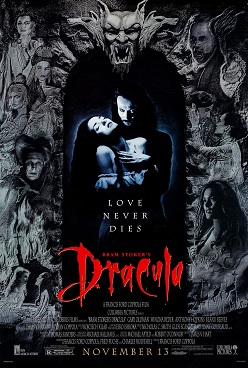
Francis Ford Coppola’s Bram Stoker’s Dracula is one of the “old movies” about which I posted some time back.  I’ve seen it at least a couple of times, and I wrote a previous blog post about it (October 11 2009).  This is a film about which I have conflicted feelings.  It has immense visual appeal and it influenced a tremendous number of followers.  It also did exceptionally well at the box office.  Since 1992 was a year in which I’m pretty sure I saw no movies in the theater (finishing a doctorate, moving back to America, and commuting weekly from Champaign-Urbana to Nashotah House drained my time and energy.  Besides, still being fairly newly married, I had not transitioned to horror movies again (that’s a different story, also involving Nashotah).)  Being a former literalist, when I first saw it I resisted the title since it takes significant liberties with Stoker, but the overall story is probably the closest of any vampire movie I’ve seen.

The strengths of the movie include its interaction with religion.  Vlad begins by renouncing God and becoming an agent of evil, stabbing a cross, and drinking the literal blood that pours out.  A number of Stoker’s own religious elements are also portrayed, and the ending brings God back into the picture, implying a kind of redemption for the defeated vampire.  The stylishness and opulence of the movie also make for engaging viewing.  It doesn’t have the gothic feel that it might—there seem to be some almost Burtonesque elements to it and some of the casting decisions feel ill fitting.  Anthony Hopkins just doesn’t do it for me as Van Helsing.  His one-liners feel out of place, and his interpretation of Van Helsing as a whole doesn’t resonate with me.

I do like Gary Oldman’s Dracula, however.  He’s right up there with Lugosi (but not quite at that level).  The conflicted vampire is an appealing character—much more intriguing than the pure evil kind.  This Dracula forsakes God because church rules about suicide keep his Elisabeta out of Heaven.  Even now the rulings seem not to allow for much nuance.  At heart, the vampire is a religious monster.  Fear of the crucifix may go back to Bram Stoker, but this movie tries to give it a backstory.  It’s a question of theodicy—why bad things happen to good people, essentially.  This is probably the biggest reason people end up turning away from religion, and it’s something theologians ponder.  While it isn’t my favorite vampire movie, Bram Stoker’s Dracula is stylish and accurate to a degree.  But it also turns back the pages a bit further than Stoker’s book does.


Finding Vampires

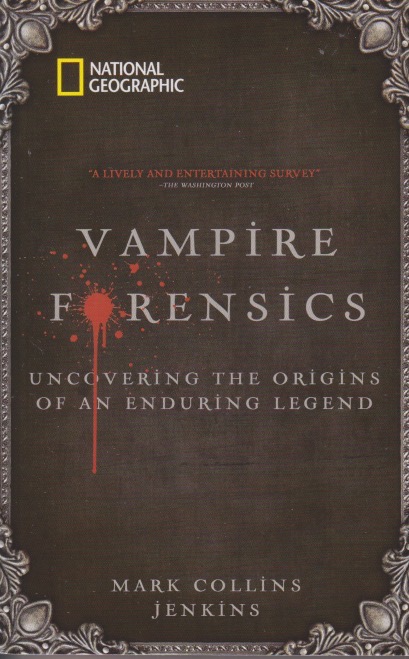
Parents always dread when their child will ask them the inevitable question: where do vampires come from?  A number of people have undertaken to answer that question, and Mark Collins Jenkins attempts it with aplomb.  Vampire Forensics: Uncovering the Origins of an Enduring Legend is quite a romp through the fields of the undead.  Ranging from the chewing dead through epidemics, Montague Summers, movies, Varney the vampire, the origin of the word “vampire,” where zombies come from, and practices of dealing with corpses, this study may not convince the reader that the mystery has been solved, but it will provide lots of information.  I’ve been pondering vampires lately, and this book ties many of these loose threads together well.  Jenkins has a talent for beginning a chapter on an apparently unrelated topic and then weaving it into the growing, ever expanding vampire tapestry.

I’ve read, many times, that vampires have ancient origins.  That really depends on how you define “vampire.”  This book explores those ancient roots, but unflinchingly points out that our modern idea of the walking dead drinking the blood of the living springs from the Balkan peninsula, largely in the eighteenth century.  This isn’t a strictly chronological study, and it isn’t limited to Europe and the lore that grew from that region between Asia Minor and Western Europe.  That doesn’t stop Jenkins from going back further in history.  It was a journey on which I learned much.  I also confess that I was nearly grossed out a time or two.  The vampire requires a stout constitution to study.  Interestingly, it seems that the word “vampire” might’ve derived from a word denoting “heretic.”  Religion and horror belong together, as I’ve said many times.

There’s always a danger with wide-ranging studies, since it’s not possible to turn a specialist’s eye toward all the cultures and historical periods under scrutiny.  Those who’ve tried it, such as James Frazer (of Golden Bough fame), come to be viewed with suspicion by later specialists.  (I discuss this in my little book on The Wicker Man, by the way.)  Jenkins does rely on Frazer a time or two.  Writing a general history on this subject almost necessitates that, however.  Even with the internet and “experts” being those who can gather the largest followings, academia has rightfully demonstrated that to get the real story you need to bury yourself with resources around a very small subject and be willing to live and breathe it for years.  Even then you might get it wrong.  But I digress.  This is a fine study of vampires and their possible origins.  It was a learning experience for me and I now have a better idea how to answer that dreaded question.


Who’s Stalking?

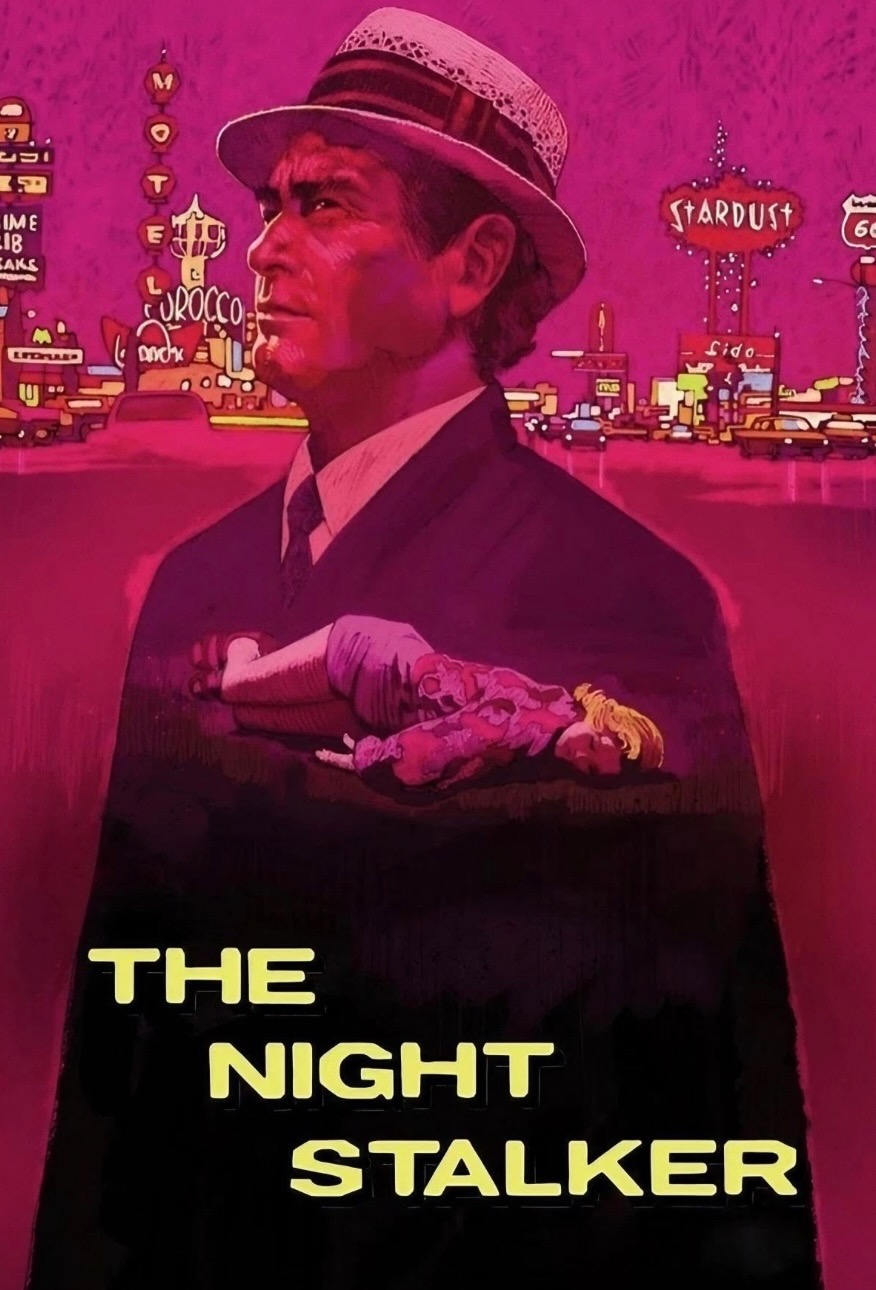
Television is a hungry beast.  Back before the internet it was probably less hungry, but still the desire for content was constant.  A few individuals worked the monster side of the tube, one of them being Dan Curtis.  Dark Shadows was Curtis’ idea, and it was in that context that he began to have an influence over my life.  I wouldn’t have recognized his name in those days, of course—do we ever really recognize those who become part of the arc of life’s direction when we’re kids?  Curtis produced a television movie that I’d never seen, taking on the vampire tale again.  The Night Stalker isn’t a great film—it was produced for television, after all—but it started something.  That something was the weekly series Kolchak: The Night Stalker.

I’ve been watching episodes of Kolchak and realized that I was missing something—the origin story.  As an historian I really like to keep things in order.  Since my research is conducted on my limited free time and limited budget, I still discover things others probably knew long ago.  In any case, I decided to hunt down and watch The Night Stalker.  It introduces, of course, the character of Kolchak.  In a way that seems unnecessary for 1972, it narrates quite a bit of vampire lore.  It even frames some scenes from Bela Lugosi’s 1931 Dracula.  As I watched this period piece for the first time, I realized that the actual night stalker wasn’t originally Kolchak.  In this movie it’s clearly Janos Skorzeny, the vampire.  The movie was based on an (at the time) unpublished novel by Jeff Rice.  And so began a number of cascading things.

I didn’t watch Kolchak as a child.  I do remember other kids talking about it, but it never made its way into our evening television watching.  (My mother was concerned that I had nightmares as a child and didn’t encourage scary things before bed.  Decades on I’m still prone to nightmares, but as I said, arcs get set early on.)  Kolchak is kind of a hapless character, rubbing people the wrong way.  The movie leaves many unanswered questions, but it was good fare for unreflective television monster purposes.  There had been monsters before—I think we all owe a great debt of gratitude to Rod Serling’s Twilight Zone—but Kolchak made the horror element, always laced with comedy, central.  The television movie received the highest ratings of any television movie to that point.  And we all know that such things lead to sequels.  Television is ever hungry.


Beautiful Vampire

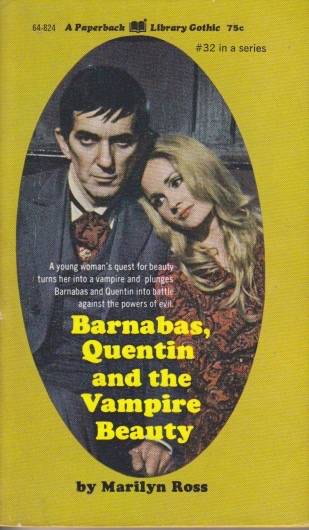
It’s been a quest years in the making.  I first found the Dark Shadows novels by Marilyn Ross at the Goodwill Store in Seneca, Pennsylvania.  The series had recently finished its television run and, as this was a used book bin, and limited in size, you could never tell what you might find.  My teenage self, fascinated by vampire lore, eagerly read those I could find.  I got rid of the volumes I had when I attended college and began to miss them when I was old enough to admit such things.  It took at least fifteen years to locate all of them, and now, for the first time in my life, I have read the entire series.  Barnabas, Quentin and the Vampire Beauty isn’t always easy to find.  I certainly hadn’t read it before.  Not that it’s high art—the campiness shows through the gothic setting from time-to-time—and yet it’s an accomplishment.

This particular story again shows some development from what had gone before.  The vampire beauty is a young woman tricked into having weight reduction surgery in Switzerland.  The surgery, naturally enough, transforms her into a vampire.  She needs help so she seeks out Barnabas Collins, which leads her to Collinwood.  From there a set of adventures head toward the typical climax of this series of books.  Nevertheless, W. E. D. Ross seems to have shown some improvement over the thirty-two novels in the series.  This story seems less similar to others in the series as a whole.  Quite a bit of effort is spent on trying to find a vampire cure, but for Adele Marriot rather that Barnabas Collins.

I have to wonder if Ross knew this would be the last Dark Shadows book he would write for the series.  He did write other gothic fiction, and even a novelization of the movie, House of Dark Shadows, but the initial series ends with a kind of knowing that we’ve reached the end of something.  Was he told by someone at Paperback Library, “Hey, we’re pulling the plug on the series” or did he simply run out of steam?  The daily television show ran for about 1225 episodes.  This original novel series had far fewer.  Still, the thrill of hunting all of them down, lining them on my shelf, and then reading them in order was a rare pleasure.  It was a recapturing of, perhaps even a completing of, part of my childhood.  It may have taken decades to accomplish, but an accomplishment is an accomplishment.


Insane Illusionist

The Dark Shadows novels supplemented my early watching of the television series.  It’s funny, but when I remember watching the show, in my mind I watched it alone.  During a conversation with one of my brothers recently, he assured me that he had watched the show too, pointing to the selectiveness of memory.  What I do know is that I was the only one who read the novels.  I bought them when I could find them used, and I kept them in an old pasteboard suitcase (we had no bookshelves and my parents didn’t read).  I didn’t have the entire collection by a long shot and I can honestly say I don’t know which ones I read back then.  I am now, however, two novels from finishing the entire series—a project I began around 2006.

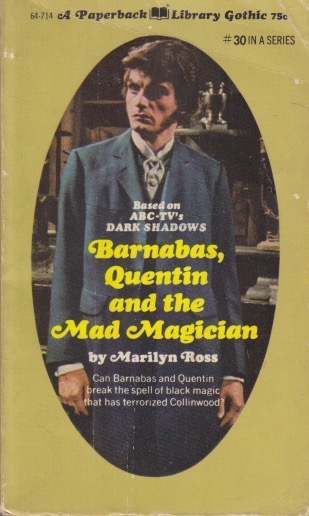
Barnabas, Quentin and the Mad Magician follows the usual formula, although this time around Barnabas is temporarily cured of his vampire curse and Quentin doesn’t turn into a werewolf at all.  They are on friendly terms and both are being set up by the rather obvious antagonist, the mad magician.  I guess you can begin to see the series winding down.  Most of the thirty-two stories are broadly similar and the writing is that rushed, breathless kind that seems characteristic of those who make a living delivering pulp fiction.  There have always been people like me who will buy it.  That’s the reason I typically use the phrase “guilty pleasure” when describing these novels.

As I note in my YouTube video on the phenomenon, Dark Shadows was quite popular in its day.  It’s what we might now call a cultural meme.  Television series, novels, two movies, comic books, lunch boxes—the whole coffin.  The monsters were likable.  That was true of some of the greats—you felt sympathetic toward them.  As horror began to “grow up” the monsters often became entirely reprehensible, with no redeeming qualities.  So as Barnabas and Quentin do their best to expose the true monster, their supernatural powers currently on hold, they have to rely on their money and connections.  Even at the end the “confession” is made suspect by the longer tacked on ending.  If you’ve read enough of these, you grow suspicious when there are ten pages left after the antagonist dies.  Stories such as this aren’t great literature, but they do fill a gap in the world of monsters that nostalgia leaves for those who knew Dark Shadows in the late sixties.


The Nature of Evidence

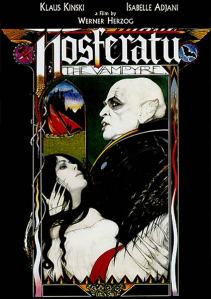
Home alone on a Friday night, I turned to Werner Herzog’s Nosferatu. Not a typical horror film, this art house production is an updating and remaking of F. W. Murnau’s technically illegal 1922 adaptation of Bram Stoker’s Dracula. It has been a few years since I’ve watched it, but the beauty of the cinematography kept coming back to me at unexpected times. Klaus Kinski is an unforgettable Count Dracula, hideous and compelling simultaneously. He draws pity and revulsion. When he’s not on camera you can’t wait for him to appear. There’s not much new in the story, of course, as it follows Murnau pretty closely, with some shots being nearly identical. One exception to this is the plague. Wherever Dracula appears the Black Death accompanies him. This leads to one of the most unusual twists of this retelling—the role of Dr. Van Helsing.

Instead of being the authority on vampires and leader of the attack, Van Helsing is here a reluctant rationalist who doesn’t accept superstition. He encourages the town elders to respond calmly to an outbreak of the plague. When Lucy Harker insists that Jonathan has been the victim of a vampire (which he has) the professor again urges caution. He insists that this must be approached scientifically, empirically. You don’t pull up wheat to see if it’s growing, he notes philosophically. Take time, trust science, and all will be well. Meanwhile the audience knows the reality of the vampire. There is a supernatural threat and it is moving fast. Lucy knows they must strike against Dracula before the vampire destroys the whole town. Despite the mounting number of deaths by plague, Van Helsing still clings to slow and steady evidence, only realizing after Lucy’s death that she had been right all along.

There’s quite a bit to unpack in this retelling after all. A female takes the lead. Lucy is the one determined to stop the vampire. She does so out of belief. Van Helsing rightly points out that this is a dangerous way to approach a problem. One ponders what might’ve happened had science been allowed to run its course. Van Helsing, if science be science, would’ve had to at last come to the same conclusion that Lucy had experientially. She’d read Jonathan’s diary and she had a late night conversation with Dracula where he did not appear in her mirror and did shy away from her crucifix. She too is evaluating evidence, only she has to allow for the reality of the supernatural. Since the story is old and the production artistic, this is no bloodbath horror spectacle. It is a thoughtful, almost quiet reflection on how we perceive reality. Even among the many vampire films it remains a thing of beauty.


Night Terrors

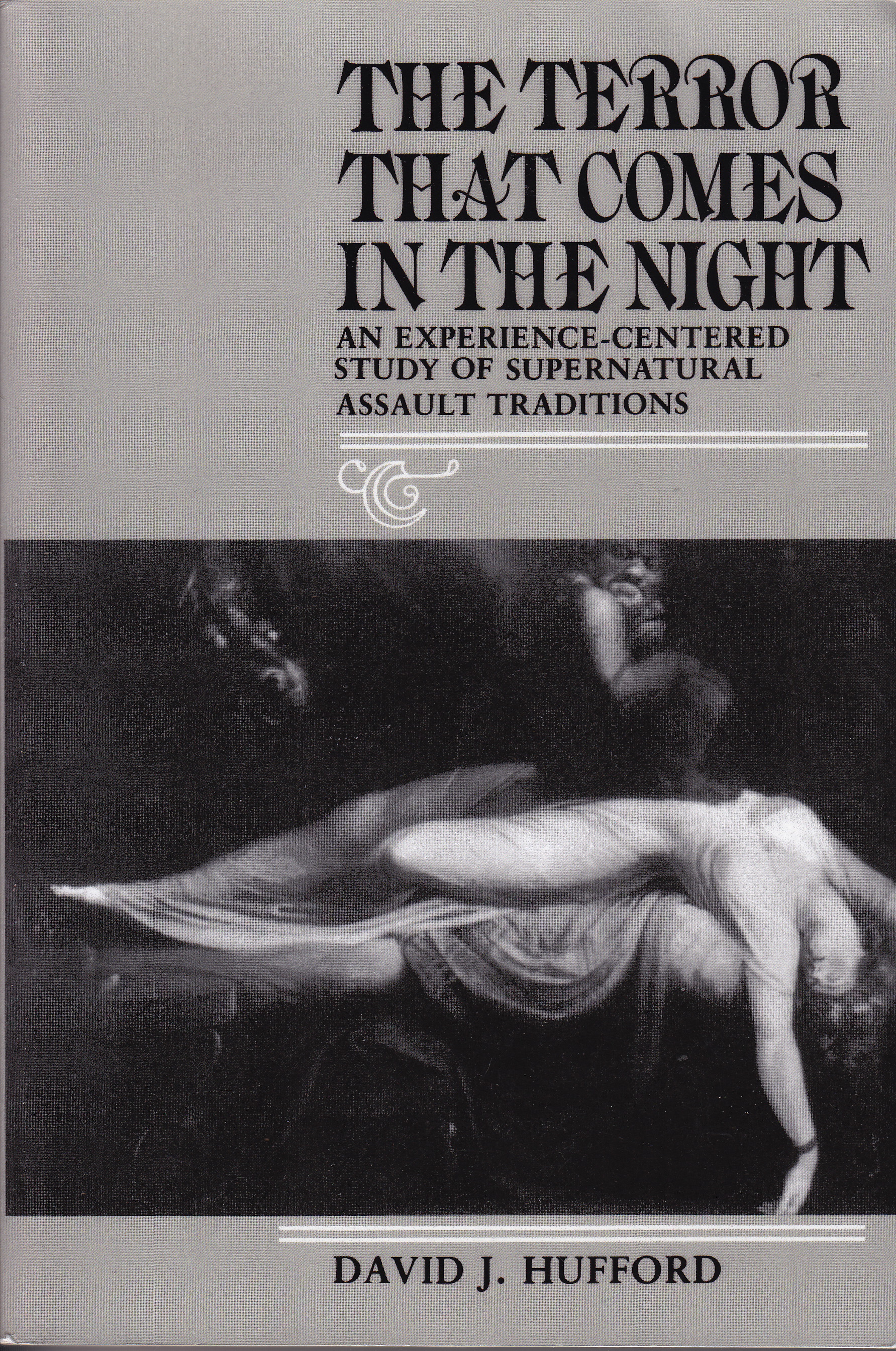
TerrorInTheNightNightmares are the stuff dreams are made of. Or maybe I’ve got that the wrong way around. Having grown up subject to frequent nightmares, I still occasionally have them. I suppose it is easy enough to assume someone who reads about monsters and watches horror films should not find this unexpected, however, I’m not sure they’re related. My nightmares visit issues that horror films avoid, and most of my monster reading is, well, academic. Surely the scientific study of nightmares has advanced since David J. Hufford’s The Terror That Comes in the Night: An Experience-Centered Study of Supernatural Assault Traditions, but it remains a very important book. As someone familiar with the phenomenon, I found Hufford’s study somewhat therapeutic, and it certainly does raise some interesting questions.

Apart from the unfortunately, inherently sexist, folk-title “the old hag,” Hufford is addressing a universal experience of people of all ages. Using his original setting in remote Newfoundland where his work began, Hufford collected tales of what might technically be called sleep paralysis with a specific hypnogogic hallucination of being attacked. A designation, he acknowledges, that is quite awkward for repeated use. Back in the early 1980’s, when the book was published, these accounts of nighttime attacks—a person waking up, or not having yet fallen asleep, sensing a presence in the room, finding her- or himself unable to move, and sometimes seeing or hearing an entity and feeling it on his or her chest—were rarely discussed. Especially in scientific literature. They seem a kind of embarrassing medievalism related to the ancient concepts of incubi and succubi, and even vampires. Having “the old hag” (a moniker relating to witches) is what the experience is known as in Newfoundland. Hufford, taking these accounts seriously, investigated what the sufferers had experienced. Unwilling to judge whether the event “actually happened,” Hufford’s scientific objectivity is truly admirable. Since the time of his book, the concept has become widely known and the argument is often made that having heard of sleep paralysis episodes feeds those with hypnogogic hallucinations the idea of a supernatural oppressor. In other words, now that we know about it, we don’t have to take it seriously.

Hufford is one of a small number of academics that is willing to engage with the supernatural on its own terms. Religion scholars do, of course, but we are generally dismissed from the starting block anyway. Most scientists disregard the possibility of anything beyond deluded brains and say nightmares are normal. Just deal with it. Those who’ve experienced the nighttime attack know that it feels very different than a garden variety nightmare. You can tell when you’re awake. Of course, we’re of the generation who’ve seen The Matrix and Inception, and we know that, at least in popular thought, reality has become negotiable. Nobody is much surprised any more by the idea of such an attack in the night. Waking nightmares have become as common as the headlines. If only more scholars would take human experience as more than just “old wives tales” we might all be surprised at how just rolling over can change everything for the better.


I’m No Legend

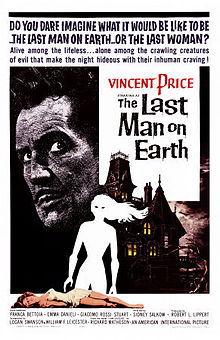
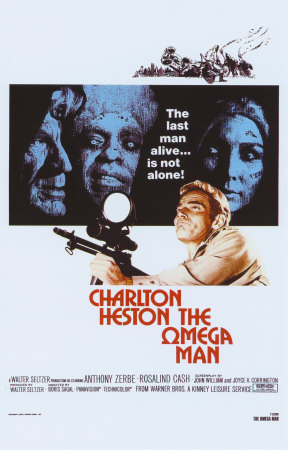
First there was The Last Man on Earth with that rare, disappointing performance by Vincent Price. Then there was The Omega Man, putting Charlton Heston into the role that fit him better than Moses. Finally, returning to the original title, I Am Legend featured Will Smith as Robert Neville. Having watched all three movies, I knew I should have read Richard Matheson’s short novel first. After all, it was a vampire story, and who doesn’t feel utterly alone once in a while? I finally decided to make an honest man of myself. It occurred to me as I started to read that I didn’t know how this story would end. All I had ever seen were cinematic treatments—and who writes anything serious about genre fiction? Still, I needed to know.

Last Man

Matheson was one of the writers who had caught Rod Serling’s attention on the Twilight Zone. Having read some of his short stories I could see why. Not knowing the ending, some of them can actually be scary. I Am Legend isn’t exactly frightening. It is, however, thought-provoking and sad. Matheson, a New Jersey native, wasn’t among the most literary of writers. Nevertheless, he conveys some deeply disturbing images of humanity in this particular novel. After all (spoiler alert!) Robert Neville is the evil one. He has been killing vampires with a cold calculation, no matter whether they are living or undead (good or bad). Who has a right to kill whom depends on your point of view.

The-Omega-Man-Poster

In I Am Legend, Matheson makes it clear that Neville, the last man alive, is an atheist. The problem, as it usually is, is theodicy. How could a god allow such a massive tragedy to strike not only himself, but the entire world? After the vampire virus had spread, Neville finds himself dragged into an evangelistic meeting by terrified survivors who had turned to religion to make sense of their tragedy. Neville escapes as quickly as he can. The movie versions tend to ignore this poignant aspect of the narrative. After all, the audience watching must sympathize with Neville or the whole draw of the movie is off. In a nation where atheists are trusted about as much as vampires, it seems that Matheson left us a parable as well as a legend.


Witching Fiction

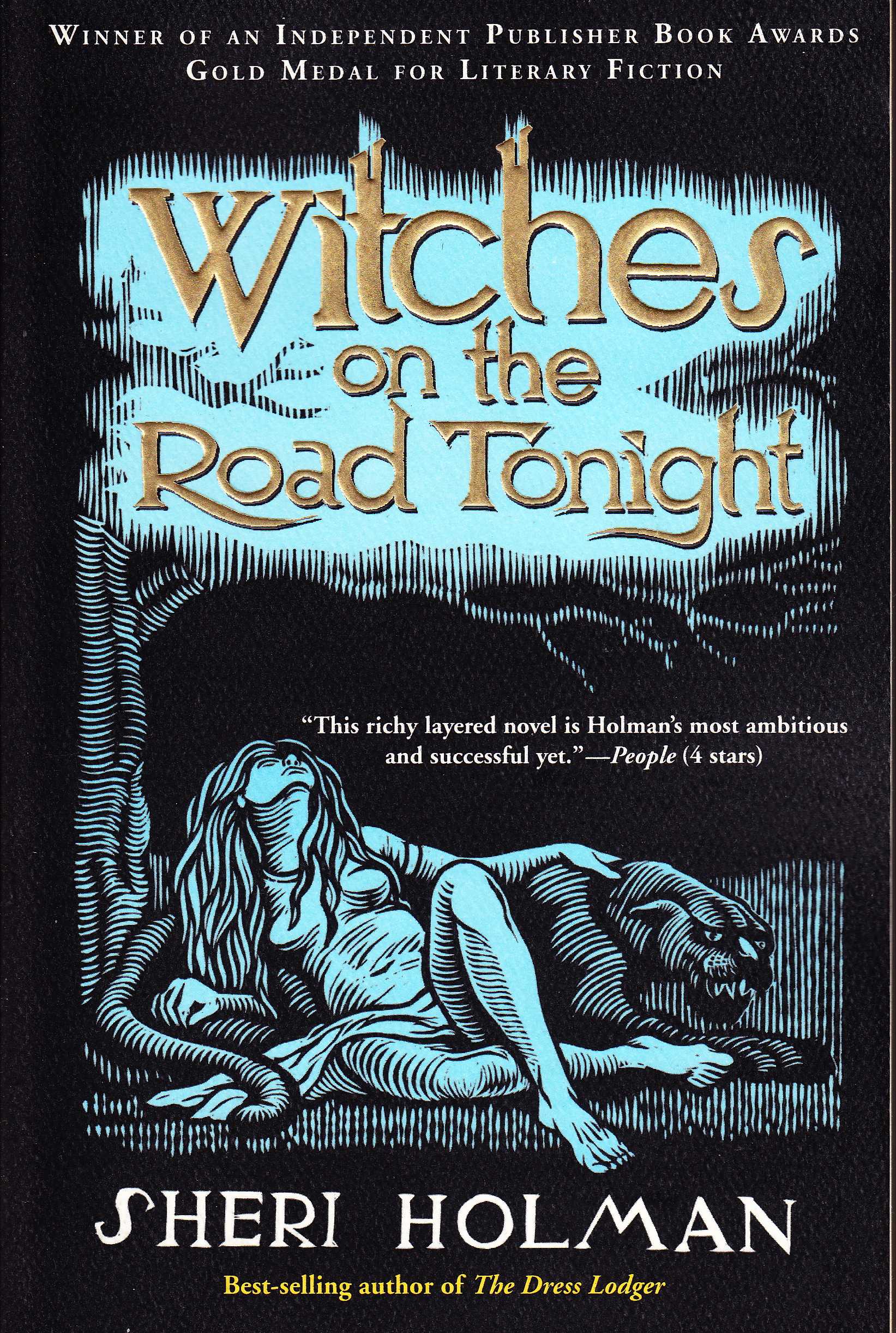
WitchesRoadLiterary fiction is a rich trove of religious thinking. Consuming fiction sustains the soul as well as the mind. Sheri Holman’s Witches on the Road Tonight was an impulse buy. The title, the cover, the intricate implications, the price were all right. It turned out to be a rewarding story that involved, possibly, witches and certainly religion. Not that it is a story about religion—definitely not. Yet, the protagonist is a weatherman who dresses as a vampire to present old monster movies on late night television. His relationships define him and, as his daughter learns, he may be the son of a witch. Deeply textured with the earthy reality of the rural poverty-stricken, at several points in the novel a thoroughly naturalized biblical vocabulary effortlessly flows. At crucial moments the story is poised on the crux of heathenism and religiosity. It is a book difficult to forget.

The fascination with witches has deep explanatory roots. When hopes are not realized as they are carefully planned, people naturally seek a scapegoat, someone to blame. Too often in history the blame has fallen on the powerless, the marginalized. Too often on women. In the somewhat enlightened twenty-first century it has become passably safe to declare oneself a witch. Our scientific worldview allows it as a harmless delusion, but the issue is more than it might seem. For some, witchcraft is the only channel available for a power that should belong to all. For others it retains a taint of evil, primarily because of a biblical point-of-view.

Israel in antiquity was a patriarchal culture. It was a man’s world that kept most women from any seat of power. “Witches” in this world are simply those who continue the trajectory of a kind of animistic faith in the vibrant life of nature. Prior to “revelation” it was self-evident that nature itself was full of vitality—spirits—if you will. When God was added to the equation, the life-force of nature fell on the “less than” side of the comparison. Even today children recognize the shaman under the name “witch-doctor,” euphemistically applied to those closer to nature than to the Bible. Reading Witches on the Road Tonight brought all of this back to me. Although largely set in New York City, it spoke to me as a rural urbanite who left something valuable in the woods of my childhood.


Gods and Goliath

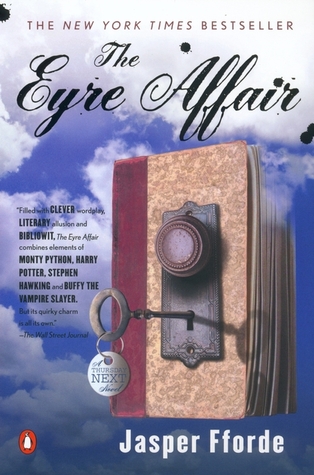
EyreAffairNot only gods are proficient at creating worlds. Writers, as readers know, are the creators of worlds too. I first discovered Jasper Fforde via a friend’s recommendation. With the depressing demise of bookstores, however, I end up picking up whichever one happens to be on the shelf. Not that this is a bad thing, but I find myself in a melancholy cast when I think of all the joy that is not being had by avoiding reading. It’s all rather hollow, wouldn’t you agree, Mr. Eliot? All of which is to say Jasper Fforde’s The Eyre Affair was great fun. As usual when I read fiction, I kept an eye out for how religion appeared in this alternate world—most fiction that ignores religion completely somehow seems to be less realistic than Fforde’s fantastic tale. In the world of Thursday Next, the churches are dedicated to GSD, the Global Standard Deity. As one of the characters explains, the GSD is a combination of all religions intended to stop religious wars. It’s a great idea on paper, but religions are prone to wars as sparks fly upward.

Somewhat later in the novel Thursday encounters a crucifix-wearing vampire. Fooled by the sigil, she almost becomes a victim to the blood-sucker. When Thursday points out the supposed impossibility of a vampire wearing a crucifix, he replies, “Do you really suppose Christianity has a monopoly on people like me?” Although Fforde can be a great comic writer, some of his quips are quite profound. Indeed—does Christianity have the only vampires? All religions have their monsters, whether that’s what the author meant (score one for reader-response theory). The truth is the truth, no matter whether intentional or not.

The idealized world of The Eyre Affair is one in which religion has become universal. The great military conglomerate in the book is called Goliath not because of the Bible but because of its size and apparent strength. It is brought to its knees, however, by Thursday—a female David, if you will. In practical terms, throughout the book the military is much more powerful that the church of GSD. Perhaps that’s because people are afraid. Religion, which once upon a time allayed fears, has now become one of their main generators. “Nothing frightens me more than religion at my door,” John Cale once sang. In this rich complexity the reader is invited to bask as Jasper Fforde works his magic. Do yourself a favor and pick up one of his books. Before it is too late. You might find yourself learning a thing or two about religion. I did.


Artifacts or Theodicy?

Last week the Huffington Post ran a story that ties archaeology, religion, and monsters together in a package too neat for some researchers. Digging in a sixteenth-century grave for plague victims (something that strikes me as being so foolhardy as to be religious) archaeologists found a corpse with a brick in its mouth. The preliminary conclusion? Sixteenth-century Italian plague-weary society was attempting to stop a vampire. The find has, of course, been disputed. Other archaeologists, the story notes, claim that a loose brick could have fallen into the cadaver’s agape mouth just making it resemble the little-known technique of stopping a vampire by bricking its mouth open. This story, written with Huffington Post’s usual pluck, raised an issue I quite often encountered as a doctoral student in ancient Near Eastern religions: anomalies are generally categorized as religious.

When my wife first pointed this story out to me I thought I might learn something of vampire lore—itself inherently religious—from the sixteenth century. The fact is, however, that artifacts (including people) under the ground accumulate a lot more than dirt. Mystery attends the lives of yesteryear, and the further back we go in time the less we understand. It was a standing joke among those of us in the textually-based field of religious studies that any artifact for which no function could be discerned would most certainly be labeled “religious” by archaeologists. When no logic attends an action, call it religious. This might be a motto for academics and their approach to the study of religion. There are some who claim religious studies is not a proper field of inquiry at all. Excuse me, but where are you intending to fly that plane?

Vampire scares (whether or not that’s what was found in Italy) do, however, follow their own logic. Although early scientists may have made connections implicating rodents (and their fleas) as carriers of plague, the average citizen would have only seen the supernatural dimension. Morbidity on the scale of the Black Death is almost inconceivable and as Europe suffered through periodic outbreaks of plague it seemed that a good God couldn’t be behind it all. Evil creatures, such as vampires, get God off the hook. They are a device of theodicy. “Theodicy” is the jargon for the theological justification of God in a world full of suffering. When God’s goodness effaces to such a point that people grow frightened, well, isn’t it just easier to say a vampire is behind it all? The conclusion that logic draws is quite different. Nevertheless, I think I’ll be replacing the garlic on my nightstand with a brick. What will the archaeologists of the future say?


Monsters Are Due on Elm Street

November 1984. George Orwell’s dark vision had not fully emerged, but the veneer had worn off of the fairy-tale world promoted by the evangelical, free-market professors at Grove City College. As a blue-collar kid in a blue-blood institution, I was out of place. The campus was buzzing, however, about a new movie—A Nightmare on Elm Street—for which I finally plucked up the courage to ask a cute coed for a date. I’d never seen a slasher movie before, having sampled mostly traditional monster-flick fare as a child. I felt a sense of accomplishment since some of my college friends had to leave the theater for fear. On the big screen, with no previous knowledge of the plot, the film worked for me on many levels. Last night I decided to watch it again.

My first reaction was a sense of surprise at how much of the movie I still recalled with pristine clarity. For having been nearly thirty years ago, such clarity is a rare phenomenon for many details of life, often reserved for memories of early girlfriends. A second reaction was noticing how religion featured in the film. The girls skipping rope chant, “One, two, Freddy’s coming for you / Three, four, better lock your door / Five, six, grab your crucifix.” Indeed, the crucifix features in several scenes as an ineffectual weapon against Freddie Krueger. The days of defying vampires are over when your own subconscious turns on you. In one of the early chase sequences, Freddie, raising his infamous glove, says, “This is God!” Religion and its overarching concerns with death and suffering come together with horror in that one moment. The traditional power structures of religion have lost their power to defend the troubled teenagers. The only one well adjusted is, ironically, Johnny Depp’s Glen. Even he falls victim to the revenge sought by Krueger.

Surprisingly, the scene I had most trouble recalling was the end. I recollected the bright, hazy sunshine, but couldn’t remember how Wes Craven released his audience from the drama. Of course, there is no end. Freddie came back in countless sequels, none of which I ever watched. Although I wouldn’t know it at the time, Robert Englund based the screen presence of Freddie on Klaus Kinski’s Nosferatu in Werner Herzog’s classic remake of that silent gem. Freddie is the vampire that defies religious cures. Movie villains are among the most adept practitioners of resurrection on the silver screen. The occasional E.T., Neo, or Spock will come back from the dead, but those who repeatedly return are the denizens of our nightmares. As Orwell’s vision continues to unfold in subtle ways, 1984 looks like an age of innocence before the ineffectual god worshipped by the establishment became self-image, writ large, on Elm Street.