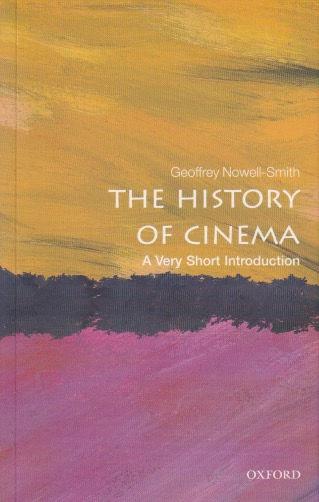
Movie History

We take much for granted.  Consider the movie.  We all know what movies are, and, prior to 2020 we all knew what the experience of going to the theater was.  Some of us even recall the drive-in experience.  Technology (and the pandemic) has changed all that.  People now watch movies at home, or alone on their devices.  Nevertheless, we still recognize what movies are and, being creatures drawn to story, we tend to enjoy them.  In fact, many theorists of myth see cinema as the new mythology.  Myths give us meaning and we tend to find meaning in films.  We also find information in them.  One of the points I’ve argued in my own work is that people learn about their religion from what they consume in the media.

Geoffrey Nowell-Smith offers a compact introduction to how we got here in this little book.  The Very Short Introductions have wide recognition among those who want to learn something authoritative without taking too much time to do it.  This introduction to cinema history is a wonderful overview of a complex subject.  A few things became clear to me in reading it: cinema began as, and remains, an artistic industry.  Other art forms developed as personal expression of visual, aural, or written expression.  They eventually codified into art forms such as painting, symphonic music, or novels.  Cinema, instead, grew out of the film industry and sought to become a new way of expressing artistic ideas.  Clearly it has done so successfully.  Not only that, unlike other art forms, it has always been a business.

Initially, photographic equipment was too expensive for most dilettantes.  Studios brought together people with skills in the many areas required to put a movie together.  You needed actors, directors, film developers, sound engineers, props and crews to make sets.  Indeed, most art—such as book writing, or music albums—is a group effort.  Movies especially so.  And these people have to be paid.  Film has, and has always had, a profit motive.  While you get the sense that many artists would’ve painted even if they starved (and many did), and that most of us who write will do it regardless of not getting any profit from it, cinema would’ve collapsed without it.  There’s a lot packed into this small book.  For those who may have been reading about film for many years it will contain startling insights.  A wide-angle book with a variety of lenses, it brings many things into succinct focus.

Biblical Literature

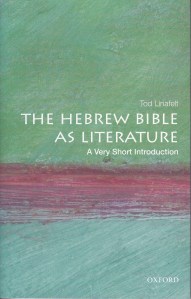
HB as LitIt must be difficult to write a Very Short Introduction. Although the series is published by Oxford University Press, I’m not being a shill. As someone who writes the equivalent of several of these little books a year, I imagine it must be nearly impossible to confine what you need to say to such a small space. I recently read The Hebrew Bible as Literature: A Very Short Introduction, by Tod Linafelt, and I imagined the anguish of my colleague as he had to decide what to leave out. Professors these days appreciate short books because there is an actual chance that students might read them. The Bible itself is intimidating as a textbook—massive and brooding as it is. Then, in addition to the Ding an Sich, the instructor also has to provide interpretive tools. One of the most common these days is that of the Bible as literature.

This obvious assignment is not without dispute, however. Literature is defined by some as a secular category. The Bible, as a set of one, is a holy book. That is to say, it can’t be considered literature at all. As a collection of written texts, however, the Bible can be understood as a literary venture as well as a sacerdotal one, and for many schools this is the only way the Bible can be legally taught. Not only that, but almost all scholars now realize that, protestations aside, the Bible is literature. It is one of the great books of the western canon. Civilization for huge swaths of the planet was based, in some way, on this book (the Bible, that is). Understanding it as literature is the venture of a lifetime, and condensing that down to an easily digestible Very Short Introduction is no mean task. Linafelt performs his duty admirably. The basics of prose and poetry are covered, as well as their interaction. The examples he chooses are compelling and I learned quite a bit myself, even having taught the Bible many years.

As I read, it struck me that the main objection to the Bible as literature revolves around the concept of truth. Linafelt raises this question early, and it stayed with me throughout the book. In a kind of sacred exceptionalism, “Bible believers” treat literature literally. Ironically, this can lead to grave misunderstandings. Truth, however, is a difficult concept to pin down. Many people equate literature with fiction and truth with fact. Truth is actually a bit more fluid than that. As any poet knows, some truths can’t be expressed in prose. Or history. Or philosophy. And some truths are best expressed in fiction. That brings us back to literature as a form of truth. I suppose that’s a good thing too, because were I to write much more I might be in danger of accidentally composing a Very Short Introduction. As long as I’m being a shill, just consider this a very short introduction to a Very Short Introduction.