Victorian Inspiration

Some stereotypes hold the truth.  Since we couldn’t afford a vacation this summer, we arranged a couple of our versions of “staycations.”  For us that means driving some place a couple hours away, staying in a hotel for a night or two, and exploring a new place for the weekend.  We’ve done that to explore the Lancaster area and a couple of times to the Poconos.  When possible, and affordable, we like to stay in unusual places rather than the typical hotel.  For example, around Lancaster we try to book a caboose at the Red Caboose.  Since those are expensive over the weekend, typically we have to take a vacation day or two to do them before the weekend proper sets in.  On a trip to the Endless Mountains region, we stayed at the Victorian Charm Inn in Towanda.  This is a converted ten-bedroom house from the late Victorian era.  Not a typical hotel, it’s an inspiring place to stay.
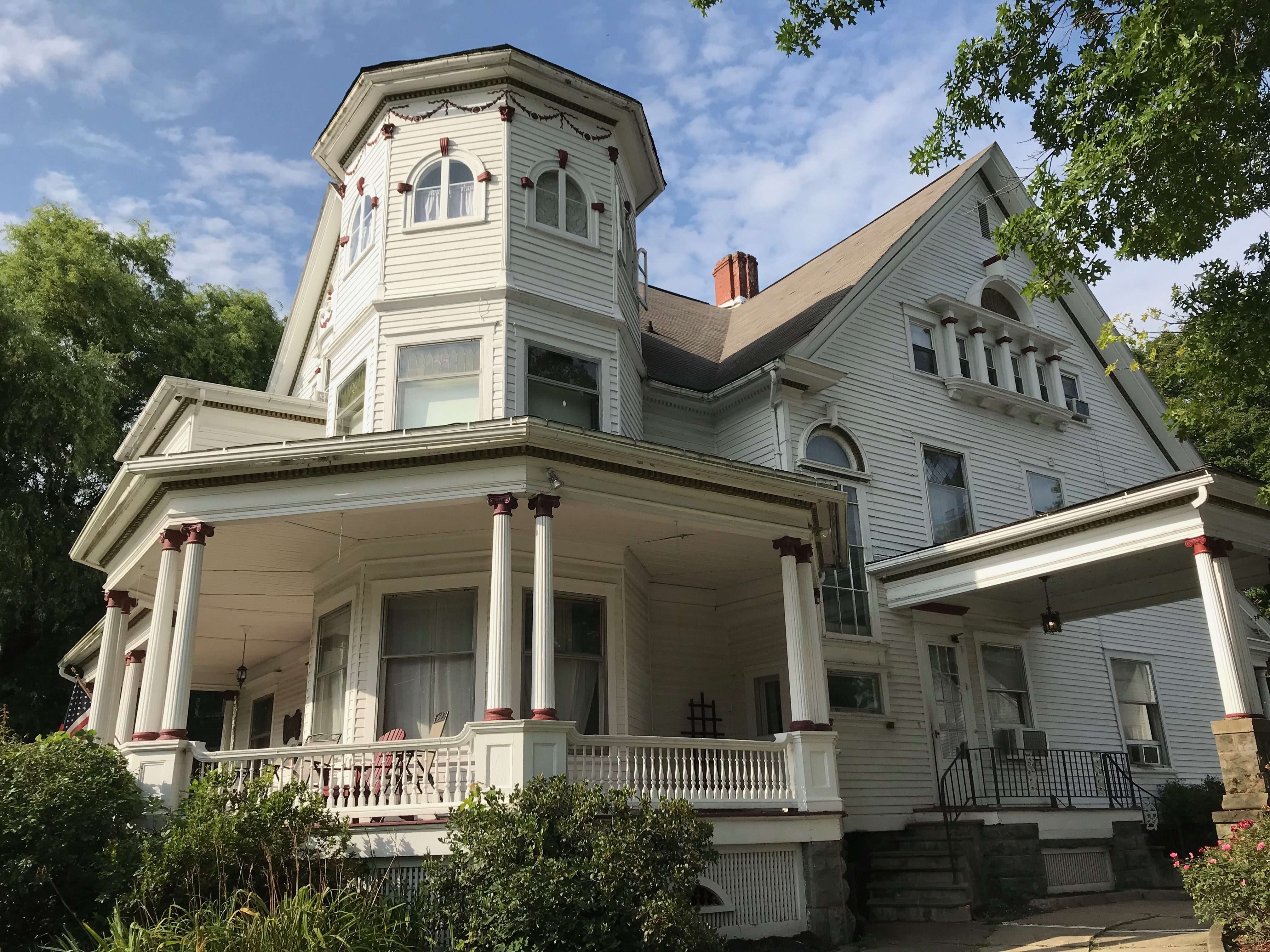
What I mean by stereotypes is that such places inspire me to write in their genres.  After staying in the Red Caboose, I typically write fiction about trains.  I’d been on a gothic kick when we stayed at Victorian Charm and indeed, it inspired gothic writing.  Not that we could’ve afforded it, but when we were looking for a house, I really wanted to buy a Victorian.  We looked at a couple but neither one had been well kept up.  I thought they would inspire my writing.  Perhaps it would get old, living in such a house and reading Poe and other Victorian writers, but I wonder if it might have led to more gothic stories.  The fiction I do write tends to draw from my experience of living in various places.  Victorian mansions have a feel to them.

Writing is mostly a matter of discipline, rather than inspiration.  All writers, I suspect, crave inspiration.  I know that I do.  When I awoke to a thunderstorm in a Victorian mansion I experienced something that had never happened to me before in real life.  It made me wonder what it would’ve been like to have been able to live in such a place.  The cracked plaster, the faded elegance.  The nooks and alcoves.  An honest-to-goodness fainting couch.  And who knows?  Perhaps a ghost or two.  Our house was built in the Victorian Era, but by those of much more modest means.  It is an inspirational place to write, but it’s also the place associated with work.  That’s why, in stereotypical behavior, we need to get away on the occasional staycation.

Victorian Secret

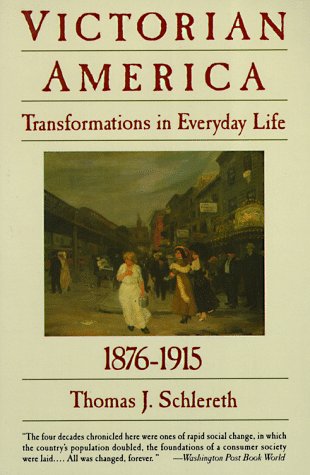
VictorianAmericaPerhaps it’s because the Steampunk World’s Fair is still on my mind, or perhaps because I’m increasingly curious about the way we came to be how we are, I read Victorian America: Transformations in Everyday Life 1876-1915. In this study Thomas J. Schlereth surveys the main aspects of daily existence during the turn of the nineteenth century into the twentieth. It is sobering to consider how quickly change has accelerated since then. Still, so much of what seems normal today was novel just a century or so ago. Although Schlereth doesn’t devote a chapter specifically to religion, he does tie it in with its natural analogue, education. We quickly forget that education was largely established because of religious principles. You can’t tell it today, but one of the main impulses behind higher education was the desire to educate people about the truths of religion so as to improve society.

Also developing in the late part of the nineteenth century was a new religious movement that considered five principles to be fundamental to Christianity. What’s more, those who promulgated this outlook also claimed it was true from the beginning of Christianity, although we know this is decidedly false. The inerrancy of Scripture, the virgin birth, Jesus’ divinity, the second coming, and atonement through Jesus’ sacrificial death—a few concepts that had rudimentary form earlier in the religion’s history—became non-negotiable. Fundamentalism, a new religion, was born in this era and claimed a right to parse true Christianity from false Christianity. This virulent form of belief quickly became politicized, and the relationship between religion and politics clearly impressed Americans from early days. We still reap its whirlwind.

Ironically, the Victorian Era, as designated by Schlereth, saw the birth of the Social Gospel. Doctrine wasn’t the first question on the minds of these reformers, but the human condition was. Yes, they tended towards Fundamentalism, but those who believed in the Social Gospel wanted first of all to eliminate human suffering and misery. It was they, not the Fundamentalists, who came up with the question, “what would Jesus do?” Education and religion eventually divorced, and the Fundamentalist children grew ever stronger in their conviction that they alone were right. The First World War brought a crisis to an optimistic culture that believed the second coming was just around the corner. Of course, we’re still waiting. In the meantime, if you’d like to learn how we got here, Victorian America is not a bad way to pass the time.