
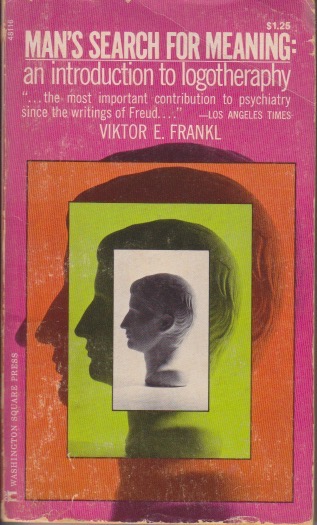
Many people over the years have encouraged me to read Viktor E. Frankl’s Man’s Search for Meaning. I admit to being put off by the unintentionally sexist title (I do remember the days when “man” was generic regarding gender, following the German usage from which it derives). I finally got around to it and I’m glad I did. I know that there has been some controversy around it but I found many of Frankl’s observations freeing. The first part of the edition I read narrates his experience living in concentration camps during Germany’s mad phase. Such things aren’t easy to read, but they are important, showing what happens when people are devalued by those in power. It also proves a place for finding meaning in suffering. The second part of the book introduces logotherapy, the school that Frankl devised. It’s based on the idea that one’s search for meaning is essential for psychological well being.
Some of us grapple with the question of meaning constantly. Why are we here? What should we be doing? Is there a purpose behind it? Religions often attempt to answer these kinds of questions, as do various philosophical schools. Nobody has the definitive, overarching answer, and Frankl doesn’t try to offer one. There is a bit of existentialism in logotherapy, but the basic idea seems sound to me. Seeking meaning helps you to carry on. Frankl also considered finding meaning in suffering, which seems to be a noble goal, if quite difficult to achieve. Most human lives involve suffering and it is often the biggest problem with which theodicy has to deal. Finding meaning in it, if that’s what life hands you, seems to be reasonable. His discussion of paradoxical intention was quite interesting.
My edition of the book has an introduction by Gordon Allport. That name took me back to my college days when the Harvard professor’s equally problematic title, The Individual and His Religion was required reading. Despite the pronoun, that was an influential book for me (unfortunately ruined in the flood after we first moved to this house). I noticed that Frankl cited Allport’s book in his own. I sometimes think I ought to replace Allport’s book, but I’m not sure that I’d be reading it again any time soon. Besides, my lost edition had my own annotations in it. A small measure of personal suffering and loss. I am glad to have finally read Frankl’s work. I certainly learned a lot from doing so. Discovering that there is a psychological school based on finding meaning exists was news to me. And it just makes sense.
 Steve A. Wiggins