A Different Village

If I’m honest I’ll admit that I first found out about John Wyndham’s The Midwich Cuckoos from The Simpsons.  In one of the episodes, “Wild Barts Can’t Be Broken,” a “clip” is shown of a horror movie called The Bloodening.  A spoof on Village of the Damned, the scene caught my imagination and I was able to learn that it’d been taken from this movie.  This was many years ago, of course.  In any case, I went out and found a DVD of Village and found it less frightening than anticipated, but it left me curious.  It was easy enough to find out the book it was based on (it’s in the credits).  Now, well over a decade later I finally read it, but I’d forgotten nearly everything about the movie but the glowing eyes.  Having read the novel, I had to see the movie again.
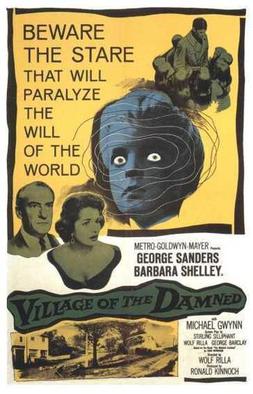
Interestingly, the book is generally considered science fiction and the movie horror.  The two genres are closely related, of course.  The explanation for the children in the movie is a little sci-fi, but the framing is horror.  So much so that in Britain in 1960 it was nearly given an X rating (the censors didn’t like the glowing eyes).  As typical, when compared to today’s fare this is a tame little piece about some unruly children.  Of course they do get blown up at the end.  That may have been a spoiler.  I guess I can be unruly too.  In any case, sequences of self-harm, and even suicide, make this a reasonably scary movie.  The film has the same stiff upper lip that the book does, but otherwise it’s a modern horror classic.  I haven’t seen the 1995 remake, but it didn’t get very good reviews.

The movie doesn’t have as much moralizing as the novel does, but it raises the very real issue of how we socialize children.  I do suspect, however, that blowing them up when they’re all together is probably not the message they wanted us to take home.  Although far from a flawless film, this is quite intelligent for horror of the period.  Consensus is that horror “grew up” in 1968, but there were some premies, it seems.  Night of the Demon is another one from the period.  Horror has, I would argue, been intelligent from the start.  Dracula, although not a perfect story, has become a bona fide classic, and Frankenstein before it, had already been a literary touchstone for decades by the time the former was published.  Not bad for watching an episode of The Simpsons.

Unconventional Demon

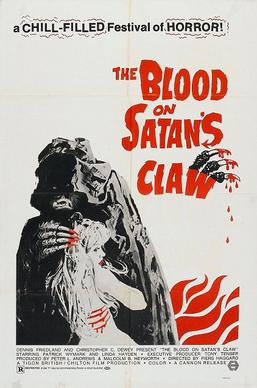
In my book Holy Horror I limited my discussion to fairly widely available and well-known films.  Part of the reason for this is that nobody can watch all horror movies and for those of us who work, there’s just limited time.  All of the films are at least American co-produced, most of them American productions.  The one exception to that is The Wicker Man.  I couldn’t bear to leave that particular movie out.  I didn’t realize at the time that it was classified as the newly coined “folk horror.”  Another film, released two years earlier was the strangely titled The Blood on Satan’s Claw.  It’s a strange but competent British horror film that has an eighteenth-century village falling prey to a demon that is accidentally plowed up in a field.

It is a film that could’ve been included in Holy Horror.  Indeed, the Bible appears in it and one of the adult characters is the local curate.  As the children are succumbing to a Satanism that’s raising a demon, he tries to teach them their Bible lessons.  Like Village of the Damned, the horror here centers on the children.  Flaunting the reverend’s rules, they play in the woods, raising the Devil.  Almost literally.  The demon they summon is called Behemoth.  Perhaps surprisingly, the judge actually saves the day in this one.  At first he’s convinced that the age of superstition is over and insists that it not be brought back.  He learns, however, that the demon is real and deals with it by rather physical means.  Who is Behemoth?

The word translates rather literally to “beasts.”  In the book of Job Behemoth is the land-bound companion to Leviathan, the two monsters that God cites to demonstrate his superiority over mere mortals.  As time wore on into the middle ages Behemoth and Leviathan were recast as demons, although it’s pretty clear that the book of Job doesn’t present them that way.  One of the points I make in Nightmares with the Bible is that demons aren’t fully formed beings in the ancient imagination.  Since the Bible says so little about them, ideas were drawn from folklore and other sources to flesh out these somewhat amorphous entities.  Descriptions of The Blood on Satan’s Claw quite often state that the children of the village are possessed.  If so, it is quite a different form of possession than will become standard two years later with the release of The Exorcist.  It is fitting, I suppose, for folk horror to have a folk demon for its antagonist.