Ending the Cycle

Curious to finish out the “Poe Cycle” of American International Pictures, I looked up The Oblong Box.  The only thing similar to Poe’s tale is the title, as viewers must’ve come to have expected even in 1969.  Poe was the marketing to sell the film, but not much more.  Okay, the theme of premature burial has Poe’s fingerprints all over it, but that’s not part of his story “The Oblong Box.”  Now, as for the movie, it has several subplots and a pretty high body count.  Its ending isn’t really explained, but after starting out as seeming racist, it comes out justifying the actions of the Africans at the beginning.  In the middle it’s a muddle.  Pacing is completely off and some sub-plots, such as the police investigation, are summarily dropped.  Apart from the positive view of Black people, which is important, the film is a confusing criss-cross of unsavory motivations.
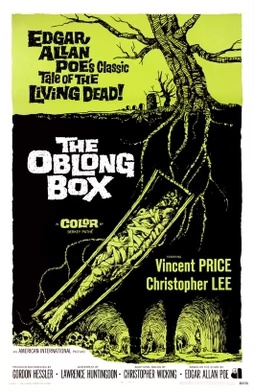
The Markham brothers own an Africa plantation and the trampling of a slave by a horse leads to revenge on the part of the slaves.  The scarred brother, Edward, is driven insane and he escapes his brother Julian’s care by being buried alive.  Grave-robbers, however, want him so Christopher Lee can experiment on his corpse.  Edward escapes again and dons a scarlet mask, but his insanity leads him to kill a variety of people, looking for the witch doctor who can cure him.  Meanwhile, an unscrupulous lawyer is cashing in on the brothers’ wealth but ends up being killed by Edward.  There’s a rather pointless bar fight, and, after killing Lee, Edward and Julian finally face off with Edward getting shot but biting his brother before he dies.  The witch doctor raises Edward from the dead, buried in his coffin, and Julian now has his brother’s scarred face (and presumably, his insanity).

The movie was the first to feature both Vincent Price and Lee.  The film had a change of directors, pre-production, and a script that was added to by another writer.  The plot verges on tedious and it’s difficult to feel sympathy for any of the characters, apart from the women, who don’t seem out to hurt anyone.  Price (Julian) also plays a “good guy” until the reveal near the end, but Edward dominates the screen time, all the while wearing a mask.  The “Phantom of the Opera” reveal is shot in the dark, however, and the results are not so grotesque.  And those who’ve read Poe’s story wonder where the ship might be.  This is the only Poe Cycle film not directed by Roger Corman, and he, as well as Poe, are both missed.
More Poe

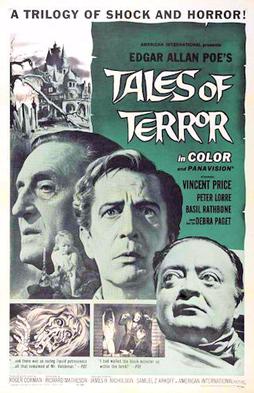
Having admitted to not having seen the entire Roger Corman Poe cycle, I figured I’d better get to work.  I had two movies left to watch and I found Tales of Terror for free on a commercial television streaming service.  As the title indicates, it is an anthology film, bringing together four of Poe’s stories in a three-featurette format.  At the same time, I am trying to catch up on Poe tales that I’ve never read.  More on that to come.  Tales of Terror begins with “Morella,” one of those stories I’ve not read.  There is a danger, of course, in watching a movie first since Corman loved to sensationalize.  I’ll need to wait until I find the time to read “Morella” to know just how much invention there is.  The movie version is an undeserved revenge from beyond the grave story.  Of course it stars Vincent Price.

Although “The Black Cat” gives Price top billing, the story focuses on Peter Lorre’s character, Montresor, borrowed from “The Cask of Amontillado,” with which it’s interlaced (The Cat of Amontillado?).  Montresor is an alcoholic who hates both his wife and cat.  Taking his wife’s money to buy alcohol (something I personally witnessed as a child), he eventually stumbles into a wine tasting convention where he meets Fortunato (Price).  When Fortunato begins an affair with Montresor’s wife it becomes an excuse to wall them both up in the basement.  Lorre plays his Poe characters funny and that makes this segment more a comedy.  Also, there’s a black cat.  The last featurette, “The Facts in the Case of M. Valdemar,” also stars Basil Rathbone.  I haven’t read this story either, so I’m not sure of its fidelity to Poe.  Yet.

The “Poe Cycle” was part of American International Pictures (AIP’s) collaboration with Corman.  Most of the movies were produced quickly and cheaply, although Richard Matheson did write the script for this anthology.  Of course, I hope I haven’t spoiled the two Poe stories I hadn’t read.  I do own an anthology of all of Poe’s fiction, and sometimes it takes movies to make me remove the ponderous tome from my shelf.  (Yes, I’m aware that Poe’s tales are also available for free online, but Poe deserves to be read from an actual book.)  As I’ve mentioned before, I never kept a record of the movies I saw, particularly on television, as a child.  Since the Poe Cycle was still being shown in theaters for part of my youth, I likely missed most (but not all of them) when they were aired on television.  I do remember seeing The Raven decades ago.  At least the internet does allow for a strange kind of resurrection since most of the cycle can be found for free online.


Terrible Comedy

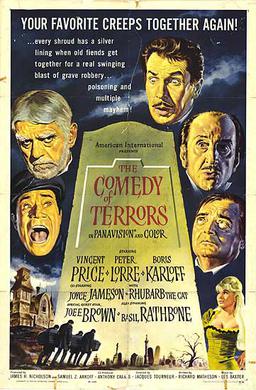
Frankly, I expected better.  The Comedy of Terrors seemed to have a lot going for it.  With my current interests in American International (AIP), Vincent Price, Jacques Tourneur, and Richard Matheson, watching it for free was a no brainer.  And I mean, no brainer.  Maybe it lacked the Roger Corman touch.  The premise is cute enough, bring together horror icons and have them take the mickey out of Shakespeare’s Comedy of Errors.  Peter Lorre and Boris Karloff join Price and Matheson scripts generally don’t disappoint.  Tourneur had a string of great horror movies behind him.  But the magic just isn’t there.  Comedy horror, or horror comedy, is difficult to pull off well.  Particularly if it’s deliberate.  What Young Frankenstein got right just went wrong in Comedy.

All of this makes me more conscious of just how impressive a great movie is.  With so many moving parts, films leave plenty of gaps where things can go awry.  The vast majority of movies perish with little notice, of course.  Success—earning more than it cost you (still waiting for that with my writing)—comes to some, and that’s what has me vexed here.  Tourneur was a talented director.  The actors all had proven themselves repeatedly.  Matheson brought life to so many horror and sci-fi movies and television shows.  Even AIP had a number of hits after starting out as notorious for their low-budget approach.  The jokes in Comedy aren’t funny and the horror’s not scary.  Some have opined that the sarcasm is spot-on, but it didn’t seem so to me.  There’s even some disagreement as to whether the film earned its budget back or not.

Horror movies come in all stripes.  And spots.  Even solids.  Comedy horror isn’t my favorite, but some of the gems of the genre (Rocky Horror Picture Show, Gremlins, Shaun of the Dead, Ghostbusters) show that the combination can work but ought to serve as cautionary tales.  (Both Ghostbusters 2 and Gremlins 2 failed to capture the magic of their forebears.)  If everything falls together just fine, step back and bask in wonder.  Trying too hard (of which I’ve been accused) sometimes doesn’t work while you’re attempting to be funny.  It’s pretty clear that Nicholson and Arkoff thought bringing all of this talent together was a recipe for success.  Of course, there are plenty of moving parts and a director, or even a producer, is entitled to a blunder or two.  I like a good laugh as much as the next guy, and after seeing this flick I could use one.


The Cycle

The last of the Roger Corman Poe cycle was The Tomb of Ligeia.  I haven’t seen all eight films in the set, at least I don’t think I have.  A couple don’t sound familiar to me but I didn’t keep track of all the movies I watched growing up.  Although critics were, well, critical of a number of the films, at least three of them weren’t bad.  In that number I would count Ligeia.  The usual problem with making Poe films is that Poe wrote short stories.  Getting them to the length necessary for a feature required padding, sometimes by borrowing against some other Poe tales.  Ligeia isn’t too far off from Poe’s original and although Corman reportedly didn’t want Vincent Price in the star role, because of his age, he pulls off what seems to me a winner.  Atmospheric, and well-acted, the story is a touch slow, but manages to bring in some solid horror themes.

I’ve been pondering Poe as a horror writer lately.  I suspect that the master himself would’ve been surprised, and probably not pleased with the characterization.  Yes, he wrote stories that would become horror hallmarks, but his fiction output included detective stories (a genre he invented), something akin to science fiction, drama, and comedy.  Some of his funny stories retain their humor today.  I suspect that one reason he became remembered as a horror author was H. P. Lovecraft’s adoration of him.  Lovecraft wrote mostly what we consider horror today, although there’s variation there too.  But since Lovecraft saw the horror, so did others.  When Corman began shooting movies he soon fell into the horror trend and, known for that genre, incorporated Poe.  By the end of the sixties, Poe was a horror writer.

What makes The Tomb of Ligeia work is Price’s tormented performance of Verden Fell.  His Byronic character is caught in the realm between death and life.  Unable to free himself from Ligeia, and she, unwilling to renounce her will, they are caught in a belief that a local declares blasphemy while Verden calls it “benediction.”  The theme of resurrection—presented mostly in the form of Egyptian artifacts—is an inherently religious one.  The setting in a ruined abbey—original to Poe—also plays into the sublimated resurrection theme.  Critics didn’t care for the movie, but separating Corman’s Poe cycle out over time allows a viewer to consider each piece separately.  In this light, this appears to be one of the best three.  Of course, I haven’t seen all of them yet.


Mad Homework

Watching movies can be studying.  It’s all a matter of what the exams are.  I studied enough when I was young to know that Vincent Price was a horror star.  Probably I had no conscious idea what “horror” was yet, contenting myself with terms such as “scary movies” or “monster shows.”  The Mad Magician was one of his earlier efforts and not really a great film.  The Prestige, of course, makes any magician film pale in comparison.  Still, many special effects were new in 1954 and gimmicks could be used to lure audiences in.  Many of these movies, such as Mad Magician, are ironically difficult to locate these days, having had their distribution rights bought up by various companies who know that some of us still have homework to do.

Although classified as a horror movie, there are really only a few tense moments in the whole.  It seems pretty clear who’s going to be magiced to death before it happens.  One does wonder how you avoid massive blood splatter when cutting someone’s head off with a buzz-saw.  (It might’ve made quite a 3-D effect, had they decided to put it on camera.)  Audience tolerance (and the Hays Code) wasn’t up to that level in the fifties.  It seems there was a lot of learning going on in the day.  How to make a movie frightening without violating strict rules regarding what might be shown?  Of course, the combination of writers, directors, producers, and actors have to combine just right to make a winning film and stories that rely too much on 3-D tend to show.

The villain in this case, as is often true in early Price movies, has justification.  The murders begin because his sponsor insists that any trick he invents, on or off company time, belongs to him.   Many modern employers try to institute similar terms—their salary buys you, in essence—while claiming to offer a good work/life balance.  That’s a new and foreign concept to our farming ancestors, I suspect.  People (and corporations) like to own other people to do the hard work for them.  Our awareness of this too-human tendency led to the necessity of unionization and other ways for employees to push back against the machine.  In other words, there is a bit of pathos in this early Price horror film.  There isn’t much horror but there is some social commentary.  And, of course, Price would move on to other films that could better showcase his talents.  Not all studying feels rewarding, but it’s necessary.


Wax Museum

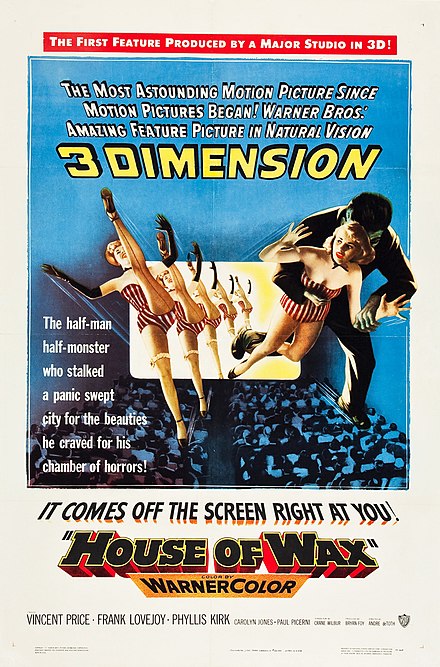
I admit to using Wikipedia and I even support it.  It’s the starting point for looking up things for which we’re not familiar.  Since most movies I watch don’t lead to discussion (ironically, I know very few people in person who watch horror), I often go to Wikipedia to find “conversation partners” about films.  One thing I’ve noticed is that a great number of articles on cinema have a section “Later Reception.”  In my experience, this usually appears on pages about movies initially panned but which have later been reassessed as being better than originally supposed.  In the case of House of Wax, the film was even selected for preservation in the National Film Registry because of its significance.  It’s interesting to read the sometimes boorish comments of the first critics.  Of course, the story had been around for some time then, so they were perhaps too familiar with the premise.

I can’t speak for the Library of Congress’ National Film Registry, but the notable features include its status as the first 3D movie with stereophonic sound, and the first color 3D movie released by a major studio.  For me, however, this was the film that launched Vincent Price to stardom.  He would go on to become the horror icon of American movies for the next two decades and many of the films would be, to use the National Film Registry’s language, “significant.”  The title already hints at the plot.  What horror film with such a title wouldn’t involve embalming a living person in wax?  Rather like Chekhov’s gun, if you title a picture like this, you need to make sure the gun, as it were, goes off.

The 3D gimmicks (I saw it only in 2D) are pretty obvious, but there are many interesting sub themes running throughout the movie.  Even in the button-down fifties there were directors who knew how to titillate.  In any case, the 3D aspect adds another detail to the story.  The director, Andre de Toth, was blind in one eye, which meant he couldn’t see the 3D effects.  This too makes the film worthy of note, and, again, significant.  Price plays his role of the urbane villain quite well, although this villain has cause to be wroth.  An artist forced to watch his work destroyed is likely to become unhinged.  As a horror film it also works well since wax museums are inherently creepy places.  I may have seen this movie in my younger years, but if so it didn’t stick with me.  I would have to agree with Wikipedia’s later reception, however.  This is an effective movie, even for a septuagenarian.


Invisible Again

Sequels are a fact of life.  Movies, although some of us look to them for profundity, are made for selling.  (I guess my writing for so long with no profit from it has skewed my view a bit.)  Still, The Invisible Man Returns isn’t too bad.  In my mind, there were a set of six canonical Universal monster movies: Dracula, Frankenstein, The Mummy, The Invisible Man, The Wolf Man, and The Creature from the Black Lagoon.  In reality, each of these successful films was followed by a clutch of sequels, filling the thirties and forties—into the fifties—with monster movies.  I never really bothered with the sequels, but some of them are pretty good.  And I still haven’t seen the more recent Invisible Man, which I hear is quite good.

When I was a kid, Vincent Price represented horror like no other single person.  He had developed a persona that was lucrative and that influenced other monster boomers as well.  He was a relative unknown when he was hired for The Invisible Man Returns.  His face only appears in the last minute of the film and his voice had not yet settled into its characteristic menace tone that would make him a genre icon.  Still, the story has a typical plot for the period.  Sir Geoffrey Radcliffe is set to hang for killing his brother—they own a coal mine.  Dr. Frank Griffin, a friend of the family and brother of the original Invisible Man, believes him innocent and makes Radcliffe invisible so that he can escape the gallows.  As we all know, the problem with the invisibility drug—here duocaine rather than monocaine—is that it causes insanity.  Radcliffe discovers the real murderer before going insane, all the while being chased by police.

These “invisible” films demonstrated what special effects could become.  Shot in black-and-white, “black screen” technology was used to make Radcliffe appear headless and handless.  In fact, this movie received an Oscar nomination for the effects.  It’s not a scary film, but it’s a reasonably told story.  And the special effects really were cutting edge for 1940.  Probably somewhat scandalous for the time, Radcliffe has to undress in front of his fiancée at one point, leading the men who discovered her fainted to suppose that seeing a naked, if invisible, man could do it.  There is a subtle humor here.  Other films followed but they veered into the comedy realm.  Until the recent remake.  I guess I’ll need to add that one to my ever-growing list of must-see movies.


Camp Tingler

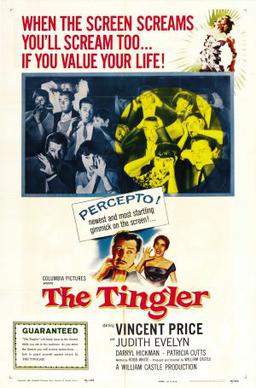
I don’t remember in which magazine where I saw the still, but I was immediately intrigued.  I didn’t know the movie it was from and in the days before the internet, when you live in a small town, avenues for finding the answer were few.  I just knew it was a photo of a woman in a bathrobe next to a bathtub filled with some opaque fluid (presumably blood), from which a hand was reaching out to her.  Or at her.  I don’t even recall when or how I learned that the scene was from the gimmick-driven William Castle film, The Tingler.  I’d heard of the movie before, but I hadn’t connected the scene with it.  No matter how you slice it, the story of the movie makes no sense.  That doesn’t stop it from being fun.  I’ve seen it before but had to refresh my memory.

I hadn’t recalled, for example, that Dr. Chapin (Vincent Price) uses LSD to try to get scared.  While the dialogue isn’t great, there are many observations on fear and how adults outgrow it.  Chapin wants to find the physical root of fear and drops some acid (apparently the first cinematic depiction of LSD use) to enhance the experience.  Although it’s crucial to the plot, I also didn’t remember that Martha Higgins can’t hear or speak.  Interestingly, she co-owns a silent movie theater and she’s a silent character in a sound movie.  She’s also the only character involved in the two color shots in a black-and-white film.  She remains in grayscale herself in these scenes.  In other words, there is some sophistication here.  And of course, Vincent Price was always classy.

Camp is an aesthetic that I appreciate but, like a tone-deaf person, don’t always recognize.  The Tingler has become a camp classic.  Many people know that Castle had vibrators installed in select theater seats so that some audience members would “tingle” at appropriate places.  This was the “Percepto” advertised with the movie.  Having himself introduce the film as too terrifying—echoing back to Frankenstein in 1931—Castle guaranteed the movie wouldn’t be taken seriously.  There’s nothing scary about this horror film.  Speaking for myself, I spent too much time trying to figure out what happened to poor Mrs. Higgins—yes, her husband’s trying to scare her to death but then she has hallucinations as if Dr. Chapin gave her the LSD instead of taking it himself.  It doesn’t make sense, but it’s fun.  I guess that’s the definition of camp.


The Movie Maker

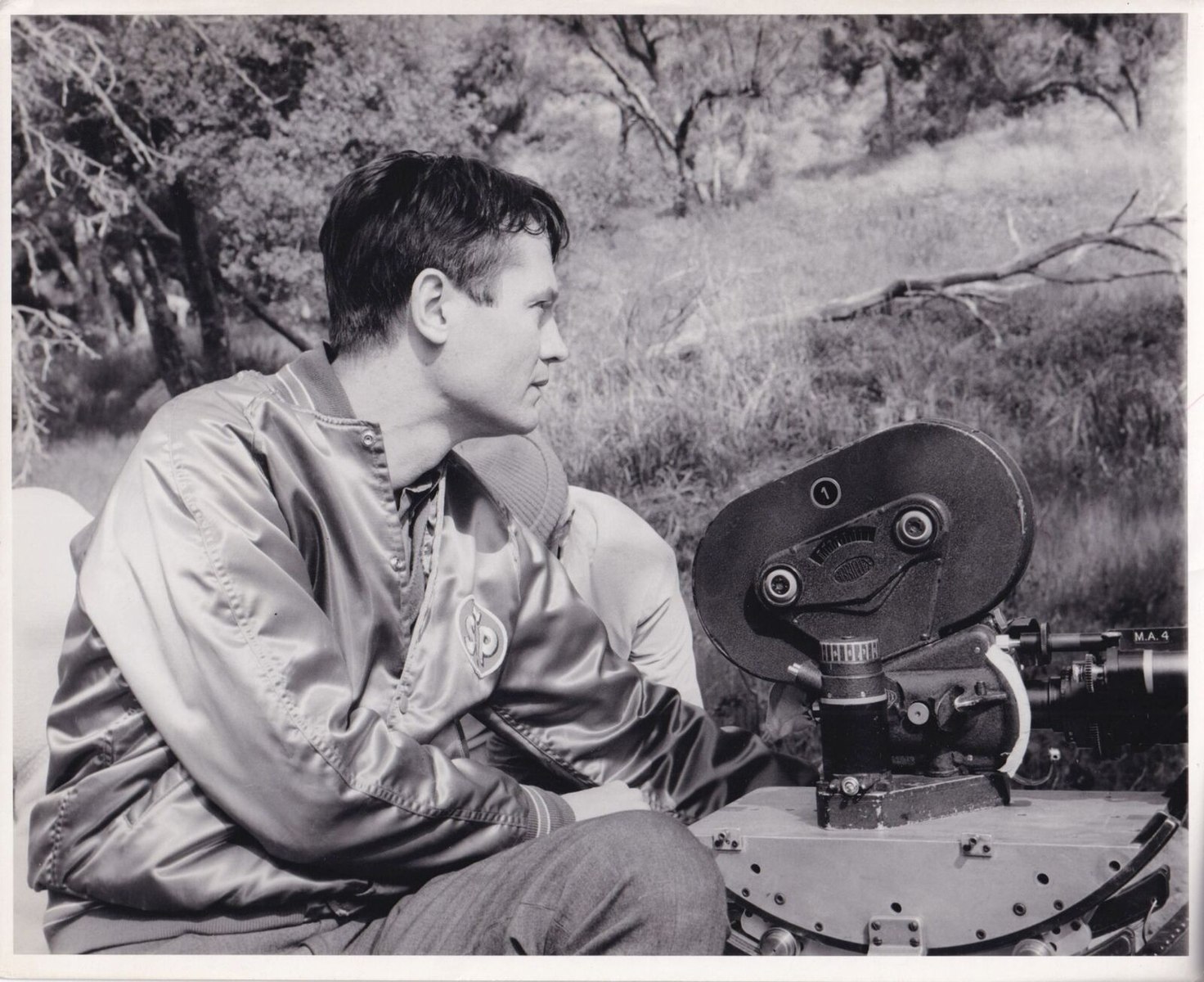
Roger Corman has died.  So passes an era.  I’ve always had an appreciation for the speculative films of the fifties and sixties.  Many of these involved low budgets and content intended to shock.  Or at least excite youngsters.  And Roger Corman was a huge name among directors, producers, and promoters of such schlock.  He entered the realm of horror in 1955 with Day the World Ended.   Attack of the Crab Monsters a couple years later put the focus firmly on monsters.  Producing and directing three or more movies a year, he built a reputation for being cheap and quick, but that didn’t prevent him from creating some good movies.  A film’s producer is the one responsible for overseeing the production.  Often they come up with the ideas of what to film.

Roger Corman, publicity still; public domain via Wikimedia Commons

As the sixties were dawning, Corman produced several films “based on” work by Edgar Allan Poe.  I remember seeing some as a young person and wondering what they had to do with the Poe I’d been reading.  Still, he managed to grace cinema with House of Usher and The Masque of the Red Death.  These are good films, despite limitations.  At the same time, Corman was still producing creature features as well, wracking up an impressive list of nearly 400 produced films.  As an established player in cinema he also took on the role of distributor from time to time.  When The Wicker Man was being ignored in Britain, Corman undertook the role of US distributor, likely saving the movie from total obscurity.

Circling back to Day the World Ended, we’ve become accustomed to believe that some kind of divine or human ending is in the offing.  These ideas get embellished over time, as I suggested in my new piece on Horror Homeroom.  Corman knew that this putative end would get the attention, whether or not there was any truth to it.  Perhaps that was the genius of his work—he knew how to attract attention.  And he wasn’t afraid to do so.  The business of cinema is one of attracting viewers.  Telling stories we want to hear.  We remember reading Poe, and even if the movies differ from the stories he penned, they are nevertheless reminders, reminiscent of what we’ve read.  If there are monsters they are somehow perhaps even more effective for not really being believable.  In short, Corman was a showman.  He made a living doing what he loved.  And he influenced many lives along the way.


Black Bird

Although we prefer typecasting—it’s so much easier!—Edgar Allan Poe had both depth and width as a writer.  He penned funny as well as scary, love poems and detective stories, even something like a scientific treatise.  One thing I’m sure he didn’t anticipate was his name being suborned for cheap horror movies.  Roger Corman is a Hollywood legend—a good example of a guy making it in the film industry on his own terms.  He paired Vincent Price with a number of Poe titles that had little to do with the actual works of the writer.  One that oddly stayed with me since childhood is The Raven.  This was well before I’d read the poem.  It’s funny how very specific things will stick in your mind.  I remembered the strange hat Price wore.  And I remembered—misremembered, actually—Price using a spinning magical device with sparklers.  Misremembered because that was Peter Lorre’s character, not Price.

That was it.  I didn’t remember that Boris Karloff was also in the film.  I was too young (as was he) to recognize Jack Nicholson as well.  Although I watched The Twilight Zone, I didn’t realize the script was by Richard Matheson.  This film was loaded with talent, but it really was goofy.  I recollected Price was a magician, but I didn’t know this was a rather silly battle to become chief magician.  Lorre’s ad libbed lines were surprisingly funny, even after all these years (I was about one when the film came out).  Surprisingly, the movie did well at the box office, despite its taking a sophomoric approach to perhaps Poe’s most serious poem.  

I’d avoided watching it again for all these years because of that sparkler scene.  I’m not sure why that particular moment wedged itself so firmly in my young brain.  It seemed so not Poe that I couldn’t get back to the movie, apparently.  With Price and Lorre camping it up—Karloff was, by all accounts, most professional as an actor—and Nicholson uncharacteristically timid, the cheap special effects, it’s obvious that viewers enjoyed a good laugh at this one.  It’s not true to Poe, of course.  It’s true to Roger Corman, however, a filmmaker who knew how to deliver cheaply and quickly and still earn some money at it.  I’d last seen The Raven about half a century ago.  I may be tempted to watch it again, after having seen it as an adult, but if I wait too long I’ll need to leave that duty to someone who’s read this and who isn’t afraid of sparklers. 


Bad Movies

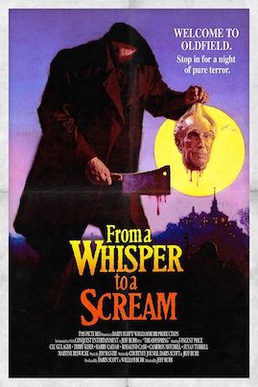
I watch bad movies so you don’t have to.  Maybe that’s my ticket to retirement (it certainly isn’t working the usual way).  In any case, my habit of trying to find something “free” on a network I already pay for often leads to films that keep me awake on a drowsy weekend afternoon, but really don’t offer much else.  Sometimes you learn something nevertheless.  I recently watched From a Whisper to a Scream.  It was free and got more than five stars out of ten, but I didn’t really work for me, even with Vincent Price.  A vignette movie, it presents four episodes from Oldfield, Tennessee, making the claim that it’s a place infected with evil.  The first involved necrophilia, with consequences.  The second—more in a moment—was about eternal life.  Lovecraft’s circus comes to town in the third, and the fourth is about the founding of the town during the Civil War.  Of course, the framing is a “bonus” mini-story as well.

The second episode, “On the Run,” has a wounded ne’er-do-well, shot by some southern rivals, falling into a swamp boat.  He’s rescued by an older African American who lives alone in said swamp.  Noticing him practicing hoo-doo (cue The Skeleton Key), the miscreant soon figures his rescuer has found the secret of staying alive forever (which he has).  Naturally greedy, the petty criminal “kills” the African American and ransacks his shack for the secret potion that keeps him alive.  Being horror, the dead come back and the owner of the shack returns to punish the white man who is trying to steal what he already has.  The Black man had given him the potion to bring him back to life.

There’s a bit of a parable quality to this particular story.  Each vignette predictably has the evil-doer punished, with the exception of “Lovecraft’s Traveling Amusements,” where the Black woman owns those who work her carnival.  And she gets away with it.  None of the characters, apart from the Black man in the swamp and the children in “Four Soldiers,” are really sympathetic.  Religion does also come in the Civil War segment since, drawing cues from Children of the Corn, the kids have created their own god.  So, a diverting film, if not a great (or even a good) one.  This was Vincent Price’s last true horror film, making it worth seeing for that reason alone.  His role is limited to the framing story which, as we might expect, becomes part of the collection of horrors from Oldfield.


Lovecraft’s Palace

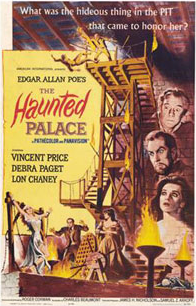
So, to see Witchfinder General I had to buy a set of Vincent Price movies.  Complex copyright deals mean that not everything can be streamed—there’s a movie I’ve been waiting months to see because Amazon Prime says “not currently available in your area.”  That word “currently” tells you that it’s a rights issue.  In any case, that box of Price movies contained a few goodies I’d never seen and had wanted to.  And one that I hadn’t heard of: The Haunted Palace.  Legendary producer Roger Corman had Price star in a variety of Edgar Allan Poe adaptations.  (Witchfinder General wasn’t one of them.)  Corman wanted to make an H. P. Lovecraft movie, but the studio insisted it stay within the identity of this Poe series.  This movie is an adaptation of Lovecraft’s “The Case of Charles Dexter Ward,” but titled after a Poe poem, “The Haunted Palace.”

Suffice it to say, I knew little of this before I sat down to watch it.  I didn’t know, for example, that this was the first big-time movie based on Lovecraft’s Cthulhu mythos.  I didn’t realize it would involve the Necronomicon and perhaps the first, blurry—to preserve the sanity of viewers—view of maybe Cthulhu.  The movie doesn’t specify which of the Old Gods is kept in this pit, so it could be Yog-Sothoth instead.  You see, as a child I watched some of the movies in this series.  They would’ve had to have been the ones showing on television, likely on Saturday afternoon.  The one that I clearly recall, and remember thinking “that’s not how it goes!” was The Raven.  And as a child I had never been exposed to H. P. Lovecraft.

Some of us have our own brand of cheap or free entertainment.  The small number of friends I had growing up didn’t care to read.  My family wasn’t literate, and most high school teachers couldn’t suggest much to a kid who’d somehow found Poe and liked what he read.  As I’ve said before, Goodwill was my bookstore.  I discovered Lovecraft on the internet during a lonely stretch of teaching at the University of Wisconsin, Oshkosh.  Like many visionaries, Lovecraft didn’t achieve fame in his lifetime, but is now considered a bizarre American treasure.  The Cthulhu mythos is everywhere.  Even my auto-suggest is quick to fill in his name as I type.  The Haunted Palace isn’t a great movie—this is Roger Corman—but it’s a pretty good movie.  And its history in the cinematography of Lovecraft makes it worth part of a Saturday afternoon.


Original Fly

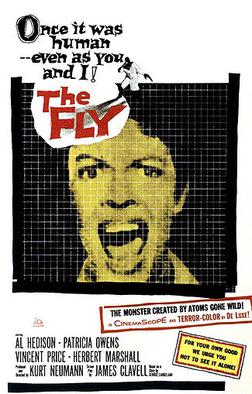
Thinking about it made me do it, I suppose.  Watch The Fly, that is.  This is a movie I grew up knowing about.  I knew the basic plot but somehow was never in the right place at the right time to see it.  Until now.  For a movie from 1958 it remains strangely affecting.  I was wondering whether religion would enter into it, and indeed, in a moment drawn from Frankenstein, André Delambre expresses that he knows what it feels like to be God.  No thunder to drown it out this time.  A short while later his wife Hélène asks him what he’s doing as he is relaxing in the back yard.  He says he’s looking at the sky, or maybe looking at God.  In the light of other mad scientist movies this is a somewhat self-aware moment.

The Fly is one of those movies that had great influence on popular culture.  Although critics at the time thought of it as a gross-out (they obviously had no idea what David Cronenberg would do!) it nevertheless managed to find its way into dialogue with other movies.  The correlation to Willie Wonka and the Chocolate Factory’s Mike Teevee’s scene is remarkably close.  (Adult’s who’ve read Roald Dahl and who’ve paid attention to the movie know that this is kid-friendly horror.)  I’m also pretty sure some of the writers from The X-Files knew The Fly as well.  The Fly, coming during the atomic age, is clearly a warning about using technology that we don’t understand.  Although the movie made a great return on investment for the time, the message still hasn’t been received.

In many ways The Fly set Vincent Price’s trajectory toward being a horror star.  After all, just two years earlier he’d been in The Ten Commandments.  Isn’t he another connection between religion and horror?  Although not the lead in The Fly, as André’s brother François, Price has the most philosophical line: “The search for the truth is the most important work in the whole world and the most dangerous.”  Like the warning about technology, this is a bit of information that might have usefully been heeded.  The political events of 2016 to 2020 demonstrated just how important the search for truth is (and demonstrated religion and horror).  Even with a partial fly brain, André Delambre destroys his notes after making Hélène promise never to reveal what happened.  The truth gets out, of course, leading to the observation behind many mad scientists’ ravings: what is really being sought is the rush of knowing what it feels like to be God. 


I’m No Legend

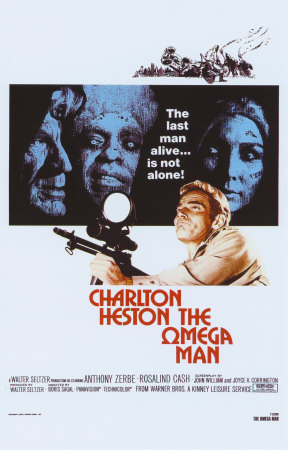
First there was The Last Man on Earth with that rare, disappointing performance by Vincent Price. Then there was The Omega Man, putting Charlton Heston into the role that fit him better than Moses. Finally, returning to the original title, I Am Legend featured Will Smith as Robert Neville. Having watched all three movies, I knew I should have read Richard Matheson’s short novel first. After all, it was a vampire story, and who doesn’t feel utterly alone once in a while? I finally decided to make an honest man of myself. It occurred to me as I started to read that I didn’t know how this story would end. All I had ever seen were cinematic treatments—and who writes anything serious about genre fiction? Still, I needed to know.

Last Man

Matheson was one of the writers who had caught Rod Serling’s attention on the Twilight Zone. Having read some of his short stories I could see why. Not knowing the ending, some of them can actually be scary. I Am Legend isn’t exactly frightening. It is, however, thought-provoking and sad. Matheson, a New Jersey native, wasn’t among the most literary of writers. Nevertheless, he conveys some deeply disturbing images of humanity in this particular novel. After all (spoiler alert!) Robert Neville is the evil one. He has been killing vampires with a cold calculation, no matter whether they are living or undead (good or bad). Who has a right to kill whom depends on your point of view.

The-Omega-Man-Poster

In I Am Legend, Matheson makes it clear that Neville, the last man alive, is an atheist. The problem, as it usually is, is theodicy. How could a god allow such a massive tragedy to strike not only himself, but the entire world? After the vampire virus had spread, Neville finds himself dragged into an evangelistic meeting by terrified survivors who had turned to religion to make sense of their tragedy. Neville escapes as quickly as he can. The movie versions tend to ignore this poignant aspect of the narrative. After all, the audience watching must sympathize with Neville or the whole draw of the movie is off. In a nation where atheists are trusted about as much as vampires, it seems that Matheson left us a parable as well as a legend.


Last Call

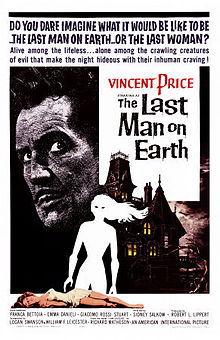
A believer in equality across media, I decided to balance out my recent viewing of The Last Woman on Earth with its chronological sequel, The Last Man on Earth. I have seen I Am Legend a time or two, but I have not yet read the Richard Matheson novel. Knowing that the first cinematic attempt at the story was the Vincent Price version, I was curious to see what the last man and the last woman had in common. Not surprisingly, it was a church. The story has been around long enough that spoiler alerts are superfluous, so here goes: basically, vampires have taken over the world. Somehow Robert Morgan has survived and spends his days hunting vampires and whiling the nights away with jazz and booze. As the opening sequence rolls, the camera lingers on a church where the marquee reads “The End of the World.” Of course, in a quasi-literalist sense this is true. Robert is the only non-infected person left. He is eventually located by the infected-but-inoculated crowd and chased down to be staked to death at the altar of a church. The culmination is strikingly similar to The Last Woman on Earth where the final scene also involves a death at the altar in a church.

The noticeable difference, however, revolves around gender. There is very little in the way of sexual suggestibility in The Last Man. Even the scenes of Robert with his wife are chaste and emotional distant. The appearance of Ruth does not even tempt him after three years alone. The Last Woman, however, revolved precisely around this axis—one woman, two men. The sexual tension is the fuel that moves this entire movie along. Of course, the 1960s became the decade of the sexual revolution, but even so the female is decidedly an object in Last Woman. Even in The Last Man, the woman leads to Robert’s death. She was sent to betray him, and although she changes her mind and attempts to save him, it is in vain. Robert dies in her arms. This fear of female power has never dissipated. How many women have been elected president since the 1960s?

While maybe not the heart of the matter, religious constructs may be the lungs or stomach of the situation. Although current religious thinking often insists on equality of the sexes, a tremendous cultural freight placing women in an inferior status continues to weigh heavily on our cultural mores. The largest Christian body in the world still denies women access to the priesthood. Even the idea of denying access underscores just how deeply this sentiment runs. The movies of the early 1960s had neither the budget nor the cultural support to suggest that things should change. Indeed, in both Last pictures the message was that the world had ended already—why bother trying to change anything at this late stage? The final shot, the stolid interior of a church, underscored the message: the status quo has the sanction of the divine.