Fighting God

Quoting Orson Scott Card, P. W. Singer notes in Wired for War that two of humanity’s “primary occupations” are war and religion. These two aspects of life are simultaneously very distant while abutting each other. While analysts cite many causes of war, there is no agreement concerning why we seem to be constantly belligerent. As a species we are keenly aware of small differences, perhaps like ants, and use those minor points to excuse the exercise of violence. Yet we are also a profoundly religious species as well, believing in supernatural powers that sometimes deliver us from, sometimes into, war. The Bible, just by way of example, contains many accounts of war. Often they are undertaken at the behest of deity. Religion and war coexist a little too comfortably.

Although Singer’s purpose in this book is to analyze the impact of robotic technology on the practice of war, he also finds indications about the origins of war itself. In today’s affluent world, dominated by technology, we should expect that armed conflict would be on the decline. Instead, it would be difficult to find any historic era when unfair distribution of basic goods has been more pronounced. As Singer notes, social disruption today tends to begin in cities, places where those in squalor daily see the opulence of their neighbors’ lifestyles. Our culture awards the aggressive—those with bigger houses, bigger cars, bigger payrolls. To these we defer. At the same time, the vast majority have difficulty finding enough to survive, let alone thrive. Still, we offer tax breaks to those who don’t need them and remind the poorest of their social obligations. This is often done in the name of religion. God is the ultimate capitalist.

The sum result, it seems, is not to lessen human hopes for religious deliverance. The belief in fairness, biologists inform us, is deeply embedded in primate evolution. We believe in fairness, and when it is elusive we thrust it toward the heavens, trusting in divine justice. Millions have died awaiting that justice that isn’t forthcoming. Again, another quote from one of Singer’s sources, “Amid galaxies of shining technologies there is a struggle to redefine human meaning… Half the world is looking for God anew, and the other half is behaving as though no god exists” in the words of Ralph Peters. Although the reference here is to technology, it could just as easily be to money or war. It appears as though we have an actual trinity of casus belli that are inseparable: technology, money, and God.

Some of our earliest technology

Battle Bibles

“There are no atheists in foxholes,” so the old saying goes. No doubt, war is among the most stressful circumstances in which humans insinuate others (who goes to war happily and without reservation?). As a corollary, to keep soldiers comforted in hellish surroundings, it has at times been common to supply them with Bibles. In an exhibit I’ve not yet seen, the Museum of Biblical Arts in New York currently has a display of soldier’s Bibles. A poignant dissonance accompanies such a concept. In the newspaper story announcing it, the phrase that leapt out at me was “Bibles clothed in camouflage.” To be sure, the Bible contains many narratives of war, even demanding genocide in certain circumstances, but as a whole the most valued commodity appears to be peace. Too often, however, it is peace on our terms.

According to the article, Bible distribution began in the United States in the Civil War. Bibles were offered to belligerents on both sides. Naturally, taken into the viewpoint of the chosen ones, God is on the side of the reader. God is the ultimate conflicted deity. This is cold comfort to a soldier dying on the battlefield of all-too-human contention. In keeping with religious differences, over time Protestant, Catholic, and Jewish versions have been offered. Notes in these government-issued religious documents urge the soldier to find succor here. One need not read too deeply between the lines to find the message is the willingness to lay down one’s life.

In a world acutely aware of religious differences, the idea of supplying fighting forces with religious backing may seem questionable. Can there be sincerity in the message that Scripture of any description ought to comfort a person who has been placed in this unenviable position by human greed, powerlust, or self-aggrandizement? What reason have we for war any longer? If religion be true, why have we not matured by even a millisecond since Joshua invaded Canaan? Giving a soldier a camouflaged Bible is to place a Band-Aid on a gaping wound requiring many stitches. Far better to take the message of peace to heart and look for reasonable ways to solve our differences. Idealistic? Without doubt. But it might help to save the cost of distributing Bibles to those whose lives are seemingly less valued than those who begin armed conflicts in the first place.

There is no “holy” in war.


Foxhole Atheists

It’s Veterans Day and prayer makes the headlines. The old adage about no atheists in foxholes comes to mind as those who fought for the values we hold reminisce about the not-so-happy days before the 1950s when the last semblance of normalcy in American life apparently died. The New Jersey Star-Ledger quotes a World War II veteran who participated at the Battle of Normandy saying “I might have prayed more than I ever prayed before.” No atheists in foxholes. As a lifelong pacifist, I have always believed that war is a terrible waste. 3.5 billion years of evolution and the best we can come up with is to hurl supersonic lead slugs at each other over who gets what and who deserves more than who else. I don’t deny that veterans should be honored – my father was a veteran – but war should not.

A sad truth is that many wars, probably in the history of the modern world, most wars, have been fought for religious reasons. The idea that God demands certain things ultimately leads to fighting over what it is God wants. Both sides often claiming the silent deity is on their side. Millions of mere mortals have had to pay the price. Hey, can’t we just talk about this?

War may very well have evolutionary roots. Studies of chimpanzees suggest that homo sapiens are not the only overly aggressive primates. If we deny our cousins religion, however, only homo sapiens fight for mythological causes. One of the great ironies of life is that the most advanced technology trickles down to civilian life from military applications. If something is new, it must have a tactical use against the enemy. Once the enemy is subdued, we can share the wealth. I grew up hearing about “godless Communists.” I watched in dismay as Bush declared a new crusade. I shudder when I read that Iran is developing long-range missile facilities. God is the midst of all this. Veterans protected us from the human-level wars of a bygone era. In our own homemade Armageddon, however, our own technology will doubtless become the weapons in the hands of an angry God.

If God be for us...


War and Peace

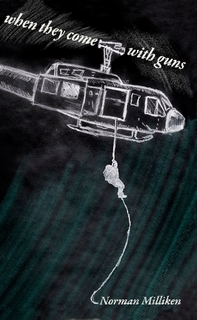
A few weeks back a friend pointed me to a Facebook-style website someone in my high school graduating class had put together. In high school I was awkward, shy, and a little too obvious about my religious beliefs, so I was a bit timid to join. Nostalgia eventually got me in a headlock, just like in gym class, so I signed up. One of my classmates helped me to find one of the people who had a profound impact on my life. Although I never had him for a class, Mr. Milliken was my Creative Writing Club advisor, and a person I utterly respect and admire. I’m not normally a hero worshiper, but Mr. Milliken had been through more suffering than many men his age and had come out of it a sincere, caring, and thoughtful individual. When I found out that he had published a brief collection of his poetry about his time in Vietnam, I immediately ordered it.

Available from Lulu.com

War has always haunted me. Perhaps it was partially because of the tales Mr. Milliken sometimes told, or because of my macabre reading about the terrors of twentieth-century conflicts, but whatever the cause for my fear, it was real. War has been with humanity for as long as its more docile cousin, civilization. Being rational creatures, there seems to be no reason that we should not be able to reason ourselves out of armed conflict, but we don’t. Knowing that one of my most respected high school influences had nearly died in Vietnam chilled me. Reading his poetry, I shiver once again.

While justifying it on theological grounds, the Hebrew Bible takes a fatalistic view of war. Killing of enemies who stand in the way of god’s plan is sanctioned, commanded even. The victims, however, are humans just like the victors.

When I get caught up in the complex web of difficulties my own life has woven into, I find it easy to complain. Reading when they come with guns, however, reminds me that many have had it much worse and have come out as superior human beings. For those who are victims of war, we can only hope that forgiveness will somehow descend on those of us who have not yet put an end to it.