Forgive Us Our Tabs

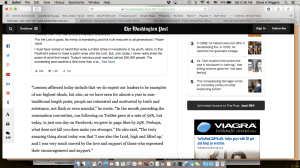
Forgiveness is somewhat of a specialization among the crowd courted by the new GOP. Although it is forgiveness that goes only one way, at least it’s a start. Think back to Bill Clinton making his non-inhalation declaration followed by W who could not hide from his drug-fueled Yale days. Televangelists who admit, in tears, that they had an affair stand a fair prognosis for at least a limited recovery. The religious right loves a repentant sinner. I suspect it will be the trump card in the deck, come this fall. A host of sins can be banished under this incredibly effective rubric. This past week Mike Webb, Republican hopeful for Virginia’s Congress, having lost his party’s bid decided to run as an independent. No forgiveness required. What’s right is right. During his announcement of his decision, however, he posted a screenshot on Facebook without checking his tabs. As the Washington Post article by Justin Wm. Moyer reveals, some of those tabs included porn sites. In a move no Democrat could’ve made, the conservative candidate thanked God for his mistake and his likes increased by 25 percent.

Technology is a kind of big brother. By their tabs you will know them. Our browser histories reveal who we really are. Browser histories, however, may be cleared. And those who know how to manipulate the forgiveness card can make no mistakes. After all the Gospels declare that you must forgive the repentant 490 times (taken literally), which leaves a comfortable margin to get elected. A little bit of time with the Good Book can do wonders for your campaign. The problem is, it only works with the GOP. If he admitted to inhaling, you can be sure that the War on Drugs would’ve crashed down on the White House. Dems have to keep squeaky-clean records because forgiveness doesn’t apply to that crowd.
Screen Shot 2016-05-21 at 5.38.11 AM

One of the ironies, apart from the Viagra ad on the page telling this story, is that such incidents reveal a basic misunderstanding on the part of the electorate. No tenet is more easily finessed than forgiveness. Who’d hit a dog who’s rolled over on his back, exposing his vulnerability, admitting that he’s just eaten what you left on the counter for your dinner? Apologies can be accepted for some of the most outlandish sins. They’re cheap to make but reap rich rewards. As a former evangelical I know this may sound terribly cynical. All I can say is I’m sorry, please forgive me. And don’t look too closely at my tabs.


Game of Thrones

IMG_2763I risk my already flagging street cred by admitting this, but I don’t watch Game of Thrones. In fact, I started to read the first book a couple years back and I just couldn’t get into it. Well, only 80 pages into it. The fault is, I’m entirely sure, my own. I lack some gene or enzyme that makes life without Game of Thrones impossible. Still, I have to admit curiosity. A story on the Washington Post, by Ishaan Tharoor, suggests “The ancient Persian god that may be at the heart of ‘Game of Thrones’” is Angra Mainyu, aka Ahriman. This managed to catch my attention. Zoroastrianism is a religion that seems to lie behind quite a bit of modern religious thought. Although dating Zarathustra, or Zoroaster, is notoriously difficult, concepts from his religious system show up in Hinduism—one of the earliest forms of religious expression about which we know a fair deal—as well as in Judaism and therefore Christianity and Islam. In fact, many of the ideas you may associate with the central tenets of Judeo-Christo-Islamic tradition may go back to Zarathustra.

One of the certainties about Zoroastrianism is that it was a dualistic religion. Good and evil are engaged in a constant struggle for control. The good god, Ahura Mazda (which sounds like a blend between Star Trek and a Japanese auto maker) struggles constantly against Angra Mainyu. Mazda’s website states that the car line is named after the deity (according to Wikipedia, I note, losing the last vestige of cred), pushing his reach even further east. With this incredible pedigree, it is no wonder that George R. R. Martin may have tapped into it. This kind of dualism is ripe for the picking.

My friend K. Marvin Bruce wrote a satire about the Persian gods, in fictional form, that was published a couple years back in Calliope, a small circulation literary journal. He told me he even won third place in a contest for it. The idea was that a disgruntled professor wanted to start the apocalypse (a Zoroastrian idea) by summoning Ahura Mazda and Angra Mainyu to earth to try to start a fight between the two. It was a fun story, but the point, if I may speak for my friend, is serious. Warring religions stand the best chance of beginning the end of times. We don’t even need the gods to do it, really. Although I don’t watch Game of Thrones, I can’t help wonder if Martin had the same idea in mind. If you want the answer to that, don’t ask me. I’m not even a hundred pages into it, and I don’t have triple play.


Le sacrifice humain

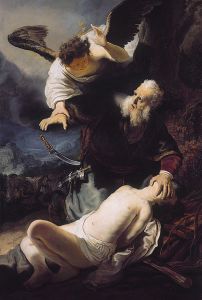
The thought of lying tied to an altar while you know someone is about to murder you is a terrifying one. For several reasons. Clearly, you don’t want to die. A more potent fear, however, may be that a darkly savage deity lies behind the dead. An angry, demanding god who desires nothing less than your annihilation. A story in the Washington Post by Sarah Kaplan suggests new findings by anthropologists now suggest a much more frightening rationale behind the world-wide phenomenon of human sacrifice. Kaplan reports that the article in Nature suggests human sacrifice was a means of social stratification. Maintaining control. Surely it must be obvious that those sacrificed are never the powerful and elite, unless, in a reversal of power structures, they suddenly find themselves on the wrong side of the might that makes right. Think of England’s King Charles I, for example. The societies scrutinized in this study, however, are less “civilized” and human sacrifice is a means to remind people who’s in charge.

404px-Ofiara_Abrahama1

What I find interesting about this is how easily the discussion slips into religion being part of the mix. Those of us who’ve spent our professional youths earning advanced degrees in the field have long realized that there is a political element to religion. Temples, yes, were built to the glory of their gods. They were also built to help finance the monarchies in power. Even the temple in Jerusalem was only erected after the monarchy was finally entrenched. Priests supported kings and kings supported priests. They were the elites of society. As Nathan so aptly pointed out, you don’t sacrifice your own lamb when you’re rich. You take someone else’s. Thus it has always been with the exercise of power.

The Nature study examines stratified and egalitarian societies. Human sacrifice is most pronounced in the most stratified. Those where—let’s not be too blunt here—the top one percent want to demonstrate their obvious control over the rest, human sacrifice is most common. Is it really religious? I think the answer is obvious. The gods people worship are those that are most like themselves. The difference is largely one of power. Might, despite all protestations to the contrary, does make right. Or at least right-wing. Human sacrifice still occurs. If the new study is right (and who can argue with science?) there is only one way to avoid being at the wrong end of the sacrificial knife. Or stone. Or torch. And it is to sacrifice the potential to become rich in order to ensure true equality.


Long Distance Commute

AwkwardSilencesWhat should my next book be? This is the perpetual question of the long-distance commuter for whom electronic devices are mere distractions. If that commuter is socially awkward and believes that only books truly understand them, that is. I’m as eclectic a reader as I am a voracious one. Each book suggests, in some measure, the next one. I always have to keep an eye ahead. Then I read (present tense) a book without peer. I feel lost because what will replace that experience I’ve had for the past few days of looking up and finding myself at my destination? Of actually looking forward to getting on the bus so I can read? I’ve been doing this commute for over 400 books now, and I’m at a loss for what to read next. I blame it on Amazon.

In the publishing world we use Amazon to purchase competitor’s books. Then Jeff Bezos decides to buy the Washington Post, you know, the way people do. Since my email address is on their list I get sent a daily invitation to read the most read stories on said Post. I read a story by Alexandra Petri and I was hooked. Where could I get more? A Field Guide to Awkward Silences is the rare kind of book that makes you laugh out loud on the bus, which, at six in the morning, generates its own kind of awkward silence.  Petri makes you feel like it was actually okay to be that dorky kid who read all the time.  Like there’s a world out there that responds to your longings, somehow.  A world of possibilities.

Now here I am about to climb on the bus without Petri. I’m like a kid staring disconsolately at an empty candy wrapper. “That was so good!” you think. “I wish there was more.” Petri writes as if she’s achieved Bob Dylan’s blessing and has stayed forever young. The time of life when the future seems so full of possibilities. Hers is writing that reminds you of a time when you didn’t spend hours a day nursing hemorrhoids, sitting on a hard bus seat. That reminds you it was possible, unlike your own experience of it, to be cool as an Episcopalian in Wisconsin. That reminds you of the time when you had A Field Guide to Awkward Silences to look forward to reading. No, this book didn’t make that choice of next book any easier at all.


Who’s God?

There shall be wars, and rumors of wars. The Bible says nothing about being able to declare what future people might have to say about God. According to a story on the Washington Post website, Larycia Hawkins, a political science professor, was suspended from Wheaton College for claiming that the God of Islam is the same as the Christian God. Administrators felt this was one of those cases where the famous statement of faith required of Wheaton faculty was violated. Seems to me the administration might want to sit in on a class in history of religions. Everyone knows that Wheaton takes great pride in its Evangelical heritage, bordering on a kind of extreme conservatism. Even so, this seems extreme.

There is much we don’t know about the early history of most religions. Probably one of the resons for this is that, apart from the founder, we’re never sure if a new religion will take off. Many religions have started and then quietly (or not so quietly) died away. At the earliest stages nobody really knows which way it might go. We do know that by about the time of the Exile, the early Jewish faith was fast becoming monotheistic. Christianity, although disputed by some, also followed in that mold, accepting the God of Jesus of Nazareth (himself a Jew) as the one God. Here many Evangelical histories grow a little weak when focus is shifted to Arabia. The cultural context that led to Islam involved a world of pantheistic worship, but Mohammad was well aware of, and appreciative of, Judaism and Christianity. Recognizing that his faith shared the same books as the other two, his understanding of Allah was clearly the same God as the one worshipped by the Jews and that Jesus had called “Father.” The three monotheistic religions of that region, historically, have always shared the same God.

IMG_2472

Disowning a deity, I suspect, comes with some anxiety. As Islam expanded and Christianity itself became an imperial religion, clashes were bound to happen. Invective included calling the enemies “pagan” or “infidel” (technically two separate things), and as so often happens, rhetoric became mistaken for fact. Since Islam and Christianity were different religions, so the thinking went, they must recognize different gods. Triumphalism is seldom subtle. Fact checking wasn’t so easy back in those days. Suspending a professor for stating the truth is, I fear, nothing new. Some schools require statements of faith so that they may ensure academic freedom is a myth. Ironically, they seldom have trouble with accreditation. The ideology of a war between religions offers a doleful prognosis for a world where religions really need to try to understand each other and where obvious historical facts should count for something.


O Come Let Us

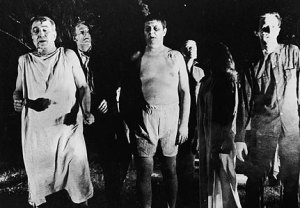
During the height of the zombie craze a meme went around the internet proclaiming “zombie Jesus.”  It was funny because the salient feature of zombies is that they come back from the dead.  Noting the resurrection and the easily annoyed trigger finger of Fundamentalist Christians, some wag brought Jesus and the undead together.  We had a good laugh and forgot about it.  A guy in Ohio with a sense of humor, took the zombie Jesus meme and constructed it into a zombie nativity scene in his yard.  None of us knew about it, of course, until it caught the attention of the news.  A story in the Washington Post notes that the man was required to take the scene down for violating zoning laws.
 
People take their religion very seriously and have a hard time laughing about it.  Religion is under constant fire from angry atheists and it already suffers a complex from having so many liberals pointing out the historical and logical faux pas from within the tradition.  Some people take advantage of American gun laws to stock up against the day when they’ll step over the line and join those who shoot up offices where they think Mohammad is being mocked.  Then we’ll sit around and wonder if we should classify them as terrorists or just deranged.  And we’ll post a take-down order, just in case any zombies remain.

NightoftheLivingDead
 
As an academic (at least erstwhile) I noted how little religion scholars reveled in the humor of their traditions.  There’s funny stuff in the Bible, believe it or not, and many religious traditions allow for a Mona Lisa smile every now and again.  A far more common stance, however, is that of taking offense.  Something that most critics just don’t realize is how much religions mean to those who believe.  I chuckle once in a while, but I never belittle the beliefs of others.  I have been in this religion thing since I can remember, and I know what it can mean to people.  The best way to avoid offending, I think, is to keep our jokes among the crowd of those who have a sense of humor.  Of course, the undead obey no rules and the media (and its unruly accomplice, the internet) can’t resist spreading memes that might earn a buck or two of advertising revenue.


Secular Seminary

The Nones have it. A recent article by Alana Massey from the Washington Post puts it well. We are cultural Christians living in a secular world. My mind often goes back to the fate of those trained by a system that proves itself to be false. We are seduced by religion at a young age, and we readily accept what our culture and our clergy tell us is true. Some, like yours truly, can’t rest without knowing the truth. We press on to seminary, then to graduate school, only to find that the answer is more questions. No church will hire you. No college will either. You’ve invested your youth in finding the truth and you’ve come up empty. There’s a comfort in the old liturgies, but they ring hollow nonetheless. I know many clergy feel this way but can’t admit it. What you sign on the line declares that you “believe” and if you’re honest you could lose a livelihood into which you’ve invested everything.

So I’m thinking, why not found a secular seminary? There are atheist churches beginning to appear. Those who would lead congregations of the unfaithful must have some training, mustn’t they? A secular seminary curriculum wouldn’t need to differ much from that of the standard churches. The secular should understand the Bible. You need not believe, but you’re naive if you don’t understand it. They should also know the history, the non-theology, and the way to lead a service. Pastoral care could be taught, even as it is for those who attend seminary. You need not be a believer to care for other people. In a secular society that requires some spiritual nurture, this is the obvious solution.

IMG_0481

There must be plenty of wealthy people out there willing to buy their way into peace of mind. If there’s no Heaven to own, perhaps purchasing tranquility here on earth would suffice. The numbers of those attending church is falling. The number of those desperately unhappy is rising. We have trouble believing the myths any more and science leaves us feeling cold. Maybe it is time to take seriously the concept of secular seminaries. There are seminaries for all denominations except the most conservative. Perhaps it is time for the most liberal to pony up as well. The Episcopalians have always said they wanted an educated clergy. When clergy are educated the crisis only deepens. It seems to me that this may be the cusp of a worthy idea. If so, perhaps there is hope for a sacred secular society yet.


Truly Educated

Binghamton University looms large in my consciousness, for rather obvious reasons. Although it sits in a small corner of upstate New York not particularly near anything famous, it has its own culture. Having taught at several schools, and having studied at many along the way, I’ve always been particularly struck by the genuine nature of Binghamton. For example, it is the only school—apart from a hazily recalled “Bible Study” led by the then president of Grove City College—at which the president has made himself available to be met and chatted with by hoi polloi. I’ve met and talked with him twice, and although I taught a phenomenal number of courses at Rutgers, and conveniently solved a crisis in the religion department for a year at the University of Wisconsin Oshkosh, I never found a time or place when the president was available to the likes of mere mortals. Not only that, but at a time when other universities are cutting whatever faculty they can to make more administrative posts, Binghamton is actually hiring faculty and expanding. I feel renewed when I visit the campus. You can tell they care about people.

A story in the Washington Post underscores this. One of the graduation speakers at the Watson School of Engineering is an Orthodox Jew. His commencement ceremony fell on Saturday—the sabbath. According to the dictates of his faith, speaking through a microphone system that passes through a soundboard is considered work, and could not be done on the sabbath. In today’s climate, I would expect most universities to say, “too bad.” Religion is not to be taken seriously, right? So just get over it. Here’s where Binghamton, however, shines. They taped the address beforehand, allowing the speaker to take the stage and have someone else broadcast his speech. This isn’t about picking apart the logicality of anyone’s personal Torah, it’s about recognizing the human.

DSCN4915

Our very religious society has a way of compartmentalizing religion so that we can still get away with what we want to do. We can be religious when our clergy so dictate, but otherwise we’re pretty much free to look out for number one. This story is one that makes me proud to have once been a part of a system that includes a school that can truly lay claim to the designation “higher education.” We learn about the world to become, ideally, better citizens of it. Any university that is able to take what might seem to be a petty problem and recognize its human dimension deserves to have our admiration. It restores my faith in the future. At least in a small corner of upstate New York.


Saving Face

Although it has been commented upon in Rate My Professor, my beard is not intended to be impressive. In fact, it’s not really. Since I was quite young I dreamed of being a bearded man. I don’t know why. My father and my step-father were clean-shaven. The pictures of Jesus with which I grew up, however, seemed to suggest that a kindly man must be a bearded one. Nature deemed, however, that my facial hair would be less impressive than that of many boys I knew in high school who were already contending with five o’clock shadow. I never liked shaving. To me, nature dictated that men should be bearded, and who was I to combat nature? Except for a brief stint when I had to make a living in retail, I’ve worn a beard since I’ve been able to do so. I don’t fuss with it, trying to make it something it’s not. It is simply who I am.

339px-Epicteti_Enchiridion_Latinis_versibus_adumbratum_(Oxford_1715)_frontispiece

So when my wife sent me an infographic from the Washington Post about religious beards, my curiosity was piqued. It actually makes me a little self-conscious, I have to admit. I vehemently dislike anyone commenting on my appearance. There’s also something vaguely sexual about facial hair, coming as it does with the onset of puberty (a few years later in my case). Looking at the ways various religious groups condone facial sculpting, I couldn’t help but think that traditionally religions have said, to borrow a phrase from Frozen, “let it go.” Or let it grow. God and nature are one here. Genetics may determine what kind of beard may grow, but it takes religions to say it is God’s plan. For me, standing before a mirror before dawn, scraping my face with a very sharp piece of metal while I’m still yawning hardly seems civilized. Wash and go seems much more natural to me.

In the biblical world, the beard was a symbol of experience. Lifespans in those days were precarious. Guys surviving to my level of whiteness were revered. Today we are considered scruffy and lazy and unwilling to play by the rules society has set. I suppose it’s no accident that I was always a fan of John the Baptist with his unkempt appearance. Like Elijah before him he was a man of the wilderness. As nature made him. I last shaved in 1988. Were I to do so again, I fear what I might find underneath. Harrell Beck, before he died, once said to me, “you’ll never shave it off.” Although once I did, he has proved himself among the prophets. Just don’t say anything about it to me since, like religion, to me it is a very private thing.


Sign of Jonas

A century ago today, the world erupted in war. Those who engaged in World War One are pretty much all gone now, but the war to end all wars has left its scars across the globe. We showed ourselves we could do it. We could drag, through our accumulated frustrations, just about every nation into open conflict. The costs were astronomical, but we didn’t learn a thing. Just a couple decades later we were back at it. Nations taking provocative stabs at other people. Keep on poking and people, being what they are, will eventually hit back. So on this anniversary of the start of the First World War (awaiting a sequel, perhaps from the start), I’m reading about the extremists in Iraq destroying Jonah’s tomb. Poke. Poke. Well, it is more a loss to fellow Muslims than it is to those who take the Bible seriously. Jonah is a nice story of a prophet (rather blithely retold in the Washington Post) who probably never existed. If there was a Jonah he wasn’t fish food, that we know for sure. The tomb of Jonah is like that of an unknown prophet. The symbol’s the thing.

In the story in the Washington Post, Justin Moyer laments that “anything in the Bible” might be destroyed in these circumstances. I wonder how you can destroy something that never happened. Doing so, in any case, is liable to start a war. It really doesn’t take that much. The last century has taught us little. Don’t get me wrong—I’m not in favor of destroying ancient landmarks or parts of a region’s history. But if we misattribute its importance to something sacred, or biblical, it will be far too simple to start a row. You see, Jonah converted Nineveh, according to the Bible. The Assyrians became good Yahwists, despite the historical record. Those who destroyed his tomb likely had conversion on their minds as well.

As these thoughts were taking form in my head, I happened upon the page of GETS Theological Seminary, which, as far as I can tell, is in China. On the banner across its homepage was a picture of its mission field. Is that the United States? Of course, if you read the description you’ll see that the world, in toto, is the mission field they intend. Still, it is a little bit of a shock to see yourself counted among the heathen. I’m sure, had Jonah really existed, that the Assyrians would have been just as shocked. They were as moral as any other militaristic society. And today my thoughts are on militaristic societies. The First World War definitively changed everything from that fatal moment it began, a century ago today. It was the first, but not the last, loss of humanity’s innocence. We would invent newer and crueler ways to kill each other in greater numbers. Blood would become the true currency of the last hundred years. Maybe we should keep a weather-eye out for a fish-swallowed prophet after all. The world could perhaps stand a bit of conversion.

f11w


Alien Bears

“And if there’s life on other planets, I’m sure that he must know, and has been there once already, and died to save their souls.” Larry Norman, one of the original Jesus Freaks, may not have been the deepest theologian, but his words come to mind as I see scientists reluctantly admitting that maybe life on earth is not so unique after all. It’s been in the news that Kepler Space Telescope’s data have been indicating that other planets like earth may be quite common. It has always amazed me that people have been so reluctant to let go of the notion that we are the only spark of intelligence in this vast, vast, cold, and dark universe. We seem to need to think we’re special. Religions generally indicate that the gods made us for some purpose or another, some love us, some are indifferent, others may be hostile. But generally, we’re unique. The Mormons have for years taught that there is life out there, but mainstream Christianity has generally been agin it, mainly owing to the crucifixion. Larry Norman, the original Christian rock artist, speculated that cosmic history repeated itself: if Jesus died for us, well then, he must’ve done the favor for them too.

Once Edwin Hubble stepped away from the telescope, stuck his famous pipe in his mouth, and said “huh,” I would’ve thought other scientists might’ve considered, like H. G. Wells, that “they” were out there looking back at us. Why this reluctance to suppose that we’re not alone? The story in the Washington Post cites the typical reason: the Goldilocks effect. Scientists, perhaps unwittingly influenced by the anthropic principle, have supposed other planets, if they existed, were either too hot or too cold to support life. We, like Goldilocks, happened to inhabit the only planet among the billions of galaxies of billions of stars, that got it just right. More like God-ilocks. The idea derives from Genesis where, it is strongly implied, we are the only ones. Religion influences culture, whether materialists want to admit it or not. The earth-only bias is inherently religious.

Who's looking back at Hubble?

Who’s looking back at Hubble?

Astronomers will gradually come around to the idea that there are other planets like ours. It will likely take decades, perhaps centuries, before they will commonly admit that life forms like ours are out there walking around. Eventually they may decide that there’s something to UFOs after all. Meanwhile, various New Religious Movements have already hitched rides on those flying saucers and they will be laughing once the rest of us catch up. We tend, under the influence of those who claim religion is always Bronze Age drivel, to forget that religion often leads the way to new territory. When the little green men and women land, we’ll find that many religions have beat science to the punchline. I’m not so sure, however, that the aliens will know who Jesus is. After all, this chair’s too hard, and this one’s too soft.


Wars and Holy Wars

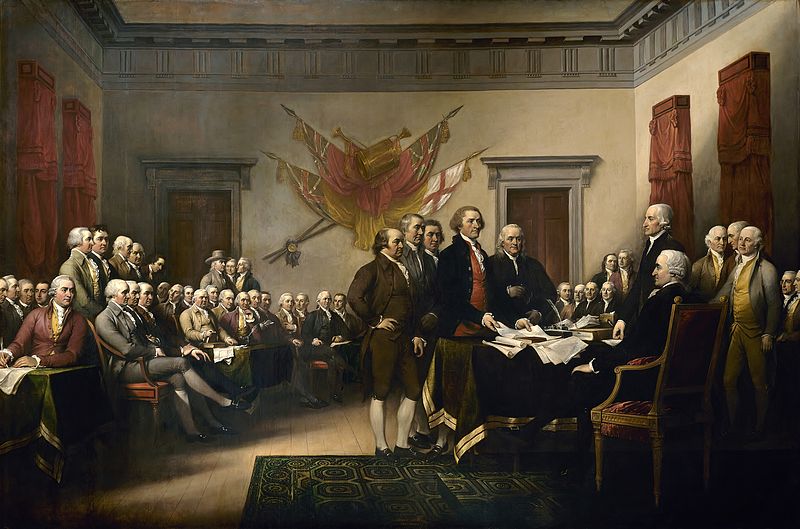
An article by James P. Byrd, promoting his new book Sacred Scripture, Sacred War: The Bible and the American Revolution recently appeared in the Washington Post. Byrd asks a very relevant question in our era: “Was the American Revolution actually a holy war?” He suggests that perhaps it should be interpreted so. The reason is straightforward enough—our nation, our culture in the United States, is so deeply steeped in scripture that even our Deist founders knew their Bibles better than many preachers today do. Byrd suggests, in his article, that people who believed in the separation of church and state could still have a deep sense of divine mission, and a belief that their war for freedom was a divine cause. Early state leaders were not anti-religious, nor über-religious. It is a balance that we would benefit from regaining.

Declaration_independence

I guess I’ve seen enough political shenanigans to realize that such posturing as the Tea Party and the Religious Right or Moral Majority present are deeply cynical. The use religion as a platform to achieve political ends while conveniently slashing and burning huge swaths of biblical reasoning leaves many questions in its wake. Were such motives sincere, I would expect a lot more turning of the other cheek, and walking the second mile uncoerced. I suspect there would be fewer hungry people and even fewer living in positions of extreme wealth and power. In short, without the agenda of political religion, I suspect we would be a more Christian nation.

War is difficult to justify from a strong ethical stance, as most ethicists know. Our founders decided to go to war against what they believed was unfair oppression by a more powerful nation. This takes on the cast of a holy war because people were being oppressed. The pre-emptive strikes were throwing crates of tea into Boston Harbor, and yet the more advanced nation refused to lessen the pressure. In the Bible, Pharaoh declared the Israelites should make bricks without straw, and we all know where that got him. Or we would know, were we as literate as our forebears were. Freedom was considered a sacred trust. We live in a time when trust is at a premium. You can’t fly or surf the internet without being watched in intimate detail. There is no talk of holy wars, it seems, since the sacred has no place in a society that does not promote the concept of liberty with all the risks and benefits it entails.