Becoming

It’s pretty difficult to summarize the feelings when watching your own child graduate from college. Of course, she’s not a child any more, but that’s always the way you’ll think of her. Binghamton University, a “public ivy,” is a competitive school to attend. Hard to get in, and hard to get out. And you know that there were serious struggles to get to this point. Courses conceptually impossible for a humanities ex-professor to understand marked the trail to this point. The academic robes, the positive energy, and the overall sense of accomplishment make this one of those joyous occasions that mark the transition from being the instructed to becoming the instructors. It’s a time unlike any other.
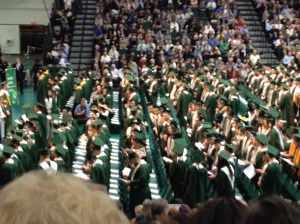
Most of my collegiate thoughts, despite my three degrees in religious studies, have focused on science and engineering. It’s not that the basis of truth has shifted, but the practicalities of “finding a job” have to take precedence these days. The STEM universe may be the only real one, according to those smart enough to know such things. It’s difficult not to feel that studying religion was chasing a chimera, if not a little deluded. Tomorrow, though, the college of arts and sciences will send forth even more graduates into a world where employment itself may be a reverie. Still, I can’t help but think these engineers from the Watson School are just a little brighter than their more humanities-inclined classmates. Parenting is its own kind of bias.

Commencement is a singular moment. Parents sitting in the crowd want to attract their child’s attention for just a moment. Each one down there is a star. You want to be seen by them, recognized if only for a fleeting smile or subtle wave. They’ve accomplished something and everyone is here to cheer them on. Your meaning is tied up in being associated with that person that you’ve coached through so many aspects of life, and you hope you’ve done it well. They’re ready to leave academia behind and experience a bit of the wider world. It’s a cycle as old as this planet’s first molten rotations as it revolved around a distant star. And as those walking across the stage are growing in magnitude, those of us cheering them on try to recollect what it was like to have so much loving goodwill focused on us. It’s difficult to summarize these feelings, but I’m pretty sure I’d call them religious.

Truly Educated

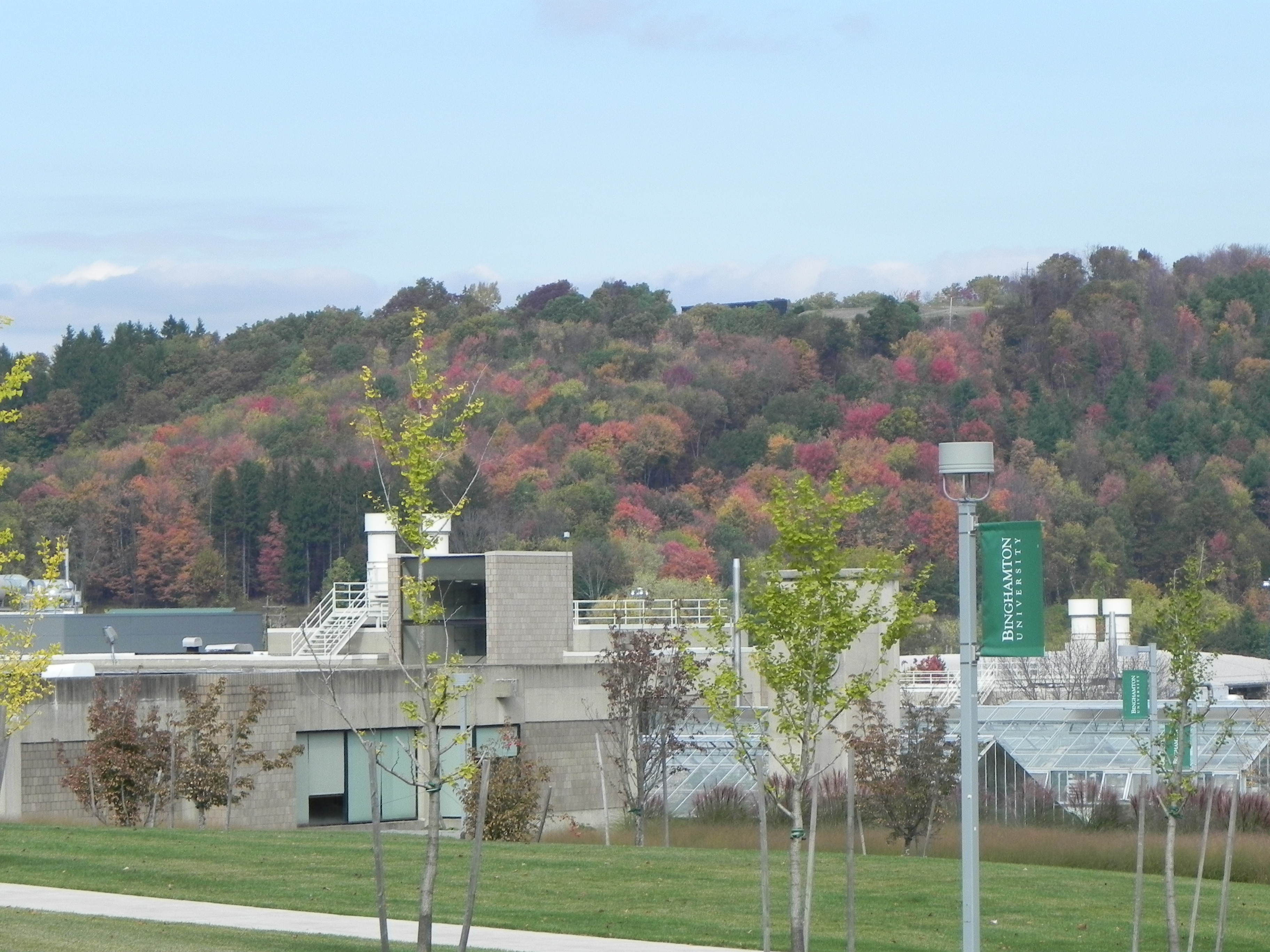
Binghamton University looms large in my consciousness, for rather obvious reasons. Although it sits in a small corner of upstate New York not particularly near anything famous, it has its own culture. Having taught at several schools, and having studied at many along the way, I’ve always been particularly struck by the genuine nature of Binghamton. For example, it is the only school—apart from a hazily recalled “Bible Study” led by the then president of Grove City College—at which the president has made himself available to be met and chatted with by hoi polloi. I’ve met and talked with him twice, and although I taught a phenomenal number of courses at Rutgers, and conveniently solved a crisis in the religion department for a year at the University of Wisconsin Oshkosh, I never found a time or place when the president was available to the likes of mere mortals. Not only that, but at a time when other universities are cutting whatever faculty they can to make more administrative posts, Binghamton is actually hiring faculty and expanding. I feel renewed when I visit the campus. You can tell they care about people.

A story in the Washington Post underscores this. One of the graduation speakers at the Watson School of Engineering is an Orthodox Jew. His commencement ceremony fell on Saturday—the sabbath. According to the dictates of his faith, speaking through a microphone system that passes through a soundboard is considered work, and could not be done on the sabbath. In today’s climate, I would expect most universities to say, “too bad.” Religion is not to be taken seriously, right? So just get over it. Here’s where Binghamton, however, shines. They taped the address beforehand, allowing the speaker to take the stage and have someone else broadcast his speech. This isn’t about picking apart the logicality of anyone’s personal Torah, it’s about recognizing the human.

DSCN4915

Our very religious society has a way of compartmentalizing religion so that we can still get away with what we want to do. We can be religious when our clergy so dictate, but otherwise we’re pretty much free to look out for number one. This story is one that makes me proud to have once been a part of a system that includes a school that can truly lay claim to the designation “higher education.” We learn about the world to become, ideally, better citizens of it. Any university that is able to take what might seem to be a petty problem and recognize its human dimension deserves to have our admiration. It restores my faith in the future. At least in a small corner of upstate New York.