Sky Mercies

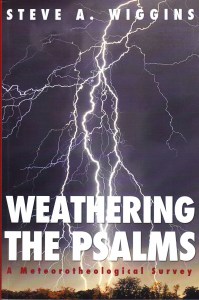
While in a used bookstore recently, I was going over the science titles. I like to read accessible science since I often find it approaches religious ideas in secular terms. Once in a while even the terms of these disparate disciplines coalesce. I spied a volume on the top shelf titled The Mercy of the Sky. The spine showed a purplish cloud-bank, and the very concept set me wondering. We’d just been through a bomb cyclone the day before with wind bellowing through our apartment. Many trees were down and power was out for several people I’d overheard talking that day. I stared at the spine, thinking perhaps this would be a good follow-up to Weathering the Psalms, but as I already had books in my hands, and since I’m not the tallest guy around, it seemed beyond my reach. Of course, after I left I thought more about it.
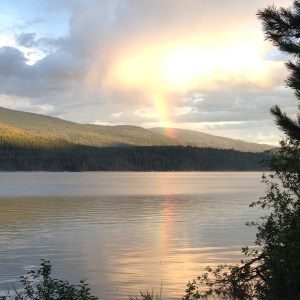
The previous day’s nor’easter had revived that sense of a storm as divine anger. Strong winds, my wife commented, are generally disturbing. They make it difficult to sleep. It’s hard to feel secure when the heavens are anything but merciful. Although the wind is easily forgotten, it’s among the most easily anthropomorphized of natural phenomena. And it’s ubiquitous. Everything on the surface of the earth is subject to it. Indeed, the atmosphere is larger than the planet itself. Is it any wonder that God has always been conceptualized as in the sky? The quality of the mercy of the sky, we might say, is strained.

Danger comes from the earth below us, the world around us, and the realm above. Like our ancient ancestors staring wonderingly into the sky, it is the last of these that’s most to be feared. The wind can’t been seen, but it can be felt. It cuts us with icy chills, drenches us with dismal rain, even flings us violently about when its anger compresses it into a tight whirl. We can’t control it. Unlike other predators it requires neither sleep to refresh nor light to see. Its rage is blind and it takes no human goodness or evil into account. After a great windstorm, the calm indeed feels like a mercy. Elijah on Mount Sinai stood before a mighty wind, tearing the land apart. It was the still, small voice, however, that captures his imagination. There’s a calm before the storm, but it is the stillness in its wake that most feels like the mercy of the sky.

Down the Road

First of all, thank you to my regular readers. I’ve been making daily posts on this blog since July 2009—nearly nine years of illustrated commentary. It seems, however, that I’ve reached my limit. My storage limit, that is, on Word Press. As a result I’m going to be upgrading my account. Now, I’m enough of a Luddite to be uncertain of how this might impact any auto-updates (I flatter myself to think there are some) or links to this blog. I’m planning on continuing Sects and Violence in the Ancient World, but it will be but one page on a website that will offer the opportunity for me to go into more detail about my books. I don’t know how it will look yet, but it shouldn’t be disappearing from cyberspace.

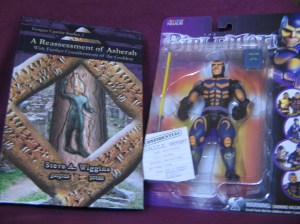
Timing, as they say, is everything. It’s never been my strong suit, however. My current book still has no final title, so it’s a little difficult to promote it properly. Oh, it’s finished, and in the hands of the publishers, and although I can give it its own page, I can’t really title it yet. Perhaps in the height of hubris, the new layout will have pages for my previous two books, A Reassessment of Asherah and Weathering the Psalms. These were both academic titles with very limited sales, but they represent a significant portion of my life and I’d rather not have them completely forgotten. My latest book is for a more popular readership, but I don’t have the platform to interest agents (not for lack of trying), so I’m incorporating it into a website that will allow for its self-serving promotion. So embarrassing. You can imagine how red my face must be.

By the way, there’s another book about half-written. (Actually, there are several, but this one looks like it might actually appear.) A new series has been announced—I’ll write about it once I learn if my proposal has been accepted—that follows my own aesthetic closely. In conversation with the series editors, I’ve put together a proposed book based on my current work. If it happens, a new page will pop up on this future website I’m envisioning. Since I’m no Luddite, I can see possibilities for these pages. The blog will continue with its daily babbling. I’ve been doing this so long I wouldn’t know any other way to start my day. Combined with the hubris of those who spend too much time in supernatural headspace, this could be interesting. If you’re search brings you to what looks like the wrong page, please persist. Sects and Violence will be only a click away.


On the Nature of Publishers

An occupational hazard of the editor is paying obsessive attention to publishers. That stands to reason. Many academics are less concerned than some publishers think they are about such matters as who publishes their book. I suspect that many have, for whatever reason, found no welcome home among elite publishers. This happens often enough to make many scholars less worried about reputation than the practical matter of getting a publisher interested at all. There are a lot of original thoughts out there, and some of them occur to a person and just won’t let her or him go. An example: what terms are used for weather in the Psalms and why? Before you know it you’ve awaken before the sun for five years and written 75,000 words on the topic and you want to get it published without having to pay someone to do it. That kind of thing. I’ve been pleasantly surprised by the number of scholars who understand this kind of reasoning.

Also, it’s a matter of scale. I work for a premier publisher in the academic world. It may surprise many people to find out just how often when someone asks what I do (not very often, for the record) and then follows it up who I do it for, the interrogator has never heard of my employer. Academic presses, even important ones, are really only known among academics. Keep scale in mind. If you’ve ever walked passed Norton’s offices in Manhattan, and then those in which I spend my days, you know what I mean. Academia is small scale. For the average person reading a book is something they generally choose not to do. Of those who do read, very few read academic books. Those who read academic books tend to stick to their own discipline, or related ones. You get the picture—smaller returns at each step.

So, having written a book about horror movies, where do I take it? This isn’t one of those footnoted, look-how-erudite-I-am kind of books. It’s more of a I-noticed-something type. The question then becomes, who publishes such kinds of thing? I do worry about academic reputation—who doesn’t?—but this is a book I want the correct readers to find. That’s why McFarland suggested itself. People reading on pop culture, know to keep an eye on their offerings. Hopefully enough people will find it to have justified the effort. It won’t impress those enamored of collecting (academic) names. It isn’t the kind of book my employer would publish. Nor would I want them to. Call it an occupational hazard. Like any subject, knowing too much about publishing can take away from the fun.


Contracting Something

Book contracts make me happy. After slipping from higher education into the limbo of editing, it took a few years before realizing that not all books have to be academic monographs. For the past couple of years I’ve been silently writing a book intended for general readers. The subject will remain hidden for now, but a contract for the book has arrived and I’m happy. As my friend Marvin says, “for a man being published is about the closest you can come to giving birth.” There’s a bit of truth to that. Several months of thoughts growing in your head finally culminate in a full developed form, capable of surviving outside the confines of your protective mind.

The motivation for many academics to write is “publish or perish.” In my career track I both published and perished. The thing is, I write because I read. It seems unfair to read so much and not to share a bit of what I’ve learned. If you read this blog regularly you know that I have a restless intellect—the kind of thing that in the old days would’ve made you a professor. I no longer have access to university libraries with their arcane journals and massive collections, but reading on the bus is its own kind of research. (Anyone who’s tried to write notes on a bus, however, knows that the research is limited strictly to what can be remembered after a wearisome 90-minute-plus ride in stop-and-go traffic.) A few years back I decided to start writing up what I’d been observing. Slowly a book was formed. The process is not a swift one.

Many people question the ability of editors to write books. No, seriously. Agents are generally only interested in professors, celebrities, and journalists, not those who may have been one of the above once upon a time. That’s why this book contract feels like a small victory. Weathering the Psalms was written for other professors while I was still one myself. A lot has happened since then. I’ve read hundreds of books in the intervening years. Slow study that I am, it took some time before I realized I could begin to analyze all of this and write it in a way the average educated reader could find engaging. Agents declined the project, but now I’ve found a publisher who believes. When you work on your own, like many authors do, finding just one believer is sometimes all that it takes.


Sky Blue

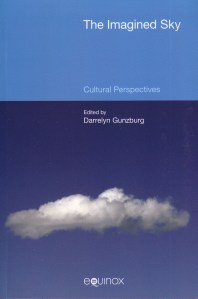
How do you capture a true and abiding fascination in words? That’s a thought that comes to me once in a while when I think about the sky. It’s so hard to define, yet it’s always there. To quote myself: “To understand the weather is somehow to glimpse the divine” (used with permission). I waited for The Imagined Sky: Cultural Perspectives, edited by Darrelyn Gunzburg, for years. I think I first saw an ad for the book two years in advance of publication (yes, scholarly presses can do stuff like that). I kept stopping by the Equinox booth at AAR/SBL to see if it was available. It was the same kind of drive that led me to write Weathering the Psalms. That hope of grasping the intangible. To hold the sky itself. One of my early creative writing club stories was about a boy who wanted the sky. I wanted this book.

Like all books of essays from different authors, it’s a mix of fruits and nuts. There’s some very interesting pieces in here while others seem to have been made to fit only with some difficulty. Still, the sky. I admit to being somewhat disappointed as I read along. This wasn’t for research—my book on the topic is already done—it was for pure intellectual curiosity, what passes for pleasure among academics. Many of the pieces were mired down in detail. Written bout the sky, they refused to soar. Then I came to Tim Ingold’s essay. Here’s what I’d been looking for. Someone who knew the sky could only be approached in terms that contradict themselves at every turn. There is something to say about the daytime sky. It has to do with the nature of light. And of the sky seeing us.

The sky, by definition, is larger than this rocky substrate we call home. It encompasses everything above us. I work in a cubicle with no access to outside windows. I wilt daily like a plant deprived of sun. (Although the wonderful article on light pollution by Tyler Nordgren gave me pause over even that.) I need to see the sky. When clouds block my view, my outlook begins to suffer. It’s that ethereal cerulean I crave. Without it I am but a troglodyte eking out a minimal survival on toadstools and lichen. The sky is our orientation. It is our timepiece. It is eternal. Of the things we do that are evil, polluting the sky is one of the most unforgivable. The key may be in the word “imagined,” but if we could only understand the sky we will have found true religion. They’re called “the heavens” for a reason.


Weather Vain

The other day I was awakened by a severe thunderstorm. It’s been quite a while since that’s happened. Unlike when we lived in the Midwest, thunderstorms in New Jersey tend to be widely scattered and somewhat uncommon. (It’s all a matter of perspective, I know.) My basis of comparison is how often I notice such storms. I’ve never been able to sleep through one. Thankfully this one came at around 4:30 a.m., past when I’m usually awake on a weekend. I’d forgotten the raw power of just how loud and bright such a storm can be. Danger seems all around. The feeling is primal and urgent. As I got out of bed and walked into the dark kitchen, windows filled with electric blue followed by and tremendous blast, I thought once again of Weathering the Psalms and the story behind it.

By the way, when I speak to young scholars about publishing I tell them this isn’t the way to go about finding a topic. That having been said, my book was born in the Midwest. Life at Nashotah House revolves around required chapel twice daily. Weather does not stop it. In fact, holding the daily office by candlelight because a storm had knocked out the power was not uncommon. Morning and evening prayer—indeed, all of the canonical offices—are built around the recitation of the Psalms. Reading the Psalter in slow, stately tones while thunder raged outside, rattling the ill-fitting stained-glass windows, left an indelible impression. It was only natural in such circumstances to notice how often the Psalms mention the weather. Thus a book was born.

I’m currently at work on a new book. I can’t say the topic just yet because someone might be able to beat me to it. (Knowing the way I come up with book ideas, however, I doubt it.) Sitting in my darkened living room, in my writing chair with the fury just outside, I was strangely inspired by the storm. Then it was over. Silence followed by birds singing, just like in Beethoven’s sixth symphony. The thunderstorm is one of nature’s psalms. As at Nashotah House, in the Midwest we had perhaps too many of that particular kind of psalm. Nevertheless, in the silence that followed I was left strongly in touch with my muse. These are the states that lead to poetry and song. Every great once in a while they might even lead to a book idea. As I tell students, just don’t expect that anyone else will get it.


Blizzard Warning

The dangers of prognostication were well known in antiquity. Most prophets, who didn’t so much tell the future as warn about probable outcomes, weren’t the most popular of people. They knew that feeling of walking into a crowded room and announcing their career had something to do with religion only to have the place fall silent. Cricket chirps. We all have our secret sins we’d rather not have some stranger judge. So it is with the weather. Something like this must’ve been in the back of my mind as I was trying to write Weathering the Psalms. I lived in Wisconsin in the days before Paul Ryan and, like said Ryan, tornados could strike at any time, unannounced. My family and I spent an anxious afternoon or two in the spider-infested basement based on the inherently uncertain predictions of how a nearby tornado might move.

Those of us in the northwest are sitting here wondering about this monster nor’easter. It’s been in the making for several days and the forecasters, unlike the prophets of old, have been hedging their bets. If this massive cold front from the midwest fails to meet up with the intense storm off the east coast we could end up with only a smattering of snow. If the two collide, well, Isaiah, Jeremiah, and Ezekiel together can’t help us. It’ll be like the book of Revelation. Only colder and with far more snow. Oh to be able to predict the future! It would certainly help when it comes to deciding whether to climb onto that bus or not. I mean a simple rainstorm can add two hours to the homeward commute without the threat of a meteorological Trump coming our way. I thought Punxsutawney Phil didn’t see his shadow.

Although predicting the future wasn’t really what prophets did, it didn’t take long before people thought that’s what they were up to. People have always wanted to have the advantage of being able to see disasters before they arrived. Wouldn’t it have been helpful to know the results of 11/9 before Thurston Howell the President was elected? We could’ve bought our Russian grammars and dictionaries before there was a run on the local Barnes and Noble. At the same time I politely dispute the saying that hindsight is 20/20. If we could see anything that clearly we would be such Untied States at the moment. Right now the glass seems to be falling and the wind’s picking up from the northeast. What does it mean? Nobody really knows.


Hollow, Sleepy Hollow

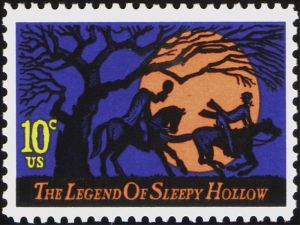
Legend_of_Sleepy_Hollow_U.S._Stamp

It was recently announced that Fox has renewed Sleepy Hollow for a fourth season. Please! No spoilers in the comments (as if)! I’m running a season behind so I want to protect my innocence. The announcement coincided with the happy news that my article on the Bible in Sleepy Hollow has been accepted for publication in the Journal of Religion and Popular Culture. I’m irrationally chuffed about this since my past publications have been primarily textual explorations of documents in languages nobody reads any more. Having something contemporary accepted for publication felt—dare I say it?—cool. As if I were part of the supernatural television crowd. It also affirmed my decision for which book to pursue next. When I say “pursue” I mean “write.”

You see, as a young scholar I struggled trying to decide what direction my research would take. After writing my book on Asherah, I was a bit sated with Ugaritic goddesses, although I started a book on Shapshu, goddess of the sun. The sun gave way to the weather and I wrote Weathering the Psalms. I lost my job in the midst of my revision of that project and it has taken a decade to find my way back to academic publishing. Research, however, takes on a vastly different form when you’re not hired to do it. Colleagues say, “I can get you access to my university library.” Such a kind thought, but my mind always says “when?” When would I have time to visit a library? I get up at 3:30 for my commute and get home in time to go to bed so that I can wake up again at 3:30 the next day. Research reading on the bus is dicey at best. Weekends are for getting the things done that are neglected all week long. Research has to be squeezed into the interstices.

That’s why I’m pleased about Sleepy Hollow. Watching television, even if on DVD, can be research. I’ve got decades of backlogged reading upon which to draw. When my tastes for light horror integrate with what I’m interested in researching it is a happy day. “The Legend of Sleepy Hollow” captured my imagination as a child. It was probably based on the Disney version, but even so, I never lost the fascination. Tim Burton’s Sleepy Hollow is still one of my favorite movies. Watching the episodes of the Fox series takes time, but now I know that time is not just simple relaxation. No, it’s research. Now to find the time to write that book that’s brewing in my head. Inspired, perhaps prophetically, by a Headless Horseman.


Sky Gods

One of the unspoken prompts for writing Weathering the Psalms was the unscientific idea that God is somehow associated with the sky. To my mind this has more to say about what religion is beyond the recognition that Anu, El, Nut, and kin were primordial deities of the celestial sphere. We’re all drawn to the sky. One of the earliest fictional pieces that I polished had to do with our desire for the sky—it’s something we deeply crave but cannot control. We dream of flying. Although flight seems almost casual these days, it is anything but. We still refer to satellite photos as being “God’s eye view” of the earth, knowing full well that the ancient cosmology of the three-tiered universe was simply a misconstrued view of how nature really works. Still, we want to embrace the sky.

Perhaps the cruelest aspect of work in the commercial sphere is the prevalence of “workstations” with no outside views. I’ve held two jobs since leaving academia where my “cubicle” was/is in a windowless room. Cut off from the sky, I’m supposed to focus on the glowing screen in front of me as if that could ever inspire me like a mountain sunrise or the silent crescent of the moon gracefully arcing across the sky. It could be night or day, snowing, raining, or brilliant sunshine, and for eight hours of each day I would never know. We call it efficiency. I think back to that story I wrote as a child about wanting the sky. If there are gods anywhere, it’s up there.

DSCN6374

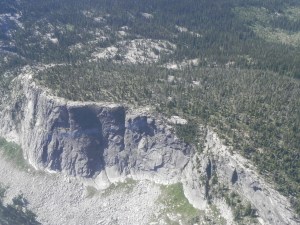
The perspective from above can change everything. On a small plane tour at 7000 feet, you can get a sense of what you’d never expect from the ground. Sharing the view of gods and angels, the land is laid out before you. “Distances,” our pilot says, “are very deceptive from up here.” Indeed, a few minutes aloft and it’s easy to forget what things looked like on the land. Pedestrian. Street-level. Quotidian life. Up here, isolated in a different way, I am seeing what the ancients could only imagine what the gods might see. For the moment I’m one with the sky. For the moment the world of everyday life is far away. That dark and gloomy cubicle no longer exists. In fact, from the sky I cannot see it in its windowless dungeon. We can’t own the sky. Being up here I start to suspect that neither can the gods.


Do the Twist

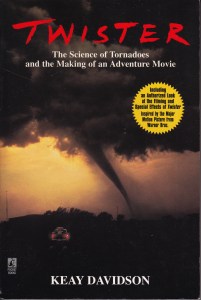
TwisterA used book sale is like a box of chocolates, if I may abscond with a simile that fits many scenarios. After all, you are there to buy books that others have discarded. Some of them show their age rather blatantly. Keay Davidson’s Twister: The Science of Tornadoes and the Making of an Adventure Movie is one such title. Those who know me well know of my fascination with weather—I wrote a little book on the subject based on that obsession. Although the weather informed and formed me long before I was ever near a tornado, these particular terrors were so exquisite that I couldn’t help but look. Although I grew up in Pennsylvania—not exactly tornado alley—one night when I was away from home a tornado swept by less than ten miles from where my family was. It toppled trees down one side of a hill and up another. It was eerie and uncanny and in many ways shook me out of the feeling that I never had to worry about them. Then when I went to Ann Arbor for a weekend with my fiancee the sky turned bronze. Rain was whipping past horizontally. Later we learned that a tornado had passed maybe four miles from where we were. Living in Illinois and Wisconsin, we experienced many tornado warnings. I never saw a tornado, but somehow thought I should.

It goes without saying that if I see a book on tornadoes that is reputable and cheap, I can’t pass it up. Davidson is a journalist whose work appears (as of the two decades ago when the book came out) in National Geographic. Some of you may not have been living in tornado alley twenty years ago, and therefore may not have felt the excitement that Twister, the movie, promised. By the time it came out I had already been thinking about Weathering the Psalms, at some level. I was a bit disappointed in the film itself, but it does mention that an F5 tornado is “the finger of God.” Davidson’s book picks up on this as well. At several points witnesses, and even scientists, lapse into divine language to describe tornadoes. One person even says that a tornado is an image of God, or that the storm is God. That’s a very natural way for people to think. The power of a Midwest storm has to be experienced to be believed.

The divine represents the highest echelon of language. The tornado fits because it is the most powerful wind on the planet. Concentrated, raging, and fickle. One can’t help but think: I was raised Protestant, what if the Catholics are right? Substitute any religion in either half of the equation. The weather simply does not do what we want it to do. It reminds us that humans can’t comprehend our own atmosphere that we so blithely pollute. The book may look dated—who remembers Twister anymore?—but it is a forceful reminder. When you need a metaphor for the most intense experience the weather will always be waiting.


Palms and Psalms

At Nashotah House, where I spent many years of my career, it was often felt that the weather during Holy Week was, in the best of circumstances, appropriate. With spring just around the corner, however—the date of Easter is based on the Vernal Equinox, after all—a number of surprises came. Particularly in Wisconsin. The ideal scenario would look something like this: sunny then partly cloudy on Palm Sunday; it was a a joyful day for a parade, but clouds make for nice foreshadowing. Nobody really commented on the weather for Monday through Wednesday, and Thursday—Maundy Thursday—was largely spent inside the chapel. Good Friday, however, should be rainy. Saturday gloomy. And, of course, Easter Sunday should be a perfect, sunny spring day. It seldom, if ever, worked out that way. The weather is not beholden to liturgical celebrations. The same holds true for New Jersey. At least the snow has been removed from the forecast today, only to come in the night.

It was at Nashotah House that I wrote Weathering the Psalms. Being a lexically driven book, it was never intended to be a commentary on global warming. It should have been, in retrospect. Already by then we were nearing the point at which, even if greenhouse gas emissions were stopped, runaway melting of the polar ice would continue apace and the weather would grow more and more unpredictable because of human action. Human action of everyone except the industrialists, of course, since they don’t believe in global warming. We cling to our palms and shout “Hallelujah” while the sea level’s rising and our weather grows increasingly erratic. We have a theology with which the weather disagrees.

IMG_2721

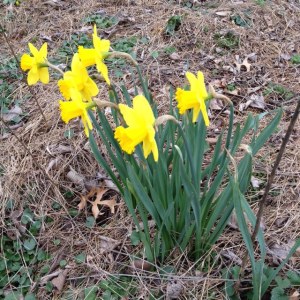
The liturgical year is, like its Jewish predecessor, cyclical. Some have suggested that holidays were invented to remind the laity of when it was safe to plant again. Of course, the climate in the “Middle East” is quite different than that of northern Europe and the United States where the Bible seems to have its proper setting. As I was walking yesterday, I enjoyed the daffodils that I always associate with Easter. When I returned home I saw snow in the forecast. Leap year, Daylight Saving Time, and my general level of sleepiness conspired to cause me to overlook that today is the Vernal Equinox. I look for the snow, grasp my palm, and think of spring.


Under the Weather

A friend, knowing my penchant to watch the skies, sent me a story about the British and the weather. The story by Alastair Sooke on the BBC’s cultural page is discussing Alexandra Harris’s book Weatherland. I have to admit that I haven’t read the book (yet) but the report of it appeals to someone who’s written a book on the weather, but for a much older timeframe. According to Harris, according to Sooke, the British are rumored to be obsessed with the weather. While living in the United Kingdom, my wife and I observed this. It is not merely casual conversation when someone discusses the weather. It is a serious topic. For a nation so accustomed to rain and gloomy skies, the weather has a religious import. It rarely goes without comment. I suppose that’s the point I was trying to make in my book. The weather is important. Vital, in fact, to human survival.

What really caught my attention here, however, was Harris’s observation that weather is used to characterize mood. Sooke mentions ice and snow and melancholy. The image is vivid: early Anglo-Saxons turing a wary eye to a winter sky with its low clouds and preternatural chill. It is so universal, it seems, not to require comment. Yet at the same time, weather can be a great trickster. C. S. Lewis once wrote that the image of the Arctic north filled him with an inexplicable joy. Winter can be fickle that way. In the world of the Psalmists, rain was a blessing and a weapon. How you look at it depends, well, on your mood.

DSCN0904

The British may take their weather more seriously, on a day-to-day basis, than those of us across the Atlantic. We tend to treat the topic casually. In reality, it is just as serious here. Drought, which has gripped the western half of the country for about half a century now, is a serious concern. Winter storms, hurricanes, tornadoes. A lightning storm can still be a theophany. (One awoke me in the middle of the night, just hours ago.) Weather impacts our bodies as well as our moods. It is all-pervasive, but we generally don’t like to articulate it. I suspect our understanding of the weather says more about us than we’re willing to admit. Our British colleagues, however, are less squeamish about the topic than we tend to be. There’s more to the sky than it might appear.


The Price of Academic Publishing

During seminary, I believe it was, a professor once told those of us in class, “You don’t get rich in academic publishing.” As the author of a widely used class resource, he added, “unless you write a textbook.” Both sides of his observation are true. I work with many young scholars who haven’t published as much as I have and I have to “manage expectations.” No, that monograph will not become a bestseller. Libraries will buy it, and, statistically, a few hundred people will read it. For those who play the more lucrative game of being acknowledged experts, however, cash can be freely flowing. The public is hungry for authentic information on religion. Despite what we’re told in the media, people are very curious about the truth.

My own academic career ended before I could crank out all the books I’ve got in my head. You have to reach a certain stage of academia before that begins to happen. I’ve been working on my writing in the meantime, and I think I might be able to reach that crossover crowd that writes for non-professionals. I’m not sure I’ll have the time, but the ideas and, I hope, the skills are there. This all came back to me when preparing my taxes. One of the truly religious certainties of this world, taxes are, I know, for the common good. At least in theory. I never complain about them. Preparing them is a different story. My little book, Weathering the Psalms, followed the typical academic course of being largely ignored. I received a small royalty check for it. I wished I hadn’t. You see, I use TurboTax to file my return because someone with as simple an economic life as I have finds hiring a professional superfluous and, ahem, not cost effective. We don’t own a house or any capital. We just hope we’ve paid enough to get a little back in the spring.

WeatheringThePsalms

Then I came on the 1099 for my meager book royalties. (They were in the double digits, just to give you an idea.) I tried to enter it into TurboTax. Uh-oh. That kind of income requires a separate form. “Congratulations,” the screen said, “on earning money from your freelance business.” That can’t be good. It turns out I had to purchase an add-on for TurboTax to handle this new tax scenario. The add-on, literally, costs more than the amount of royalties. Technically, then, I lost money on the publication of my latest book. Those are the harsh realities of academic publishing. An abstract publisher contacted me a few days later—would I like to do the abstract of my own book? Why not? I’ve paid for it. If I ever get back into academe I’m going to write books people will want to read. In the meantime, I write them to contribute to the tax base. At least academically.


Book Deaf?

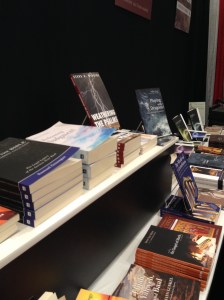
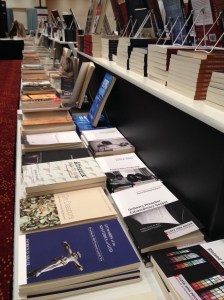
It’s Tuesday morning and I have been listening to authors pitching their books for three solid days now. Truth be told, I am a bit jealous. I’ve got a few more books in me yet, but research time simply does not exist in the world of capitalism and its discontents. Not that I envy being on the author’s side of the table—I remember how it felt to pitch Weathering the Psalms to several editors and to receive an icy “no” in response. I think now I begin to understand. Yesterday one of my appointments asked if I was “book deaf” yet. It was a term I’d never heard, but I immediately knew what he meant. Editors hear pitch after pitch. I pull out my phone and look at my calendar and see a new project every half-hour throughout the day, but no, I’m not book deaf. In fact, I have to constrain myself to keep my credit card firmly inside my wallet. Being surrounded by books is like being in a jungle teeming with deadly animals.

IMG_2614

From the exhibitor’s booth, Tuesday is a day of relief and worry. Most of the papers are over at AAR/SBL, and most of the participants have already left. As at any conference, fair, or exhibit, we are strictly forbidden from taking down the booth before closing time. We stand about, straining our ears to hear that first transgressive ripping of strapping tape from its roll, indicating that someone in another booth is being naughty. We’re tired, weary even, but not book deaf. Never book deaf.

IMG_2615

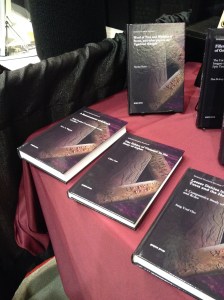
In my unguarded moments I sometimes think that maybe some day I’ll have a book here that others will clamber to find. Maybe someone like me will prowl to a pre-selected booth with a specific title firmly in mind, and that title will bear my name. I suppose it could happen, although it isn’t likely at this point. I hear each pitch and more. I hear the dreams and deep desires of every author. We want to be heard. We want others to think us respectable, honorable even. There are publishers out there who will publish anything. They will accept books to fill catalogues and websites and you’ll never hear from them again. Still, you’ll find some interesting things if you wander by their table. And if someone sees that you’re an editor while you’re browsing you’ll never turn a deaf ear. This is what religion scholars live for. Books are our reality.

IMG_2617


Think Bigger

PlanetRagesI’ve spent a lot of time with academics. Having been one myself, I know something of their habits. Getting through a doctoral program involves, at least in some fields, becoming the specialist on a very tiny piece of information. Since people have been thinking about things for millennia, finding something new to say can be a challenge. Often, by the time they’re done, newly minted doctors know an incredible amount about a very specialized topic. This is, in many ways, simply an intensification of the human experience. We think small. Part of the problem is that our brains haven’t evolved to think big. Having learned an awful lot about the weather in the book on Psalms, I have instinctively taken an interest in natural disasters. Charles Officer and Jake Page share this interest, as is evident in When the Planet Rages: Natural Disasters, Global Warming, and the Future of the Earth. This, however, is a big idea book. Globally big.

Throughout the first two sections of the book, which deal with humans in the face of nature, God often comes up. As scientist and science writer (respectively) Officer and Page simply reflect common beliefs. Nowhere do they advocate invoking God, but they note that throughout history, in the face of just about any species of natural disaster, people have. Many people still do. Disasters and God. What a team! We worship what we fear. Once Officer and Page reach the third section of human impacts on nature, however, God drops out of the picture and the fingers are pointing solely at us.

When I read about what we’ve already done to this planet, I, as a colleague once said, start seeking another species to join. We have destablized the atmosphere so throughly that it will take at least ten-thousand years to return to it’s pre-Industrial Revolution state. Ten-thousand years. At the same time, the largest industrial pollutor (the United States) has jury-rigged politics so that only the wealthy can attain high office. Votes can be bought and we simply won’t sign the Kyoto Protocol. Those who knowingly doom their children are the smallest thinkers of all. We have changed the course of the biosphere well beyond our share of time, and even those scientist who deny global warming know that it is true. You don’t bite the hand that signs the pay check. After all, specialists have a tendency to be very small thinkers.