
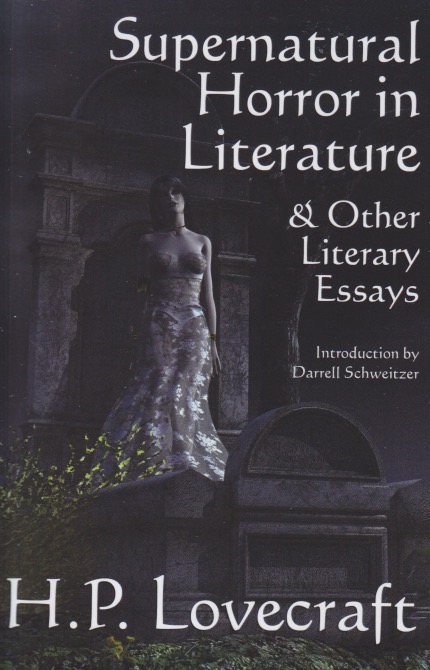
It seemed natural enough to follow up Stephen King’s On Writing with H. P. Lovecraft’s famous essay “Supernatural Horror in Literature.” This piece, widely quoted, is available online but it is lengthy and I wanted the convenience of not reading it on a screen. What can I say? I like to turn pages. I found a print copy, along with two other, shorter Lovecraft essays in Supernatural Horror in Literature & Other Literary Essays. This was published by Wildside Press, which added a brief introduction by the speculative writer Darrell Schweitzer. The text of the main essay was obviously computer-read—a couple reading errors remain—but it is clear enough to read. Like Poe before him, and King following, Lovecraft put down some of his thoughts on the craft of writing. Interestingly, Lovecraft is seldom considered as a producer of belles-lettres, but he is world famous as a horror writer now.
The essay itself is worth reading. Mostly it is a summary of what Lovecraft felt was worthy weird fiction. I tend to agree with much of what he says here, as would be evident were anyone to read my own fiction writing. I can’t say that I learned this at Lovecraft’s knee. I only discovered who he was when I was teaching at the University of Wisconsin Oshkosh. I did not have literary friends growing up; my reading tastes were determined by myself, largely based on what was available at Goodwill any given week. Nobody I knew read Lovecraft and although his books may have been in that bin, he wasn’t really someone I’d have known to keep an eye out for. As a child I didn’t think of myself as a horror reader. I liked monsters, and vampires were among the most immediately recognizable. My brother, if I recall, got me started on Poe.
When I began writing fiction, probably around twelve or thirteen, it was weird fiction. One of my other influences was Ray Bradbury. I agree with Lovecraft that, to be interesting, fiction often requires a speculative element. I do read realism, of course, but I really enjoy tales with a bit of supernatural. It’s useful to read Lovecraft’s ideas about influential writers. I’ve got my homework cut out for me. I can certainly recommend this edition for anyone who wants to read this lengthy essay in print form. The one thing that struck me as weird was the cover design. It features a woman wearing a strapless dress in a cemetery. Lovecraft famously didn’t really have women as one of his main themes, and his women characters are among his most inaccurately drawn. Still, it’s best not to judge a book by its cover.
 Steve A. Wiggins