Ginger Wolves

I’ve known about Ginger Snaps for years but the reason I finally watched it was a rainy fall weekend.  The kind of day that suggests imminent winter and you wish that you had a fireplace instead of waiting on the furnace guy to check everything out for another year.  Surprisingly, in my experience, there aren’t many movies that capture that mood very well.  The Little Girl Who Lives Down the Lane is one of the best.  But movies new to me give me topics for blogging, and so I watched Ginger Snaps.  It’s not a typical werewolf movie.  It’s become a cult favorite over the years since it didn’t get much of a box office boost.  It’s smart, and sad, and moody.  And, as is becoming more important to me, well acted.
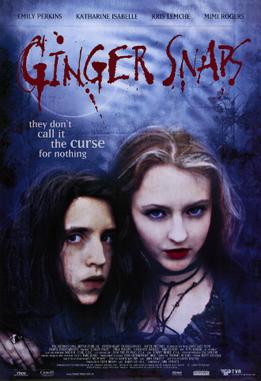
Brigitte and Ginger are teenage sisters, 15 and 16 respectively.  They share a room and morbid interests.  Their affluent, suburban parents just don’t understand them.  They’re ostracized at school.  Then Ginger gets bitten by a werewolf.  The plot is a coming-of-age story for women, and it has attracted feminist interest over the years.  The sisters are devoted to each other because both are pariahs and, well, sisters.  This begins to change when one of them becomes a monster.  But only to a degree.  Brigitte is determined to stick with her lycanthrope sibling, and tries to cure her.  There’s quite  bit of dark humor along the way but this is pretty effective body horror.  Making it about growing up adds an emotional poignancy to the story.

Werewolves have always been my favorite classical monster.  Ginger Snaps made me realize that it’s almost always a guy problem, however.  Men are the ones struggling to keep the beast inside.  Having this apply to a young woman throws into relief all the uneven standards society harbors.  Some exist for pretty obvious historical reasons, but others are matters of convention, often religious in nature.  Religion is pretty much absent from this movie, however.  Lycanthropy is transmitted like a virus and you don’t need silver bullets to stop a werewolf.  This is a world, in fact, where teens have to try to figure out their own way because parents are too distracted with their own problems.  It is a kind of modern parable, but without a religious angle.  The girls are conflicted about what’s happening to Ginger.  She enjoys the power but fears the consequences.  It is a good Halloween movie, but mostly it’s about growing up, whatever that may be like.


Of Wolves and Humans

Time has a funny way of distorting perceptions.  I remember when The Wolfman (2010; please, I’m not old enough to have seen the classic initial release in 1941) came out.  I’d already started this blog by then, and I was occasionally watching and writing about horror movies.  Initial reports said this reboot was too violent and bloody.  I had the impression that it’d done well at the box office, but I didn’t see it.  I found a used copy on DVD several years later and still I waited to watch it, a bit afraid from the initial assessments I’d read.  (I tend not to read reviews or watch trailers before seeing a movie—I prefer to come in fresh.)  All of this is to say I finally got around to seeing The Wolfman and I was disappointed.  I really wanted to like it too.  The wolf man was my favorite classic monster as a kid.

I do need to praise the gothic setting and landscape cinematography.  This is beautiful and well done.  Part of the problem is the way the story is changed.  Another is that, apart from The Silence of the Lambs, Anthony Hopkins doesn’t seem to fit the horror genre very well.  Claude Rains made a believable Sir John Talbot, despite being so much smaller than Lon Chaney.  Hopkins has trouble pulling it off.  It could be poor directing, I suppose, but it was difficult to take him seriously.  And two werewolves?  That suggests just a little too much CGI.  Still, there are some good moments.  I did appreciate Sir John encouraging his son to let the wolf run free.  I suppose if you’ve got a werewolf issue, having a dad to talk you through it would be a good thing.

Werewolves, like most classic monsters, are thinly disguised psychological tendencies.  Civilization isn’t always easy, even for social animals like our own species.  There’s a werewolf inside.  Transformation, however, always suggested redemption to me.  The ability to become something better.  I saw The Wolf Man as a parable.  That may have been unusual for a kid, but when religion and monsters come together strange things can happen.  The wolf may be angry, but it need not be dangerous.  It turns out that I really didn’t have to wait thirteen years to see this movie.  I’ll probably watch it again for the points it scores on the gothic scale.  The action features aren’t necessary for a good monster flick, though.  The 1941 version worked just fine.


More Ethnic Monsters

There seems to be a real interest, this haunting season, for cultures to claim their monsters.  I recently wrote about a story on the Jewish background to Frankenstein.  I also saw an article in Greek Reporter titled “The Ancient Greek Origin of Werewolves,” by Tanika Koosmen.  Earlier this year I read a book about the werewolf in the ancient world.  Unlike Frankenstein, or even Dracula, the werewolf has no defining novel.  Perhaps one of the reasons is that human-animal transformation stories have been around a very long time and have been extremely common.  Since monsters are finally becoming a (somewhat) respectable area of academic study, and since the standard role of the werewolf is well established, it’s too late for anyone to write the defining novel now.

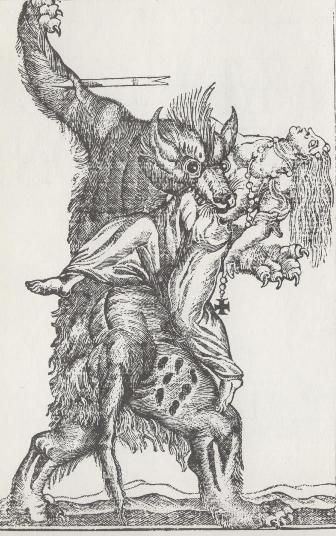
As the article, as well as many books, point(s) out, Lycaon was transformed to a wolf by Zeus as punishment.  The ancient Greeks liked stories of such transmutations, as the work of Ovid clearly shows.  Although these aren’t monsters in the Greek way of thinking—they had plenty of monsters—there is a real wonder in the ability to transform.  Becoming something else.  People have long found the idea compelling.  Almost religious.  Animals, although closely related, have incredible abilities we crave for ourselves.  The werewolf, of course, represent the freedom of the beast.  Outside society it lets the pent up violence and frustration out through attacking others.  It’s very primal.  And so very human.

What makes most monsters monstrous is their occluded humanity.  They’re scary sometimes because we wonder what they’re thinking.  Are they thinking of us as humans or as prey?  Do they intend us harm or are they innocently trying to communicate with us?  Are they evil or just misunderstood?  Werewolves, for all of their violence, don’t seem to have been evil in antiquity.  By the late Middle Ages into early modernity, however, they’ve been associated with the Devil rather than with the gods.  People who’ve purposely decided to transform, via a pact with evil, are a different class of monster.  Like the concept of witches at the same time period, Christianity demonized them by making them associates of Satan.  Part of the problem is that werewolves have no origin story that we can point to, no myth that says “here’s what they really are.”  As Koosmen’s article points out, transformations go back much further in history, to ancient Mesopotamia.  The beast, it seems, has always been with us.


Old Wolves

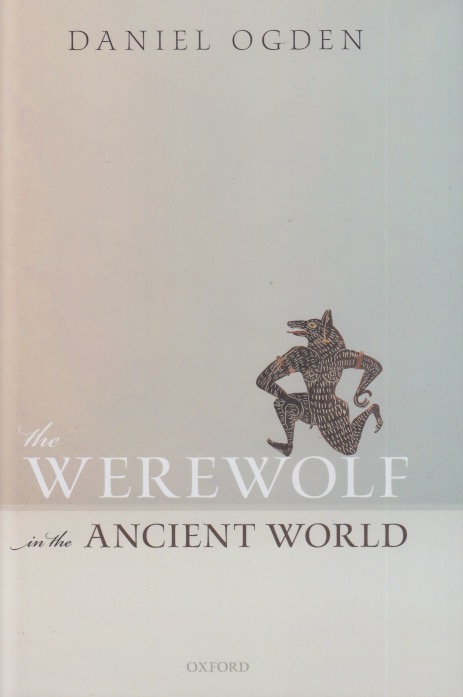
Among the classic monsters, the werewolf seems to suffer from lack of a foundational novel.  Yes, vampires are older than Bram Stoker’s Dracula, and antecedents can be suggested for Mary Shelley’s Frankenstein, but there isn’t a werewolf novel of similar stature.  Daniel Ogden, however, does us a service by providing an extended discussion of, as his title states, The Werewolf in the Ancient World.  His survey is intriguing and informative, and also insightful.  The werewolf is not always what it might seem.  Ogden is an able guide through sources from antiquity through some medieval tales, focusing mainly on the ancient ones.  He extensively explores their associations—witches, sorcerers, ghosts, and the like.  And related tales of human transformation.  He even suggests what some of those transformations may have been seeking.

The werewolf is perhaps the most obvious monster that expresses repressed desire for transformation—a kind of salvation.  Civilization comes with a cost and the werewolf is symbolic of the individual driven by animal desire, unrestrained by human convention.  It’s also an idea of great antiquity.  Although Ogden doesn’t go into it, stories of humans turned into wolves goes back at least to the Epic of Gilgamesh, one of the earliest pieces of literature we have in fairly complete form.  The idea is attested in writers such as Plato and Augustine, if only to refute it.  In other words, it is clearly something people have thought possible from very early times.  Our long association with the wolf, and its domesticated version—the dog—certainly plays a psychological role in such tales.

As Ogden points out, Guy Endore’s novel The Werewolf of Paris, published in 1933, is perhaps as close as we come to a foundational novel.  In the Universal monsters series that developed a canon for monster boomers, The Wolf Man was a somewhat late entry, appearing in 1941—a decade later than Dracula and Frankenstein.  Despite these tardy cultural appearances, the werewolf has been part of our collective psyche far longer.  Ogden shows that clearly.  When you stop to rethink stories like Little Red Riding Hood, the talking, humanized wolf appears so naturally that we don’t often stop to consider the implications.  I certainly hadn’t made the connection explicitly until reading it here.  Ogden’s work is readable but academic, so be prepared for citations and some technical talk.  Nevertheless, this is the clearest guide to lycanthropy and the magical ideas behind it from ancient times to have appeared in recent years.  


Wolves? Where?

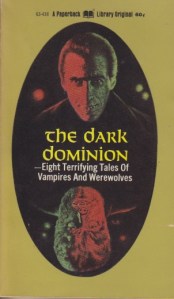
One of the oldest tricks in the capitalistic playbook is to make something look like a more successful product.  Trademarks and copyright laws prevent too close a similarity—for money is sacred—but we all know “brands” that try to look like other brands in hopes of picking up some of the business that attends success.  The same feature was apparently at operation behind The Dark Dominion: Eight Terrifying Tales of Vampires and Werewolves.  This is a book that I picked up in a used bookstore because its cover design—a dull olive green with a picture oval on the front—was clearly based on the Dark Shadows book series.  While the latter are still available, they’re increasingly difficult to find in used bookstores, so when I come across one I don’t have I tend to buy it.  I knew this wasn’t part of the series but the cover suggested to me it might be similar enough, like store-brand breakfast cereal.

Werewolf stories, it turns out, shouldn’t hunt in packs.  There’s no surprise since it’s pretty clear that one of the characters is a shapeshifter and it’s pretty obvious which one.  Six, or maybe seven, of the eight stories concern werewolves while one outlier has a vampire menace.  Some of the stories in the book are clever, but most follow the same trajectory: attacks are made, the villagers suspect something, one of them turns out to be a werewolf.  Time for the next story.  I noticed a long time ago that unlike vampires and Frankenstein’s monster, the werewolf doesn’t have the definitive novelistic origin.  Others wrote vampire tales before Bram Stoker’s Dracula, but that telling set the stage for those that followed.  The olive green cover suggests Barnabas Collins, but in reality is more in Quentin’s territory.

Interestingly, The Dark Dominion, like occasional collections before and after, doesn’t list an editor.  Modern books use the stature of volume editors to reinforce that what’s contained within has quality.  Otherwise who knows whether someone with good taste has picked the stories by authors you’ve never heard of and wrapped them together in a package meant to move?  That’s not to say that some of the stories aren’t good.  A couple are quite clever.  One is a translation of a medieval German tract.  Another comes from medieval Ireland.  The remainder are stories from the nineteenth and early twentieth centuries.  Perhaps it’s the burden of an editor to wonder what the selection criteria might have been.  What’s entirely obvious, however, is that making something look similar to a recognized book series still has the power to sell.


Gendered Lupines

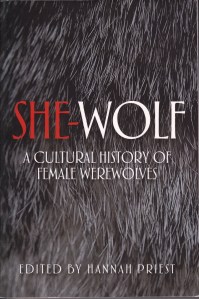
No doubt an excuse isn’t required for reading about werewolves this time of year. Something about October encourages that sort of thing. Hannah Priest edited a collection of essays from various scholars titled She-Wolf: A Cultural History of Female Werewolves. As is to be expected among academics, there are several interpretations wrapped together here and the book covers female werewolves from the Middle Ages—where they are sometimes associated with witches—up through modern cinema. A number of literary sources and a few television representations, and even an RPG, are also part of the mix. The problem with multi-contributor books is that it’s difficult to draw any overarching conclusions, but some observations do come up repeatedly here, and they are worth pondering.

The connection of the female with the animal nature of human beings is stressed for the female werewolf. As might be expected in a patriarchal culture that is becoming more so daily, this is considered an aspect of inferiority. The connection between lunar cycles and werewolves as an inherent feminization of the monster is also brought up more than once. The bodily transformations of puberty also play a role. What we can clearly see amid all of this is that although male werewolves outnumber females in literature and film, and, with a few exceptions, in folklore, the very nature of the werewolf is coded as feminine. This is something that isn’t obvious until a book like this points it out.

Given my own idiosyncratic interests, I was surprised how much religion came into the discussion. Among classic monsters, werewolves tend toward the secular end of the spectrum. There was, however, from the Medieval Period up through early modernity, an ecclesiastical fascination with werewolves. This fascination often came in the form of recriminations against women—attempts to subject them to the wills of men. The church often blamed werewolves on women out of the control of menfolk. And of course, you may kill a monster with no need to feel guilt. More modern views of female werewolves—particularly in movies—are more, well, humanizing. Recognizing that wildness is part of being an evolved animal means that we’re more sympathetic (or had been until November of last year) to the woman who is able to let go of convention and become truly liberated. Now that we experience the poignant lengthening of nights that stir our primal fears, werewolves come naturally to mind. If only we could learn what they have to teach, we might all howl at the harvest moon.


Teaching Vampires

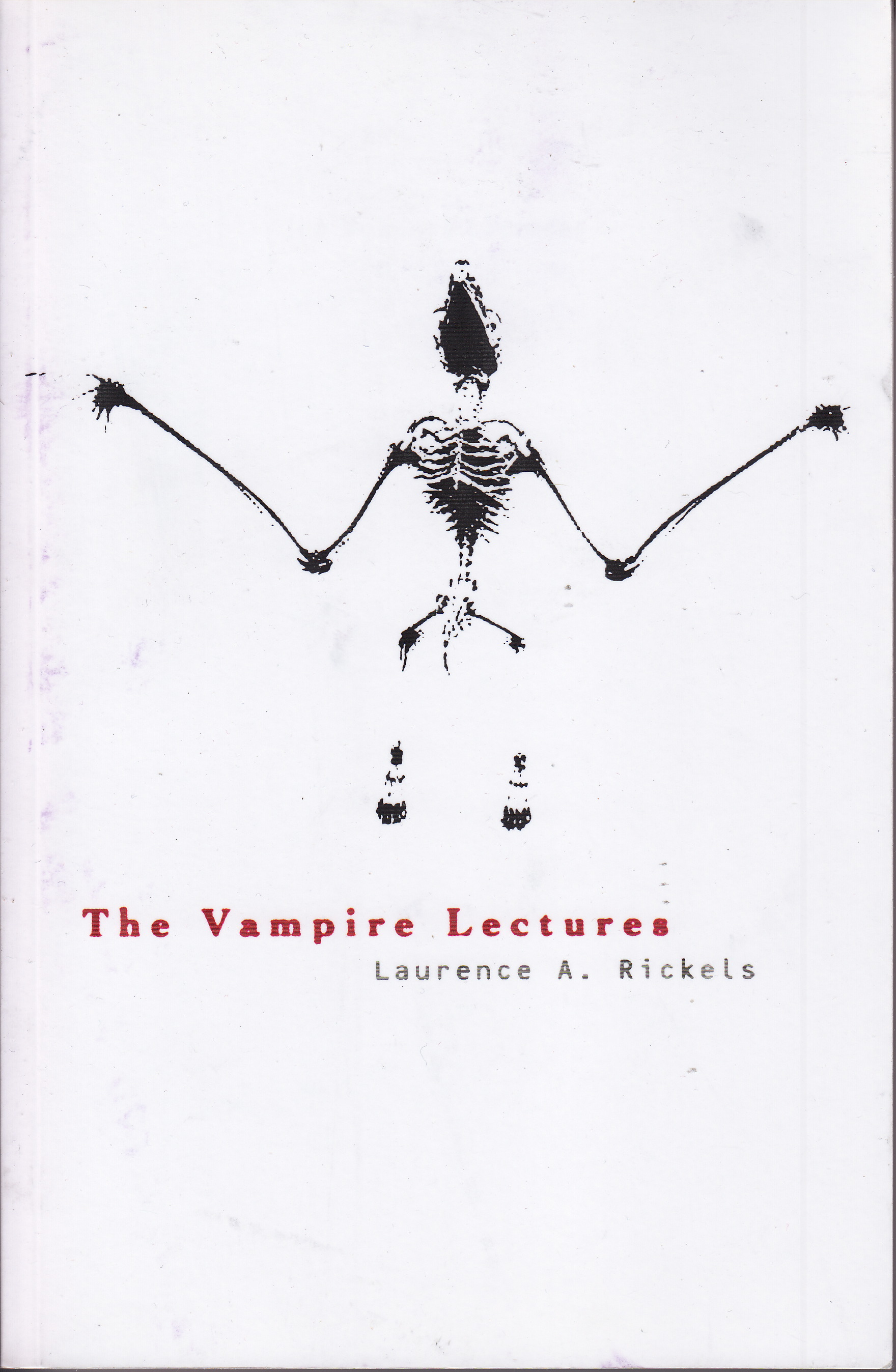
VampireLecturesWhat do you get when you cross German literature, psychology, and the undead? The Vampire Lectures, of course. Laurence A. Rickels, one gets the feeling, must be one interesting guy in the classroom. When I was a student the thought that anyone would take vampires seriously enough to offer college credit to study them was, well, a foreign concept. We all know that there’s no such thing as vampires, or werewolves, or Frankenstein’s monsters, or mummies—wait, mummies are real, but just not animated. In the reigning cultural paradigm, if something’s not real, it’s a waste of time. The human psyche, however, disagrees. The fact is there’s an awful lot of mental baggage that the vampire addresses. So much so that the University of California at Santa Barbara can offer a twenty-six lecture course on the topic. The results are what we have in this unusual book.

Rickels has read widely in the literature of the undead. The vampire’s share of the material goes to Bram Stoker’s Dracula, the novel that defined, in many ways, the modern concept of vampires. The lectures do cover earlier and later literary representations, but when movies began to be made, they started with Stoker. One of the most interesting aspects of the lectures is the utter breadth of movies Rickels addresses. Movies that I’d never heard anyone else mention, let alone analyze, are here, alongside the more famous examples. It becomes clear that vampires have been a favorite of film-makers as well as readers. Culturally they are omnipresent. One gets the impression that Rickels might have an inkling of why we have this fascination, although his analysis is often Freudian, he does come back to the concept of mourning. Vampires (who would’ve guessed?) mask our unresolved sense of loss.

The style of The Vampire Lectures reflects the kind of literary criticism that isn’t always easy to follow. The book has more puns per hour than any other academic title I’ve ever read. Perhaps such serious topics as loss, parental relationships, and sexuality require a good dose of humor to make them less overwhelming. Still, the puns show the shifting nature of the ground beneath your feet when you try to take a topic like this seriously. Not surprisingly, Rickels does spent some time reflecting on the religious nature of vampires. There’s no question that monsters trespass on—or maybe even arise from—sacred precincts. They also occupy similar mental spaces. Perhaps it’s no surprise that as the number of nones grows so do the fans of monsterdom. We need an outlet for our surfeit of fear and loss. Come to think of it, perhaps I need to take a class in this as well.


My Beloved Monsters

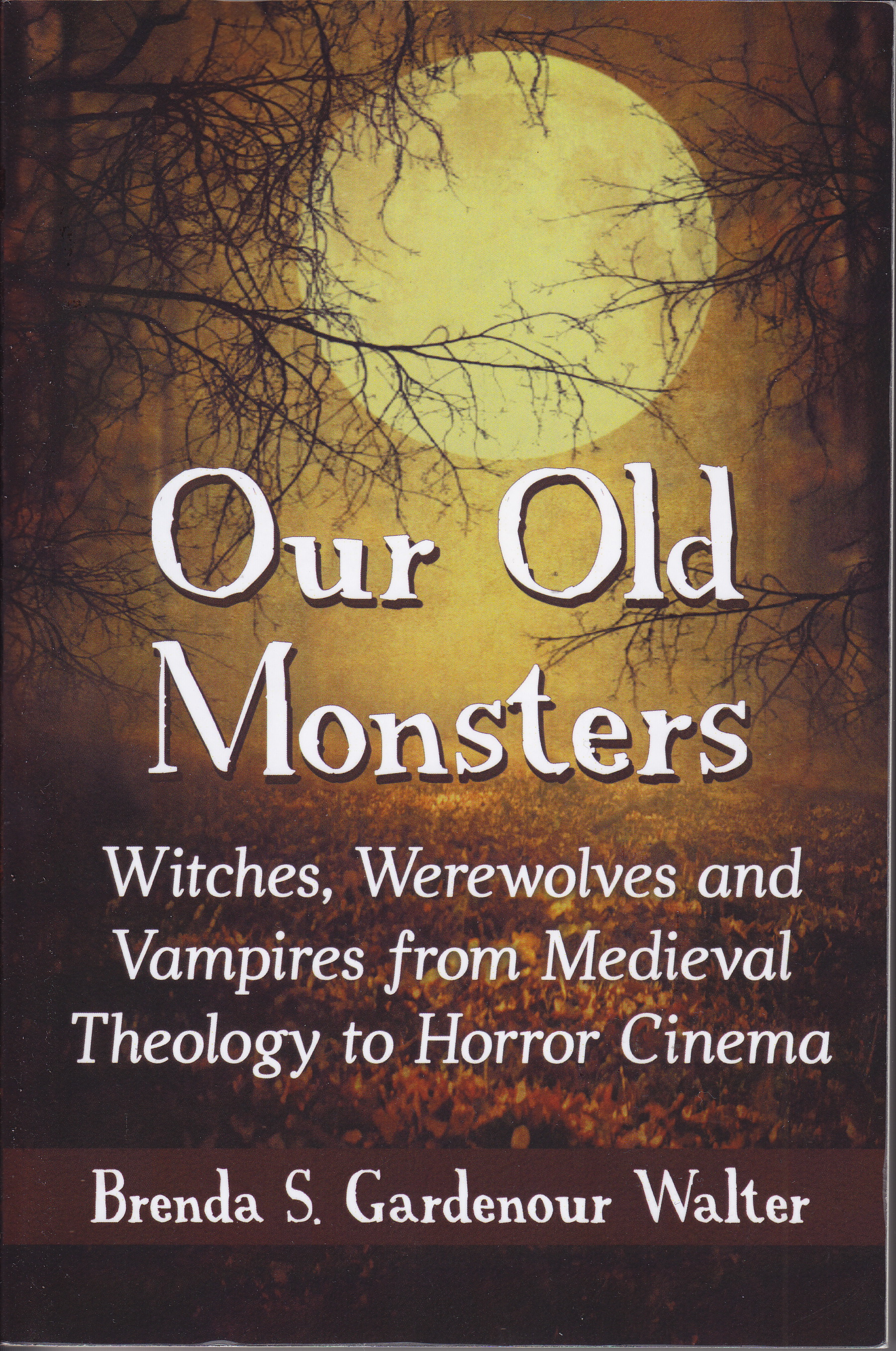
OurOldMonsters copyOnce upon a time I felt radical in claiming that monsters and religion shared a pedigree. Having grown up fascinated by Universal, as well as much cheaper and more tawdry, monster movies, I always experienced a twinge of guilt. My family was very religious, and these monsters were, well, evil, weren’t they? Yet I couldn’t let them go. Although college, seminary, and graduate school each took their toll on this early fascination as I was restructured as a more rational man, the monsters always lurked. In college a friend and I named an invented monster “the lurking.” In seminary and graduate school, demons and ghosts still captured my imagination. Brenda S. Gardenour Walter has, quite unintentionally, vindicated my outlook. Our Old Monsters: Witches, Werewolves and Vampires from Medieval Theology to Horror Cinema just about says it all. Not limiting herself to witches, werewolves, and vampires, Gardenour Walter has given us a novel thesis: monsters come from theology.

Well, not exactly. Medieval theology, as many of us learned in seminary, continued the ancient Greek practice of dividing the universe into four substances: air, fire, water, and earth. Each was associated with a humor in the human body: blood, yellow bile, phlegm, and black bile. Keeping these humors in balance led to healthy bodies. Gardenour Walter, who teaches history in a Pharmacology school, shows how monsters were often viewed against this paradigm. As she notes, this Weltanschauung was not friendly to women. Seeing man as the perfect, rational being, women were considered less rational and more controled by their base urges, leading to the concept of witches. Witches were also associated with demons at a later time, and there is a considerable discussion of that transition.

Vampires were often associated with black bile. Although there are vampiric beliefs going back to very ancient times, Gardenour Walter shows how the modern vampire indeed derives from medieval theology as eastern ideas met western. Unfortunately, in unenlightened times, the concepts were anti-semitically applied, with unwonted liberality. Werewolves were generally dismissed as illusions wrought by demons, although, there always remained an ambiguity. I have to admit not having known that even Augustine discussed werewolves in The City of God, which, it comes to mind, would make an excellent horror movie. The book brings each of these medieval monsters up to the silver screen and considers how their theological pedigree plays out in modern times. This is a book I would have enjoyed as a college student, but maybe, secretly, enjoy even more now as an adult.