Credit Is Due

In an article on Nomad by Brandan Robertson, the issue of Larycia Hawkins at Wheaton College is discussed. Hawkins was suspended for stating that Christians and Muslims worship the same God. Robertson’s analysis, in my experience, is right on target. He suggests that when he was a student at Moody Bible Institute he was told that the school was a “discipleship institution” rather than an academic one. This leads Robertson to conclude that the school practices indoctrination rather than education. Although I’ve been saying similar things for years, there is a particular point that stands out here. Institutions like Wheaton and Moody, and others I could easily name, receive the benefits of academic accreditation for non-academic programs. These schools do educate; however, the education is not an academic one. Any faith group that has already declared that it has the final answers has no motivation to promote free inquiry. New information is dangerous, and indeed, is often treated as heretical. Accrediting bodies shrug their shoulders and say, “whatever.”

The purpose of academic accreditation is to ensure that a degree is worth the paper it is (computer) printed on. I could establish myself as an institution of higher education but the reason no one would take me seriously is that I’m not accredited as one. At the same time, schools like Bob Jones and Oral Roberts universities are given the seal of approval while teaching that the standards of higher education as recognized by any non-biased board are wrong. Revelation, not research, has already revealed the truth. And these schools grant degrees that have accreditor’s approval. Some of it is doubtlessly political. Other aspects are more difficult to fathom.
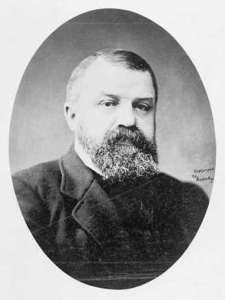
Dwight_Lyman_Moody_c.1900

I’ve known accrediting bodies to visit a campus where faculty and students give intentional and obvious warning signs that the school is not offering what it claims because of some point of doctrine. I have yet to see even a notation to come on a record because of this. And they call it education. Open minds, willing to accept what the evidence indicates, are classified together with those closed to new ideas. Just learn by rote what our favorite spokespersons have said and you’ll get your degree. The nation’s accrediting bodies won’t interfere. If I could only get them to visit my house, I’d start handing out degrees as well. Only to those who pay four year’s tuition, of course.

Who’s God?

There shall be wars, and rumors of wars. The Bible says nothing about being able to declare what future people might have to say about God. According to a story on the Washington Post website, Larycia Hawkins, a political science professor, was suspended from Wheaton College for claiming that the God of Islam is the same as the Christian God. Administrators felt this was one of those cases where the famous statement of faith required of Wheaton faculty was violated. Seems to me the administration might want to sit in on a class in history of religions. Everyone knows that Wheaton takes great pride in its Evangelical heritage, bordering on a kind of extreme conservatism. Even so, this seems extreme.

There is much we don’t know about the early history of most religions. Probably one of the resons for this is that, apart from the founder, we’re never sure if a new religion will take off. Many religions have started and then quietly (or not so quietly) died away. At the earliest stages nobody really knows which way it might go. We do know that by about the time of the Exile, the early Jewish faith was fast becoming monotheistic. Christianity, although disputed by some, also followed in that mold, accepting the God of Jesus of Nazareth (himself a Jew) as the one God. Here many Evangelical histories grow a little weak when focus is shifted to Arabia. The cultural context that led to Islam involved a world of pantheistic worship, but Mohammad was well aware of, and appreciative of, Judaism and Christianity. Recognizing that his faith shared the same books as the other two, his understanding of Allah was clearly the same God as the one worshipped by the Jews and that Jesus had called “Father.” The three monotheistic religions of that region, historically, have always shared the same God.

IMG_2472

Disowning a deity, I suspect, comes with some anxiety. As Islam expanded and Christianity itself became an imperial religion, clashes were bound to happen. Invective included calling the enemies “pagan” or “infidel” (technically two separate things), and as so often happens, rhetoric became mistaken for fact. Since Islam and Christianity were different religions, so the thinking went, they must recognize different gods. Triumphalism is seldom subtle. Fact checking wasn’t so easy back in those days. Suspending a professor for stating the truth is, I fear, nothing new. Some schools require statements of faith so that they may ensure academic freedom is a myth. Ironically, they seldom have trouble with accreditation. The ideology of a war between religions offers a doleful prognosis for a world where religions really need to try to understand each other and where obvious historical facts should count for something.


God’s Country Club

Last week CNN’s religion Belief Blog reported on the five most and least religious colleges in the United States, according to Princeton Review (not affiliated with Princeton University). Having attended one of the five most religious colleges on the list (Grove City College, but whether it is number one or five is difficult to determine), I took an interest in the overarching question: how do you determine if a college is religious? The author of the survey indicated that it was through student interviews concerning whether they perceived other students as religious or not. And that’s where the bone of contention pokes through—who determines what is religious behavior? Are students able to determine who is religious or who acts religious? Does religious mean Christian in this context, or religious in any tradition?

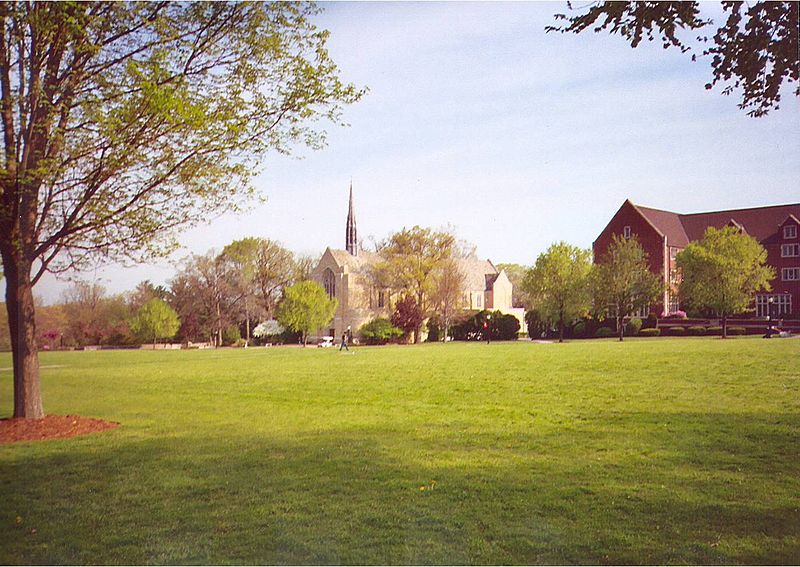
Grove City College, God's Country Club

My years at Grove City left little doubt that the school itself was proudly religious. An evangelical bastion against many forms of critical thought, plenty of indoctrination took place in those hallowed halls. A few religion professors (I was even then over-zealous to learn as much as I could about this field), while personally faithful, asked serious questions that many self-righteous classmates blithely ignored. From glancing through alumni magazines, they seem to be the successful ones. Those who asked the hard questions seriously were ostracized; now they are lost in obscurity. Is this true religion? The Princeton Review is concerned with providing potential students with accurate data about their collegiate choices, but I wonder if the religiosity proffered is anything more than denominational branding.

Three of the four other most religious schools might bear this out: Brigham Young, Thomas Aquinas College, and Wheaton College. Hillsdale College, the final member of the most religious fraternity, is the exception. A liberal arts school, formerly Baptist but currently independent, it fits somewhat uneasily next to the Mormon, Catholic, and Reformed natures of the other four schools. While I can’t speak for the other colleges, at Grove City there was definitely a coercive peer pressure to behave like everybody else—to be religious, i.e., evangelical Christian. With required attendance at chapel and required courses in religion, the ethos was heavily impressed. Were other students truly religious? That depends on the measure that is used. Many have gone on to be entrepreneurs declaring free market economics in the name of the kingdom of heaven. If that is a measure of true religiosity, all hope is lost indeed.