In the Morning

The arrival of the most recent issue of MAARAV (15.2) was a poignant blend of joy and melancholy. Joy in that my article about the odd Hebrew word galgal was finally published, and melancholy in that this will likely be my last academic article. I began publishing academic pieces back in the early 90’s and kept a steady stream going until being abruptly dismissed from Nashotah House. Research requires a regular, steady employment situation with access to obscure materials and a somewhat predictable teaching load. Since being cast into the outer darkness of the adjuncts’ world, well, it’s awfully dim out here to try to devote the scant free time to in-depth study. Such is the world of academics.

This article was a spin-off of a much larger project – a book that was completely written and rejected by a noteworthy publisher and lies dormant on a hard-drive somewhere – on the weather terminology in the Psalms. Several publishers expressed minimal interest, and this article was an effort to demonstrate how weather language has been sublimated due to faulty methodology. The unusual word galgal likely derives from a root with connotations of circularity. Nineteenth-century travelers in the Levant associated the word with tumbleweeds, and this association has stuck ever since. In my article I sort through the lexical information seeking some kind of consensus in the West Semitic language family for a more solid understanding of this troublesome lexeme. To the unbiased observer, the earlier favored translation of “whirlwind” still holds a considerable amount of evidence.

This particular paper holds an enduring place in my memory. I first read it at the Society of Biblical Literature Annual Meeting in 2001 in Denver. Well, I started to read it. The morning of my paper I’d visited the Denver Museum of Nature and Science to see the famed dinosaur and mineral exhibits. While in the museum I became violently ill and had to take a taxi back to my hotel. When I tried to read the fated paper that afternoon, nausea swept over me and I couldn’t finish it. Somehow, returning to a project that had made me physically ill held little appeal, no matter what its academic merits. The paper sat, forgotten, until I thought to submit it to MAARAV a couple years back. Now it awaits the criticism of others while I move on to other things. I do hope that this humble contribution to Hebrew lexicography might be taken seriously since like Denver’s dinosaurs, it is the last of its kind.
The Divine Finger

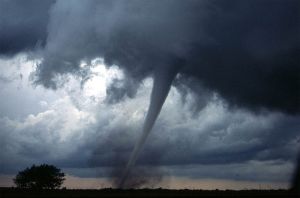
As the thunderstorms break out overhead yet once again, I am naturally reminded of tornadoes. I grew up in a part of the country relatively free from natural disasters. In my little corner of western Pennsylvania we felt secure from the earthquakes, volcanoes, wildfires, mudslides, and hurricanes that seemed to plague other parts of the continent. Then one night a tornado came. I happened to be a few hundred miles from home working a summer job when the cheery newscaster announced that a tornado had swept through my hometown during the severe thunderstorms we’d had the night before. I had always believed our unrelenting hills made us somewhat resistant to the tornadoes that plagued our next-door neighbor Ohio. It was probably then that my fascination with severe weather, especially the tornado, began.

Pulling the divine plug?

Pulling the divine plug?

One of the reasons for the entirely understandable fear accompanying tornadoes is that they have all the hallmarks of an ideal divine weapon. In an article soon coming out in Maarav, I argue that an obscure Hebrew word should probably be associated with whirlwinds rather than tumbleweeds. Although violent tornadoes are rare in Israel, the story of Elijah seems to imply that a weighty prophet may be hefted skyward by a whirlwind, and that sounds tornadic to me! There are passages where whirling winds are referenced as harbingers of divine wrath, an association that clings to tornadoes even today. I ended up writing an entire book on weather terminology in the Bible that had been fueled on by this ambiguous fascination. Publishers, it seems, alas, do not share my enthusiasm for the topic.

Classic F-5

Classic F-5

The popular media, however, shows a glimmer of understanding. The second half of the 1990s (when I finished my draft of my book/doorstop) was a bonanza of American storm fascination; Sebastian Junger’s The Perfect Storm (1997) was shortly followed by Erik Larson’s Isaac’s Storm (1999) and both tailed the much-touted movie Twister (1996). Being somewhat of a connoisseur of tornadoes, I was disappointed by Twister, but one scene remained scoured into my memory. A layman asks one of our overly-folksy, lovable storm-chasers what an F-5 tornado (the F-, or Fujita-scale is the measure of a tornado’s intensity based on the level of damage it leaves behind — 5 is the highest number on the scale) would be like. One of our jocular heroes becomes suddenly serious and replies, “The finger of God!” Despite the cornball, this is an accurate explanation of the awe that surrounds a storm as random as a tornado. Adjacent houses can suffer entirely different fates in a tornado, or, in a poignant story I’ve never forgotten, a Wisconsin tornado killed one of a set of young twins in the same house during the storm. Finger of God, indeed. If Moses had lived in Iowa I’m sure he would have made liberal use of the tornado for precisely that image.