Liking Everyone

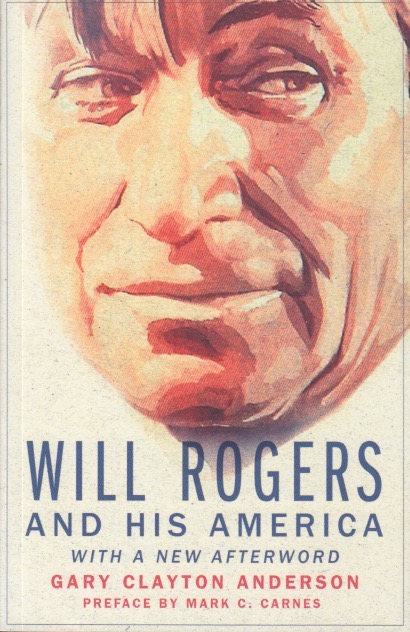
I’m not really interested in politics.  Powerful people deciding the fate of the rest of us seems inherently depressing.  We could use a good laugh.  I’ve been curious about Will Rogers for some time now.  He’s a name that everyone in my generation seems to recognize but few people know anything about him, beyond some of his famous quips.  So I read Gary Clayton Anderson’s Will Rogers and His America.  It was an eye-opening experience.  Rogers died in 1935, the year my mother was born.  What a difference less than a century can make!  At the time of his death he was one of the most famous people in the country, personal friend of U.S. Presidents, an international traveler, and widely syndicated newspaper columnist.  He was also a film actor and comedian.  When he traveled internationally world leaders gladly met him.  Not bad for a poor boy from Oklahoma.

Anderson’s book is a good introduction to who Rogers was, but it does tend to focus on the politics.  Arguably that’s where one’s greatest impact in life might reside.  Still, there’s a lot more to an individual than politics.  I’m curious about Rogers’ career as an entertainer.  He started out as a Vaudeville roper—literally, a rope act.  His noted wit, however, made him famous.  At various points he was one of the highest paid entertainers in the country.  His sympathies, like many of us born in humble circumstances, tended to be with the average person who, it seems, is always struggling against an economy that favors the wealthy.  See?  There I’ve done it myself, gone and got political.  It’s difficult to avoid.

Perhaps the most widely read columnist in the country, who influenced political opinions and could rake in the money at just about any form of comedic enterprise, Rogers nevertheless faded from view after his death in a plane crash.  He was part American Indian.  He never completed college.  He was homespun and yet influential around the world.  Fame comes with no guarantees, of course.  I guess it would be helpful to know what Roger’s motivations were.  Was he, like most people, simply trying to secure his future for himself and family?  Was he trying to change the world?  Can anyone manage to do that for very long before things come along and everything’s suddenly different?  (Think AI, for example.)  I’m glad to have met Will Rogers through Anderson’s book.  Even though I’m not really interested in politics, I learned something about them too, along the way.

Horseman Horror

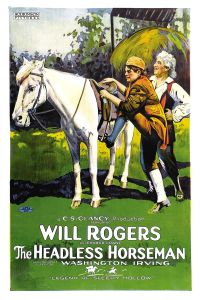
Yesterday was distinctly autumnal around here.  Cloudy and cool, the overcast was definitely moody although the equinox is still a couple weeks away.  Still, the mood was right for the Legend of Sleepy Hollow.  The earliest full cinematic adaptation of Washington Irving’s story is the 1922 silent feature The Headless Horseman, starring none other than Will Rogers.  Now, Irving’s story is fairly brief, and to get nearly a full seventy-five minutes out of it, the tale lends itself to some padding.  The film makes a great deal of Ichabod Crane knowing Cotton Mather’s A History of Witch-Craft, and even being accused of being in league with the Devil that leads to a  disturbing scene where he’s nearly tarred and feathered.  In reality Mather’s book was Wonders of the Invisible World, but the point of the film is better made with the fictional title.

Having watched Tim Burton’s 1999 version—Sleepy Hollow—many times, I was taken by the introduction of the Bible into the story.  The groundwork, however, was laid by Edward D. Venturini’s version.  True to the story, Ichabod teaches Psalmody in his role as schoolmaster.  Venturini’s film has a contrived scene in the church on Sunday that includes a lengthy sermon with everyone—even the usher—falling asleep.  The episode, which is lacking in Irving’s original rendition, introduces the Bible into the narrative.  The connection is thin, but nevertheless present.  Burton picked up on the religious element and built it firmly into the plot as Ichabod Crane’s backstory as a skeptic, raised by “a Bible-black tyrant.”

As someone interested in the integration of religion and horror, early examples, despite the comic aspect of Venturini’s version, are often instructive.  The comedic spirit is actually in the original; Irving’s tale gives a caricature description of Crane that gives the lie to the handsome protagonists beginning with Jeff Goldblum on through Johnny Depp and Tim Mison.  Will Rogers plays the homely image to its hilt, and although lighthearted, the movie has some classic horror elements.  To arouse his dozing parishioners, the minister yells “Fire!” When they awake asking where, he states “In Hell,” which sleeping churchgoers can expect.  Although the eponymous headless horseman is shown to be Brom Bones, a remarkably effective early scene presents a skeletal, ghostly rider that haunts at least the imagination.  The sun is out this morning, and the brooding skies of yesterday have passed.  They will be back, however, as the season for ghost tales is only just beginning.