Finding The Exorcist

This blog is the closest thing to a diary that I keep anymore.  It’s also the place where I remind myself when I read a book or saw a movie.  I started this blog (actually, my niece did, but I started putting content on) about a decade-and-a-half ago.  Most of the books I’ve read since then (but not all), have been featured here.  It didn’t start out that way with movies.  I watch a lot of films.  The other day I was wondering when I first watched The Exorcist.  I figured that it must’ve been something I’d blogged about, knowing me.  It could be that I watched it before 2009, or it could be that the search function on WordPress doesn’t allow me to find the post, if it exists.  You see, I don’t know what else to search for beyond “The Exorcist,” because I can’t recall what I might’ve written about it.  If I did.
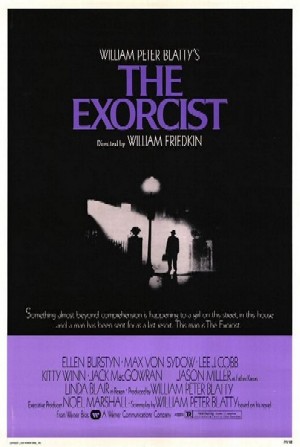
So, in case I haven’t, I do want to say a bit more about that experience.  I was only eleven when the movie was released.  Three movies that I grew up terrified to see were Rosemary’s Baby, The Exorcist, and The Omen.  I finally saw them as an adult.  Since it was the DVD era (preceded by the VHS era, and followed by the Streaming era—all within about three decades) I bought the disc.  In all likelihood this was at FYE, which used to be a thing, just like Blockbuster before it.  Of course by the time I sat down, trembling, to watch it I’d seen many clips, stills, and parodies.  Still, I was afraid.  The movie, some thirty years old, lived up to its reputation.  I was left trembling more than when I started.

Many books have been written about The Exorcist, and although people sometimes laugh at it today, most horror fans I know still speak of it with reverence.  This movie changed horror.  It also changed demons.  Today what we believe about demons derives largely from this movie.  Its explanatory value is that it offers somewhere to turn when nothing else works.  Religion as a last resort.  And, ultimately, religion works where everything else fails.  It is possible, that somewhere in this sprawl of a blog, that I wrote first impressions of seeing it.  It would’ve been 2009, or perhaps I saw it as early as 2006.  I was struggling with my own demons then.  And, as often happens in such cases, precisely when things happened can be a little difficult to determine.
Another Exorcist

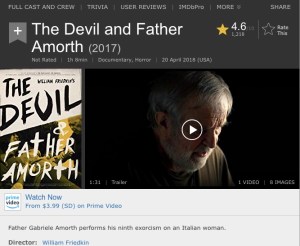
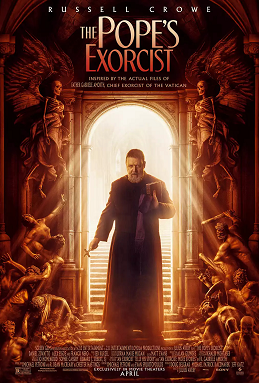
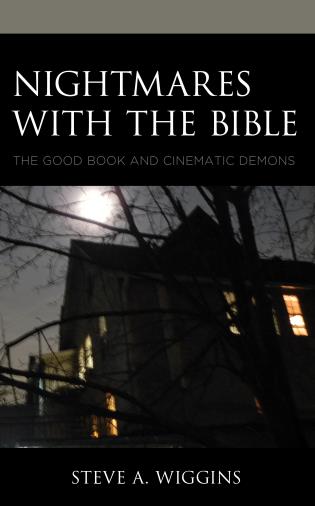
I learned from the wonderful Theofantastique that Russell Crowe’s new movie is The Pope’s Exorcist.  (I guess Crowe hadn’t read Nightmares with the Bible to think to send me a personal notice.)  I knew instantly, from the title, that it had to be about Fr. Gabriel Amorth.  Say what you will about him, he inspired William Friedkin to make a documentary titled The Devil and Father Amorth.  It’s pretty unnerving to watch, no matter what is really going on.  Catholic officials aren’t trilled about Crowe’s movie—I wasn’t impressed with his portrayal of Noah in Darren Aronofsky’s take on the flood story a few years back.  It takes a certain kind of director (like Friedkin) to be able to handle theologically dense material in a believable way.  I can’t say anything about Julius Avery’s The Pope’s Exorcist, of course, without having seen it.

I can say, however, that those who publish books at $100 miss many opportunities.  My book is one of very few written by a credentialed religious studies scholar on demons in movies.  A quick web search will reveal that it remains basically unknown and uncited.  (The only Amazon review is a two-star job by an evangelical who didn’t like what I was doing.)  Pay $100 for a book with a two-star review?  Most people, reasonably, have better things to do.  I once got around this in the past by posting a PDF of one of my book for free on Academia.edu, where, at recent count, it has been viewed over 6,000 times.  Academic publishers don’t realize the appeal of most of the books they publish.  Even demons can’t open a wallet to a Franklin level.

So while I’m waiting for enough royalties to afford seeing The Pope’s Exorcist, I’ll focus on my current book project.  Of course it’s on something completely different.  The Wicker Man should be coming out in September, but my mind will likely be elsewhere.  Those of restless intellect are condemned to wander, it seems.  Of course, I have Theofantastique to keep me busy.  There are other kindred spirits out there.  They don’t know the way to my website, I suspect, but I’m not alone in being excited about a new exorcist movie.  I’m not expecting anything to surpass The Exorcist, however.  Like The Wicker Man, The Exorcist turns fifty this year.  One guess which was the more popular film.  Given Crowe’s profile I’m surprised there hasn’t been more buzz about his new film.  Demons can be funny that way.


Mephistopheles

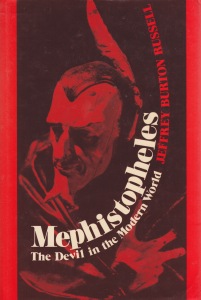
Jeffrey Burton Russell is one of the clearest thinkers I’ve ever read.  I first encountered him in my background reading for Holy Horror, and have subsequently tracked down his books on the history of evil.  In what is a dangerous move for a scholar, Russell admits in The Devil that he believes in some kind of personified evil.  Except for religion scholars employed in seminaries, such thoughts are generally kept carefully guarded as academia has followed the materialist paradigm since it boldly declared that there’s no other way to know the world.  Russell’s intellect penetrates through that posturing and logically lays out what can or can’t be known based on empirical evidence.  And in Mephistopheles: The Devil in the Modern World, he concludes his historical sweep of an idea as old as civilization itself.

This is a wide-ranging book.  The previous three covered long periods as well: antiquity through the Hebrew Bible, New Testament through late antiquity, and the Medieval Period.  Mephistopheles has to cover from the Reformation through the present of the latter 20th century (when it was written).  Finding evil in the modern world is arguably way too easy.  Since 2016 it has become more fashionable to the point that an entire political party can laud it.  Russell writes with the strong conviction that love and the will to goodness can overcome the tendencies of humans to allow hatred, fear, and prejudice to rule.  What seems to be lacking, some three decades on, is the will.  We have given in to our cynicism and elected the worst of our inclinations.

In William Friedkin’s documentary The Devil and Father Amorth, Russell, looking depressed, is interviewed about the reality of demons.  His advice is to look for the good instead.  Nevertheless, having spent years of his life researching how evil appears and reappears, his own fascination demonstrates why we return to the subject time and again.  The world hasn’t righted itself.  His books indicate that there is a way, but we continue to ignore that way, preferring instead to follow the loudest of mouths rather than the warmest of hearts.  Some would personify this into Mephistopheles, the modern, entertaining aspect of the Devil.  Others would claim it’s merely a metaphor.  No matter which may be the case there’s no denying that evil exists.  And if it exists it behooves us to know about it.  And once we learn its identity we must name it.


Beneath the Exorcist

William Friedkin rose to fame as the director of The French Connection.  William Peter Blatty had written the screenplay for the Pink Panther film, A Shot in the Dark.  Now Blatty had a serious project in mind as he considered whom to pitch to direct the film of his novel, The Exorcist.  He wanted, and got, Friedkin.  The two disagreed about the final cut of the movie, with Friedkin winning out.  The movie was a tremendous success.  Several years later the cut favored by Blatty was released, again with success.  Blatty died last year.  The year before that so did Fr. Gabriele Amorth, an exorcist for the Diocese of Rome.  Last night I watched The Devil and Father Amorth, a documentary by William Friedkin about the famed exorcist.

The Exorcist made an impact on the lives of many people, not least Friedkin.  Over four decades after making this film, the director is still mulling it over.  The Devil and Father Amorth is primarily footage shot by Friedkin of an exorcism performed by Amorth.  In general the filming of exorcisms is forbidden, but given his stature as a film-maker, Friedkin was given permission to film without crew, on a small, hand-held video camera.  Although nowhere near as violent as the fictionalized film, it is disturbing to watch.  As a documentary, it includes interviews with doctors, some from Columbia University, who agree that possession is “a thing,” but one suspects they might disagree with the director as to what that thing might be.

Although Friedkin isn’t an academic, society accepts that (at least some) film-makers are intellectuals.  Perhaps lacking subject specialization, they nevertheless read a lot and possess quite a bit of street knowledge concerning psychology.  Friedkin does.  At just over an hour, this documentary isn’t long, but it is provocative.  For me it raises once again an issue that I address in Nightmares with the Bible—the curious laity, due to lack of engagement by traditional scholars, must rely on such efforts to get information about spiritual entities.  The documentary, which deals with a heavy subject, is one that Friedkin tries to lighten a bit at the end by stating that if there are demons then angels must also exist.  This goes back to the idea, discussed more fully in my book, that demons derive from fallen angels.  The “one size fits all” approach of academia has shoehorned belief in one direction.  While The Devil and Father Amorth won’t likely convince skeptics, many who watch it will be left wondering.


You’ve Never Seen

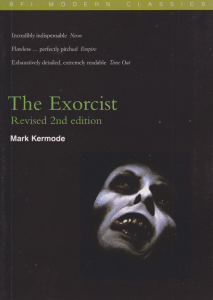
In spite of accusations of puerile voyeurism, horror is a genre containing many deep films. I have no training as a film critic, but it’s evident that among the more weighty of horror heavyweights is The Exorcist. Mark Kermode is, on the other hand, a film critic, and his book named after the movie demonstrates just how much a viewer can see. I’ve watched The Exorcist quite a few times and there were things I’ve consistently missed. I also realize that I’ve only ever seen The Version You’ve Never Seen (the 2000 theatrical re-release). Having been too young and far too skittish to have seen its debut, I’ve been happy—if that’s the right word to use with such a production—with the version I’ve seen. That’s the human condition, I guess. Kermode made me wonder what it would’ve been like to have experienced it before the spoilers became universally known.

Yes, there are striking special effects—especially for the early 1970s—but the message is what really holds the depth. The story is the classic struggle of good and evil. Demons are, after all, a form of evil personified. The fact that a young girl is the victim may be a little too true to life, but it also gives the drama considerable emotional resonance. In the end, according to the view of the writer and director, good wins. The struggle, as they portray it, is real and costly. It’s always informative to find out what those who made a film thought it was about. Even with the motive of making money, many involved in the industry still have the hearts of artists. Maybe even priests.

Having learned at the feet of post-modernists, we know that no interpretation—even that of the creators—is privileged. Just as there’s no such thing as “only reading,” no one “only watches” cinema. The acts of reading and watching inherently involve interpretation. Kermode draws that out nicely in this little book. His interpretation, as insightful as it is, is but one way of looking at it. Was The Exorcist the version originally released in 1973? Bill Blatty and Bill Friedkin disagreed to the end about what the definitive version was. The many sequels and spin-offs have reinterpreted the story in their own ways. So it is with the struggle against evil. There’s no one single way to go about it. Some make horror movies to demonstrate that point precisely. At least in my view they do.