Weather Religion

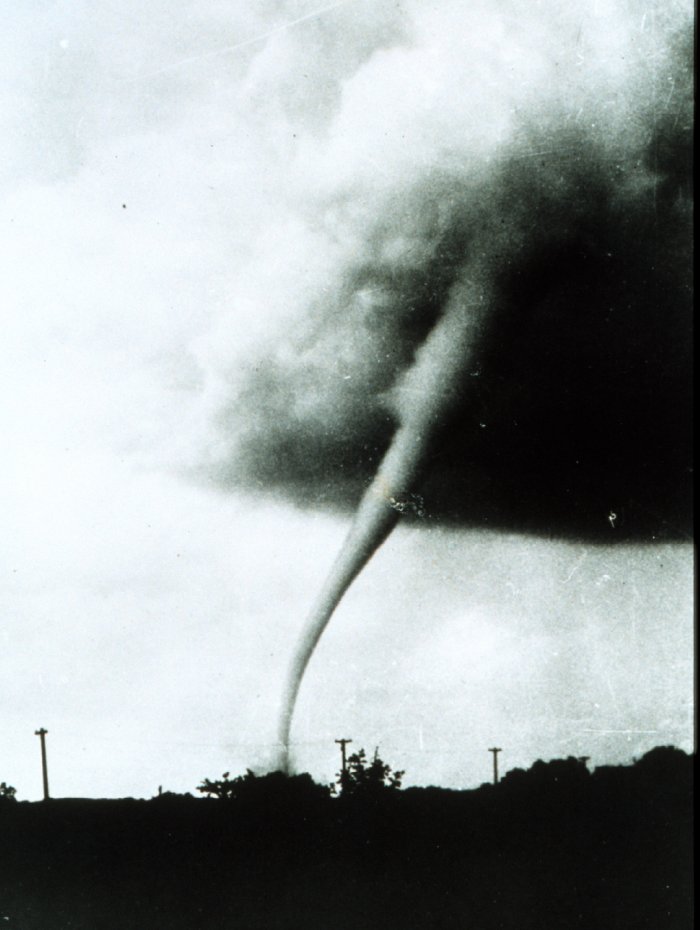
Byline: Yazoo City, Mississippi. Event: major tornado. Suspects: God. In the face of any tragedy, whether it be killer tornadoes or Christie’s budget, God is always implicated. It is the white god’s burden of monotheism. I am the last person to make light of tornadoes. Many a nightmare and sleepless night in Wisconsin were haunted by the loud, roaring gusts and twisted detritus mangled by apparently willful winds. Erratic fluid dynamics of violently spinning vortices of air are often chalked up to the divine. No less so in Saturday’s tornado outbreak.

An Associate Press article begins, “One prayed to God under a communion table as his church was blown to pieces around him.” The article goes on to note that a ravaged hymnal lay open to the page with “Till the Storm Passes By,” as if there were a divine message inscribed on a chance event of nature. One of the hardest lessons to accept is that nature cares nothing special for our species and that we are offered no guarantees in life. This is one of the reason religion is so powerful: here the faithful find divine-bound guarantees of at least a peaceful afterlife if the present life is torn apart by storms both physical and metaphorical. It is hard to struggle without an assurance of final victory.

I have contended for years that the association of the divine with the weather is intimate and tenacious. The weather has eluded human control well into the space age, nuclear age, and technological revolution. We still can’t stop the rain on Sunday’s picnic or festival. And so we pass the weather on to the CEO in the spiritual chain of command. God controls the weather, while we crouch under rickety communion tables. There is a deeper lesson here, for those willing to sift through the rubble.

Nightmare on Church street


Civil Rights and Science Fiction

I remember reading L. Ron Hubbard’s science fiction before the Church of Scientology was widely known. Not surprisingly, the religious movement began in New Jersey – a state where anything seems possible (except finding a job or having a stable government). Over the weekend, however, a New Jersey Star-Ledger story noted that some former members of the Church of Scientology are trying to sue their religion for violation of labor laws and unreasonable pay. Lawyers predict such a case cannot win in court, and I personally wonder how such cases of enforced labor differ from other brands of organized religion that require that extra push from their members. Doesn’t the church reserve the right to demand, voluntarily of course, that citizens forfeit their legal rights?

When I was young and naïve (instead of being old and naïve, as I am now), I took my first teaching job at Nashotah House. I was not yet thirty. It was, of course, a conflicted situation: a bunch of men living in the Wisconsin woods trying to maintain a monastic presence nestled between the sinful cities of Madison and Milwaukee. (And a few women, always the minority of the student body collective.) One of only two non-clergy on the faculty, I was surprised when, in response to what was an unreasonable administrative demand I was told, “When you signed your contract, you gave up your civil rights!” I’m not a lawyer, but I learned an important legal lesson – never mess with the saintly sorts that make up the church administration. Religion is big business. And religious bodies can afford big lawyers.

I feel sorry for the plaintiffs in this legal dispute, but they are in a wide and vast company. Organized religions are human constructs, and human constructs will always favor climbers. Climbers who reach the top will always build fortresses to protect their personal interests. In the church they’ll call it ecclesiastical authority and trace it right back to Jesus handing Peter some metaphorical keys. No, the church is not above the felonies and misdemeanors that secular courts just can’t judge. Potential members should read the contract, including the fine print. And don’t be taken in by the bits that sound like science fiction.

Inventor of new worlds


View from the Snowpocalypse

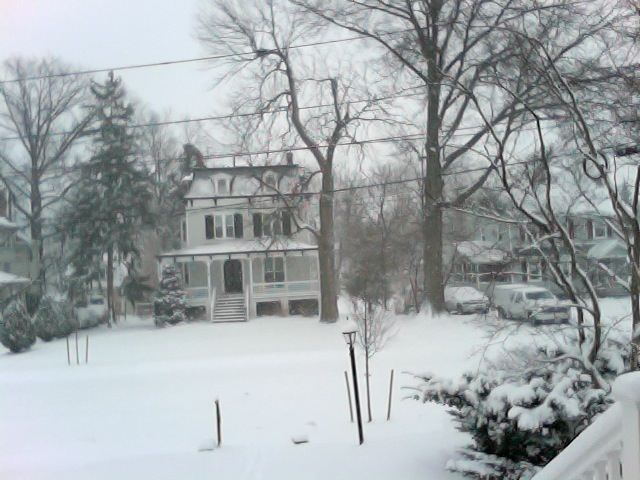
With all of the hype and anxiety of the current Nor’easter dumping snow on the East Coast, a guy from northwestern Pennsylvania can’t help but shrug his shoulders. What’s all the fuss about? Growing up in the snow belt of Lake Erie, I was accustomed to forgetting the color of the ground between December and April. School seldom closed with under a foot of snow. And I had to walk a literal mile to catch the bus, but it was uphill only one way.

The truly fascinating aspect of this storm is the creation of biblically charged words to describe it, as if the American vocabulary has run out of appropriate adjectives. “Snowpocalypse” and “snowmageddon” both appeared in this morning’s paper. The late biblical concepts of apocalypse and Armageddon indicate a devastating turn of the era when a new world is ushered in. All I saw out my front door was a bunch of snow. Peaceful, white, and pretty.

Snowmaggedon? Hardly.

I lament the farming of the otherwise underused Bible for images that cheapen the visceral fear and dread that accompanied ancient outlooks. Once while at Nashotah House in Wisconsin, when the temperature plunged to 38 degrees below zero (air temperature, not wind-chill) and the tired snow was being blown about by unforgiving winds, we were required to make the trek to Milwaukee for a day long spiritual retreat. Just about all human institution had shut down, with the sole remaining exception of a church eager to revitalize its aging congregation. As the ice on the window of the bus refroze immediately after being scraped off, I came close to thinking apocalyptic thoughts I admit. The weather, I guess, has always had a divine connection in our primitive minds after all.