Witching Season

Tis the season for movies about witches.  The cult classic The Craft is another one of my old movies—I don’t think I’ve written a blog post about it before.  In any case, this autumn felt like good timing for a movie about female empowerment.  Rewatching it, it was difficult to miss how religion and horror are tied together.  Indeed, the Bible appears in the film as well.  This makes sense since the girls attend a Catholic school.  So what is this one about?  Teenage Sarah has moved to Los Angeles and is having trouble fitting in at school.  She is a “natural” witch who catches the attention of the small coven consisting of Nancy, Bonnie, and Rochelle.  They invite her to complete their coven so that they can invoke Manon, a deity larger than God.  Once they attain their powers, they begin redressing personal wrongs, but begin to hurt others as they do so.
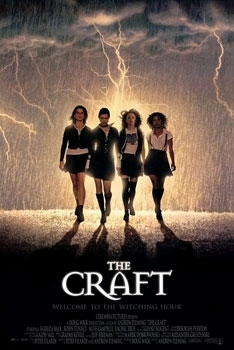
Sarah is the daughter of a witch and her mother died in childbirth.  Sarah has difficulties with using powers to hurt others.  She was primarily interested in a love spell, but it too has consequences.  The coven experiments with even more powerful spells, giving the girls very obvious powers.  Especially Nancy.  Nancy is angry and enamored of power.  Sarah decides she wants out of the coven, but they’ve become too powerful.  Since Sarah tried to take her own life before, Nancy tries to force her to do so, only to succeed this time.  She’s backed up by Bonnie and Rochelle, both enjoying their powers.  Their attack, however, brings out the natural power of Sarah’s witch nature.  In the end, all of them lose their powers except Sarah.  

There’s a strong moral streak through the movie.  Unrestrained power leads naturally enough to abuses—something we’re living through daily in real life.  This is played off against a largely ineffectual Catholic Church.  A street preacher, who doesn’t seem very Catholic, also tries to warn Sarah but his method of using snakes is off-putting, to say the least.  He dies off pretty early in the film.  Religious structures of the monotheistic world have historically closed doors to women.  Some still do.  The power of nature encompasses both women and men, and the power that women have often frightens men.  Again, we see the fear of losing power played out.  This is comically addressed in another witch movie, The Witches of Eastwick.  Indeed, it is directly addressed there.  That’s yet another of my old movies, unless I’ve written about it here before but have lost my powers of memory.
Halloween, Disney Style

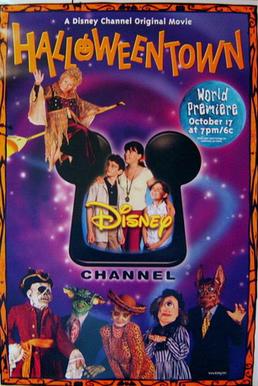
I really don’t spend much time on social media.  It’s literally just a few minutes a day, half an hour at most.  I’m too busy to spend more.  I tend not to join groups because, well, I don’t spend time there.  One group I did join on Facebook is for Halloween fans.  I believe that’s where I heard about the movie Halloweentown.  I was surprised that, as a fan of Halloween for pretty much all of my life, I’d not known about this 1998 movie.  Watching it, it became clear why not.  It is a Disney television movie.  In the nineties we didn’t have television (a few channels from a snowy aerial at Nashotah House) and certainly didn’t subscribe to the Disney channel.  While the movie failed to penetrate my consciousness, it went on to start a franchise.  Once I heard of it, I decided I should see it because I’m interested in the darker side of Disney.

Television movies, with their comparatively small budgets and limited viewerships, don’t have the finished feel that theatrical films possess.  This is the story of a family of witches, three kids and a mother, living in the human world.  The children don’t know they’re witches.  Then when their grandmother visits on Halloween, they sneak into the eponymous Halloweentown with her.  This is where witches and other monsters live because humans fear them.  The “monsters” mostly consist of obvious humans wearing masks and makeup.  There are a few mildly frightening moments as the evil Kalabar tries to take over the human world by persuading his fellow monsters to join him.  But this is Disney where threats are gentle and good fairly easily defeats evil.  While the movie isn’t even as scary as Hocus Pocus, some people watch it to get in the Halloween mood.

One thing that I’ve noticed about many movies that try to capture the autumnal feeling while being shot in California, is that they miss the more dramatic temperate shift in seasons.  This annual outdoors Götterdämmerung resulting in the colorful dying of leaves and the surrender of summer to the inevitable chill to follow is integral to my experience of Halloween.  In fact, one of the few criticisms I’d make to John Carpenter’s Halloween is that Haddonfield, Illinois was shot in Southern California.  Other movies make a similar gaff.  I’m always on the lookout for movies that manage to emulate that Halloween feel.  The film that perhaps does this best, in my experience, is The Little Girl Who Lives Down the Lane, shot in Canada and Maine.  I’m still searching, however, for my own Halloweentown.


Not the Witch

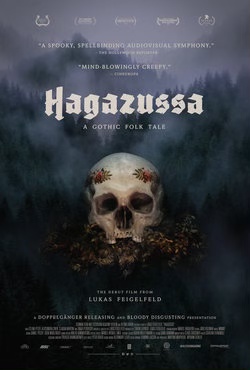
Hagazussa came to my attention from, I believe, the New York Times.  In the autumn normally staid news sources start suggesting horror films to watch.  Subtitled A Heathen’s Curse, this new Euro-horror (filmed in German) immediately reminded me of Robert Egger’s The Witch, but with a lot less plot.  It’s a moody and disturbing story of the life of an outcast young woman in the sixteenth century.  Raised by a poor, goat-herding mother, Albrun watches her mother die of the Black Death, when Albrun’s a tween.  She continues living in her childhood home, with a daughter whose origin, like that of Albrun, is never explained.  The locals shun her as a witch but a seemingly friendly villager befriends her before turning against her and betraying her.  After this neighbor, and then others, die, Albrun drowns her infant daughter after eating a toadstool in the woods.  She then bursts into flames atop a hill in the Alps.

As folk horror, the movie is more about the haunted landscape than about an intricately plotted story.  There’s nevertheless a great deal of symbolism used, including much regarding Eve—apples, serpents, and goddesses all play a part.  Locals fear pagans, and the church interior lined with bones reminded me strongly of St. Stephen’s Cathedral in Vienna, where plague victims’ bones fill the underground vaults.  Seeing such a place reminds you forcefully of your insignificance.  Hagazussa is an art film as well as folk horror, and it appeals to gothic sensibilities.  There’s very little dialogue.  Indeed, the loneliness of Albrun is a major aspect of this moody, atmospheric work.  Such stories always remind me of how difficult life was for those who had to try to scratch a living from the land.  Existence was tenuous at best.  Especially for women alone, as determined by Christian society.

The movie left me reflective.  It also underscored how religion and horror tread the same paths repeatedly.  The village priest tells Albrun that sacrilege must be cleansed, even as he hands her her mother’s skull, polished and decorated.  He wearily admits that he struggles to led the community.  Indeed, Albrun’s new “friend” castigates Jews and heathens, even as she takes part in the robbing of Albrun’s livelihood.  Witches, as “monsters” were invented by the church as fears reached out to point to new sources.  Even if they had to be fabricated at the expense of innocent people.  Fear operates that way still, as anyone who watches political ads knows.  It’s easier to persecute than to educate, it seems.  In the end, Albrun burns up and we realize we’ve just watched a parable.


Empowerment

Recommended as a worthwhile contemporary gothic novel, Alix E. Harrow’s The Once and Future Witches is a feminist tour de force.  Set in a world similar, or perhaps parallel, to ours, it follows three witch sisters in 1893.  The sisters are estranged, having been raised by an abusive father, and each has found her own way to New Salem.  The old Salem had been destroyed after the witch trials.  The three find their lives drawn together, not even knowing the others are there.  But there are also still witch hunters.  None worse than Gideon Hill, the leading candidate for mayor.  I’ve long known that books written after Trump are often fairly obvious for the hatred that oozes from political leaders.  This is one such case.  The story is one of female empowerment in the face of constant male opposition.  It goes fairly quickly for a book its size.

It’s an enjoyable read but it grows, well, harrowing towards the end.  You come to like these three very different sisters and appreciate the gifts they offer to their world.  Men, however, make the rules and often they feel that women have no place in making decisions for the public good.  I’m amazed at the number of people who still believe this.  It makes novels such as this so important.  Women with power are crucial examples to present.  The three sisters may cause mayhem, but it is generally good for the city.  When men are in charge, things tend to get repressive.  Sound familiar?

Conveying the gist of a 500-page novel isn’t a simple task so I’ll simply say that this isn’t a conventional witch story.  There’s never a question that witches are good, but capable of doing bad things.  In other words, they are pretty much like all of us.  That’s not to deny that some people become evil and that such people will gain ardent, blind followers.  The characters are memorable and likable in their very humanness.  As far as genre goes, this is a magical realism novel.  As you get drawn into Harrow’s world it becomes believable.  It’s a book that should be widely read and its plea for tolerance must be heard.  I can think of other comparisons—others have also conveyed that an unquestioning religion may become evil unintentionally.  Such conversions aren’t the kind publicly discussed, but they do fit with human experience.  I’ve intentionally left out spoilers since I want to encourage readers.  It certainly has left me thoughtful.


Colorless Sunday

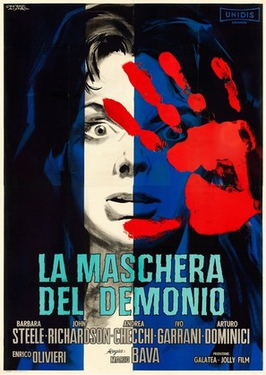
Growing up, my Saturday afternoon horror movies were catch as catch can.  I never really had a plan and I’m sure that there are several films I saw that I have forgotten.  I’m sure one of them wasn’t Black Sunday.  I knew nothing of directors and their reputations then and I was unaware that Mario Bava made quite a splash with this moody movie.  I can now understand why (thanks to Amazon Prime).  This is an unusual vampire and/or witch story, and one which had quite an impact on future films, including one of my favorites, Tim Burton’s Sleepy Hollow.  Indeed, Black Sunday is about as gothic as they come.  A witch is murdered as the film opens, along with her lover.  Two centuries later a couple of doctors stop for the night in the Moldovan town where this happened.  They find the corpse of the witch and accidentally reanimate it.

The monster the witch raises (her lover, initially) attacks people like a vampire does and the victims become vampires themselves.  The best (but not only) way to kill them is by driving a sharp spike through their left eye.  This is quite violent for a 1960 film, but it certainly cemented Bava’s reputation.  In any case, the younger doctor falls in love with the local princess, but the witch has designs on her too.  The older doctor and the princess’ father both get transformed into vampires and get killed off.  By the end, only the young doctor and the princess remain, along with an Orthodox priest who helps with deciphering how to take care of occult monsters.  The plot is more complex than that, and the film is now understood as a landmark.

At the time and place where and when I went to college, courses in horror films were not on offer.  (I was rather preoccupied with religion, in any case, and might not have taken one anyway.)  By the time I was in college, however, I viewed monster movies with nostalgia, but I was trying hard to be respectable.  You always have to be proving yourself when you grew up poor.  Learning how these early horror films fit together is a form of self-education.  And it’s fun.  And horror movies offer an escape from a world where you know you’re having trouble fitting in.  Many of the movies I watch are still catch and catch can, but I think it pays to be more intentional about them.  And I’m glad I caught Black Sunday at last.


Which Love

Perhaps some content creators use genre as a guide when writing, or when filming a movie.  Some categories are pretty well defined—the western, the romance, or in writing specifically, the literary.  Others are less easily settled.  Horror is particularly slippery.  Although The Love Witch was an interesting story with a feminist message, the horror trappings weren’t entirely obvious.  In fact, it reminded me quite a bit of The Wicker Man.  (Not in any literal way, of course.)  Afterward I read that it is also a comedy and that helped make sense of it.  It gets generally high marks although, to me, the acting seemed pretty wooden.  The Love Witch follows Elaine, a young, present-day witch, who’s moving to a small town in California that tolerates witches.  Her husband has recently died and flashbacks imply that Elaine may not have been entirely innocent in the matter.

Once she settles in Arcata, she starts looking for her “prince charming” as she continues to practice the craft.  She finds an emotionally unstable professor who take her home readily enough, but he quickly proves to be too needy.  Part of this is because he took a love potion she gave him.  He dies that very weekend.  Elaine seems less than distraught as she buries him and begins seeking the next possibility.  The husband of a friend comes over when the friend is out of town and he too proves emotionally immature.  After their affair he dies by suicide.  A policeman investigating the missing professor comes to suspect Elaine, but he too feels drawn to her.  The locals, meanwhile, aren’t as witch-friendly as they seem.  They riot in a burlesque club, chanting, “Burn the witch, burn the witch!”  I won’t spoil the ending.

I was watching all of this with the genre “horror” in my mind.  I’d not seen it labeled as “comedy,” and, as an art film there’s nothing so crude as a laughter track or cheesy and obvious comic music.  Instead, the film is an example of “the female gaze.”  Film analysts, and even religion scholars, have long written about “the male gaze,” which looks at women a certain way.  This movie’s writer, director, and producer, Anna Biller, experiments with the female gaze instead.  The results for some men, I suspect, are disturbing.  They certainly aren’t in control in this film.  Retro in execution, it’s unlike most other horror I’ve watched.  Unusual for the genre, the critics responded well to it.  It was a fun flick, but I’m still not sure how wide “horror” stretches, but I do sense that it’s quite inclusive.  And I applaud the female empowerment on display, even if I’m confused.


Unexpected Gifts

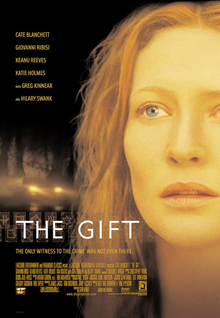
Sometimes horror movie therapy doesn’t go the way expected.  (No surprises there, so no snarky comments, please.  No therapy is “one size fits all.”)  This was brought home to me when watching The Gift.  I was attracted to the speculative aspect of the premise and although it came out over twenty years ago I hadn’t heard of it before.  Although there are speculative elements—at least two ghosts—it is largely a human drama and one that hit me unexpectedly.  As a public service for those who also practice horror movie therapy, I thought I’d consider it here.  (Then call my regular therapist.)  Annie Wilson is a psychic in rural Georgia.  She gives readings for donations to help supplement Social Security since she’s a widow and she has three young sons.  I don’t know why this didn’t start the warning bells a-jangling, but when it was over I realized her situation was like mine, growing up.  (My father was alive, but nobody knew where he was, otherwise I’m on board.)

A violent neighbor, scarily played by Keanu Reeves (forever Neo in my mind), keeps threatening the family since he’s a wife-beater and Annie recommends his wife leave him.  Then a woman is murdered and her body is in his pond (or better, bayou).  Annie realizes that this threatening bully, who’s convicted of the crime, is actually innocent.  Her lawyer, however, doesn’t see the problem—the guy was a menace to society and he’s locked up.  Annie, however, insists on finding the truth.  I have to say that this movie genuinely scared me.  I almost stopped watching.  It wasn’t the speculative part, though.  It was the human part.

Religious locals accuse Annie of being a witch and a Satan-worshipper.  She is, however, simply trying to get by in a society that has failed her.  Having an unstable neighbor threatening her kids doesn’t help.  What’s so scary is that this isn’t far from real life.  For those of us who grew up poor, safety nets are few and the weave is very, very loose.  And you’re made, even as a kid, to feel the social stigma of the crime of being poor.  Annie has a good heart.  She tries to get a man wrongly accused released from jail, knowing that he’ll probably begin threatening her again, if not actually harming her.  Society, however, doesn’t really care.  Raising three small children on welfare on your own isn’t easy.  And, in fact, those kids may well grow up needing therapy.  Even if it’s watching horror to try to make sense of life.


An October Movie

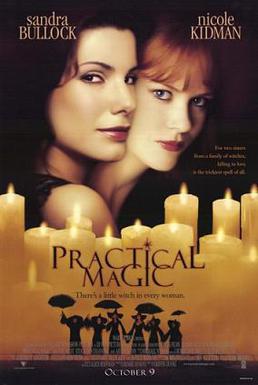
October means different things to different people.  I know what it feels like to me and I suspect, and hope, that there are others who experience it like I do.  When I search for October movies I’m looking for a kind of happy melancholy unique to the season, but others seem to think movies about witches capture the feel.  So it was that I came to watch Practical Magic, which was recommended on more than one October movie list.  It’s not a horror film, in fact it’s a rom-com and it doesn’t try to frighten anyone, although there is one tense scene.  Like many movies about modern-day witches, it has a good message of female empowerment.  I’m glad I watched it for that reason, and the story isn’t bad.  Set on an island community, presumably in Massachusetts, but shot in California, it’s not exactly falling leaves and pumpkins, though.

Witches seem to be the preferred monsters for feminine endorsement.  Most people, I suspect, wish they had magical powers.  We all want things to go our way and would like to manipulate them in that direction.  But there’s something more to it.  It’s tapping into an ultimate power—something that can’t be challenged.  Practical Magic, although not always in a serious mood, does portray the struggles witches have against occult powers.  The story is of the Owens family, which have been witches since the pilgrims landed.  They suffer under a curse dooming the men with whom they fall in love.  Not all the women are cut out for such a life.  So it is that Gillian and Sally set out to break the curse, each in their own way.

Other occult powers are at work, however.  One is clearly the curse itself and another seems to be an undead boyfriend who eventually possesses Gillian.  The women of the community have to come together to exorcise this entity, and that finally leads to communal acceptance of witches.  A major studio production with a reasonable budget and star power, it really didn’t do well at the box office.  Barbie seems to have struck a feminist chord that Practical Magic was reaching for, but the late nineties were a time when women’s power seemed to be starting to secure itself.  I noticed that, when looking for the movie on streaming services, it’s now having a limited theatrical run—it’s October, after all.  This may not be my October movie, but it has a good message that still needs to be learned.


Forgetting Witch

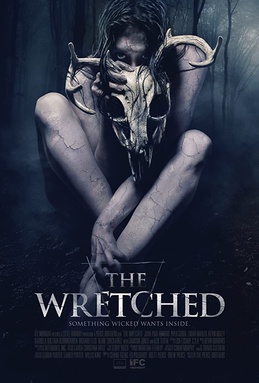
Being forgotten.  Isn’t that one of our greatest fears?  We want to be remembered, our desperate “Kilroy was here”s scribbled on the impermanent earth.  This is the fear that’s at play in The Wretched.  This fairly low budget horror film came to hold the record of being a box-office top earner for six consecutive weeks in 2020.  This was a technicality, of course.  The pandemic was in full swing and other major motion pictures were put on hold.  The Wretched played on, earning little, but more than other films.  It’s not a great movie, but it’s not a bad one either.  It all has to do with what might best be called a “witch.”  In reality, the monster is based only in part on witch traditions, but the twist is this monster makes you forget the people she takes as her victims.

The story hinging on an impending divorce and a somewhat rudderless young man being sent to live with his father in Michigan while his parents sort things out.  Ben, the young man, notices the neighbor’s young Goth wife, but something’s strange about her.  While in the woods, she and her son encountered the monster—revealed as a witch by the occult symbol carved into a tree near her den.  She steals the family baby (you’ll probably hear echoes of The Witch here, and you wouldn’t be wrong) and the family forgets there was a baby.  She then takes over the body of the mother.  Ben spies on them, Rear Window-style, when he’s not at work.  Soon the older son of the couple is missing, and the father claims they have no children.

Ben, while starting a romance with Mallory, a girl from work, pieces together what’s going on, but nobody believes him.  The problem is the missing persons are all forgotten.  To me, anyway, that was the scary part.  Ironically, while not literally so, the movie itself has been forgotten.  We all remember those days of panic in the spring of three years ago.  Long days when we didn’t leave our homes because some killer virus was rapidly spreading and the leader of the country simply didn’t care.  Those who released movies (or published books) in 2020 know that their work was quickly forgotten.  People had other things on their minds then.  I still don’t quite get why it’s called The Wretched, unless it’s perhaps those who are forgotten.  If so, the movie may become a parable of the many creative works that emerged during a time when our collective mind was clearly elsewhere.


When Autumn Starts

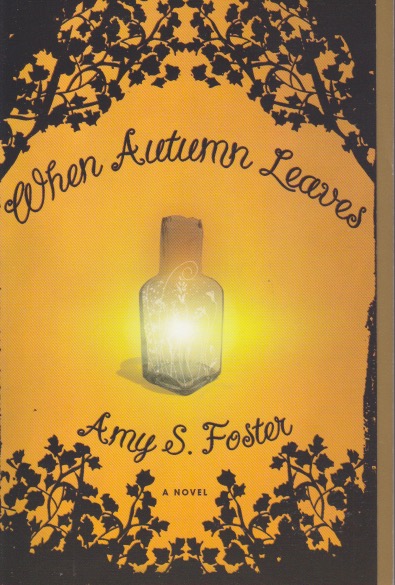
Some books catch my attention and I’m not sure why.  Knowing myself, the title When Autumn Leaves, invoking my favorite time of year with its intriguing syntax, probably did it.  I’m always on the lookout for books that capture the spirit of autumn.  Although she’s quite well known as a lyricist, Amy S. Foster’s name wasn’t familiar to me.  The cover looked autumnal and I knew it was about witches.  It came out quite a few years ago, so my recollection of why I’d marked it then had faded by the time I finally got to it.  The title is a play on both autumn and leaves.  The main character of the ensemble cast is Autumn and knowing that changes leaves from those on a tree to a verb of action.  I’ll try not to put any spoilers here since there’s plenty to say without giving away the ending.

Autumn is a good witch.  Well, the book doesn’t out and say so directly.  Being magical realism there’s some room for interpretation.  She’s the matriarch of Avening, an island city off the west coast.  Those drawn to Avening tend to have some kind of magical powers, whether or not they know of them.  The story unveils the various women coming to be aware of their special talents, but generally they’re unsure what to do with or about them.  Autumn is the one to help them.  She’s been in Avening as long as anyone can remember, but, as the novel opens, she learns it’s her time to leave (thus the title).

Before she can go, however, Autumn has to select a replacement.  This is what introduces us to the various characters in the story.  We hear of the magical powers of some of the thirteen in quite a bit of detail, and others more incidentally.  Many of them don’t know they have these powers.  They know there’s something special about Avening and that they were drawn there, but they don’t know why.  So it’s a tale of female discovery.  Some of the vignettes are difficult to read, dealing with serious subjects, but they reflect realities in women’s lives.  It’s not really an autumnal story, spinning as it does through the wheel of the year, beginning with the winter solstice and ending up at Samhain.  It doesn’t dwell on Halloween, however.  It’s much more a character-driven story.  It creates a wondering image of Avening and what might happen if women were in charge.  And in that respect it’s very compelling indeed.


Witches of September

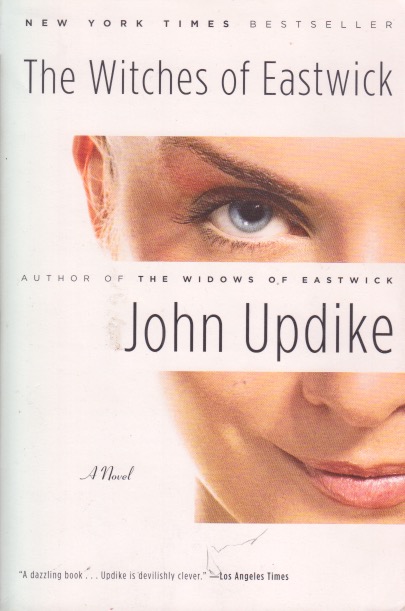
I’ve never read any John Updike before.  I understand that his novels foreground religion, which I didn’t realize.  I have watched The Witches of Eastwick, in movie form, a time or two.  In fact, I wrote a bit about the film in one of my books.  This got me curious to read the novel and I found a copy at a used book sale up in Ithaca some months back.  Now that September’s here, it seemed like an opportunity to see what the original story had to say about witches.  There is a problem, of course, in having watched the movie first.  Not only does it tell you which actors the characters should look like, but it also predisposes your orientation to what will happen.  In this case all that will mislead you.

The movie centers on Jack Nicholson’s Darryl Van Horne—like most Nicholson movies, his character takes over—whereas the novel is definitely centered on the three witches, Alexandra, Jane, and Sukie.  They don’t fall into the background, but neither do they always work in concert.  The movie tells, in other words, a very different story.  Updike’s literary treatment focuses on female characters and the mischief they cause.  Nor is it entirely clear that Van Horne is demonic, as in the movie.  A church features prominently in both versions, amusingly Unitarian in the novel, with Van Horne not upstaging the sermon but giving an invited one himself.  No fear of sacred places here.

The wrath of the witches isn’t directed toward Van Horne either.  A character left out of the film, who marries Van Horne and whose brother is his real target of affection, is hexed and killed by the witches instead.  In many ways this could be construed as a kind of gentle horror story, although it’s never marketed that way.  I kept waiting for certain scenes in the movie to be narrated, as it were, in the flesh.  This led to the revelation that these scenes were invented for the cinematic version.  Both novels and movies are stories.  When shown on the big screen, we expect them to be adapted.  My personal preference is for the film to present the same story.  It can’t always be done, of course.  In this case the movie left some questions open that I hoped the novel would answer.  Since the stories are so different, the questions remain.  I have a feeling I’ll read more Updike down the road, but I’ll avoid watching the movie first.


Which Wednesday

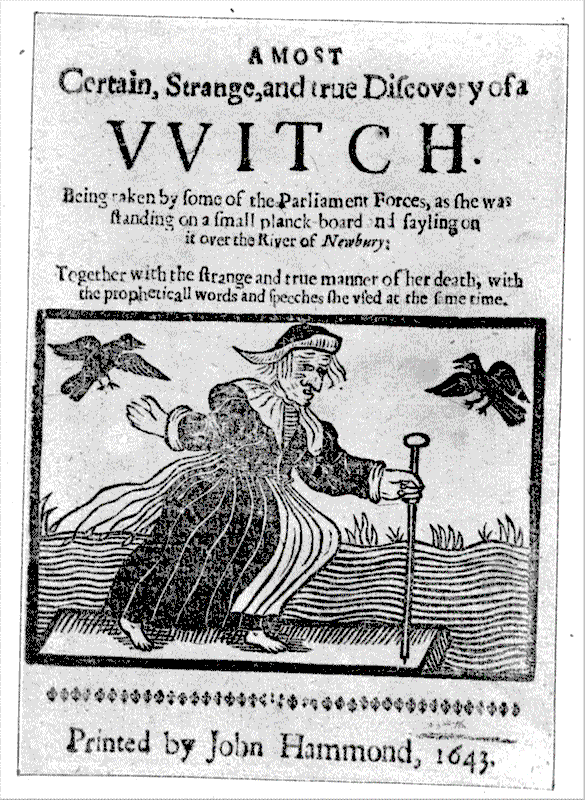
I’m not superstitious but it’s still pretty dusky when I go for my constitutional on cloudy days.  I was walking along thinking about Cernunnos, the way one does, when a black cat darted out of the underbrush and across my path.  My thoughts turned to witches.  Then a large toad jumped out in front of me in the half-light.  Perhaps it was because I picked up a booklet about witches recently, but this felt very uncanny to me.  There’s a place where the woods close in on both sides of the path.  The sun wasn’t yet up, and the clouds meant it wouldn’t have much mattered anyway.  When the bird calls stopped I began thinking about turning around and going home.  Nobody else was out this morning and although I don’t mind starting my day with the weird, I was thinking “not on a Wednesday.”

A thick mist lay over part of the path and I realized just how uncomfortable we tend to be when we can’t see clearly.  Despite that, and the black cat and the toad, I’ve never really been afraid of witches.  I guess I try to please people too much to think that someone might want to harm me supernaturally (at least among those who know me).  I recently found a booklet on witches—one of those strange impulse buys after being mostly house-bound for the better part of a year-and-a-half—that perhaps prompted my thinking this morning.  Although it seems to be most interested in earth-centered religions, it has an article about Salem.  Despite the more modern embrace of witchcraft in Salem, historically it had to do with human fear and hatred, a combination that is scary indeed when applied by those who are superstitious.

Cernunnos is a Celtic god generally portrayed with deer antlers.  Although lack of literature means we know little about him, he’s been adopted as the male counterpart to the female earth-goddess in some traditions.  Modern witchcraft is based on an orientation toward nature.  It’s kind of a ground-up religion rather than a top-down one.  Christians traditionally labelled it “Devil worship,” as they tended to do with anything they objected to.  Such demonizing helps no one, of course.  And when these ideas grow into superstitions people get hurt.  So I’m out here in the half-light because in the mornings days are shortening quickly and I have less and less time before work begin after the sun rises.  And I have witchery on my mind.


Witchfinder, Generally

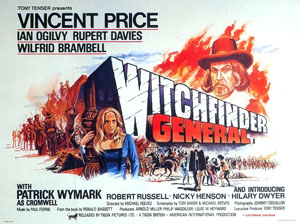
In Holy Horror I describe the “unholy trinity” of movies that figure strongly Christian themes: Rosemary’s Baby, The Exorcist, and The Omen.  These movies span 1968 through 1976 and all were extremely successful.  Another writer earlier dubbed another three horror films from the same era the “unholy trinity” (I didn’t realize I was being trite) of folk horror: Witchfinder General, The Blood on Satan’s Claw, and The Wicker Man.  These three were low budget and not particularly successful at the box office.  They’ve all become cult classics, however.  I suppose that together these six films help mark the late sixties and early seventies as the beginning of a new realm of horror films.  Folk horror continued to exist but wasn’t terribly common.  It has recently been given a high profile by The Witch and Midsommar.

Of all of these films Witchfinder General stands out as the least obviously marked by horror tropes.  It’s set as a fictionalized account of the historical Matthew Hopkins, a man actually responsible for about a fifth of all British witch executions in the seventeenth century.  There’s nothing really supernatural in the film and its horror reputation is attributed to the cruel tortures depicted—these really pushed the envelope in 1968.  Not only was Rosemary’s Baby released that same year but so was Night of the Living Dead, another defining horror film.  The sixties were a chaotic time—the birth pangs of a new outlook that is still being resisted by many politicians.  We all know about the music of the era, but the cinematic impact was also immense, as these six films show.

As different as they are, these two trinities all feature horror that is fueled by religion.  Although this had been pointed out earlier in the century, people were now being made aware that, apart from the good religion does, it also brings potential evil into the world.  There’s no question that misguided over-protectiveness of Christianity led to many, many innocent deaths.  The more cynical might note that the Christianity being “protected” is actually key to an economic system that benefits the rich—that supports the interests of the wealthy.  The historical Matthew Hopkins was the son of a clergyman.  Apart from his reprehensible role in rekindling the witch trials in England, not much is known of his life apart from his preoccupation will executing “witches.”  As time has gone on, we’ve unfortunately circled back toward the religious conflicts in the folk horror trinity.  Watching horror may yield some valuable lessons.  


Learning To Fly

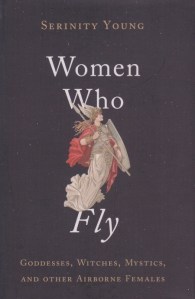
It’s perhaps the most deeply rooted human dream.  Flying.  Women Who Fly, by Serinity Young, is a fascinating book.  Subtitled Goddesses, Witches, Mystics, and Other Airborne Females, the book covers all of these and more.  The dream of flying is played out in many ways here, but often the narrative comes back to how patriarchy imprisons women.  Is it any wonder they want to fly?  Very wide in historical scope, the book can’t cover all cases in equal depth.  It nevertheless demonstrates how pervasive the idea is.  Beginning with ancient female figurines bearing bird-like features, Young moves through the related concepts of captivity, transcendence, sexuality, and immortality, showing how female characters are related to these idea in universal and unrelenting ways in the form of flying females.

There are many lenses through which to view patriarchy.  It can be explained as a consequence of settled agricultural existence with its subsequent division of labor.  Such a scenario raises questions of whether women dreamed of flight before that, and I believe the answer must be yes.  For as long as we’ve observed birds and associated the sky with gods we have longed for flight.  Although birds make it look easy, it is an incredibly difficult and costly adaptation.  Still, women dream of travel without obstacles (let the reader understand) to the realms where deities dwell.  It is difficult to summarize a book that covers so much historical territory.  Young doesn’t limit herself to western religions but also spends a fair bit of time among Buddhist, Hindu, and Daoist ideas of flying women.  She covers mythical, folkloristic, human, and historical flying females all the way up to modern astronauts.

As I was coming to the close of the book the real message hit me—I can be thick at times, although much of my own writing is metaphorical—men have actively tried to clip women’s wings for a long time.  Often under the auspices of religion.  Think of it: for centuries of existence the major monotheistic traditions have refused female leadership.  The one (inevitably male) god has set up a boys’ club of sacerdotal leadership.  As Young points out, even the named angels in the Bible are male.  I used to comfort myself with the explanation that male leaders were simply too self-centered to consider others, but it is becoming clearer, the more I read, that men have always had a tendency to try to keep women down.  And thus they fly.  There’s much in this book for both women and men to ponder.


Bodies and the Fall

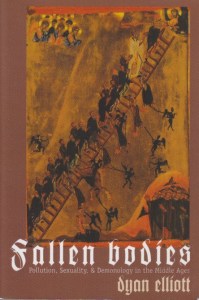
Less common than it once was, the term “Dark Ages” was formerly used to denote what in Europe was known as the Medieval Period.  We now know that the pervasive darkness ascribed to the time was only partial: science, legal thinking, and rationalism were well underway.  Nevertheless, the sway of the church was enormous, and even until and beyond the days of Isaac Newton, the supernatural was assumed to exist.  Dyan Elliott’s Fallen Bodies: Pollution, Sexuality and Demonology in the Middle Ages is a fascinating journey through this contradictory time.  Elliott explores how the mysteries of sex (nocturnal emissions and menstruation loom large among them) played important roles in the development of Catholic theology that ultimately led to the close association of demons and witches.  Concerns with priestly purity, largely due to concerns about transubstantiation, led to enforced celibacy and the (further) denigration of women.

It would be difficult to summarize this insightful book.  Although relatively brief, it packs a wallop.  Concerns about purity go back to the Bible and before.  Ancient cultures had recognized aspects of contagion and knew that some diseases spread by contact.  Their perception of biology was “scientific” according to their current understanding, but it lacked microscopes and knew no shortage of supernatural entities.  Demons had great explanatory value in such a world.  As Elliott shows, they often appear in disquisitions about sex.  How can spiritual beings engage in physical relations with human bodies?  What were they made of?  Were they all bad?  Although demons had explanatory value they also raised many questions.

Fallen Bodies draws correlations between the dismissal of priests’ wives and the evolution of witches.  As the Eucharist became more and more holy, stricter controls had to be placed on consecrating hands.  Sex was the great source of pollution, and the Virgin Mary became rather less human through her own miraculously sterile conception.  The implied misogyny may not have been so much intentional as a reflection of the struggle to understand what modern medical science generally explains materially.  We still grapple with the mystery of life.  Conception can be viewed clinically, and biological responses can be “explained” scientifically (anyone who’s been in love will admit to the mystery of it, though).  Denizens of the Middle Ages worked with the tools they had to make sense of a world often bewildering.  Even physics still has to deal with quantum realities.  History teaches by its unfortunate missteps.  Someday those who “govern” the world may learn to read it and exorcise demons now otherwise readily explained.