Not Tomorrow

Two of the sweetest words I know are, in the context of a vacation, “not tomorrow.”  They’re especially sweet after you’ve had a couple days off and you start feeling anxious that time is running out, only to realize that although work will start again soon it’s “not tomorrow.”  You have another day when you can stay in your pajamas, read, watch movies, or, if you’re a certain personality type, write.  Or play games, put a puzzle together, visit friends.  Whatever it is you do to find meaning in life outside work.  Outside academia I’ve never worked for a company that gave more than one day itself for the Christmas holiday.  (Two, if you count New Year’s Day, but that’s technically on next year’s meager holiday tally sheet.)

Each year I cash in vacation days so that I can feel “not tomorrow” more than a day or two in a row.  One of the more depressing recollections I remember is climbing onto an empty bus well before sunrise to commute to an otherwise empty office my first December working for Routledge since I hadn’t accrued enough vacation to take the week off.  I’ve worked for two British companies and it doesn’t help knowing our colleagues in the UK automatically have that week off.  Colonials, however, have far fewer holidays, and if that means trooping to the office for form’s sake, so be it.  Very few people answer their emails between Christmas and New Year’s.  Her majesty’s realm thrived for my presence, I’m sure.
The pandemic has taught us that many, if not most, workers are self-motivated when not confined to an office.  We also know that the United States has the lowest life span among developed nations, and my guess is that one contributing factor is that we don’t have enough “not tomorrows” until it becomes literally true.  Life is a gift, and spending it doing the things we value is something we tend to deny ourselves in the hopes that someday we might retire.  Many companies have begun to cap the number of vacation days you can accrue at numbers so low that the year looks like a desert from January through late November.  It’s that stretch of “tomorrow is a work day” punctuated by weekends so vapid that they vanish by the time errands you can’t do during the week are done.  Why have we done this to ourselves?  For me personally, I only have two more regular work days off.  I’m beginning to feel anxious about it.  Then I tell myself that, for today at least, although I have to start work again soon, it’s not tomorrow.


The End of Snow Days

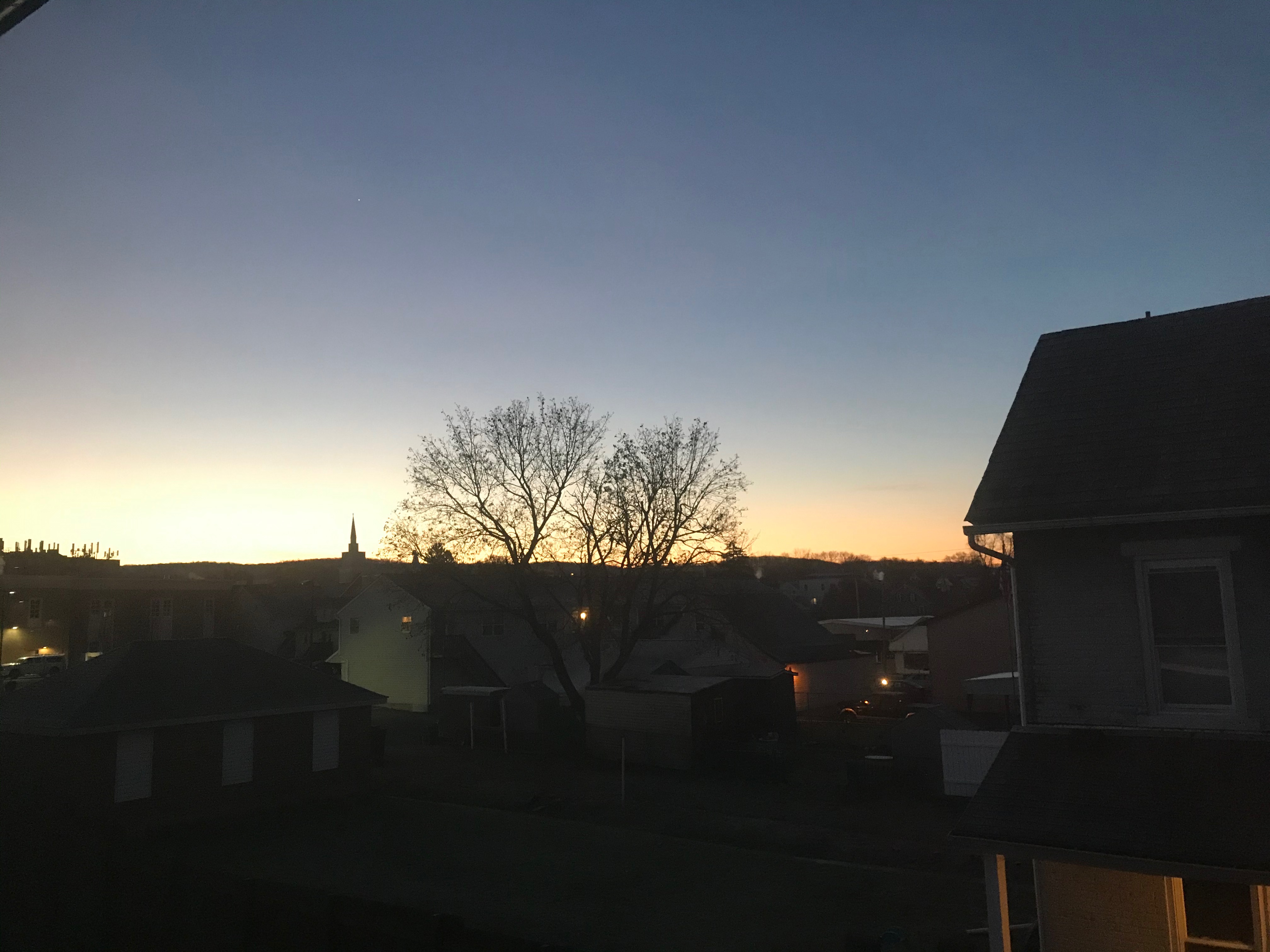
It’s a chilling thought.  An article in the New York Times said it, but we were all thinking it.  Snow days may well have become another victim of Covid-19.  No, it’s not snowing yet (but give climate change a chance!), but New York City schools have figured out that if students can learn from home then one of the truly treasured memories of our youth may no longer be necessary.  In fact, snow days ended for me when I began working remotely.  My supervisor had suggested, even before that, that I take my company laptop home daily, in case of inclement weather.  The idea of awaking, wonder-eyed, at the world covered in white—that cozy feeling of knowing you had no obligations for the day but to enjoy the pristine world out your window—is a thing of the past.

Technology has changed our lives, and some of it is even for the better.  It hasn’t made work easier for some of us, but has made it longer.  We used to talk about kids and their continuous partial attention, but now work is always at home with you and that time signature on your email says something about your work habits.  As the days are now shorter than the nights, as they will be for six more months, finding the time to do what you must outdoors (it may be cooler, but lawns still insist on growing) is always a bit more of a challenge.  And when the snow does fall you’ll still have to shovel the walk.  All time has become company time for a truly linked-in world.

The real victim here, it seems to me, is childhood.  Snow days were a reminder that no matter how strict, how Calvinistic our administrators wanted to be, the weather could still give us a smile now and then.  A legitimate excuse not to have to go to school and, if parents couldn’t get you to daycare, a day off for everyone.  The strict number of limited holidays allotted by HR had limited power in those days.  Although we all know that well-rested, happy workers tend to do better jobs than those who are constantly stressed out and who have trouble sleeping, we’ve now got the means to make the sameness of pandemic life the ennui of everyday life, in saecula saeculorum.  Thanks, internet.  At least now we work where we have a window and can look out on nature and can see what we’re missing.


Spoiler Alert

I work in a cubicle. That’s just one word shy of the famed “six word novel” challenges. I’m wondering what qualifier I should add. To understand this dilemma you have to realize a few things. My first professional job (professor) included a three-room office to myself. Also, I am a middle-aged man amid a work-pool of mostly twenty-somethings (everyone else my age has their own office). My cubicle has walls six feet high, so I can’t see, but can hear my just-out-of-college neighbors. Very few people talk to me at work. In fact, I can go an entire week without anyone saying anything to me, right here in the largest city in the country. The office is generally very quiet. You can hear everything. This leads to my concern with a very specific peril regarding work in a cubicle.

Much of the meaning in my life comes from what I read. In addition to all the books I review here on this blog, I have quite a few fiction projects going at any one time. I happen to be reading a book just now that was recently made into a movie. The reason I know it’s been made into a movie? My unseen, 20-something colleagues began talking about it yesterday morning. Complete with spoilers. Now, they couldn’t see the contortions on my face, hidden in my cubicle. The people who sit next to me work in a different department than mine and I have no reason to speak to them—they don’t even know who I am. Should I, like the voice of God, thunder unseen from my cube, “No spoilers!”? Or should I just continue to sit here with my fingers jammed firmly into my ears and hope that when I pull them out I don’t learn anything more about what I haven’t read yet?

I know it’s just me. I don’t read the blurbs on a book before reading the book itself. I don’t read reviews of movies before seeing the film. Guys my age appreciate the craft of story, building up to the reveal, not getting it in Monday morning water-cooler talk. I finally got up and walked away from my desk. There’s nowhere private to go on my floor, so I went to the stairwell and pointlessly climbed to the top floor and back down again. I returned to my desk and they were still talking about it. Not only was it Monday morning in a New York City where nobody had spoken to me in the three hours since I arrived in town, but there wasn’t even a spoiler warning for one of my favorite pastimes. Such are the perils of cubicle life.