
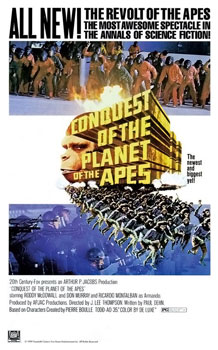
 The year was 1972. In the continuing saga of the Planet of the Apes, the fourth installment, Conquest of the Planet of the Apes, addressed the civil rights movement directly. Caesar, the son of Cornelius and Zira, is the last speaking ape left in the past to which his parents had escaped. Inexplicably, the other great apes have all suddenly evolved by 1991—the year in which the story is set—into large sized, almost upright creatures whose population matches than of humans (almost). Initially purchased as pets since the cats and dogs had died off in the late 80’s, apes have been imported as slaves. They are given menial tasks and beaten mercilessly if they make errors. A deep fear pervades the establishment that these apes will try to take over. Breck, the governor of California, decides to find and kill Caesar, at any cost, while his deputy MacDonald tries to save him. When Caesar reveals himself to MacDonald, an African-American, he states that he especially should know what it means for a people not to be free.
Martin Luther King Jr. had been assassinated only four years earlier and although civil rights had made progress, there was still a long way to go. Still is a long way to go. As an affluent culture, we remain reluctant to share. We still see disproportionate numbers of African-Americans and Hispanic Americans forced to live in areas that the amorphous “white” population has fled. Xenophobia is one of the less noble traits with which evolution has endowed us. Even so, the classes we devise aren’t always helpful in determining who people really are. “White” can mean anyone from the southern tip of Chile to the tundra of eastern Siberia. On job applications now “Hispanic” is classified as “white.” I get the feeling that there’s a few unresolved issues here. The sense of entitlement did not begin with this generation. Those who have naturally suppose that they deserve. Caesar observes the unfair treatment and, down to the detail of the weapons the apes stockpile, leads a plantation-style revolt that overcomes a heavily armed command post. Gorilla warfare indeed.
In classic 1960s-70s style, Caesar grandstands after his victory. He was about to order Breck’s execution, but stays his hand in the recognition that even humans deserve to live. We do have to wonder where he might have learned about God, being raised by a circus trainer and in what is an otherwise completely secular society in the film. In any case, his final words in the movie place the apes on a higher moral plane than humans. “But now… now we will put away our hatred. Now we will put down our weapons. We have passed through the Night of the Fires. And who were our masters are now our servants. And we, who are not human, can afford to be humane. Destiny is the will of God! And, if it is man’s destiny to be dominated, it is God’s will that he be dominated with compassion and understanding. So, cast out your vengeance. Tonight we have seen the birth of the Planet of the Apes!” Maybe it’s all the dead bodies around, but I’m still having a little trouble with the “Destiny is the will of God” part.

 Steve A. Wiggins