Club Frankenstein

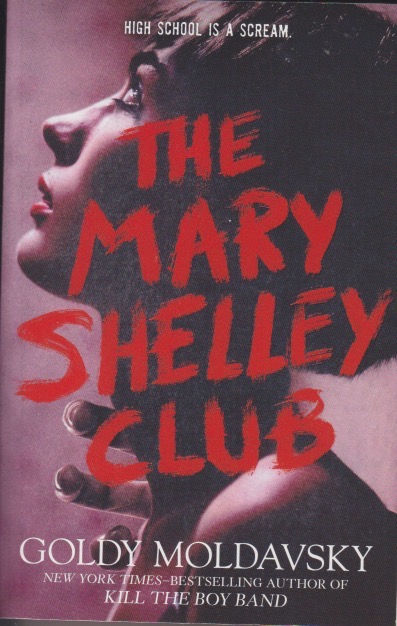
Reading YA novels once in a while reveals that younger folk have quite a good selection of literature from which to choose.  Goldy Moldavsky’s The Mary Shelley Club is a good pick for horror fans as it takes several cues from horror movies and mixes them with the anxieties of high school.  Rachel Chavez is a new student at Manchester Prep in New York City.  Her mother moved her there after a break-in and attack at their old home on Long Island.  With really only one friend at her new school, she finds out about the secretive Mary Shelley Club which meets to watch horror movies—or so she thinks.  Rachel then learns that the club’s real raison d’être is to play a game called Fear Test in which a targeted student is frightened, sometimes to death.  Rachel settles in the the club, being a horror fan, but grows increasingly uncomfortable with the game.

I won’t say much more than that about the plot, but I will say it is compellingly written and a page turner.  I didn’t quite buy the resolution, but that’s often true of horror movies.  It captures well the anxiety of high school, and of moving to a new location.  And Moldavsky certainly knows her horror movies.  I sometimes ponder what makes a novel YA.  I suppose it’s the focus on high school/college kids and a restrained vocabulary, shall we say.  While there’s no explicit sex scenes, there is some making out with intent here (this isn’t a romance), and there are a few f-bombs dropped.  And there is a body count.  Still, for horror, it doesn’t feel as gristly as “adult novels.”  Young people seem to lack the more developed evil of their elders.

My motive for reading it, apart from the horror aspect, was that The Mary Shelley Club is occasionally cited as an example of dark academia.  It’s easy enough to see why.  An exclusive school, wealthy families, and a dark subtext involving a secret society.  These are often hallmarks of the genre.  Dark academia may blend with horror, as it does here, or other genres.  That’s part of its appeal.  In this case the school, Manchester Prep (the name borrowed, it seems, from Cruel Intentions) may not be the center of the story, but it is what brings the main characters together, even if the horror is extra-curricular.  It was a fairly quick read, despite its size, and it bodes well for other good reading while exploring this particular aesthetic.
The Dark Season

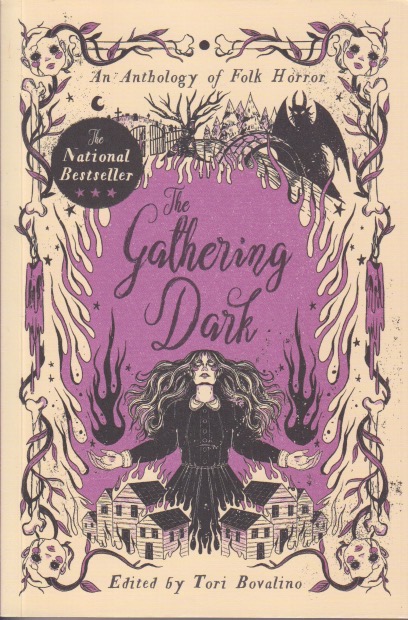
It was on Goodreads that I first saw The Gathering Dark.  Since I’ve been trying to read more short stories, I decided I should give it a go.  Subtitled An Anthology of Folk Horror, it sounded like important for a viewer of said folk horror.  Anthologies, both fiction and non, are uneven by nature.  And something that wasn’t clear at first is that this was a young adult collection.  I’ve read YA books before, of course.  Some of the most creative fiction of the last couple of decades has been for that demographic.  The feature I noticed most here was that the horror was mostly gentile, kind of like the horror in my fiction.  I never consider myself a YA author, however.  Occasionally my characters are teens or twenty-somethings, but for the most part they participate in the adult world, where something is wrong.

Youth is, of course, a fraught time.  We’re exploring relationships and trying to sort out the changes taking place in our bodies and our lives as we leave the larval stage.  There’s a kind of natural horror to it.  At the same time, “folk horror,” like horror itself, is a slippery term.  Some of the stories seem to be based on urban legends, and that is definitely the present-day source of folk horror.  When it’s found online it’s often called “creepy pasta.”  It can be the basis for horror stories, and I’ve seen a few movies that make use of it.  Folk horror tends to favor rural settings (true of all the stories here), and superstition, and isolation.  Often it involves pagan religion, but here only one story dwells in that territory.

Overall I found the collection interesting and well written.  A number of the stories did evoke the feelings of what it was like to be young and afraid.  I do wonder how the anthology came about.  There’s no introduction and, I know from my own publishing experience that anthologies are a hard sell to most publishers.  I’ve noticed Page Street books before.  They recently began accepting horror written for adults.  They already have a strong YA list, thus The Gathering Dark.  They’re also committed to diversity, and that clearly shows throughout this collection.  I think it’s important to read young adult literature now and again.  It is, literally, the literature of the future—this is what forms young people’s tastes.  This particular book was a national bestseller, and it earned some notice on Goodreads.  And that was enough to draw me in.


More Young Fear

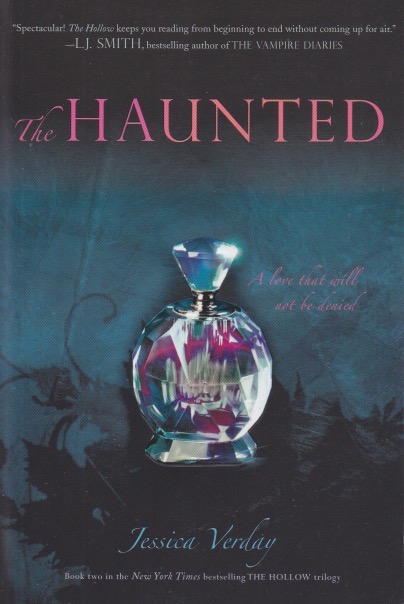
Okay, so the second one has a cliff-hanger ending.  I should’ve seen that coming.  This installment of Jessica Verday’s The Hollow Trilogy moves the story pretty directly into the realm of the dead pervading the everyday world of Sleepy Hollow.  For young adult literature from the era of Twilight, it does raise issues that, although they were around when I was young, have become more prominent in the thinking of teens.  Overdoses, college choices, attempted rape (or at least threatened), seem like things our society might’ve either overcome or matured about.  Instead, we start putting these pressures on our young and wonder why society has a hard time coping.  Sometimes I wonder if we’ve made society too complex.  As an adult it’s become so complex that I’m never quite sure if I’m getting things done correctly, or if they might come back to haunt me later.

In any case, in the first novel of the set, The Hollow, the protagonist/narrator, Abbey, discovers that her boyfriend has been dead all along.  The Haunted, volume two, is about how she copes with that.  I read many years ago that certain narratives are something like preloaded in human brains.  Given even the most basic pieces, our minds fill in the blanks.  When girl meets boy and likes him, our thoughts go toward getting them together.  Of course, a story is all about the difficulties that threaten to prevent that from happening.  For most of us, we start to experience these things as teens and even as adults we remember it well.  These are intense emotions and society complicates them because just when we think we know what we want at high school age, college separates us and we start over again.  Thus college visits.  It’s even more complicated when your boyfriend is a shade/ghost.

How the material and spiritual relate is an unresolved issue.   Materialists have already decided by cutting the spiritual out altogether, but the rest of us, perhaps trusting our feelings more, wonder.  Although these books are more paranormal romances than philosophical musings, they nevertheless raise questions that even adults struggle with (or should).  We don’t have all the answers and we hope that our children might get further along this path than we did.  Young adult literature helps them do so.  Some choose to respond by banning books.  The rest of us know that literature can help to discuss difficult topics in a world we’ve made far too complicated, for young and old alike.


Young Fear

The amazing thing about people is that even when you’re aging you remember what it was like to be young.  I used to have to stop and consciously think of that if I wanted to realize it when talking to those older than myself.  Now that I’m no longer young I don’t need to have it explained.  I’m not afraid to read teen literature.  Those who write it well (John Green comes immediately to mind) make you feel like you did when you were a teen.  I read Jessica Verday’s The Hollow because of, well, the Hollow.  Sleepy Hollow, that is.  This is a young adult novel and even before I was half-way through I got the strong impression that to be satisfied with the story I’d need to read the entire trilogy.  This was a relief since I’ve read Sleepy Hollow novel series before where I had no real desire to press on beyond volume one.

The story isn’t a modern-day retelling of Washington Irving’s legend.  It is set pretty much in the present (although, I notice, tech changes so fast that it’s immediately clear that this was set a decade ago.  Has anyone considered how this constant change will affect literature?) where Abbey, the protagonist, is trying to come to terms with her best friend’s death.  Since her best friend was really her only friend (some of us know what that can be like), she finds solace among strangers.  Those strangers, it becomes clear late in the novel, are not what they seem to be.  Throughout the novel both quotes from and discusses Irving’s story—how could any tale set in Sleepy Hollow not do so?

In any case, this is a quick read despite its size.  Verday captures what it’s like to be a teenager.  My experience of teenage girls was always limited, but I have no reason to doubt that she represents that part accurately.  The funny thing about being an adult is that you learn that you don’t really know how to be one.  For me, dips into youth help to center me when this whole adult thing just doesn’t seem to make any sense.  I don’t want to give any spoilers for the story here, but I’ll likely move on to the second novel in the series before too long, and by the time you get to second in the series it’s okay to assume those reading about it won’t mind a bit more information.  At least that’s the way I think about it, having once been young.


Not Sterling

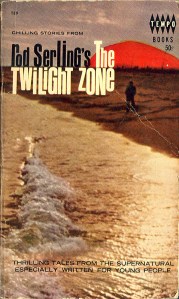
Only indirectly has the coronavirus pandemic influenced my decision to read books of short stories.  Indirectly because bookstores are closed and I have several such volumes gathered here at home.  This particular collection includes a book “especially written for young people” called Chilling Stories from Rod Serling’s The Twilight Zone.  This is a book I had as a young person, discarded, and then regretted discarding.  I have to say that most books I discard I eventually regret.  When you’re young and moving from apartment to apartment, though, you can’t keep all your books.  Anyway, I re-acquired it several years back.  The book doesn’t list an author.  Instead, the title page says “Adapted by Walter B. Gibson.”  Gibson was best known for writing The Shadow series.  The end result is that I don’t know who wrote the stories in this book.  They have the ideas of Rod Serling, but the writing isn’t in his style.

When I buy a book (I got this one used on the internet, back when it was young) I like to know the author.  WorldCat lists Serling as the author, but the book was published pre-ISBN days, back when publishers could be a bit less than transparent about such things.  Other websites put Gibson first under authors, followed by Serling.  The publisher, Tempo Books, was an imprint of Grosset & Dunlap, which eventually came under the Random House/Penguin umbrella.  Originally publishing primarily children’s books, Tempo lists this book for young readers, although as an adult reader I wonder if it could appeal to young people today.  There’s no sex and any violence is really implied rather than explicit, but there’s some adult-level subtlety going on.  Books for young readers are much different these days.

Just recently my daughter introduced me to the increasing sophistication of levels of book genres.  Like most readers and writers I’m encouraged at how young adult books have taken off.  A future generation of readers is cause for hope.  There are now “new adult books.”  These are targeted at those college aged or just over.  Unlike young adult titles they’ll have sex and adult language.  My Twilight Zone book lacks these, and it also lacks the sparkle of Serling’s teleplays.  Serling was a playwright and screenwriter.  These stories clearly contain his ideas but not his ability.  I didn’t know that as a child.  I do know that I never finished the book before now.  One of the reasons, I expect, is that it didn’t really seem like I was reading Serling, even to my young self.  Still, ghost stories during a pandemic have their own appropriate place, and who doesn’t want to be young at heart?