
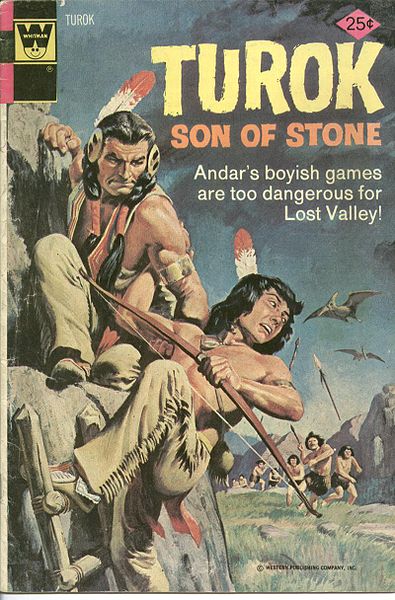
One of my favorite comic books growing up was Turok, Son of Stone. We couldn’t afford as many comics as our friends, but among brothers we’d share our resources and get a fair variety of reading material. Turok belonged to my older brother. It felt so ancient and sophisticated, tinged with primal urgency as Turok and Andar attempted to make their way from the Lost Valley where dinosaurs daily threatened their existence. The comics had a gravitas that even The Valley of Gwangi lacked. In one installment, a scroll-keeper joined Turok and Andar and claimed his sacred scrolls would show them the way free of this accursed valley. Turok doubted this and was rebuffed with “Fools scoff at what they don’t understand!” as their erstwhile companion decisively re-rolled his scrolls for storage in a handy leather pouch.
One pilgrim's progress
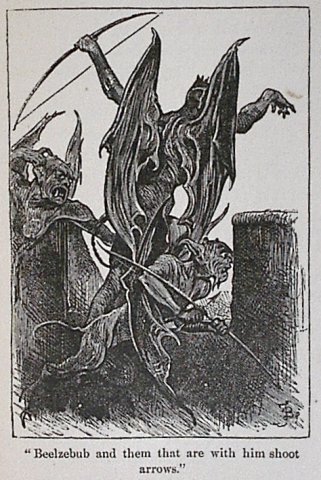
That image comes back to me when I think of how ancient writers sometimes used ridicule to castigate competing religions. It even happens in the Bible. A friend recently inquired into the figure of Baalzebub, the famous “Lord of the flies.” The Bible attributes worship of such a deity to the Philistines, the popular pagan foil of the children of Israel. The Philistines, as we know today, were a sophisticated group of Indo-European settlers on the coast of the eastern Mediterranean who showed up about the same time as the early Israelites were emerging from their “Canaanite” milieu. Since they didn’t practice circumcision and didn’t worship Yahweh, the Philistines were shackled with the worship of ineffectual fish-and-insect deities. (Dagon would never regain his proper significance until he was rediscovered by H. P. Lovecraft many centuries later.)
A different pilgrim's progress
With the discovery of the Ugaritic tablets, the common usage of the term zbl (let’s say zebul, so it can be pronounced) was clarified. Zebul commonly designed “prince.” One of the recipients of this honored title was the deity formerly known as Baal. Baal-Zebul, “Prince-Lord,” the great thunderer Hadad. From the sketchy evidence of Philistine religious practice, it seems the new-comers did adopt some of the gods of their new land, and perhaps among them the lordly Baal. In order to disparage the cafeteria choice of their neighbors’ gods, a biblical writer renamed Baal-Zebul, Baal-Zebub, Lord of the Flies. There have been other explanations for the title, but the lessons learned from our youngest days often furnish our adult interpretative lenses. This explanation makes sense to me, and it reminds me of a bit of wisdom from Turok, Son of Stone.
 Steve A. Wiggins