
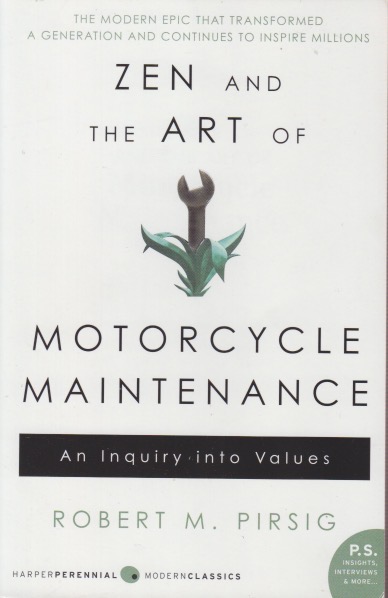
Among my introductory lectures to students was one that covered genre. I recall saying something along the lines of “when you read something your expectations of genre influence how you understand it.” Strangely, my own writing sometimes defies easy categorization, but I find it disorienting to read something without an idea of whether it’s fact or fiction or whatever. I suspect I’m not alone in this. When my wife suggested we read Robert M. Pirsig’s Zen and the Art of Motorcycle Maintenance together, I wanted to know what it was we’d begun reading. The BISAC code (the category on the back cover of a book) simply said “Philosophy.” I took almost enough philosophy in college to minor in it, so I had a general idea of what philosophy might look like. Then I remembered reading Nietzsche’s Thus Spake Zarathustra and found myself back at the question of genre again. Was this philosophy, autobiography, or a novel? All of the above?
Now, I’ve known about this book from college days on. It was in the college bookstore and I’m pretty sure it was assigned in some classes (not the ones I took). What threw me was the autobiographical part. Was this fiction? The philosophy parts were pretty stout stuff. And was Phaedrus real or imaginary? Of course, you start getting some inklings that Phaedrus and the narrator are the same. And that the latter isn’t a particularly good father. The edition we read came with a helpful introduction that suggested that Phaedrus was the one with a correct outlook all along. And an afterword that told how Chris died during a mugging when he was only 22. There was pathos all over this tale. Even when we finished I wasn’t quite sure what we read. It’s sometimes classified as an autobiographical novel or philosophical fiction.
Rejected over 120 times, the book became a national bestseller when one editor took a chance on it. (That is how publishing works.) Perhaps the most poignant part of the book is the author. What’s more, Pirsig wrote the book by getting up and writing at the same time slot that I use, so he could work a regular day after. And he had been in a psychiatric hospital and had received electroshock therapy for schizophrenia. Clearly a lot was happening behind the scenes for this most unusual tome. Among the academic publishing crowd it’s common to hear that Stephen Hawking’s A Brief History of Time was a book that many bought and never read. I did find that one a bit rough going too, but I do wonder how many engage with the philosophy in Zen and the Art of Motorcycle Maintenance. There’s heady stuff here to ponder. And I’m glad for that one editor who thought differently from all his colleagues.

 Steve A. Wiggins