O Come Let Us

During the height of the zombie craze a meme went around the internet proclaiming “zombie Jesus.”  It was funny because the salient feature of zombies is that they come back from the dead.  Noting the resurrection and the easily annoyed trigger finger of Fundamentalist Christians, some wag brought Jesus and the undead together.  We had a good laugh and forgot about it.  A guy in Ohio with a sense of humor, took the zombie Jesus meme and constructed it into a zombie nativity scene in his yard.  None of us knew about it, of course, until it caught the attention of the news.  A story in the Washington Post notes that the man was required to take the scene down for violating zoning laws.
 
People take their religion very seriously and have a hard time laughing about it.  Religion is under constant fire from angry atheists and it already suffers a complex from having so many liberals pointing out the historical and logical faux pas from within the tradition.  Some people take advantage of American gun laws to stock up against the day when they’ll step over the line and join those who shoot up offices where they think Mohammad is being mocked.  Then we’ll sit around and wonder if we should classify them as terrorists or just deranged.  And we’ll post a take-down order, just in case any zombies remain.
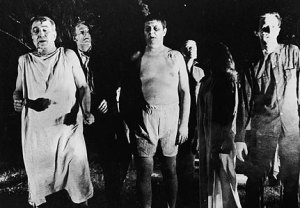
NightoftheLivingDead
 
As an academic (at least erstwhile) I noted how little religion scholars reveled in the humor of their traditions.  There’s funny stuff in the Bible, believe it or not, and many religious traditions allow for a Mona Lisa smile every now and again.  A far more common stance, however, is that of taking offense.  Something that most critics just don’t realize is how much religions mean to those who believe.  I chuckle once in a while, but I never belittle the beliefs of others.  I have been in this religion thing since I can remember, and I know what it can mean to people.  The best way to avoid offending, I think, is to keep our jokes among the crowd of those who have a sense of humor.  Of course, the undead obey no rules and the media (and its unruly accomplice, the internet) can’t resist spreading memes that might earn a buck or two of advertising revenue.

Zombie Jesus

It must still be October. Despite a snowstorm before Halloween (one of nature’s trick-or-treats), all the signs are still there. My daughter showed me a Venn diagram yesterday, during a whole-day marathon of putting plastic around our drafty old windows, showing the intersection of three “monster” traits: resurrected from the dead, local townspeople fear and revere him, and convert as many mindless followers as possible. The creatures that inhabit this eerie universe are Dracula, Frankenstein, Zombie, and, where all three intersect, Jesus Christ. Obviously this was just for a laugh, but interestingly, one of the traits of Penn Jillette’s book, God, No!, is his rather frequent reference to Jesus as a zombie. Then I clicked over to Religion Dispatches, and the lead story is headlined, “Praying to the Zombie Jesus.” Ours is a world of mindless, quick connections where the compelling idea of resurrection has lost its appeal. Despite our religious culture—or perhaps because of it—we have come to see Christianity as just one more peddler of a wonderful, disturbing idea.

As regular readers of this blog know, I find the abuse of religious ideals inexcusable. Using one’s faith to beat another down is just plain wrong. Nevertheless, to focus on the folkloristic aspect of resurrection (or perhaps it is a metaphor) is to miss what drew the very earliest followers to Jesus. Before the idea of rising from the dead came a message that people should love each other and treat one another with respect and dignity. By the end of the first century of the common era, or perhaps as early as Paul, that idea grew to be a quasi-magical resurrection from the dead. No longer were women counted as equals among the followers of Jesus, and no longer were wealthy compelled to give it all up. Paul’s faith looked to a future world, beyond death, and was willing to consider this world, well, to be polite, crap. The reasons for this transformation are legion: the persecution that Christianity was undergoing, the failure of an apocalypse to take place, the disenfranchisement of the believers. They needed something to look forward to.

Zombies are likely a passing fad. When we start seeing books of zombie Christmas carols, zombie haikus, and zombie apocalypse survivors’ guides, we seem to be reaching the peak of the plateau. The zombie is mindless, rapacious, and entirely selfish. It will not go away. It is the perfect denizen of October. When I stare into those uncomprehending eyes, and see the disturbing lack of compassion and the desire to consume human brains, I start to make connections of my own. Analysts often describe zombies as the ghoul of the common folk. But all these characteristics taken together suggest that perhaps the month in which to expect zombies is November. Surviving another snowpocalypse, earthquake, and hurricane, the human spirit is difficult to dominate. And yet, when the polls open up in the darker season of the year, zombies will rise. The plastic on my windows does nothing to stop these chills.

Borrowed from a friend's site