In the Light of the Moon (Sin)

While teaching at the University of Wisconsin Oshkosh I was assigned a course whimsically entitled “Myth and Mystery.” With little more than an old syllabus and some Agatha Christie reading experience to go on, I set about building an academic study of the unknown. (Ironically, in the years since then it has mostly been students from this course who have contacted me later to follow up on classroom material.) One of the mysteries I addressed was the werewolf legend (also see the previous post).

The earliest known record of a man becoming a wolf derives from ancient Greece. An Olympic athlete named Lycaon reputedly turned into a wolf (not during the games, I suspect, or he would had to have been put in the dog races). I would contend, however, that werewolves are at least biblical and likely older yet. The tale of Nebuchadrezzar transforming into an animal in Daniel 2 is widely known. Less recognized is that this story likely originated earlier than the book of Daniel, and it was associated with Babylonian king Nabonidus. Nabonidus was a devoted worshiper of Sin, the god in charge of the moon, and was rumored to have struggled with an “evil ulcer” (the mind reels) instead of having transformed into a beast. Rumors that he’d gone insane abounded, which, for lunatics, must count for something! How far back the moon’s transformational powers go is not known, but the marauding beasts of the night were known and feared long ago, along with the occasional insane king.
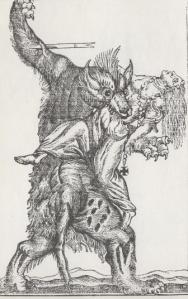
Not Nabonidus, but maybe one of his kids?

Not Nabonidus, but maybe one of his kids?

Unfortunately only after my Oshkosh course ended, I struck up correspondence with Linda Godfrey, a journalist who lived almost close enough to be a neighbor. Linda is an avid researcher of the Beast of Bray Road, Wisconsin’s own home-grown version of the werewolf. The closest I ever came to experiencing the beast was being awoken one midnight by a pack of coyotes howling through the yard, but I read Linda’s books with wonder. Are ancient fears really present realities? I suppose only time will tell, but our ancient ancestors sometimes had more keen eyesight than their modern day beneficiaries do. Their advice was to love the moon with caution since it could cause insanity in select cases!


Vampires, Mummies and the Holy Ghost

One of the many quirky things I experienced in my teaching days at Nashotah House was the fascination of theological students with the (then current) Jimmy Buffett hit “Vampires, Mummies and the Holy Ghost.” Not really a Buffett fan (I must confess, however, to being strangely touched by “Margaritaville” although I’ve never had a margarita and I’ve never been to Mexico) I was nevertheless intrigued by this juxtaposition. One student confessed to being a vampire-novelist wannabe. The vampiristic connection with the Eucharist was kindergarten, but there was a more ancient tale hidden here.

With a career crashing down around me, I found myself habitually watching horror movies — something I hadn’t done since my own seminary days. One bleary-eyed morning it struck me how our nightmare-zone creatures are religious in origin. Vampires can be traced back to ancient Sumerian mythology. Mummies? Ancient Egyptian burial practice to preserve a body for the afterlife. Ghosts, apart from finding a feared spot in most cultures, are attested in the Hebrew Bible and even earlier. They are, of course, from the supernatural realm. Werewolves are a branch of the lunar worship tree, again an ancient form of religion. Even Frankenstein’s monster toys with the account of Adam’s creation, although Mary Wollstonecraft Shelley associated him with the Greek mythological figure of Prometheus. While Godzilla (apart from his apparently theophoric name) may fall outside this scheme, most of our nightmare creatures are ancient kin of the gods.

My favorite vampire

My favorite vampire

At a professional conference last year I found and purchased a book entitled Sacred Terror: Religion and Horror on the Silver Screen, by Douglas Cowan (Baylor, 2008). Given my renewed penchant for fright flicks, I was intrigued by Cowan’s contention that religion lies at the heart of horror. Indeed, one may think of them as fellow ventricles in the anatomy of fear. Perhaps ancient religionists were on to something when one of them penned “the Lord taketh pleasure in them that fear him” (Ps 147.11). Religion may be a response to fear, or to a world that for us has become natural and upon which we wish to project a human (or divine) face.


Sects and Violence

Religion-sanctioned violence has a long (overly long) pedigree. Early myths going all the way back to the Sumerians incorporate violence on the part of the gods. Depending on one’s school of interpretation, this could be seen as “form following function” — people saw the violence inherent in nature and projected its causation onto the source of nature, namely, the gods. Ancient people did not perceive of the world in terms of natural phenomena. “Nature” behaved the way it did with will and reason, the will and reason of the gods.

The stories preserved from ancient Ugarit stand as witness to this conceptual world. In one story, Kirta by title, the eponymous king Kirta seeks a family and has his wish granted by El and Baal. Hedging his bets, he makes a vow to Asherah that he forgets to fulfill. Asherah sees to it that Kirta’s divine gift comes undone. More obvious is the tale of Aqhat, another divinely granted child. Aqhat is given a bow by the craftsman god Kothar-wa-Hasis, only to have it coveted by Anat. When he refuses to release it to the goddess he is unfortunately pecked to death in a hitchcockian demise by a swarm of buzzards with attitudes. Violence is introduced into the human realm by the gods themselves.

Today, some 3,000 years after Ugarit, we still find ourselves living with violence sanctioned by religion. Whether it is as obvious as extremist factions of a religion calling for outright attacks on others, or as subtle as self-professed righteous believers destroying a colleague’s career in the name of Jesus, religion is used as a mental crutch for striking others. While I can not walk all the way with Christopher Hitchens, I do have to acknowledge that when it comes to human-on-human violence religion is a socially accepted motivation, no matter how pure its original intentions.

Hypatia, a scholar-martyr due to religious violence

Hypatia, a scholar and martyred victim of religious violence


God is Great (not)?

As a teacher/editor with an “advanced” degree in religious studies, I was intrigued by the sudden popularity of Christopher Hitchens’ God is Not Great (Twelve Books, 2007) a couple years back. I bought it as soon it was available and read it cover-to-cover after a morning out picking strawberries.

Reading Hitchens’ analysis I found myself nodding my head quite a bit; he scores a substantial number of points on which various religions should plead “guilty.” And while I found many of his arguments persuasive, part of me still wonders if perhaps religion, that most ancient of cultural forms, has not had at least some positive impact on humankind. In the most basic sense, our civilization would not be here to critique religion if religion had not been an impetus to get our civilization to begin its motion towards today’s civilization. Black and white are not in the palette of serious religious studies.

For the scholar of religion, however, Hitchens should be required reading. Sometimes we have to stare hard into the face of the facts of what our object of study has become and wonder, with Samuel F. B. Morse, “what hath god wrought?” Religion bears the mark of Janus, and scholars of religion have to pay attention to what people are saying about it.


What’s a Ugarit?

Self-knowledge for any society begins with a knowledge of its past. We identify ourselves with where we have come from and what we have experienced. As denizens of a highly technological world in which change occurs rapidly, it is easy to forget that in ancient times technology progressed at the rate of centuries, or even millennia. The rapidity of cultural change is closely linked with the efficiency of communication with large groups of people over great distances. Working together we build on the many stories already built below us, we begin on a higher level than those in the stories below us did.

When we think of the Middle East, named from the western penchant for placing itself at the geographic center, we think of it as a region of perpetual conflict. Looking beyond our accustomed frame of reference, this region of the world is also where western civilization itself began. It was here that written communication itself was conceived. Ancient Egypt and Mesopotamia have often captured the western imagination. When enumerating the important archaeological discoveries of this region, most informed people would easily tick off the Rosetta Stone, King Tut’s tomb, and the Dead Sea Scrolls. Missing from most rosters would be Ugarit, an ancient city of incomparable importance among the lower stories of the tower of our society.

The great founding nations of civilization grew along the banks of west Asian rivers. Apparently developing independently, Egypt flourished along the Nile and the nations of Mesopotamia along the Tigris and Euphrates. The Euphrates was the quintessential waterway of the ancient world, known by many as simply “the River,” just as the Mediterranean was “the Sea.” Early in human history the city-states of Mesopotamia coalesced into united ventures recognizable as nations. The same unification occurred in Egypt and among the Hittite peoples of what is now Turkey. The basic unit of civilization, however, tended to be the city-state.

(Please see the Full Essays page for the remaining text of this essay.)


Asherah Begins

Back in the Dark Ages when I was working on my dissertation on Asherah, web research had not been born, or even conceived. Its parents might not have even met yet at that stage! When Gorgias Press decided to print a second edition of my book on the goddess a couple of years back, I utilized the opportunity to peruse the web to find out where the old girl is these days.

It seems that Asherah worship is alive and well, according to the internet. I suspect that the ancients would be scratching their heads — and not just because of the omnipresent lice — at the ways she is portrayed these days. The matronly bearer of the gods of Ugarit is a lithe and whimsical girl, walking on the water just like so many other ancient divine figures. She has become a patroness of witches and is identified with any number of pet causes. She is chic, sexy, and alluring.

Unfortunately, what we know of the actual goddess is quite a bit less exciting than all that. Asherah is best attested at Ugarit, a city on the northern coast of Syria that has been extinct for 3000 years. Here she is matronly, passive, and interested in doing the laundry. Her role in the mythology is small, despite being the mother of the gods. She does become notorious in the Hebrew Bible and still has the power to inspire the “bad girl” dreams of many a rebellious youth. She is a fascinating figure — some pundits even think she might have been the main squeeze of someone very high on the spiritual food chain!

Perhaps this is one of those “disconnects” that pop-up like toadstools during a wet and rainy summer. Technology has outstripped reality. A goddess once feared and revered as the ancestor of the gods has become a pin-up girl in a digital era. If a mirror could be held up to time itself, I’m not sure that Asherah would recognize herself even if she long gazed into it.


Bible Guy

Strange bedfellows?

Strange bedfellows?

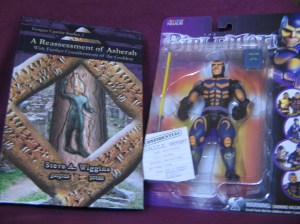
In my Nashotah House teaching days, standing sentinel in my office was the 8″ action figure of Bibleman. I first discovered Bibleman while surreptitiously skulking through a Christian bookstore seeking Veggie Tales paraphernalia (don’t ask). I quickly rounded the corner in the kids’ section and there he was, encased in purple-and-yellow body armor, packing a Bible and laser sword and a packet sealed forever from the curious eyes of Biblegirl. I knew then and there that I had to have him. I sent my wife back to buy him later.

Naturally curious, I found a website and learned that an entire culture and money-making industry had grown around this ultimate good guy. He had a sidekick called Cypher (sold separately), and arch-enemies with such names as Primordious Drool and Wacky Protestor. I marveled at the missed opportunity here — they could have called them Text Critic and Doctor Mentary Hypothesis! Fascinated, I watched video clips of Bibleman’s deft swordplay in a scene that brought back the poignant death scene in Robocop. This was certainly not the old-fashioned fundamentalism I’d grown up with. But even with a Schwarzenegger build and phallic light sword, this guy was KJV and GOP all the way.

Shortly after taking another surreal job, this time at Gorgias Press, my wife showed me a related article in the newspaper. Wal-Mart announced that it was planning to carry Bible action figures, manufactured by One2believe. The line includes Noah, Moses, Daniel, Goliath, and of course, Jesus. I must admit that I was let down that David and Bathsheba figures did not seem to be available. Jesus does have a pull-string, however, for quoting his favorite Bible verses. Even as I throw the paper aside in vexation, I know that come fall, when I find my way back into a classroom at Rutgers, Bibleman will likely have a new companion on my office shelf, and it may be the son of the Big Guy himself.