Leggo my Ego!

Last week on my way to an interview, as I was merging onto the interstate, a state trooper in the center lane let out a whoop on his siren and broadcast on his speaker, “the left lane is for passing — got that?” Naturally I assumed the broadcast was directed toward me; I was in the right lane and the trooper was moving considerably slower than the posted limit. Should I pass him on the right or slow down? Now I was apparently joining a highway drama already in progress (status quo for New Jersey) and after a few intense heart-thumping minutes I realized that the cynical lawman was likely addressing a slower driver in the left lane. All of this is to introduce the problematic mindset of egocentrism.

The human brain, we are informed, is the most complex thing in the universe. It is also our gateway to all experience, knowledge, revelation, insight, and inspiration. We are limited in all our ventures by the tangible limits of our biological brains. Everything we associate with religion is mediated and filtered by our brains. As my friend and seminary professor K. Marvin Bruce likes to say, “consciousness is as much a curse as a blessing.” Our brains can be traps as well as explosive openings into new worlds. Everything begins and ends with the humble ego.

I was recently reminded of this while looking at the latest round of Hubble Space Telescope images released from NASA. We consciously know the universe is incomprehensibly large, the number of stars way beyond human imagination. And yet, on this smallish planet racing around a medium-sized sun somewhere in the outer banks of the universe, people have always thought the gods were concerned with them. The earliest cultures believed that humans were created in the service of the gods. We live, we wonder, we die. As long as the gods are pleased, the world continues much as it always has. In their eyes the stars that far outnumber the human population were gods. Their universe was more divine than profane. Yet even in our galaxy-filled universe, our brains can’t help but believe that somehow we’re in the very middle of it all.

Where's Wiggins? Not even on the map!

Where's Wiggins? Not even on the map!


Turning Brown to Green

Dan Brown’s The Lost Symbol comes out tomorrow, and I, for one, will not be standing in line to purchase a copy. I actually read his previous two Langdon stories in the correct sequence — Angels and Demons then The DaVinci Code — and what immediately struck me was their similarity of plot and lack of historical veracity. Perhaps as a sometime writer who has had difficulty finding publishers I am just jealous, but the stories to me seem to draw on tired theories of some great conspiracy in antiquity that involved Jesus and Mary Magdalene eloping to France after the crucifixion where they happily raised a family only to be forgotten by history while he was off becoming a deity some thousands of miles away.

I read an interview with Dan Brown about his new book in which he confesses that he’s not a believer in conspiracy theories. To me some of the Area 51 stories sound more convincing than the trite material from Holy Blood, Holy Grail that has been recycled into a fictitious field of academics — symbology — and given a fake pedigree by placing Langdon at Harvard. I was in college when Holy Blood, Holy Grail came out and my literature prof told our class that the work was revolutionary and would restructure modern society. The only restructuring I’ve seen is the planet tipping a little towards Brown’s bank account trying to readjust to all the cash rushing in.

Perhaps my real frustration is with the fact that the ancient world is already fascinating without requiring fictionalization, yet those who actually do know something about it experience difficult times finding non-fictional university posts. Meanwhile average citizens will swirl around bookstores like the insects in an Indiana Jones movie waiting to purchase a copy of a book that fictitiously recreates that ancient world. If Harris tweeds are as miraculous as they seem to be in Brown’s books, maybe I should click my elbows together and say three times, “There’s no place like Rutgers” and I’ll end up in a fulltime professor of Symbology instead of teaching Ancient Near Eastern Religions as a mere adjunct tonight.

An authentic Harris tweed in its native Scottish environment

An authentic Harris tweed in its native Scottish environment


Intelligently Deceived

One of the most difficult things about the life of the academic gypsy is having tons of books. Literally tons. Having been cast from institution to institution in search of that mythical full-time teaching post, we’ve put books in storage and sometimes even forgotten that we’ve had them. So it was that when I was looking for a copy of Great Expectations for my daughter’s English class assignment, I was in the dusky attic, hoping the upstairs neighbors didn’t burst in on me, up to my armpits in boxes of books, that I rediscovered a treasure. Taking a leaf from Dr. Jim’s Thinking Shop, I decided I would review a few of the Creationist books I grew up with. Fortunately I had the presence of mind to keep them although I’d long dismissed their facile, often juvenile, point of view. They have provided great entertainment and even some poignant instruction in the ways of manipulating the minds of the young. Fear of Hell is a great motivating factor to a kid who sees ghosts in every corner and finds bats on his pillow!

So, without further ado, I present the top 5 creationist books of my youth. (Those that I purchased as an adult I bought from used bookstores so as not to add any royalties to the fundamentalists’ already bursting coffers.)
Textbook

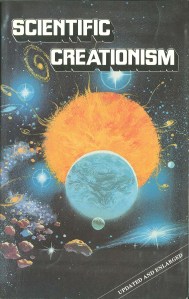
We’ll begin with the textbook. Scientific Creationism makes no pretense, such as the “Intelligent Design” school does, about being non-(necessarily-but-we-all-just-happen-to-be)Christian specific. Here Henry Morris begins with the assertion “the Bible and theistic religion have been effectively banned from [public school] curricula” and offers the present book as a corrective to the situation. A better title for the content, however, might have been Scientific Fiction.
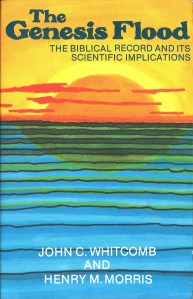
GenFlood

The work that really opened the flood-gates, so to speak, was The Genesis Flood. This craftsterpiece was penned by Henry Morris (again) and his compatriot John Whitcomb. Both proudly proclaiming themselves “doctors” they point out “evidence” designed to confuse the unsavvy into believing that there is a physical way the world could be entirely flooded. They even make room for dinosaurs on the ark, noting that they would have been juveniles of the various species. I’ve been in academics long enough to know that a Ph.D. does not guarantee credibility (or even sanity) on the part of the holder. The fact that Whitcomb’s doctorate is from Grace Theological Seminary ought to speak quite plainly as to its objectivity.

Gish

Written by Duane “the Fish” Gish, Evolution, the Fossils Say No! is an attempt to demonstrate that since not every single phase of the fossil record has been uncovered, the whole theory of evolution is in shambles. Gish, one of the few authentically scientifically credentialed Creationists, should have been able to see that his “back-and-fill” technique was going to fall on hard times as new fossil forms were discovered. As the fossil record grows more complete each year his book becomes more and more outdated.

EvolutionHS

Evolution and the High School Student terrified me in my delicate years. This booklet intimated that when I reached high school the unending assaults of the atheistic non-believers would be unrelenting. I feared for my very soul. Instead, in high school I found nose-picking, pocket-pool playing, and chalk-print-on-the-pants-seat teachers were among the openly committed Christians. Some even kept Bibles on their desks. (This was a public school.) The book lost its teeth.
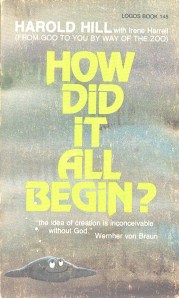
GooZoo

My personal favorite is How Did It All Begin? (or From Goo to You by Way of the Zoo) by Harold Hill (obviously when he was not out swindling River City, Iowa folk of their hard-earned cash to start a bogus boy’s band). This booklet, complete with cute, cartoon drawings, convinces grade-schoolers that evolution answers no questions at all. He had me going as a kid, until I got to the part where he claimed scientists had invented a machine that could indicate if you were “saved” or not. Even as a gullible child I couldn’t buy that.

The efforts of the Creationists are tireless. Even this brief survey of books that I happened to chance upon is nowhere near a comprehensive survey of what is out there. What it does serve to demonstrate is that all reasonable people should be wary. After all, even Jesus knew that a person in the wrong, if persistent enough, could convert even a hard-hearted judge.


Good Book, Bad Seeds

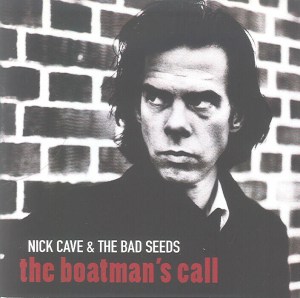
A gray day in September. Nowhere to go, nothing to do. A stark melancholy races on the winds of a distant nor’easter. It is a perfect day for The Boatman’s Call.

Searching for land

Searching for land

I have to admit up front that I found out about Nick Cave & The Bad Seeds from the Shrek movies. The soundtrack crew from the first two movies did their homework exceptionally well, tapping some truly desultory, lugubrious tunes from artists who don’t make the top twenty. I was so taken by “People Ain’t No Good” that as soon as I could afford it I purchased the album (The Boatman’s Call, not Shrek II). The album begins with the line “I don’t believe in an interventionist God, but I know darling that you do . . .” Throughout the album the achingly sacred and profoundly profane are blended in an eerily subdued way. The music is haunting and thought-provoking. Almost each track on the album has a biblical reference, but these references are mixed with what would be crude if handled with any less artistry.

All that I know about Nick Cave is what I’ve read on Wikipedia, but it is clear that he is well versed in the Bible and makes effective, if dark, use of religious imagery. Perhaps the reason I admire this album so much is that Cave’s ambivalence toward religious structures is so honest. He isn’t out to convert anyone, nor is he willing to let go of his religion. The religion that wafts out of the drafty attic of this disc mirrors the complexity that faith ought to possess. Especially on a dark and rainy autumn day.


Sternutation Salutation

Perhaps it’s the specter of swine flu or perhaps it’s the onset of the autumnal allergy season, but sneezing is unmistakably prevalent. While meeting with one of my students this past week, I was asked why people said “God bless you” after someone sneezed. Immediately my mind went back to the explanation I’d learned in some history class that superstitious folk in less enlightened times supposed that your soul flew out your nose and mouth during a sneeze and wished to ensure a safe transition of a person’s spirit back inside. Others trace the phrase to the period of an early plague when Pope Gregory had Kyries sung at sneezes to prevent the spread of disease (although plague was not really characterized by sternutation as much as buboes). Still others continue the myth that one’s heart stops during a sneeze and the comment is simply a verbal defibrillator of sorts.

In my mind a cough is much more sinister than a sneeze, but we have no standard verbal accompaniment to coughs. The same is true for hiccups, belches, or, God forbid, something even worse. How does the humble sneeze achieve a status so as to invoke the divine? Soul-spewing aside, sneezes are naturally violent events. Some medical experts clock dramatic sneezes at up to 650 m.p.h., inciting the question of how we might harness such energy. Unlike coughs, hiccups, burps, or — ahem — other expulsions, the sneeze solely involves the respiratory tract. In the ancient world breathing is life. The standard measure for viability in the Hebrew Bible is not a beating heart or even a functioning brain (a relief to many Republicans), but breath. Those who do not breathe do not live. The sudden loss of breath via a sneeze could be cause for alarm.

Zeus seconds the motion

Zeus seconds the motion

The humble sneeze is even mentioned in the Bible, although the “God bless you” part is not. In 2 Kings 4.35 Elisha, emulating his master Elijah, revives a dead child. Significantly, when the child reanimates, he sneezes seven times. He is breathing, but not yet out of danger. In ancient Greece it was supposed that sneezes were messages from the gods, a kind of Hellenistic “Amen!” to eloquent rhetoric to which the gods just couldn’t hold their applause. No one knows just when “God bless you” was attached to the sneeze, but it is difficult for those accustomed to remark on sternutation to hold still. Even in classes of 70 students or more, a sneeze out there in the audience is always followed by a “bless you” from across the room. Whether it is a message from God or a harbinger of H1N1 I’m just not sure.


By the Numbers

Just when you thought it was safe to go back to the airport, the Bible Code strikes again! This morning’s newspaper carried the story of Jose Flores, a would-be hijacker of Aeromexico Flight 576. Flores boarded the flight with a Bible and fabricated a pretend bomb out of a juice can (the story doesn’t specify exactly what kind of juice —) and instructed the pilot to fly around Mexico City a Jericho-esque seven times. Flores informed the flight attendants that he was part of a set of four hijackers, the other three, he later revealed to police, were the Father, Son, and Holy Ghost. The flight landed safely and Flores was extricated from the plane. Why all the fuss? Yesterday was 9/9/09. Flores realized (with or without the help of his three co-hijackers) that upside down this would be 666. Safely on the ground he told reporters “Christ is coming soon!”

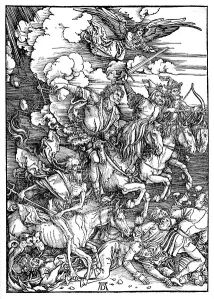
So once again we meet a believer in coded messages in the Bible. Clearly one of the most misrepresented books in the Bible is Revelation. This book is a textbook example of apocalyptic writing, a genre wide-spread and easily recognized in the ancient world, but which suffers from being taken literally by people living a couple millennia after it was penned. Even before the ink slipped from John’s pen (we don’t know John’s last name), people were looking for a new world to burst in on this old one in need of radical repair. That urgency has continued unabated for two thousand years.

Is life really so bad that we need it to end? Apocalyptic outlooks are perfectly understandable among the disadvantaged and persecuted that they were intended to console. It is a strange phenomenon, worthy of a sociological dissertation, why many affluent, educated people strain for the end of this god-awful world where they are so comfortable. Perhaps it is that we evolved from lemmings rather than primates, but it seems to me rather another example of the wealthy taking from the poor. Even their hopes of sticking it to the rich have been co-opted.

Something to look forward to?

Something to look forward to?


Lost and Found

As a young lad I was fascinated by the supernatural. This may explain, but in no wise excuses, my choice of a career in religion. As I grew in years and skepticism, this interest began to feel like a security blanket in a college dormitory — an embarrassment to be jettisoned as quickly as possible. Along the way, of course, I’d given away what I thought to be the detritus of childish fantasy, including my collection of cheap, pulp fiction, tending toward the Gothic.

As I grow more ancient, and more observant, I see that sometimes the impetuousness of youth cradles a profound wisdom. Sometimes we do get it right the first time. I still haven’t figured out if that’s the case with me, but it seems to be a hypothesis worth the exploration. Part of my current search for reality is the reassessment of my childhood learning in the school of classical Gothic fiction. The books are no longer as cheap as they used to be, and when I take them out in public I hide them inside a larger, more academic book so that no one really knows what I’m reading. As a friend once observed, people think that those of us who hang out in the religion sections of Borders are immediately suspect. More so the adult toting a beaten-up paperback written for a teen readership a number of decades ago.

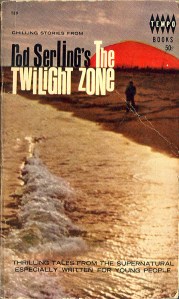
One of my lost memories was a juvenilized version of Rod Serling’s Stories from the Twilight Zone. I had shoveled my copy off to Goodwill along with many other shards of my childhood when I “grew up.” The memories of the angst that the very cover generated in me led to a frantic online used book hunt a few years back. Inside the stories seemed flatter than I’d recalled, but the larger ideas they generated were still worth paying attention to. Perhaps the real lesson is that childhood should not be dismissed as wasted time playing and indulging in carefree amusements. Our childhood proclivities, it now seems, preset the trajectories for our lives. So I still have a quasi-career in a religion department, and I have a copy of a book that started me asking the bigger questions.

Anybody else remember this?

Anybody else remember this?


Go and Dust No More

Finally getting around to reading Philip Pullman’s The Golden Compass (I hate to admit that it took the movie ads to prod me into reading the book), I have been surprised by the depth of the story. Spoiler warning! From the very first chapter I have been pondering what dust might be, and I have just discovered that it is Pullman’s metaphor for original sin. In the chapter where this is finally revealed to the protagonist, Lyra, her father reads an explanatory passage from Genesis 3 (somewhat altered). Indeed, dust drives the plot of the story.

With apologies to the magisterium

With apologies to the magisterium

Pullman’s treatment of the topic once again throws into relief a popular, but mistaken, concept. “Original sin” is simply not a biblical idea. Nowhere in either the Hebrew Bible or the Christian Scriptures does the text suggest that people are born with the taint of a physical liability passed on from the first human coupling, as Augustine hypothesized. In fact, the Bible hosts several potential explanations for the origins of human troubles. One solution that it never reaches is a genetic passing on of an original sin.

Tradition often makes Scripture into its own image. Ideas are inevitably read back into the story and a chimera of hazy concepts emerges. Pullman’s treatment of the human condition is to be applauded, and to his credit he does not attribute the concept of original sin directly to the Bible. Although he alters the text a bit he doesn’t add this most damaging concept to it. The belief that people are inherently defective has allowed for some of the worst crimes imaginable against our species. As a concept original sin is dust in the wind.


Bible Land

Once upon a time I took a trip to visit a friend in West Virginia. I made the drive from New Jersey across parts of Pennsylvania and Maryland. Having grown up in Pennsylvania I never supposed it to be considered part of the “Bible Belt,” but it seems that some of the spillover may be making its way north of the Mason-Dixon line.

Interstate 78 has recently struck me as being highly evangelized. I saw a billboard reading “Blessed is the nation whose God is the Lord” and remarked at how out of context this verse was taken. Last time I checked, the Bible tended to be concerned with Israel, not the United States. Further along I saw a church near Bethel, PA called the Assembly of Yahweh. Not being aware that there was confusion as to who the God of the Israelites was, it amazed me to see that they have their own radio station called “The voice of the Assembly of Yahweh.” This struck me as a missed opportunity; the real message could have come through more clearly with “of the Assembly” left out. Yet further along was an ominous billboard from a local Mennonite Church that sounded eerily like Amos. “You Will Meet God” it announced.

Storm's a-comin'

Storm's a-comin'

As I entered Maryland the sales tactics intensified. In Frostburg there was God’s Ark of Safety Church where an actual replica of Noah’s Ark is being built right along Interstate 70/68. Since the steel frame is all that was currently finished, I was glad that it hadn’t recently been raining. Perhaps a more recent translation of the Bible has updated gopher wood to Bethel steel. Further along I spotted a lighthouse atop a hill over a hundred miles from the nearest substantial body of water. This was the World Lighthouse Worship Center. While visiting an actual lighthouse on Lake Superior a few years back the docent informed me that lighthouses were now considered superfluous with the advent of Global Positioning Systems. (Shhh — please don’t inform them that science has again trumped a quaint piece of folklore! I can imagine that the lighthouse may be useful when the new ark is completed.) Along route 219 in McHenry, MD I saw “A House of Love Gathering Place” that I just couldn’t dissociate from the B-52’s for some reason. Just about on the border to West Virginia was the Fresh Fire Church of God.

The United States is truly an impressive reservoir of biblicism. Perhaps university administrators who believe the study of religion isn’t worth the meager salary of an assistant professor should take a road trip. It would be a learning experience.


Lost in Translations

Furor is up like storm waves concerning a revision of the New International Version of the Bible according to the Associated Press. Evangelical groups, fearful lest the word of God be misrepresented (!), claim nothing is wrong with the Old New International Version. The story of biblical translation is long and colorful and peppered with more than a few deaths. People, originally especially Europeans and Americans, but spreading like swine flu around the world with the missionary movement, are very concerned about being certain they have they exact words from the Author himself.

Concern with having the correct answer is natural enough, but the goal of a perfect translation is unattainable. The basic reason is that translation, like Bible-writing, is a human endeavor. And people just don’t achieve perfection. Also, words often betray us. I used to ask students what the word “die” means. Some would say to cease living, while others would say it was the singular form of dice. Some even recognized it as the nominative, feminine singular definite article in German. The truth is, however, that words do not have meanings. Words are symbols that have usages, but the letters “d-i-e” in that order mean only what we intend for them to indicate in any given circumstance. Certainty is a mirage; it can never be reached.

A few years back Today’s New International Version was published and it has been called “an emblem of division in the evangelical Christian world,” by Moe Girkins, president of Zondervan (owned by Rupert Murdoch). Even among self-identified evangelicals unanimity is illusory. Each person’s religious beliefs start to differ from everyone else’s in the privacy of his or her own head. That is because everyone is unique. The Bible can be made to “mean” whatever an individual wants it to mean. Until we became merged into some Borg-esque entity new translations will be loved by some and hated by most.


Bosnia Jones meets Egypt Jones

Scholarship is a remarkable human achievement; so many people from countless backgrounds sparring over ideas with comparatively little bloodshed should be applauded. In the political and religious worlds where armaments are often thrown into the mix, well, the results are colorful but often less kind. I was reminded of this when one of my students recently showed me a copy of a letter regarding a somewhat outlandish claim by Sam Osmanagic (see Momma Maya: Is It the Apocalypse Already? for more on him). Osmanagic, who is studying for a doctorate, has recently added another hapless cause to his dossier of unlikely mysteries of the human past. Investigating Visocica, a hill in Bosnia, Osmanagic has concluded that it is really a pyramid.

The letter to which I referred, written by the irrepressible head of the Antiquities Council of Egypt, Dr. Zahi Hawass, is very gentle. Hawass, a kind of self-styled Egyptian Indiana Jones, notes in a letter to Archaeology magazine, “What was found there is really just a mass of huge stones, evidently a natural geologic formation.” He does, however, also note “His [Osmanagic’s] previous claim that the Maya are from the Pleiades and Atlantis should be enough for any educated reader.” Interestingly enough, Osmanagic is a self-styled Bosnian Indiana Jones, and he has written a book arguing for the pyramid option. Meanwhile, most serious scholars are more circumspect about the claims of any Indiana Joneses. After all, to quote Raiders of the Lost Ark, “archaeology is not an exact science.”

I am sometimes challenged by those who discover that I read such things as Drosnin (see Edoc Elbib Eht) or Osmanagic, but despite my objections to their conclusions that I inevitably reach, I want to hear them. Scholarship suffers from silencing the maverick voices. I have never ascribed to the principle that a person has to have a Ph.D. to be credible; often the reverse is true. I have met many Ph.D.s barely worth listening to while some of the most profound thoughts I’ve encountered came while I was working as a janitor’s assistant, listening to my boss. He was a man who engaged in physical labor that afforded him time to think. No, I do not buy Drosnin or Osmanagic’s conclusions, but I applaud them. Scholarship would be dull if not for those willing to take chances out there on the edge of credibility. (And wearing cool hats while doing it.)


Hell on Earth

October 8, 1871 is remembered by many as the night of the great Chicago Fire. Few Americans ever learn that it was also the night of what many consider to be the greatest natural disaster in United States history: the Peshtigo Fire. The autumn of 1871 was tumbleweed dry in the upper midwest. A wildfire that burned over a million acres of northern Wisconsin and Michigan completely incinerated the town of Peshtigo, Wisconsin on the same night Chicago burned. 1,200 people were killed in a single night. One of the most terrifying books I’ve read is Robert Wells’ Embers of October (also published as Fire at Peshtigo), a factual horror story filled with survivors’ accounts and early aid workers’ reports. Many described the scene as reminiscent of Hell.

Gehenna in Wisconsin

Hell is an interesting concept. Following on from my podcast on the origins of the Devil, the concept of Hell is an equally interesting development. The Hebrew Bible knows of no Hell. The dead, good and bad alike, go to Sheol, the gloomy world of the dead, after they die. There is no punishment or torment beyond the languor of being deceased. People seem to be described as having some recollection of life and its benefits, but they are weak and sleepy and attached to their drying bones. The concept of an afterlife comes pretty late to the Israelites, depending on how you define “afterlife.” The book of Daniel, the latest in the Hebrew Bible, provides our first glimpses of a kind of resurrection for the righteous who died before their time. The earliest biblical Hell is the Gehenna of the Gospels, the garbage heap perpetually burning outside Jerusalem.

To picture an eternity of constant burning and torment requires a kind of distinction between an afterlife and afterdeath to be made. Zoroastrian influence on emergent Judaism provided the dualism that made a Devil possible after a few centuries. It also provided the distinction between the glorious afterlife of the good and the doleful fate of the wicked. Concepts that eventually blossomed into the theological constructs now regarded as Heaven and Hell drew their inspiration from an ancient religion of Afghanistan and Iran. Given what human imaginations are, Hell has naturally grown more and more gruesome over the centuries, but if one requires a sense of an entirely natural version of what can happen to good and bad alike, the Peshtigo Fire may also deliver many sleepless nights.