Daniel in the Lyin’s Den

Yesterday I found myself. Online, that is. I was cited ambivalently as “some guy” in the Uncommon Descent blog comments, noting my Creationism’s White Box podcast. For those unfamiliar with Uncommon Descent, this is a blog hosting many posts by William Dembski, a leading creationist. Finding myself there, I instantly recalled that Daniel was never masticated in the lion’s den.

Not being one to judge without good cause, I read the critique with care. It read: “Some guy I read in the last few days here [link to my podcast] has suggested (to the approval of a few clerics) that creationism is an early 20th century phenomenon but all he’s really done is conflate creationism with the Creationist movement that grew out of, or was associated with, the publication of ‘The Fundamentals’.” Since academics like to split hairs (and even atoms), I thought I’d use today’s post to explain, in History 101 style, the problems with this assertion.

Creationism, like any other human enterprise, has a history. Christianity was born in a literalistic age, of sorts. Early Christians took the Hebrew Bible (pretty much The Bible in those days) literally. Belief in a flat earth and mythic beings still predominated the upper cortices of early brains too. My detractor could have been correct had the conflationism charges been laid at my door prior to the Enlightenment. The fact is that everyone born since the eighteenth century (academically speaking) has had access to science and the facts we’ve ascertained about our world. One of those sets of facts has had to do with evolution, and another with the history of the Bible. Interestingly, both of these sets of facts coincide perfectly: biological evolution took place and the Bible was a product of its environment. These truths have been available for centuries for any who would look at them.

The veracity of this statement is attested by the nearly universal acceptance of evolutionary theory by Christians in the western world in the late nineteenth century. Creationism, as such, did not exist at this time. It was in reaction to a number of social and theological factors that Creationism first hatched around the turn of the twentieth century. It was a new bird (I’ll avoid saying “hopeful monster”). Any claim that it was a default version of Christianity is strictly Retro — any such claim is tantamount to declaring that the Enlightenment never happened. I’m not a supporter of revisionist history, so I just can’t accept this flimsy construct. Fact is, Creationism is relatively new.

There is a great bibliography out there for anyone interested in getting the actual facts. Start with Ronald Number’s The Creationists: The Evolution of Scientific Creationism (University of California Press, 1992) and read on. Otherwise, feel free to believe in a flat earth — you can find good proof of this in central Illinois or Kansas.
God-Adam! Is That What it Really Says?

GodAdam

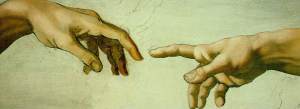
While reading a recent article on the origins of the abstract art movement I was struck by this quote from Wassily Kandinsky, widely considered to have been one of the founders of the movement: “the contact between the acute angle of a triangle and a circle has no less effect than that of God’s finger touching Adam’s in Michelangelo.” Apart from putting me in mind of Edwin Abbott’s Flatland, this statement emphasized once again the power of one of Genesis’ creation stories. It also made me aware of a new dimension of the distressed pleas of Creationists for a reversal of science and a resetting of the hands of time itself. It seems that there is so much to lose.

Michelangelo’s Adam, as I always tell my students, has bestowed a disproportionate influence on all subsequent biblical interpretation. Rather like the case with Handel’s Messiah and Isaiah 9, modern readers find it exceptionally difficult to climb over Renaissance images to peer directly at the ancient sources themselves. Isaiah was writing about Hezekiah ben Ahaz rather than Jesus of Nazareth, but just try to convince any holiday shopper of the fact! Art has made the decision for us; there can be no questioning of Handel. Michelangelo was a brilliant painter, indeed, a genius by any stretch of artistic imagination, but he was no Bible scholar. Even if he had been, the tools available now were not available then.

I sense that Creationists fear the loss of the literal image (if it can even be considered literal) of Michelangelo’s God and Adam. How threatening it is to ponder that God is not a bearded white man! What blasphemy to consider that instead of an insouciant Adam we have promiscuously procreating ape-like hominids hopping around!

One of my favorite movies has always been 2001: A Space Odyssey, Kubrick’s coming of age. The iconic monolith with early, distinctly apelike humans cavorting around it, timidly daring to touch it, to become something more — this abstraction felt like creation to me. Indeed, much of the film is abstract art. Creationists fear the demise of classical art; however, abstract artists do not destroy classical art, but rather build on it. It is humanity growing up. Like abstract art the biblical images leave much to the imagination. Is it better to remain firmly mired in what we know cannot be true or to allow human progression to continue? Even Wall-e reaches a mechanical hand out to the light (image copyrighted, all rights reserved).


Evolution of Egyptian Cats

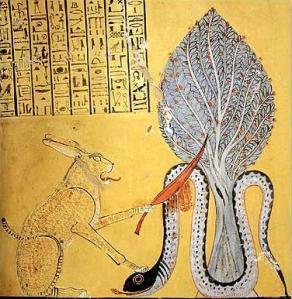
The Egyptians were the first people to “domesticate” cats. Perhaps taking their cue from their pets, they very early venerated cats as divine. Cats were, however, working animals that controlled vermin and poisonous creatures that violated the principle of stability that the Egyptians so valued. From the earliest records of the Old Kingdom we find the goddess Mafdet portrayed as a cat. Her name translates to “swift runner” and she was protector of Pharaoh, and thus of all Egypt. She was also associated with justice, a role reprised by Puss-in-Boots in Shrek 2. The hearts of evildoers were ripped out by Mafdet and brought, like a dead bird or mouse, to the Pharaoh.

Mafdet? (Don't give your kitty knives!)

Mafdet? (Don't give your kitty knives!)

Mafdet’s fame declined with the rise of Bast, or Bastet. Bast (“devourer”) was also an early goddess, associated with the sun, and like Mafdet, she was a fierce protector. Her cult was centered in Bubastis, a city named for her. The guardian of Lower Egypt, she kept the kingdom safe from cobras, scorpions, and presumably hair-balls. Unlike the gentle kitties of today, she was also represented as a lion, a goddess of war.

Bast, all grown up

Bast, all grown up

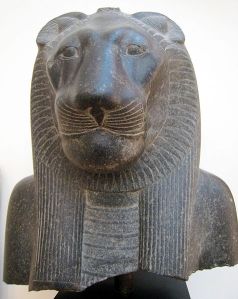
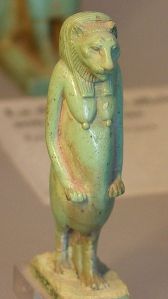
Bast’s fortunes faded with the rise of Sekhmet, the warrior goddess of Upper Egypt. With a name translating to “powerful,” Sekhmet was yet a third feline protector. She was also a lion-shaped goddess whose breath created the desert. (I have worked for human beings who could justifiably make that same claim.) Like Bast, she wore the sun on her head and became Egypt’s version of the violent goddess. Ancient peoples all feared the raging goddess, no matter what name or shape she took. Perhaps they always expected bad behavior from men, so when female deities got in on the act it was all the more powerful.

Sekmet with the breath that sank a thousand ships

Sekmet with the breath that sank a thousand ships

Where does evolution go from there? Is it merely coincidence that the Ashera Cat is part African Serval (as was perhaps the original Mafdet) and that it is being billed as the royal cat? I think not! Cats have a long pedigree with the divine, and from what I’ve been reading, Ceiling Cat has a very wide following. Evolution of the Egyptian cat, it seems, takes us from the Old Kingdom right up to Lolcats.


Sex and the Single God

In my Ancient Near Eastern Religions class we have been discussing Egypt. Students have been giving their deity reports and have been shuffling their feet in an embarrassed way when they have to discuss some of the gods’ various sexual activities. I have to assure them that this is not “dirty talk” or pornography — it is simply a pre-Victorian way of looking at the world. Understanding of the mechanics of conception and fertilization, involving, as they do, microscopic gametes, has only fairly recently emerged. Ancient people knew that sex led to kids, but they didn’t know how. When you can’t explain it, pass it along to the gods and forget about it!

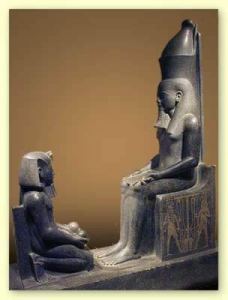
Ancient Egypt is often where this disjunction appears most clearly. Various gods in a constellation of creation myths (Atum, Ptah, with others probably standing in line) onanistically generated the matter that makes up either other gods who reproduce sexually or the very stuff of the universe itself. This explanation of the world was not profane or vulgar; indeed, it was the very sacred act that brought all of this into existence.

When we look judgmentally on earlier religions we are condemning our own ancestors. It has become abundantly clear in recent years that ancient religions freely borrowed from each other and developed their own distinctive traditions without wholesale rejection of the earlier cultures they knew. It has even been suggested the Psalm 8 might reflect this very form of creation as an echo in the Hebrew Bible! So instead of looking nervously at our feet, or trying to find a big stone to throw at the heathen while our eyes are down there, it is best to recall that religions grow out of unions and parturitions of other religions. Unless they are created single-handedly — and this is what originates the concern in the first place.

Atum teaches Horemheb the facts of life

Atum teaches Horemheb the facts of life


Clothes Make the God

What is it with gods and clothes? Today’s news announces that Rob Halford, the Metal God, vocalist of Judas Priest, has just revealed his own Metal God Apparel line. Now, I try to be equitable, but isn’t metal all about sticking it to the establishment? Isn’t designing your own line of clothing the most establishment-worthy enterprise ever? Where have the rebels gone?

Whip not included

Whip not included

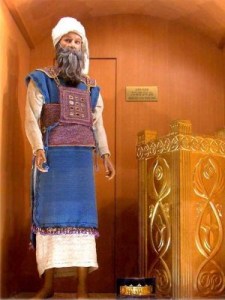
No sooner are people getting the hang of things in Eden than God marks designer clothes first on their list of accessories. Gods seem to be impressed with dressing the part. The Bible details what priests, and especially the high priest, will wear in the temple/tabernacle. Such location-specific wear indicates a very deep awareness of sacred space that pervades most religions. More than that, however, the clothes themselves are highly symbolic. Although modern readers may not be able to come to any consensus on the “symbology” (oh that word!) of each and every ephod and tinkling bell, we can be assured that nothing about the priestly garb was accidental. Indeed, Exodus informs us that God selected the fabrics himself.

Judas Priest, meet High Priest

Judas Priest, meet High Priest

So I’m not so shocked that the Metal God has made his preference known in the line of apparel appropriate to wear to the worship of this particular deity. As I watched a motorcycle club in their well-worn leather roar past me in my timid mini-van this weekend, I was reminded of the power of clothes. We may not be born with the body we want, but if we dress it up right, others might be made to believe that we’re gods too.


The Life Is in the Blood

Finally, after a couple of decades, I got around to watching Francis Ford Coppola’s Bram Stoker’s Dracula. As viewers know to expect of a Coppola film, the cinematography is stylish and artistically exaggerated. It has been even more years since I’ve read Stoker’s novel, the book that gave birth to the modern vampire, but I am pretty sure that the many oblique references to the Bible count among the film’s innovations. Coursing like an artery through the movie is the phrase “the blood is life,” taken from Leviticus 17. I’ve posted earlier concerning the biblical outlook that life is equated with breath, and so it is. The Bible does not always remain consistent on this point — natural enough for a book with multiple authors living centuries apart. Blood and breath obviously share crucial functions in maintaining life.

Stoker

Ancient peoples believed in a world peopled with unusual, quasi-supernatural beings, including blood-drinkers and nocturnal baby-snatchers. Theirs was a world of harsh realities where death was more closely observed than it tends to be in many parts of the world today. The fascination, often coupled with religious underpinnings, continues to engage our imagination today, as can be seen in any given Halloween season or on el Día de los Muertos.

Whether el chupacabra or Bela Lugosi, the fascination with mythical creatures of the night that thrive on the life-source of others is a concept never far from religionists. No matter how many stakes we pound through undead hearts, the unholy bloodsuckers continue to show up in our theaters and on YouTube. A childhood penchant for Dark Shadows books has recently been reactivated in the restless gray-matter in my head. As the days grow shorter and shadows become an increasing element of daily experience, I marvel at how the human imagination parodies our daily experiences, dressing them up in fanciful garb to parade about with the other ghosts of October. What is perhaps even more unusual is that money is still to be made in this business of selling the parasite. How else can we explain Buffy and all her cohort? The life is indeed in the blood.


God’s Wife

Podcast 13 follows up on the previous two posts concerning Asherah. Here a little more background is provided on the discussion/debate concerning the goddess. I trace the origins of Asherah, best attested at Ugarit, and explain why this should be our primary source of information about the character of the goddess. I consider the 40 biblical passages briefly before moving on to the Mesopotamian, Hittite, and Epigraphic South Arabian material. Clearly the most important evidence for the debate on whether Yahweh was wed or not is the set of inscriptions from Kuntillet Ajrud and Khirbet el-Qom. I examine these bits of evidence as well, explaining why I doubt that they intend to portray a divine couple. The podcasts closes with what I believe to be the way forward — a clear understanding of Asherah based on Ugarit and read without a scholarly agenda (yes, they do exist!).


Who’s Your Daddy?

Is there an epigrapher in the house?

Is there an epigrapher in the house?

As long as I’ve broached the issue of Yahweh and his Asherah, it would be fitting to consider the supporting evidence of Khirbet el-Qom. The attention of William Dever was drawn to this burial site as long ago as 1969 by a badly striated inscription purchased from an antiquities dealer that had been traced to the location. Indeed, the exact spot of the excised inscription was discovered where it had been removed from a pillar near a tomb. Dever originally translated the inscription with no reference to Asherah and with an admission of its poor state of preservation. It was only after Kuntillet Ajrud was discovered (see yesterday’s post) that scholars began reading Asherah back into this extremely difficult epigraphic puzzle.

Since that time, Kuntillet Ajrud and Khirbet el-Qom have become the requisite two witnesses to seal the case: Yahweh had a wife named Asherah. Now slow down a bit! What does the second witness say? The Khirbet el-Qom inscription is extremely problematic; those who’ve examined it closely do not all agree that “asherah” occurs in it at all. If asherah appears here it is grammatically unwieldy: “blessed be Uriyahu by Yahweh for from his enemies by his asherah he has saved him,” and that’s only if the word really is “asherah.” Although Dever has gone on to write a book about God’s wife, he has never changed his original translation sans asherah. I followed his publications on the topic to see his revised translation, but surprisingly, he defers to others, some of whom have never seen the original. Am I the only one who sees something odd here? Only after “Asherah” appears in a grammatically awkward way from Kuntillet Ajrud does she get back-read into Khirbet el-Qom, in an even more awkward syntactic construction, and voila! Yahweh is happily wed!

My scholarship suffers from no conservative agenda, and I cannot be accurately classified as conservative by any stretch of the imagination, but I simply cannot
abide sloppy scholarship (and I’m the one without a full-time job!). It seems to me that if Yahweh was married, even if so considered by a tittering band of heterodox Israelites who liked to hang out in tombs and scrawl graffiti on public property, we would find some solid indication. So far all we have is ambiguous references to Yahweh of Samaria (and Tema) and “his asherah” at Kuntillet Ajrud and a badly defaced inscription from Khirbet el-Qom that may or may not even mention “asherah.” I cannot see this as strong evidence for a case of divinely wedded bliss.


Here Comes the Bride – Maybe

Kuntillet

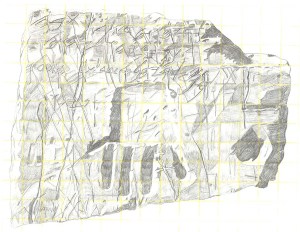
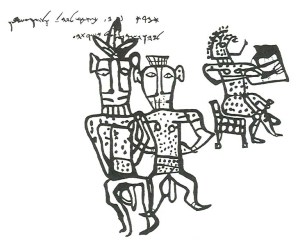
This is one of my favorite doodles from the ancient world. Its rich ambiguity lends to its appeal — some see it as salacious, while others see it as sacred. For those of you unfamiliar with the graphic details of the Asherah debate, this image is an ancient graffito from a desert way-station called Kuntillet Ajrud, a one-period site from the eighth century BCE. Like any number of other ancient drawings, this one would have probably remained in the obscure curios-portfolio of ancient scholars if it hadn’t overlapped an inscription that mentions “Yahweh of Samaria and his asherah.” Discovered in 1975–1976, this inscription, along with a couple others, revolutionized many scholarly assessments of ancient Israel’s religion. Yahweh had a soft side after all, a wife no less, the old god!

I’ve taken some flak in my circumscribed academic career for suggesting that this inscription, and a perhaps somewhat similar one from Khirbet el-Qom, are ambiguous. Sure, I’d like to see Yahweh happily married as much as the next guy, but is that what is going on here? Yahweh and Asherah, sittin’ in a tree? My doubts don’t stem from a squeamish conservatism (come on!) but from a concern of over-interpreting ambiguous evidence. Asherah, as a goddess, was rediscovered with the excavation of Ugarit. Forgotten by time with only cryptic references in the Hebrew Bible to some kind of cultic item called an “asherah,” scholars were excited to learn that she had a body and a personality. Many aspects of that personality fit, circumstantially, with a lovely pairing with Yahweh; wherever Asherah appears she is the consort of the high god, she is royal, matronly, and never showy.

The image above, however, has nothing to do with the inscription it overlaps. The two larger figures in the foreground are clearly Bes, the minor Egyptian protective deity. The characteristics are so clichéd that only the will to see Yahweh and Asherah arm-in-arm suggests anything different. Scholars like a happy ending just as much as anybody else, but I am obligated to state that, taken objectively, Asherah simply isn’t in the picture here.


Into the Great Beyond

It is a sobering moment when one of your advisors shuffles off the mortal coil. Just a year after my master’s degree, Harrell Beck, my program advisor passed away amid a flurry of unusual happenings. Just a few years back, Simon Parker, his colleague and an Ugaritologist who befriended me, also slipped into the netherworld. I just received the obituary of John C. L. Gibson, my doctoral advisor from Edinburgh, reminding me that my obvious concerns with death and religion in this blog have a very practical application. We all have to face it sometime, and hopefully our legacy will be a good one.

Professor Gibson was best known for his revision of outdated but valuable reference materials. His work as a Semitic linguist was highly regarded, but he didn’t wander too far from convention. As a clergyman in the Scottish Kirk, he had natural constraints. He also had a clever way of turning a phrase. Late in my time at Edinburgh University, I started to keep a list of his aphorisms. If I’d started earlier I might have some more nuggets to lay out here, but I thought it a fitting tribute to a fine gentleman scholar who always took a dram with his breakfast to pass along a few of his choice quotes in this post. You’ll have to do your best to imagine the Scottish burr —

“Don’t lead with your chin” (this was in the context of taking on academic debate).

“Skullduggery is just around the corner in archaeology.”

“Archaeologists and epigraphers shoot each other on sight” (this was in reference to Ebla).

“In Job the daring word is often the right one.”

“If you want to stand against him, do so. But get your armor on first!” (This remark came after I challenged a time-honored thesis by the late James Barr, while he was still early.)

“Every word in Arabic refers to a part of a camel as well as something else.”

“Inscriptions like Ajrud, they’re a nuisance; they shouldn’t be there.” (Kuntillet Ajrud is the site of one of the famous “Yahweh and his Asherah” inscriptions.)

“Who is Asherah and what is she doing here with Yahweh?” (In the same conversation as the previous comment.)

“Turning pages is a major activity of scholarship.”

There were, of course, many more. Professor Gibson will always remain a large part of my Edinburgh experience. Sitting in his pipe-smoke during one of my sessions, I noticed he had no computer. “Ach, aye, they offered me one, but I wouldna used it,” he explained. He didn’t even own a typewriter. In my mind, his passing is like the passing of old school scholarship itself.

J. C. L. Gibson, a cipher, and Nicolas Wyatt

J. C. L. Gibson, a cipher, and Nicolas Wyatt


Papal bull?

In world news, yesterday’s paper ran an article entitled “Pontiff praises Africa as font of spirituality” (New Jersey Star-Ledger). This brief piece concerning a clerical meeting about Africa (held in Italy), dredged up some interesting concepts: that the African continent is a font of spirituality, but it suffers from materialism and fundamentalism. Having never been to Africa, I am not in a position to assess how materialistic the continent is, but from the images seared into my brain of barely clothed, starving children who own nothing, having this comment come from the opulence of the Vatican is jarring. Teaching by example is far more effective than, well, pontificating. Perhaps if some of the art and Christian swag were sold to invest in the poor, there might be reason to listen to rebukes from foreign potentates.

Catholics and Fundamentalists sometimes share political agendas and cooperate to get their holy candidates elected, but clearly they clash when it comes to issues of religious praxis, and especially, authority. I watched with horror over the last two decades as Roman Catholic bishops paired up with the likes of Pat Robertson and Jerry Falwell to support the Bush family legacy because they agree on the same conservative side of the issues. I even saw this on a small scale at Nashotah House. Once the victory is won, however, the honeymoon is over and the claws come unsheathed and fangs are bared.

Religious fundamentalism is an extremely dangerous force, and Rome is right to call it a “virus.” Like Catholicism, however, it is based on fear of dissing the almighty. If we dare probe deeper, underlying all the obsequious servility towards the divine, both forms of Christianity thrive on their own power. Being able to control the masses with claims of sole spiritual authority — sorry, only one set of keys to the kingdom — is also a dangerous thing. Benedict IX, meet Jimmy Swaggart; Jimmy, meet Bennie.

Jerry blesses a papal bull

Jerry blesses a papal bull


Let Us Make Moses in Our Own Image

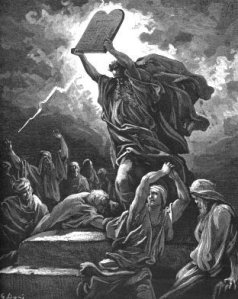
This week’s Time magazine contains an article entitled “How Moses Shaped America” by Bruce Feiler (actually it is an abstract from his book, America’s Prophet: Moses and the American Story). Feiler points out how Moses has been manipulated and utilized by various factions of American society from the earliest pilgrims up through President Obama’s campaign. There’s some interesting stuff here, from the proposal of the Great Seal that depicts the parting of the Red Sea to the Mosaic elements in the Statue of Liberty. No doubt about it, America loves Moses.

As intriguing as I found Feiler’s thesis, I couldn’t help but be a little bit disturbed by it. Serious biblical scholars are early taught to avoid prooftexting like a plague of frogs. Prooftexting is part of a Fundamentalist’s daily spiritual calisthenics, right after chapter-and-verse-presses. Prooftexting is pulling random Bible verses out of context to support a confessional position on any issue. You can always tell it’s coming when someone opens with “the Bible says…” Then you get a chapter-and-verse punctuation mark. What Feiler is describing in his article is just that, a use of Moses that fits the crisis of the moment. While there is nothing wrong about looking to a great leader in time of need, whether that leader be mythical or historical, I wonder how different this is than marching into battle with “Gott und Ich” inscribed on your belt-buckle.

One statement Feiler makes, however, I must take exception to: “With the rise of secularism and the declining influence of the Bible in the 20th century, Moses might have melted away as a role model.” No doubt secularism was in the ascendant during the twentieth century, but the influence of the Bible was never stronger. The twentieth century saw the Bible co-opted as part of a powerful political agenda that drove this nation to the brink of destruction. Never before had the Bible been used to deceive many thousands of untrained religious believers in the ways of war and greed and inhumanity. Bible-thumping had become more effective than rational thinking or coherent speech in the political debates we all so painfully watched. No, the Bible’s influence has not been shrinking. What is needed is a Moses to wrestle it back to its proper place. Even the Bible can be a golden calf.

Moses gets down

Moses gets down


Origin of Dragons

The ancient Greeks often take the credit for concepts they borrowed from the Ancient Near East. When casting about for the origin of dragons, a staple, if unstable, element of ancient Semitic myths, the credit often lands in ancient Hellas. Those of us influenced by western culture prefer the Greek versions of myths because they tend to be (mostly) coherent and do not have large gaps like those scrawled on fragmented clay tablets. Also, the word “dragon” traces it etymology to ancient Greece where it apparently derives from the verb drakein, “to see clearly.” Often commentators suggest that the rationale for the name is that dragons guard treasure and need to see clearly to do so.

Babylonian dragon

Babylonian dragon

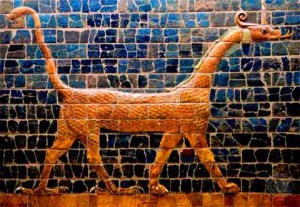
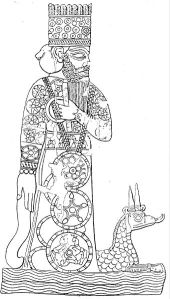
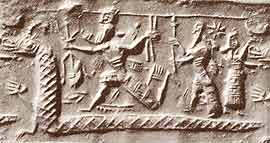
Dragons, however, actually first appeared, like so many western civilizations concepts, in Sumer. In the ancient world, what we would recognize as dragons are always associated with water. Water is an uncreated element, existing as the primordial substance from which everything emerges. It is personified as a dragon that must be subdued for creation to take place. Images of the dragon from somewhat later time periods in Mesopotamia already depict the familiar form we still recognize as draconian.

Marduk astride Tiamat

Marduk astride Tiamat

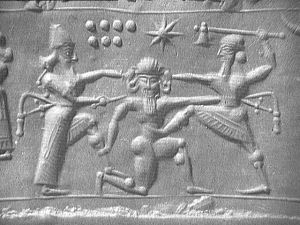
The Bible has its share of dragons as well, although they never actually existed. Tannin, whose name probably relates to serpentine features, is regularly cited as a biblical dragon. Leviathan, as described in Job 41, has scaly skin, lives in the water, and belches fire (perhaps having taken lessons from televangelists). These characteristics probably played into modern conceptualizations of the dragon. Fire breathing, however, is first attested with Humbaba, the Cedar Forest guardian of the Gilgamesh Epic. Humbaba is not a dragon, but he may be the ancestor of our fire-breathing Leviathan. Some ancient iconography may also show fire projecting from the mouths of dragons as well.

Humbaba (center) on a bad day

Humbaba (center) on a bad day

Traditional Mesopotamian dragon

Traditional Mesopotamian dragon

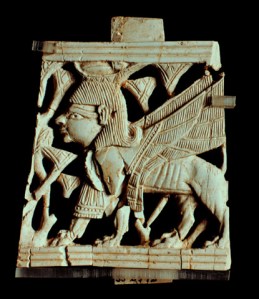
I would even venture to suggest that the origin of the name dragon could go back to ancient West Asia. The idea of seeing clearly reminds me of the ancient cherubim. According to Ezekiel, they are full of eyes. This complements their role as guardians of the thrones of ancient deities. Cherubim are Mischwesen composed of lions, eagles, humans, bulls, or any other spare parts lying around. In my imagination it doesn’t take much to shape them into dragons, the original watchers.

A true cherub

A true cherub

No matter who coined the word, dragons have been with us from the beginning of human civilization and continue to live on in popular culture. Maybe they are, like the unruly waters, truly uncreated.


The Hardest Job

Being a religionist is the world’s hardest job. That’s because you are trying to peddle something that everyone gets for free – their own religious opinion. No other professional field has such universal competition. From the time our parents mutter their first bedtime prayers to us, we begin to become masters of religion. With an entrenchment deeper than any wisdom tooth, we know, on a sub-atomic level, that we are right. We consult lawyers about the law and physicians about aches and pains, but on the level of religion, we already know we are right. We seek houses of worship that agree with our way of looking at things, and if the minister strays too far from our views, we go shopping again. Never try to make a career out of studying religion – it is a dead-end street.

I bristle whenever someone calls me a “theologian.” I am not. I have spent my life studying religion, sometimes participating in it, sometimes sitting back and watching it, but always analyzing it. Theologians deal with abstract concepts that can never be verified or falsified. The unquantifiable is their realm, and their rarefied debates seldom touch those of us of less exalted mental energy. And they are also never wrong. Those of us in religious studies watch how people’s religious outlooks impinge on the real world. Put your tin cup on the sidewalk in front of you. Everyone knows the answers already.

For some 25 years I have been specializing in religious studies, and I still assert that it is the most important, yet neglected academic field in the humanities. Twice I have been released from a living in the field by religious folk with less theological acumen than Cal Meacham. (If you don’t recognize the reference please educate yourself!) Not even eight years of a brutal Bush administration could convince university folk that the study of religion should be given priority. The most powerful nation on earth run by a recycled fundamentalist, and we don’t care to understand, thank you. Everyone is an expert. As we watch religious leaders of “foreign” nations posture with their weapons and rhetoric, we can sit back and be assured that even if they start a nuclear war, we were right about religion all along.

Better burn than learn

Better burn than learn


Noah’s Lark

This podcast deals with the myth of the great flood. It begins with a consideration of why modern expeditions do not find anything (nothing to be found), and considers the reasons the story is so appealing to present-day readers. The Sun Pictures productions on the flood story are reviewed, along with the story of the hoax played on Sun in their 1992 made-for-television movie. The history of the flood story is briefly narrated, beginning with George Smith’s 1872 discovery of the Mesopotamian flood story, back to Atrahasis and the Eridu Genesis from Sumer. The flood story is one of the earliest religious stories known.