Marmots and Briny Deeps

While driving through Utah some years back, I spotted a large rodent next to the road. Born with a need to announce automatically every land-animal I see while driving, I called out “there’s a marmot!” My wife, half-asleep, said “A Mormon? Where?” We were headed toward the Great Salt Lake with an ultimate destination of Dinosaur National Monument. Naturally we saw many more Mormons than marmots. The story of the Church of Jesus Christ of Latter-day Saints has always fascinated me. The whole concept of the “Great Awakening” and “Burnt-over District” conjure images of apocalyptic vividness where nineteenth-century evangelists are shaking angry fists at the declining modern world around them and are warning of the imminent approach of an angry deity.

I naturally found it interesting when the paper declared yesterday that the Mormon Church has decided to back anti-homosexual discrimination legislation. This doesn’t mean the Latter-day Saints approve of the practice, just that they don’t want gays to be unfairly treated in the secular world. One of the implications of a changing world is that modern readers often lose sight of the fact that the world in which the Bible originated was a very different one than the one we inhabit. “Homosexuality” was not a lifestyle in biblical times, but that does not mean there were not men and women born gay. The real issue was the misplacement of “seed” that vital element that mysteriously led to new people. The only references to same-sex “love” in the Bible commend the depth of friendship. The only problem is where the seed ends up.

The story of Sodom and Gomorrah is an etiology for the Dead Sea. The major crime of Sodom, as even Ezekiel directly says, was lack of hospitality, not homosexuality. The city that does not extend hospitality to the needy and the traveler is truly wicked. It is buried under fiery brimstone covered with stagnant water. I dipped my pinkie into the Dead Sea and touched my tongue when I was there (this might explain my current state of mind). The saline brew was gut-wrenchingly revolting. So as we parked beside the Great Salt Lake a couple decades later, I decided to repeat the experiment. I was disappointed; nevertheless, if salty lake basins are a sign of God’s wrath we really ought to wonder whether the salinity will lighten up just a bit more now that an act of human decency has occurred in Utah.

GreatSaltLake

NASA-eye view of the Great Salt Lake

Make Room on the Ark — Another New Dinosaur!

Enter Aardonyx celestae! A new dinosaur announced yesterday in South Africa is being hailed as a missing link in the sauropod chain of development, much to the chagrin of Creationists. I have to admit that I never outgrew my childhood fascination with dinosaurs, and when we purchased the life-like models for my daughter as she was growing up I secretly coveted them for myself. The rate of discovery among new genera of dinosaurs is between 10 and 20 per year, meaning that the maybe 20 different dinosaur types I knew as a kid has ballooned into well over 500 different species and 1,800 genera. Late at night I still hear the call of paleontology and I slip Jurassic Park into the DVD player and weep.

With each new dinosaur discovered Noah’s ark must evolve into a larger boat for some among the Creationist camp. After all Genesis says “two of every kind” lumbered aboard. The newbie this time is a proto-sauropod, a missing link between bi-pedal herbivores and their earth-shaking descendants who required four tree-like legs to support their immense weight. It seems that Noah must have been quite the engineer to handle all this displacement. And it is a good thing too — scientists predict that the new genera to be discovered represent only about 30 percent of the total, and the number will likely continue to climb for a century and a half yet.

Dinos

Wikipedia proto-sauropods race for the top deck

So it seems that the God-of-the-gaps grows smaller while the ark grows larger. Of course, the dinosaurs might have evolved into all these different genera over time, but then, Creationists can’t allow for that, since it would admit room for evolution. And that seems about as likely as the Church of Jesus Christ of Latter-day Saints backing anti-discrimination laws against homosexuals!


Let’s Do the Time-Warp Again!

Yesterday MSNBC reported that the Vatican has again called for a conference involving serious scientists to discuss the implications of astrobiology — life in space. Despite the mocking sneers of the media, growing numbers of serious thinkers are doing the calculations and scratching their heads. When I was a child, I was assured that earth-like planets elsewhere in the universe were virtually impossible, statically. Now we know of several rocky orbs circling distant suns. Our own sudden advances in technology have started some to think that if we raced from heavier-than-air flight to the moon in only 66 years, and from landline to audio implant in about a century, maybe other intelligent life could do the same? What would the implications be for the geocentric world of Genesis and the Gospels?

The Catholic Church and Science are hardly best buddies; frequently they are not even on speaking terms. No, the tide did not change to a warm embrace with the (centuries late) apology to Galileo or the sudden realization under John Paul II that evolution is “more than just a theory.” All one has to do is think of the issue of stem-cell research and the eagerly offered hand is suddenly withdrawn. But on the issue of aliens, perhaps the church can race ahead of the projected God-of-the-gaps, do an end-run, and be ready to embrace E.T. when he finally makes himself known.

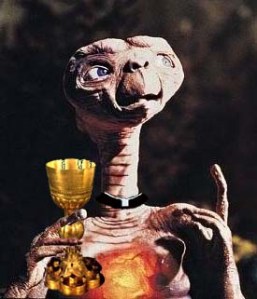
Don’t get me wrong, I am grateful that the Vatican has embraced evolution and thumbed its Roman nose to the creationists. (They deserve even more than that!) I am glad they are considering the possibilities of extra-terrestrial life. There is, however, a nagging doubt in my mind that they may be coming to the conclusion that the late Larry Norman once did that “if there’s life on other planets, then I’m sure that he must know, and he’s been there once already and has died to save their souls.” What good is advancement in science if mythology refuses to budge? What would an extra-terrestrial priest look like? What if they don’t have blood to fill their chalices? Do they have trumpet-horns on their saucers to announce the second coming? Yes, let’s explore our universe, but let’s not forget to update our credibility meters as well.

ETpriest

Our father which art in heaven?


Care of the Dead

Stretching back before the advent of writing, back before civilization itself began, people have shown reverence for their dead. Paleolithic era grave goods attest to care of the dead residing among the earliest strata of human behavior, and it is a behavior that continues to evolve to reflect the belief structures of the Zeitgeist. The idea of constructing cemeteries in a garden where family and friends might visit their departed is a relatively recent innovation. Increased population and concerns about epidemics led to the landscaped, garden-variety cemetery outside of populated areas in the 18th century. Before that graveyards could be located within the city itself, often near a church or sacred location.

While visiting Swan Point Cemetery in Providence, my niece asked me why people left pennies on gravestones (H. P. Lovecraft’s tombstone had one on it, and others around it). My thoughts went to Wulfila’s recent blog post on the Black Angel tomb in Iowa City and the pennies scattered there. I also recalled La Belle Cemetery in Oconomowoc, Wisconsin where a “haunted statue” was always richly endowed with pennies in her cupped hands. LaBelleThe specific form of penny offerings seems to go back to Benjamin Franklin’s burial, at least in America. A few years back while in Philadelphia, I saw for myself that people still leave pennies on Franklin’s grave in Christ Church Cemetery.

Franklin

Franklin pennies (and a few nickles)

There is no universally accepted reason explaining why Benjamin Franklin should have been the first to have received such treatment — in fact, I would argue that it is much older than Dr. Ben.

Money to accompany the dead has a long history. Pennies on the eyes or under the tongue of the deceased originated in the need to placate the ferryman across the river of — what’s it called? — Oh, yes, the river of forgetfulness. The classical Greek form of this mythic character is Charon, the boatman who punted the dead across Styx. He required payment, and since coinage had been invented, it was a convenient way to pay. (Today the truly devoted might leave a credit card in the casket.) The ferryman must have his pay, as the movie Ghostship warns, but the idea is much older still. The earliest references to being poled across the river go back to ancient Sumer, the earliest known civilization. As soon as people became civilized they began to pay homage to the gloomy captain of souls.

While in Prague just after it opened to western visitors, my wife and I stopped by the famous Jewish cemetery where the tombstones are so tightly packed in that they are barely legible. My wife asked why so many of the tombstones had smaller stones on top, placed there as dedications.JPrague I recalled having seen stones on tombs outside Jerusalem some years back, and I even had a student bring me a stone from Israel to keep as long as I promised to put it on her grave after she died. This practice in its recent form is associated with Judaism, but again, it has ancient roots. The building of cairns, or piles of stones, is often associated with the Celts or the pre-Celtic inhabitants of the British Isles. On our many wandering through the highlands and islands we saw several Neolithic examples in Scotland, particularly in the Orkney Islands. The practice of putting stones atop the dead also goes back to ancient times. One plausible suggestion is that it was intended to keep the dead in their graves. A more prosaic conclusion is that digging deep holes takes more work than hauling over a pile of rocks.



No matter what the origin of the practice may be, one of the surest signs of civilization is care for the welfare of the dead. Today a penny is easily left, costs the bearer little, and creates a memorable image for all who follow.


Love the Craft

It is a cold, windy New England day in November. You find yourself in Providence. How can you not visit the gravesite of H. P. Lovecraft? I have mentioned Lovecraft before, in my podcast on Dagon, but that brief citation does not give credit to a man whose life provides episodes that feel strangely familiar to me. Barely known as a writer in his own lifetime, Lovecraft had difficulty finding employment and had a fascination with ancient gods. Indeed, I discovered Lovecraft while researching Dagon for a serious presentation and soon students were telling me about the Cthulhu (I would not dare attempt to pronounce) Mythos and how I had only scratched the surface of his writing.

Lovecraft’s fascination with ancient gods brought new life to forgotten entities. Dagon, despite being a major deity of ancient Mesopotamia, would likely have been completely forgotten by all but professors of arcane mythology had not Lovecraft resurrected him, albeit in a fishy form. His fascination with the protagonists of ancient myths, nearly forgotten deities, clearly influenced Neil Gaiman in his American Gods, and has preserved for the modern reader some of the fascination with powerful, ancient forces that show the insignificance of humanity. I found reading American Gods while in Providence a very humbling experience. Lovecraft also gave the world Arkham, the asylum of Batman fame, as well as Miskatonic University.

Along with Melville and Poe, Lovecraft deserves a place of honor in the pantheon of American literary explorers. The assortment of gifts left for him at his tombstone, including a small cairn, pennies, a pen, and even a note reading “thank you for the ideas,” attests his local fame. The prominence of his books at neighborhood bookstores assured me that I was not the only traveler to breathe in the air that Lovecraft exhaled. My visit also brought to mind a story that a friend of mine started to write some years ago. It had something to do with ancient gods coming back to life, although my friend had never heard of Lovecraft or Gaiman. Lovecraft’s spirit, it seems, may still be alive and well in Rhode Island and in the minds of other residents of Arkham.

Lovecraft


Rhode Island Blue

Rhode Island is often overlooked as the smallest state, a place seldom happened upon by accident, somewhere that one has to intend to go. Drawn by family, I made a trip to Rhode Island and serendipitously learned the lesson of Roger Williams. Roger Williams was the founder of Rhode Island, and, for those only familiar with the Southern Baptist movement, a rather unbelievably liberal Baptist. The founder of the first Baptist church in the nation, Williams was also the advocate of a form of religious freedom that is still railed against today by conservative Christian factions that wish to make America a “Christian nation.”

FirstBaptist

Roger Williams' first Baptist church (in the country)

We are accustomed to religious propagandists today telling us that the “founding fathers” were Christians just like they are (simply not true), and that America should remain a “Christian country.” Roger Williams, although not often spoken of in the same tier as George Washington or Benjamin Franklin, classifies as one of our founders and he was an outspoken advocate of conscience as the guiding force behind religion, not state or federally mandated compliance. Rhode Island was offered as a “shelter for persons distressed of conscience.” It was a state where a mind was free to follow its lead.

I confess to overlooking Rhode Island often. But as a refuge for “Papists, Protestants, Jews, or Turks,” it is the Dreamland of religious liberty. Progressive to the point of welcoming Jewish believers and Muslims, Williams went as far as to declare, “none [should be] compelled from their own particular Prayer or Worship, if they practice any.” Even the unbeliever was welcome. How far the “religious right” has fallen from this original ideal of a humble Baptist who envisioned a homeland where residents were free to believe as their conscience dictated!


Mortarboards and Greenbacks

I admit to being an idealist. I grew up far, far from academia. No one in my family had ever been to college before, but when my high school teachers described it, it sounded like a bookish place where knowledge for knowledge’s sake was valued above all more pedestrian concerns. There men and women read and studied and devoted their lives to learning. They lived in shimmering ivory towers and led the way of the future from their scholastic bunkers. And so I worked my way through college. Granted, studying religion may not have been the wisest choice for changing the future, but it seemed the right course at the time. I found a limited acceptance in academia, an idealist who just didn’t know when to give up. It was only after earning a Ph.D. that I stopped to look over the landscape with informed eyes and began to feel a deep dismay.

The best way to encapsulate that dismay became clear in a headline in the New Jersey Star-Ledger earlier this week: “More millionaires among college presidents.” It seems that the extremely rare job of college president is increasing becoming the path to riches. Now to a guy who has never found that mythical teaching position that supports a small family, this felt like a kick in the gut. More than that, it also summarized the dismal view I’d garnered of academia as a whole: it has become a money-driven enterprise.

The tawdry reasons given to justify college presidents earning six figures, some creeping toward seven, per year is that of unadulterated capitalism. Prestige, keeping up with the other corporate executives in academia, showing the strength of the school through the number of greenbacks wasted on the salary of a single individual — I simply don’t buy it. The college president worth his or her paycheck is the one who would take a pay cut for the honor of having the job. Okay, so I’m an idealist, but I believe that higher education, which began as an outgrowth of religious education in such institutions as the University of Paris, has lost its way. I know adjuncts at Rutgers who earn less than $30,000 a year (in New Jersey!) while the president’s salary tops $635,000. And don’t even get me started on the football coaches! I wonder who would win a purely intellectual contest: the University of Paris vs. the Big East Conference?

Education


Our Myth of History

“Myth” is a difficult word to define. In the ancient world, however, reality, or truth, was expressed in terms of myth. Today we assume that myth is “untrue” or false. This dichotomy often leads to an unfortunate undervaluing of ancient texts and stories. At root the problem is that we are on the far side of a paradigm shift. This podcast addresses the question of how we might try to understand myth in a way that fits with the modern outlook. Since historical veracity is the modern paradigm, it stands to reason that history has become the mythology of present-day thinkers.


Neo-Canaanites

The world of religious studies is full of surprises. Since people are forever seeking new forms of fulfillment, the endless variety of religions itself comes as no surprise, but the results of religious experimentation sometimes lead into uncharted waters. One of my students at Rutgers recently pointed me to a new religion called Natib Qadish, “the sacred path” in potentially vocalized Ugaritic. (Ugaritic, like most ancient Semitic languages, was written without vowels. Some modern scholars, basing their reconstructions on likely vocalizations known from other Semitic tongues, have tried to give voice to this dead language.) I have no idea how large a following this religion has, but it does maintain a substantial website explaining its core beliefs — the modern worship of the Ugaritic/Canaanite gods.

Unsatisfied with the tradition monotheism that eventually drowned out polytheistic voices in western religions, followers of these reconstructed religions are looking back to something more ancient, more primal, and perhaps, more human. What strikes me as odd concerning all of this is that religions such as Natib Qadish are based on extremely fragmentary understandings of ancient religions. We have perhaps a 101-level understanding of Ugaritic religion; some parts are very well attested, but there are huge lacunae that confuse the overall aspect. As I tell my students, ancient religion was based less on belief than it was on practice. Belief-centered religion is a relative newcomer on the historic scene. Ancients inherited their “religions” without question, based on where they were born. Tess Dawson, the founder of Natib Qadish, writes: “I have yet to find any word that means ‘religion’ in any of the ancient texts.” I would argue that it is because the concept of religion itself is a modern one.

Humans seem to have believed in gods from very early times. If gods are there, they must be placated. This is not religion; it is commonsense. Not to placate gods is to invite disaster. In Ugarit these gods included Hadad (Baal), El, Asherah, and Anat, among a host of others. These were the gods people “discovered” as they tried to fumble their way through a difficult existence. And gods like to eat meat, they learned. Sacrifice was born. What is a feast without ceremony? Ritual must emerge. I know this is overly simplistic, but belief doesn’t really enter into this scenario until late in the game. Heterodox belief was normative until Christianity assigned eternal consequences to correct belief, and now we are free to believe whatever we will.

As far as I can tell, Natib Qadish does not actually involve animal sacrifice to the gods (although it is based in Chicago, long known for its slaughterhouses). Like many modern Christians, the followers of this religion wish to reach back to a more pure form of ancient belief. It is an exercise in futility, however, in many respects. The framework has changed beyond recognition and we have no way of knowing what any ancient god would require of us in an internet age.

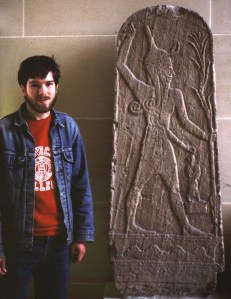
SAWHadad

A young Dr. Wiggins meets Hadad in Paris


Picturing Genesis

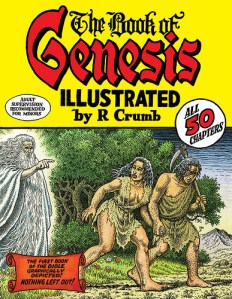
genesiscr

The book of Genesis is elusive and evasive, telling stories that have been read as both science and fiction, but never revealing its own deepest secrets. For over two decades I have been researching the book, never publishing my work since there is so much more yet to read on it. Many truly bizarre interpretations on the introductory section of the Bible have appeared with the proliferation of publication — Robert Capon’s Genesis the Movie and Harold Bloom’s Book of J come to mind — even by otherwise careful scholars. Nobody seems able to get to the essence of the book while everybody thinks he or she already understands it. As a piece of literature it is perhaps the most influential ever penned since it is the basis for so much of the world we’ve constructed around it. Maybe the reason we can’t understand it is that we don’t have it in pictures. Now that’s all changed: R. Crumb’s (serious) comic book version, The Book of Genesis Illustrated, is finally available.

R. Crumb is well regarded in the comic book world, but less recognized in the biblical academy. He is not the first to storyboard sacred writ, nor will he be the last, but he is grappling with the same material that defies definition. Creationists can’t live without the assertions of Yahweh’s creatio ex nihilo, that they read into Genesis (for those who are willing to read what’s there, chaotic water is pre-existent, not created), and many biologists wish that J and P had shown a bit more discretion and humility before setting the framework that dogs their each and every evolutionary observation. Those who take Genesis too seriously will likely be offended by a comic-book version, but the text is based on the revered King James Version and Crumb said in an interview that he had “no intention to ridicule or make visual jokes.” The problem is, the text is full of its own riddles and jokes, along with serious assertions of the superiority of Yahweh over Marduk and Baal and Teshub.

Unlike many Bible readers, Crumb does not stop his Genesis with the Flood or the Tower of Babel. Instead he takes his readers through the entire book where “iron-willed Old Testament matriarchs” are presented in his characteristic muscular style, perhaps recalling She-Hulk more than Sarah. The images may be unfamiliar and a little frightening, but I applaud Crumb for taking on the patriarchal chokehold over shy, hand-wringing wives wondering why they can’t seem to take the biological package their virile husbands send their way. The Bible was written in a man’s world, but it is now ensconced in a more enlightened age and it is ready to benefit from a new, and unfamiliar reading.


Biblical Weddings

Maine is getting ready to vote tomorrow on the legalization of gay marriages. With conservatives hopped up on fears that such a move will destroy traditional, patriarchal privilege, the Bible is beaten rather severely as proponents seek evidence for man + woman = marriage in holy writ. The funny thing is, the Bible says very little about marriage.

In an era when marriage is often associated with houses of worship and a smiling, tolerant divine face beaming down on a couple about to do “the bad thing” with divine sanction, it is difficult to realize just how little the Bible talks about it. The Hebrew Bible is particularly mute when it comes to the particulars of wedding ceremonies: “Then Isaac brought here into his mother Sarah’s tent. He took Rebekah, and she became his wife,” according to Genesis 24.67. No sacral ceremony here, by prior arrangement, sex equals marriage. A few chapters later when his son Jacob marries, there is a feast mentioned, but no sacerdotal functionary hovering nearby (one who might have actually noticed that Jacob ended up with the wrong woman, by the by). And so the biblical narrative limps on with patriarchs bedding and marrying their women with no mention of God. Eventually religious folks got a little nervous about this and ceremonies with divine approval were introduced, but that is not even in the case with the wedding at Cana, which, in desperation, the Book of Common Prayer latches onto for a marriage lection: “The bond and covenant of marriage was established by God in creation, and our Lord Jesus Christ adorned this manner of life by his presence and first miracle at a wedding in Cana of Galilee” (the Order for The Celebration and Blessing of a Marriage). Apart from the difficulty of a covenant being an uneasy peace between a superior and inferior party, this introduction relies on a literal Adam and Eve and the means for a large wedding party to get drunk, courtesy of the miracle in Cana. Apart from Paul’s putative comments regarding the marital status of early church leaders, we hear little else in the Bible.

I have nothing against weddings; I was the groom in a particularly stylish wedding in Ames, Iowa some years back. The problem I see is that the Bible is being forced to say what it does not. If the few biblical marriages are all heterosexual, it simply reflects the options open at the time. How does allowing gay marriages threaten the marital bless of the heterosexual? It seems to me that the only thing to be lost is “privileged status” and benefits allotted to those formally united in the eyes of the law. Unless things have changed recently, even in a religious marriage a state-issued license is required! Why not allow firm affirmations and privileges of loving couples without relying on non-existent biblical platitudes? I hope Maine will do the right thing tomorrow.


Robots vs. Ancient Deities

NasaRob

Yesterday I found myself at my first ever robotics competition. As a scholar more familiar with the offering recipes for long extinct mythological deities than with the practical application of computer technology, I felt a little out of my league. I had gone to support the local high school robotics team, and, well, robots and Halloween seemed a natural combination.

The first thing that stood out was the large NASA van parked in front of the school. Fidgeting over finding a job at the moment, I realized that the money is far more forthcoming for practical enterprises than reading ancient history. It is, literally, for rocket science. So I was crammed into high school gym bleachers with other aging parents, surrounded by kids smarter than I’ll ever hope to be, watching robots compete in exercises too complex for the average Republican. There was rock music blaring and yes, nerdy people dressed like science fiction movie/television characters. I was really feeling lost when I spied the character below.

DrJim

I had no idea that Dr. Jim of the Thinking Shop had relatives in the robotics field! As I saw the bearded Norseman approaching me, I was strangely reassured that there might be a place for me here after all. Religion and NASA do share an interest in celestial realms, and if my generation has been capable of producing kids this smart, there may be hope for the future yet.