Im in ur blogz

Translation. The Bible as we know it would not exist without translation. Ours is a culture of convenience — Americans want divine revelation dished out in easy-to-swallow portions in their own tongue. Going through the rigors of learning new alphabets and grammatical systems, not to mention the eerie specter of textual apparatus, are enough to frighten off all but the most stalwart of truth-seekers. This is a good thing. We would never advance as a culture if we all had to spend our time learning actually to read our religious texts as they were written, only to find out that we have no original texts at all. So we trust our translators.

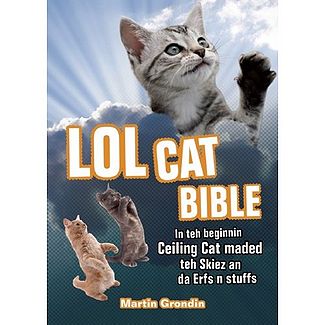
A few weeks back I posted an entry on Andrew Schlafly’s misguided (imho) Conservative Bible, devoid of liberal bias. Since then Stephen Colbert’s interview with Schlafly has been making its rounds on the internet and thousands of people are now aware of the project and its biases. I stand by my original objection that biased translations are unfair representations of the actual ancient texts. But it looks now like I’ll have to be eating crow. A new translation is scheduled to arrive in stores next month, and it looks like it may have a bias. Still, it is a translation that no internet-savvy reader can afford to ignore. Yes, the Lolcat Bible is nearly ready to pounce from the press.

The culmination of the Lolcat Bible Translation Project, over two years in the making, a Bible in Lolspeak will soon be available. Comparing what I’ve seen of the two projects, I think there is more truth in the Lolcat Bible than in the Conservative Bible. I’ve studied more ancient languages than any sane person rightfully should, but I do rely on my able research assistant (aka daughter) to help read Lolspeak. She suggested the title for this post, but the full text reads, “Im in ur blogz, postin mah wurdz of wizdum.” That’s straight from the mouth of Ceiling Cat!
A Walk Around the Watchtower

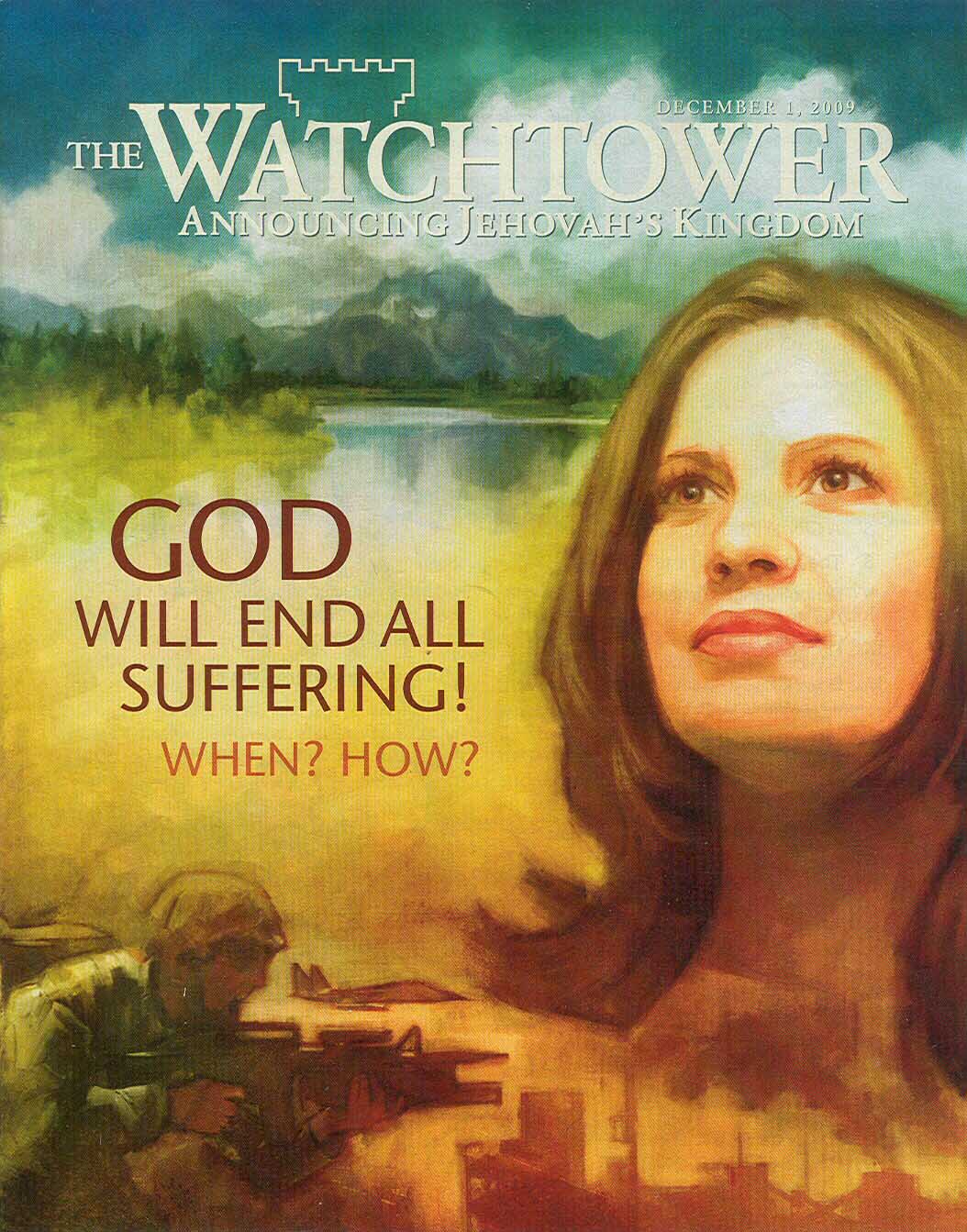
The Jehovah’s Witnesses stopped by yesterday. I never pretend not to be home, and when I’m less stressed out I like to engage them in terms of biblical exegesis — religion is all about conflict. Yesterday I was still recovering from the disappointment of not getting a job I really wanted, so I simply answered their questions and accepted their Watchtower magazine. Thumbing through it, I ran into some hermeneutical obstacles — an occupational hazard for those of us who’ve spent a little too much time with the Bible, I suppose. A story about Joshua informed me that “Jehovah wants you to succeed.” It tasted a little too much like prosperity gospel and not much like life in the present. So I flipped a few more pages.

An article on Lunar New Year (Chinese New Year, as it is traditionally called), warned against Christians celebrating it, in part because of ancestor veneration. The Watchtower declares, “the Bible show that the ‘ghosts’ and deceased ‘spirits’ are really wicked spirit creatures pretending to be the deceased. For what purpose? To mislead people and bring them under their evil control!” Now, I admit to being drawn into the Ghost Hunter fan-base, but I do recall the story of Saul summoning Samuel from the dead. The Bible doesn’t indicate that he’s evil; in fact, it is Samuel himself! If ghosts want to deceive then they need to show up a little more clearly and give more direct messages.

I then learned about King David’s remarkable musical prowess in the story about music in the Bible. It is truly amazing what can be extrapolated from a literal reading of the Psalms. The magazine informs us that King Sennacherib, emperor of Assyria, demanded male and female musicians from Hezekiah. “It seems that they were first-class performers.” This seemed a little too much like the stereotype of Jewish entertainers, and since it was extra-biblical I couldn’t accept it. The story concludes by indicating that music is not a human invention. “The Bible describes music and singing in the heavens themselves, where spirit creatures play figurative harps and sing praises around Jehovah’s throne.” As I pondered what a figurative harp would sound like, I could swear I heard the sound of one hand clapping.

Being that time of year, the issue has an Epiphany story. Well, most Christians associate the wise men with Christmas, so I’ll call it a Christmas story. Eager to be honest, the author notes that the wise men were really foreign astrologers. And although they were into witchcraft, the angel announced Jesus’ birth to them to lead them away from this abhorrent practice. Then a divine revelation came to them in a dream in order that they could avoid Herod and his wicked plan. So the astrology that led them to Jesus was bad, but the end result was good.

When the Jehovah’s Witnesses ask me if I know about the Bible, I look at my feet and kick at an invisible speck of mud on the floor as I admit that I have taught Bible for nearly twenty years. But when they ask what I believe about the Bible I tell them the same thing I tell my students — what I believe is personal and I choose not to share it. I don’t begrudge any person of their religion. I even share the Jehovah Witnesses’ hope that the future may be brighter than the present. If you want to convert a religion professor, even an adjunct one, however, it will take more than a Watchtower to do it.


Happy Whatever

Over the past couple months I had been interviewing for a position at the Tanenbaum Center for Interreligious Understanding in Manhattan. Although I did not get the position, I still recommend the center for those who are dealing with religious conflict. One of Tanenbaum’s concerns is the “December dilemma.” The month of December is dominated by the celebration of Christmas, and many people are barely hanging onto sanity awaiting those few days off near the end of the year to catch their breath before jumping back into all of it again. Yet, with the continual mixing of cultures and traditions that makes America such an interesting place, other traditions have difficulty competing with Christmas. Well, it is hard to compete with such a capitalistic holiday, one that is based around getting stuff.

There has been a movement afoot in recent years to mash the December holidays together. One such movement is the celebration of Chrismukkah, albeit somewhat tongue-in-cheek. Hanukkah naturally falls around the usual time of Christmas, and Kwanzaa was created to add yet more texture to the month. Despite all this, Christmas is still predominant. As I tell my students, the mindset of America as a whole (not demographic or even factual, but perceptual) continues to be Protestant Christian. Apart from Kennedy all of our presidents bear this out. And Protestants, although they don’t care much for the “mas”part, are big Christmas fans.

A Dickensian Christmas

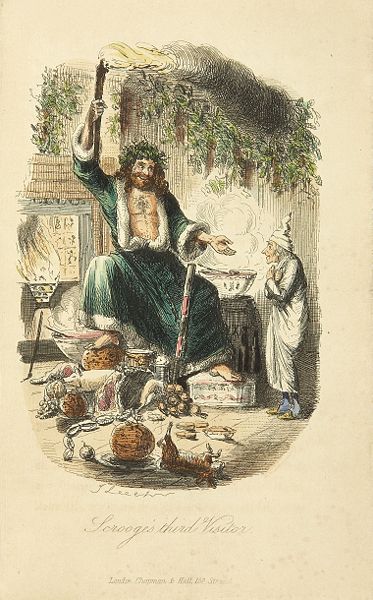
A few years back I wrote a book for tweens that examined the roots and traditions of the major American holidays. (So far publishers haven’t been impressed.) One of the facts I learned about Christmas is that its celebration as a major holiday is a recent phenomenon. Before the nineteenth century Christmas was barely noted in America at all. In the wake of Charles Dickens and his influential stories, Christmas became an institution that celebrated family and home and goodwill. Eventually it grew into a major commercial holiday and everyone wanted to get in on the fun. Now we have a largely secular Christmas and other religions are eager to join in the non-confessional part of the holiday. Everyone would like to have Christmas day off work (except the clergy), and those who don’t have it feel lonely, I’m sure. I don’t see the reason for the big fuss about whose holiday it is. Christmas is symbolic of peace and togetherness, and no matter what it is called or who claims ownership, this is by far the superior path over religious fear and hatred.


Biblical Science Fiction

1950s science fiction films are perhaps the most parsimonious celluloid genre. Standard Saturday afternoon fare in my childhood, I still have a soft spot for the unapologetic self-confidence of these movies with their painted backdrops and hokey effects. The messages are frequently self righteous and often biblical. So yesterday as I treated myself to a viewing of The Mole People, I went on instant alert as the biblical references began right away for an audience that would have known the Bible well enough to take it all in. Set in “Asia,” the archaeologists are digging for Sumerian artifacts when then discover a stone tablet “below the great flood level.” That makes it at least 5,000 years old, the assembled academics declare. A diffident Dr. Roger Bentley tells his fellow excavators, “in archaeology all things are possible!” When a young boy of the indigenous population discovers an oil lamp shaped like a boat, the archaeologists note, “the flood’s been proven to be a historical fact.” The boat is a model of Noah’s ark, the Sumerian version. The scene of the expedition climbing Mount Kuitara includes footage from the 1955 Fernand Navarra trek up Mount Ararat during which a wooden beam was found, reputedly from Noah’s ark.

If you can stomach the bogus Sumerian you’ll learn that ancient Mesopotamians also survived the flood, a kind of “children of Cain” motif. These Ishtar-worshiping pagans are practitioners of a kind of social Darwinism, killing off their own kind when resources in their underground world become strained. Their great underground civilization parallels that of ancient heathenism while more advanced civilization on the surface of the globe has the benefit of an enlightened Christian worldview. Even the Sumerians whipping the actual mole-men is reminiscent of the Egyptians whipping the Hebrews in the Ten Commandments (released the same year).

Fast forward fifty years. We now live in a technologically advanced civilization where the myths of ancient people have little place. Science provides logical explanations for most of what we encounter in the world around us. Yet there are still otherwise intelligent people seeking Noah’s ark on Mount Ararat. The past is impossible to escape. The Sumerians in the film (whose walls are inexplicably decorated by Egyptian artwork and hieroglyphics) represent those who hold onto a confused religion that has become a form of terrorism in the eyes of the more advanced archaeologists. Perhaps the paradigm has shifted, and those who use religion today to gain political power and personal gain have become the self-righteous Sumerians of The Mole People.


Christian Movementarians

After a distressing day of job-hunting yesterday, I turned to the Simpsons for solace. Often the most intelligent program on American television, as well as being the longest running series, the Simpsons frequently hits religion with a few good-natured and well deserved whacks. Last night I watched The Joy of Sect from season nine. It has been a few years since I’ve seen the episode, and I was pleasantly surprised how it correlates with the overall theme of this blog.

Although the episode ends with a normalcy returning to Springfield after the appearance of a cult called the Movementarians, the parallels between the cult and Rev. Lovejoy’s church are numerous and poignant. This perhaps hits too close to reality for many religious believers — what separates a “cult” from a “church” is more a matter of perspective than a matter of practice or accident.

Even early Christianity had considerable connection to and similarity with Gnosticism. When religions collide, they must emphasize their distinctiveness to survive. Like biological organisms, those that meet the needs of their societies (“the fittest”) survive, while others go extinct. It seems to me that the main cause of religious violence is the need to claim exclusive access to the truth. People are not comfortable believing a religion that might be proven wrong. Like the Simpsons they wish everything will return to normal at the end of the day.

The very definition of normal


Hadad in Copenhagen

Let us talk plainly about the weather. Global warming is a reality, and yet the issue is clouded by religious conservatism. To be precise, it is difficult to determine whether it is really greed or the religious right that stands so firmly behind free-market capitalism that is driving this chariot of the sun. The strange and unholy alliance between religious and political conservatism, however, has become a force daily striving against reality and its proponents want to be on the top of the pile when the whole thing collapses.

I can not speak to the political end of this continuum; I am not a political scientist or economist. As a “religionist,” however, I recognize a deeply disturbing trend that I have followed since my youth. Fundamentalists have consistently taught their young that the “Second Coming” is only minutes, possibly seconds, away. Undaunted by the two-millennium delay in wish-fulfillment, they suppose the words supposedly uttered by Jesus indicate a kind of divine “I’ll be right back” just before pushing off from the Mount of Olives. The signs of the times given in the Bible describe the then current condition, yet modern-day Fundamentalists wish to force the almighty hand, call the bluff of the Texas Hold-‘em expert above. If the general in the sky said wars would come, well, we’ll make wars. If the only way to get his attention is by destroying the planet around us, so be it. Deny global warming for the sake of the religious right, since their world is about to end.

Baal in Copenhagen?

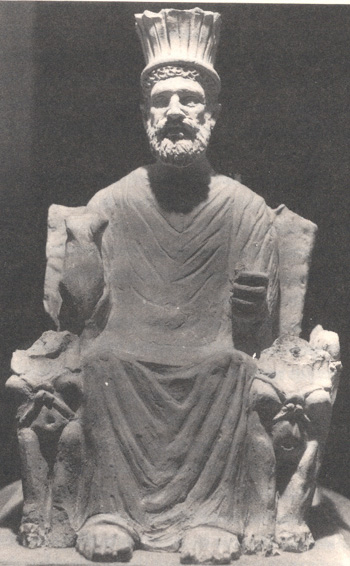
The rest of us might want to stick around for a while. Ancient meteorologists believed that particular gods controlled the weather. At Ugarit Baal, or Hadad, took responsibility for drought and plenty. If there was a problem, they knew just to whom to offer a sacrifice. In our monotheistic western world, we’ve pared the gods down to a single man. Not everyone agrees on his mood or character, but some are convinced that he has his bead trained right on this planet and they want to help from here below. Others believe — o the heresy! — that natural processes control the weather and that we can do something to make our situation better. We might be in a better place if those who believe the gods control the weather were relegated to theology classes rather than political offices.


Moses and the Calf

It seems that Moses just can’t get away from that calf. Last week in a manger in rural Connecticut a calf was born. The calf is brown rather than golden, but it bears a distinctly cross-shaped white marking on its forehead. The owner suspects it might be a divine message, but he’s not sure what the message is. The children of the area named the calf Moses.

Does this all fall into the category of coincidence? Or is it indeed a long-awaited sign from on high? It does fall a bit on the C.E. side of the long-expected red heifer, but it looks like it just gamboled out of a bovine White Ash Wednesday service. And it was born in December! In a manger! (Or at least the present-day equivalent of one.) He bears the name of the arch-nemesis of venerated calves — Moses, the solemn monotheist. Even the chair of the Dairy Sciences Department at the University of Wisconsin-Madison declares the Catholic birthmark to be unique.

All in all, I think the farmer got it right. If divine messages come in the form of calves, we’ve got a serious mixed-signal problem down here. The greatest crime, according the book of Kings, that the Northern Kingdom of Israel perpetrated was the erecting of a set of golden calves. And the sign we get is a denominationally confused calf? Perhaps the appropriate question at this juncture would be, “how now, brown cow?”

Photo credit: Aaron Flaum, Associated Press


The Safest Place to Hide

One of the most poignant stories in religiously motivated violence, at least in the consciousness of Americans, was the series of disastrous events of 9/11. In the wake of that event, several previously assumed privileges of United States citizens came under scrutiny and were subject to curtailment. I know that on the rare occasions when I fly I feel demeaned by some uniformed stranger telling me to partially undress and explaining that if s/he has to feel me up it will be with the back side of the hand, to protect my modesty. Still, I never complain. Freedom has its price, they say.

Another place where we have funneled our abundant national resources is the Department of Homeland Security. We are willing to pay quantum-sized price-tags to feel safer at home. Then today’s newspaper announces that a fugitive from justice has been working at Homeland Security for two years. A woman nationally wanted for insurance fraud, arrested once after the bulletin was posted, was just now discovered to have been working for Homeland Security. Having watched concerned parents have to go through extensive background checks and even fingerprinting to accompany their kids on a school fieldtrip, I’m not sure that this news makes me sleep any more securely. If we can’t find a criminal who is a government employee (politicians excepted, of course), who has presumably undergone a background check (regularly required for those of us subjecting ourselves to applying for job openings), well, maybe we ought to address the religious violence issue instead.

A friend once told me of an acquaintance who’d failed a test to work in a fast-food restaurant who went on to be hired by the Transportation Safety Administration. So that guard reaching a latex glove toward me may not have had the wherewithal to attain to fast-food service, but will be keeping terrorists off our airplanes. If religious leaders would lay down their ungloved hands and seek to understand their enemies perhaps none of this would even be necessary.


Be Kind to Your Canaanites

You can never find a Canaanite when you need one. This has been the bane of scholars of the Ancient Near East for many years. While teaching my class on Ancient Near Eastern Religions the question frequently arises: who are the Canaanites? Problem is, nobody really knows.

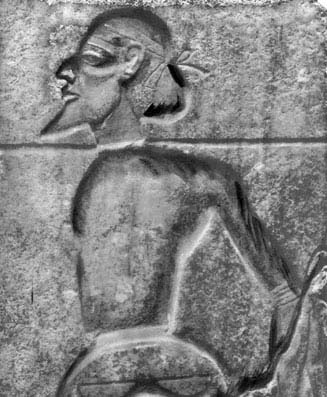
The Canaanites have prominence in the ancient world due to the Bible. The people already occupying the land that would one day become Israel are called Canaanites. They appear to have been culturally contiguous with Aramaeans in what is now Syria, the Phoenicians in what is now Lebanon, and even with the Israelites. While there are references to the Canaanites in antiquity, we have yet to discover a people who call themselves Canaanites (unless the Phoenician inscription from Brazil is legitimate!). Canaanite, at this point in time, is only attested as a name used for somebody else. “They are Canaanites,” not “we are Canaanites.”

An Egyptian version of a Canaanite

In this we have a useful paradigm. Today religions continue the “us versus them” mentality. In the Hebrew Bible it is often open season on Canaanites since they worship other gods. Today this fear and distrust continues with members of some religions declaring war on those in other traditions. Sometimes it is even within a single religion: Catholic versus Protestant, Baptist versus Catholic, or everyone versus Unitarians.

Religion is, however, always taken on faith. No technique exists to determine, empirically, which is the “true religion” or whether they are all paths up the same mountain. Religions are not fact, they are belief. And religions evolve. It would be the greatest evolutionary leap forward for religions to accept each other, to do away with the ersatz Canaanites. Not that Canaanites should be decimated or eradicated, but they should be accepted for who they are. Who are the Canaanites? They are anyone who practices a religion different from your own.


Billion Dollar Babies

Yesterday I attended a holiday-themed concert. It was an unusual mix of the archaic and post-modern in that although many traditional holiday pieces were sung, the readings were from an assortment of writers, some still living. The theme, not surprisingly, was the wonder of birth. One of the readings was from D. H. Lawrence, a writer more often associated on the making of babies end of the equation. Nevertheless, as the soporific music flowed I found myself once again thinking of special babies.

The concept of a special child marked at birth has an ancient pedigree. Long before Samuel, Samson, and Moses there were ancient heroes known from their unusual births. The theme is at least as old as Sargon of Akkad, and probably even older. Those who grow to achieve great things in life must, by back-formation, have had a wonderful birth. Of course, when they were born nobody knew they were special yet, and so our mythopoeia demands we devise incredible births for them. Anyone who is a parent knows that time stops and the entire world stands in rapt silence as your own child is born. All babies are billion-dollar babies.

The subtext to all of this is that without even looking for a special child we should realize that all people have inherent value. If religions truly taught that message there would be a lot less religious violence in the world and the dreams of many more infant dreamers might be attained. Perhaps all religions should take the stories of their own origins more to heart and hear them more often than once a year.


Special Babies

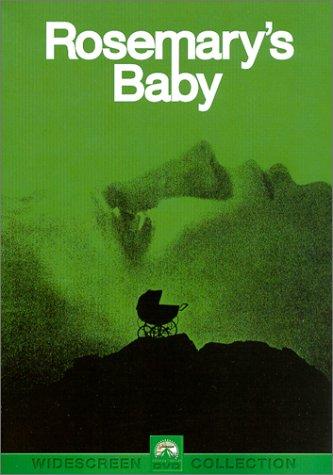
Roman Polanski has been in the news quite a lot lately. While I haven’t been following the story, his name is perennially associated with Rosemary’s Baby in my mind. In my youth I feared this movie and made no attempt to watch it until I reached my 40s. Like other works conceived by Ira Levin it features a threat to what we value most; the original Stepford Wives is still almost too scary to watch. While Rosemary’s Baby remains a good psychological thriller, the counter-Christmas theme became quite evident the last time I viewed it. I won’t worry about spoilers since the movie was released in the 1960s, but if you’re still waiting to watch it and want a surprise ending, you might want to turn to another post at this point!

The 1960s were times not only of a strong counter-culture but also a period of fear. Many popular evangelists were warning of the coming of the Antichrist and the Time article entitled “Is God Dead?” is featured in the movie itself. Although it is unclear until the end, upon first watching, who fathers Rosemary’s baby, the child-spawn of Satan is presented with many of the trappings of the first Christmas as Rosemary herself makes the discovery. In fact, Christmas comes as Rosemary is pregnant, and the film carefully accentuates the contrast between Mary and Rosemary. The suffering of the expectant mother still makes the film difficult to bear at points.

As Christmas nears in this very commercial and recession-ridden season, many lawns are sporting “Keep the Christ is Christmas” type displays. Isaiah is being taken out of context and the Religious Right continues its attempt to make Christmas a political petard. Babies represent new beginnings. And while Rosemary’s baby was born six months after (diametrically opposed to) the celebration of the birth of Jesus, in both cases the infant represents a radical change. Any human parent knows that babies are special and that knowledge demonstrates that a young Roman Polanski recognized a theme that would scare audiences for at least forty years.


Algernon Sydney v. Estelle Walker

A headline in yesterday’s paper read “Mom expected God to provide food, daughter testifies,” regarding a New Jersey court case on child endangerment. Back in 2006 an unemployed mother decided, based on what her religion dictated, that God would sustain her family. Her children nearly starved to death after eleven days without food. In a society where those who take their religion literally like to wear it on their sleeves, and politicians receive excessive adulation for their piety, this case is a splash of ice-water honesty. Reality is, people starve to death. Many of them children, many of them religious.

The non-biblical adage “God helps those who help themselves” can properly be traced to Algernon Sydney, a seventeenth-century British philosopher. Quite apart from this noteworthy comment, Sydney was also aware that taking the verses of the Bible out of context you could prove just about anything. He famously wrote, “If you take the scripture to pieces you will make all the penmen of the scripture blasphemous; you may accuse David of saying there is no God and of the Apostles that they were drunk.” Found guilty of treason for his own words taken out of context, Sydney was sentenced to death. Today many people believe his words are biblical.

God help the man who speaks the truth

Perhaps the reality is that people do not want to own up to responsible religion. Believing that God dabbles almighty fingers into the realms of physics, biology, and chemistry every day, violating the laws of nature, they suppose that our little planet is the focal point of a grand cosmic scheme. Meanwhile, a glance at the paper reveals evil perpetrated in the name of God, and a glance at history reveals sensible thinkers facing the gallows.


Live and Let Love

The vote on homosexual marriage comes up in New Jersey today, and headlines are tense with anticipation. The New Jersey Star-Ledger’s assonant alliteration announces “Same-sex showdown” on page one. Protesters for and against are both shown in photo-ops as the sides line up for this epic battle of morality. Or is it?

“Same-sex” is a phrase I find offensive. One of the uncontested realities of life is that gender is much more complex than is usually supposed. Intersexual individuals (sometimes still called hermaphrodites) make up a larger part of the population than most citizens are consciously aware; studies suggest that in the United States the number may range from 50,000 to 5,000,000. Worldwide the number is likely higher. If the big guy in the sky wants to make gender straight and clear, we are receiving mixed messages.

If we are honest about this, we need to admit that what is on the docket is not morality but power. Apart from a few purists who have no choice on what to say in the matter, people are now widely aware that sex is not just for procreation. Studies of animal populations demonstrate this, and any number of people who use birth control, for whatever reason, also know it. Once sex is released from its procreation-only bounds, then where is the moral qualm within committed, loving relationships? The Bible says much, much more about adultery than it does about homosexuality (but don’t tell that to televangelists or Republican elected officials). Both are eligible for the death penalty.

One of the groups shown protesting in the paper is Torah Jews for Morality. They hold a sign reading, “Gay Union A Rebellion Against the Almighty.” One wonders what they are afraid of. The Torah is only binding on those who adhere to Judaism, no matter what Christian groups say. This is one point on which Paul and Jesus actually agree.

If we follow logic rather than emotion on this issue it is clear that all that is preserved by refusing marriage to homosexual couples is the privileged status of heterosexual couples, whether they engage in adultery or not. Society turns a blind eye to infidelity while going ballistic over committed homosexual union. So pick that gnat out of your teeth and get ready for swallowing a camel.


Towers of Babel

Yesterday I ran across a graphic on the Awilum blog that juxtaposed the tower of Babel with the Burj Dubai, the world’s tallest structure, to be completed next month. Perhaps it is a “guy thing,” but I can’t stop being fascinated by very tall buildings. An inveterate acrophobe, I avoided New York City until I was in my twenties and I was gritting my teeth the entire visit the first time I went to the top of the Empire State Building. Although they frighten me, I can not keep away from them. Driving through Chicago while living in the Midwest, I always kept a wary eye on the Sears Tower, lest it should fall my way. When the Society of Biblical Literature met in Toronto, I braved the CN Tower and even stood on one of the thick glass plates that give a bird’s eye view of the ground far, far below. Now there is an even taller building that fully deserves the name “sky-scraper.” At 818 meters, the Burj Dubai in the United Arab Emirates soars far beyond other efforts at the ultimate masculinity. It will be nearly twice as high as the Empire State Building when it is completed.

Gnu view from Wikipedia

Joseph Campbell, the late mythographer from Sarah Lawrence College, has had an enormous impact on the study of myth. As a specialist in Ugaritic mythology I find many points of disagreement with his assessment of mythic symbiosis, yet he once said something that has stayed with me ever since. In his Power of Myth video, he states that societies show their values by their tallest buildings. This statement is perfectly justifiable — the amount of resources required to erect enormous buildings does show a dedication to a quasi-divine purpose on the part of a society. Campbell’s example was the medieval cathedrals, and for anyone who has visited a medieval town this is easily affirmed. (St. Vitas Cathedral in Prague and St. Andrews Cathedral in Scotland confirmed this for me.)

The Hebrew Bible, however, casts another view on tall structures. Buildings such as the Tower of Babel are the ultimate in a Judaic assessment of hubris. Genesis 11 makes short work of Babel, stating that God has to stoop down to see this great effort, yet he feels threatened by it nevertheless. Our towers today demonstrate our conspicuous consumption, yet I can’t help but be impressed. Where some see only shifting sand atop endless pools of petroleum, other visionaries see the tallest structure on the planet. Just thinking about it, I find myself clenching again. I don’t plan a visit there anytime soon, but it is in the neighborhood of Babel, for those who speak the language.


Anomalies in Paradise

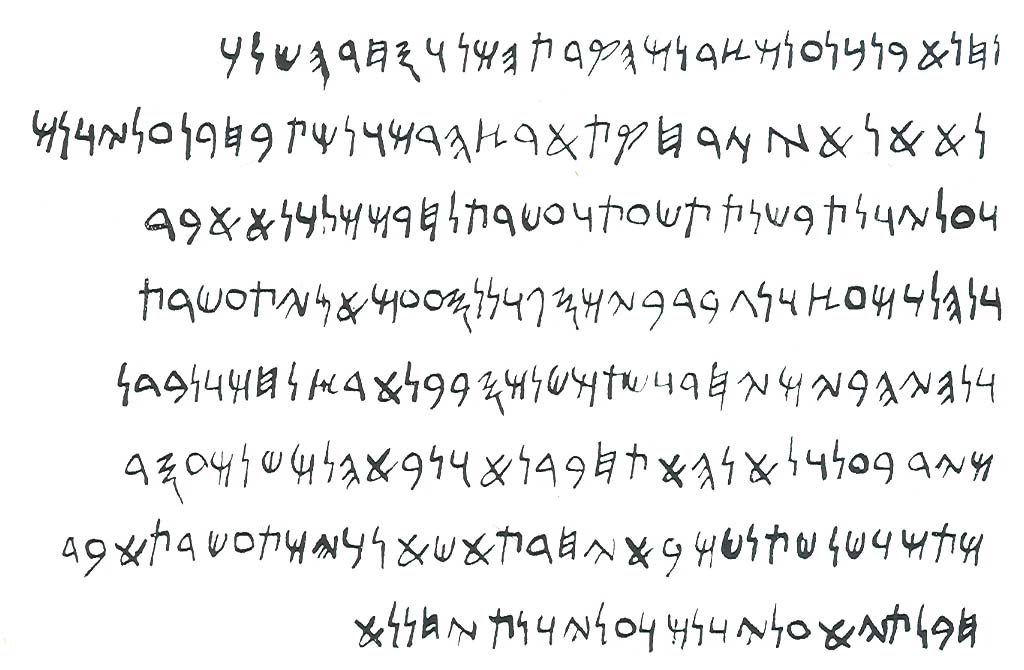
In 1874 (C.E.) a mysterious ghost of an artifact from Brazil was announced. In a story full of twists and turns and multiple Spanish surnames, a director of the National Museum of Rio de Janeiro had received a copy of a Phoenician inscription allegedly found in Brazil. Efforts to trace the letter to its source and to find the actual artifact both ended unsuccessfully, leading the director, Ladislau de Souza Mello Neto, to conclude the letter was a hoax and the artifact non-extant. The story might have ended there had not Cyrus Gordon, one of the premier Semiticists of the last century, allowed his open mind to reexamine the evidence. Gordon, in an article in 1968, argued that the inscription had to be authentic because of advances made in the understanding of Phoenician that would have been unavailable in the 1870’s. Gordon’s interpretation was in turn challenged by Frank Moore Cross, noted Harvard epigraphist, and scholarship heaved a collective sigh of relief and returned to the status quo. No Phoenicians ever crossed the Atlantic.

Neto's un-copy of the un-inscription

This little incident highlights one of the persistent conundrums of academic life. Anomalous objects are found/reported every once in a while and mainstream academia immediately debunks them to come back to center. A student of Hinduism asked me recently about the correlation of ancient calendars; before British colonialism hit India artifacts were dated to much earlier periods. Under the influence of Britain Dravidian culture grew younger and the background to European culture was considered more ancient, more time-honored. Those with investment in the system do not like to have privileged positions challenged.

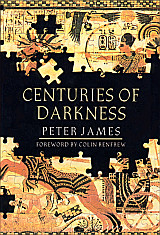
While a post-graduate student at Edinburgh, my advisor had me read Peter James’ Centuries of Darkness, a study that challenged the accepted chronology of the ancient world. Intrigued, we set up a seminar with representatives from the Archaeology Department to discuss whether this was a feasible approach to the many problem areas of ancient chronology. The archaeologists duly trooped in, set up their weapons and took pot-shots at the book, blowing multiple ugly holes in its arguments. After about an hour, when the archaeologists were unable to answer a very specific question by my advisor, he asked, “How many of you have read the book?” Sheepishly, not a hand was raised. The premise of the book was sufficient for its well-deserved snubbing. I learned a valuable lesson about academia that day — open minds lead to trouble. It is a lesson that demonstrates a very basic insecurity of those who do not wish to have their assumptions challenged.