
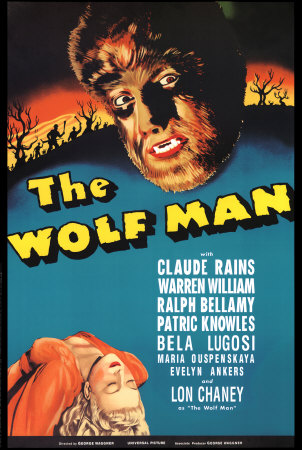
Last week my colleague James of Idle Musings sent me a review of Stephen Asma’s On Monsters that I’ve been meaning to incorporate into a post for several days now. Since New Jersey has been buried under more snow than it’s seen since the last Ice Age, I’ve been busy shoveling and navigating icy roads to class and only now am finding the time to respond. (Still, I have to say that the snow we have here now is no comparison to good old lake-effect snow where I grew up. Of course, the population back home was much smaller so the media never made a circus of it. After all, it is just winter!) In today’s paper, however, there was a review of The Wolfman that graciously affords me another opportunity to address one of my favorite, if under-represented, areas of religious studies: the monster.
Local film critics haven’t exactly panned the remake of the 1941 classic, although it is noted that the new version tries to avoid the essential subtexts of “alpha-male dominance, sexual repression, compulsive behavior and father-son feuds” (from Stephen Whitty’s Star Ledger review; Whitty also notes, on the cheerful side, that Universal is trying to revive its monster franchise). The werewolf has always been my favorite monster character. Aside from the negative aspects noted by Whitty, the werewolf also represents transformation from the helpless, lost, and confused Lawrence Talbot to a purposeful, confident, and unambiguous wolfman. The werewolf is everyman/everywoman pressed to the limits by a demeaning, heartless society until individualism breaks out in all its savagery and power.
Apart from the religious elements in all monsters (is the werewolf not a paragon of spiritual transformation?), a political subtext also emerges. While the front page declares the financial woes of the state and the continued trouble trying to pass any healthcare reform, page 3 declares “Top 5 health insurers post soaring profits.” One person’s cancer is another insurer’s boondoggle. Meanwhile the Larry Talbots of the world are being told, “give a little more – everyone’s got to share this burden.” Eventually, however, there will be a full moon and transformations will take place. As a student of religions, I can recognize the werewolf as more than a monster and as containing far more symbolism than a Robert Langdon could ever untangle.
Who's not afraid to look in the mirror?

 Steve A. Wiggins