Utopia

In a rare moment of free time I stumbled across the website of Damanhur, a planned eco-society physically located in Italy but with branches in other (mostly European) nations. The Federation of Damanhur is dedicated to the spiritual, artistic and social development of humankind. It is probably most famous for the hand-carved temples deep within a mountainous location in northern Italy. The Temples of Humankind are, from web pictures anyway, quite stunning, often earning the hackneyed accolade of the “eighth wonder of the world.” The temples are dedicated to Gaia, the earth, and humanity (often, unfortunately, its greatest enemy). The Temples contain a hall of waters, hall of earth, hall of mirrors, hall of metals, hall of spheres, a labyrinth, and the Blue Temple. Begun in 1978 as the vision of Oberto Airaudi, a tunnel was excavated and the temples were carved from the rock. A moving account of how government officials, determined to shut down this clandestine operation only to emerge from the temples emphatically stating that they must be preserved, came to the aid of the Damanhurians is presented on their website.

Like other utopian movements, the Damanhur society seeks a better world. Their vision of a planet in sync with rather than warred upon by humans is compelling. Their achievements are admirable. Still, it remains a sad commentary on the world that greed and capitalism have constructed. Every day self-satisfied faces of wealthy politicians glare out from the newspaper or Internet declaring that they know a better way. The evidence of our world belies their claims. Damanhur and other similar societies only thrive when they are small. Once paradise opens its doors, entrepreneurs enter.

The religion of Damanhur is far from orthodox. It is, however, peaceful and sensitive to the connection that binds all of earth’s inhabitants together. The society promotes education – a simple commitment that seems beyond the will or ability of many state governments in this wealthy, fully industrialized and technologized society. I wish the Damanhurians well. They have constructed a beautiful world for themselves. If they fare better than most utopian societies, perhaps they can continue to be a light for a world that sees only veins of potential bankable wealth inside mountains.

Temples of Humankind



Seeing God

My daughter reminded me that one further aspect that stood out at the Red Mill Museum in Clinton was the persistence of pareidolia. Pareidolia, or matrixing, is the tendency to interpret “random” data as meaningful. More specifically, it is often used to refer to seeing a person (or entity) where it is not. As I wrote in an earlier entry, it has been suggested that pareidolia is the ultimate origin of religion.

For my purposes here, however, I wonder if the sheer amount of false faces we encountered while at the Red Mill might have some connection with the idea that the property is haunted. Somewhat of a skeptic, I am somewhat swayed by ghost accounts since they are so plentiful and since many of those who report them are reputable persons with good observation skills. Ghosts are, however, impossible to separate from some form of religious thought since they are the ultimate examples of the intangible, unmeasurable phenomenon. If there are ghosts in the laboratory, they haven’t been quantified yet.

Old buildings, which abound at sites like the Red Mill, are full of knotholes or other apertures whose original hardware has long since disappeared. Round holes, or spots, as many insects and fish “know” are easily interpreted as eyes. Add a horizontal line beneath your “eyes” and you have a basic face.

Perhaps my favorite example of pareidolia at Red Mill is an old sycamore tree. A large burl on the trunk bears a striking resemblance to a human profile. This is more easily seen in real life where the mind more easily filters out the distracting coloration and focuses on the shape. Since pareidolia is such a fascinating aspect of the human experience of the world, and since it might, conveniently, be tied to religion, this seemed to be as appropriate a venue as any other to share some great examples.


Bibles and Freedom

Visiting the Red Mill in Clinton, New Jersey is always a worthwhile experience. Yesterday, a gloomy, gray September postcard, was perfect for such a visit. In addition to the many buildings on the museum grounds that retain an atmospheric feel year-round, the Mill is supposedly haunted and is frequented by a number of ghost hunting teams. With its long (for America) history and its picturesque beauty, the museum is a popular spot with tourists as well as ghost hunters.

One of the buildings on the grounds is an old one-room schoolhouse. As a family we have visited a number of these, although none of us qualify as having been actual pupils at one. A frequent blandishment at such institutions is the rules by which school teachers had to live in the nineteenth century, usually posted on the wall. Yesterday as we read the obligatory list, one “commandment” stuck out from the 1872 code of conduct: “After ten hours in school, the teachers may spend the remaining time reading the Bible or any other good books.” While many of the rules were condescending in their moralizations, this one carried a perfect example of how a nation, naively short-sighted, was already giving preferential treatment to one religion, Protestant Christianity.

As a nation founded as a haven for religious freedom, the colonists and settlers simply had narrow exposure to religions of the world. Freedom seemed an ideal worth dying for, but usually it meant freedom to be whatever (Protestant) denomination you wished to be. Catholicism was associated with the old powers of Europe, and the religions of the east were barely known. The Protestants were the ones who promoted Bible reading in those days, and while the rules allowed for other good books, there is an unstated superiority given to the Good Book in its pride of place. Once the colonials became nationals, it was still fair to taunt Quakers, Unitarians, and others who didn’t seem to fit the mold. We didn’t see any ghosts at the Red Mill yesterday, but it did seem that a haunting memory of true religious liberty hung about the place.

Clinton's Red Mill sews freedom


Chosen Ones

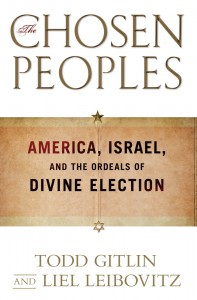
Religious dominance has been so much in the news lately that when my wife pointed out the review of Todd Gitlin and Liel Leibovitz’s The Chosen Peoples in today’s paper my mind once again fastened on the issue. I have not read the book; today’s review is the first I’ve heard of it. The salient point, however, is the continued evidence that monotheism is a tremendous burden on society. Most rationally considered analyses of western religious traditions recognize that the same “base God” is recognized in Judaism, Christianity, and Islam. These three religions are so deeply intertwined in their influences and theological commitments to the singularity of God that such a convergence is inevitable. Nevertheless, three religions sharing a God is like three children sharing a lollipop. Each wants to claim exclusive ownership.

The issue becomes more complex when ethnic identity is tied to religion. Given the nature of religions, this is, however, another inevitability. Religious thought and practice develop among populations separated, in Darwinian fashion, and those who lived in the original arenas of religious development were probably closely related. This is evident in the easy blending of Judaism as a culture and a religion, as well as ethic Orthodox Christianities that maintain a strong cultural component, and in Middle Eastern descent and Islam. People accept the religion of their own people. Monotheism then takes over with the demands of exclusive rights to chosenness or theological correctness. Religion itself contributes to its own fractionalization.

Those who are excluded protest: who wants to be left out of the chosen ones? If there is one God, who wishes to be the second or third or fourth favorite? If we (whoever “we” may be) are those legitimately chosen, are we not in some measure better than other believers? This logical crux slices through all theological niceties for those who examine the issue honestly. Many religions and one God. Chosen people abound. Perhaps it would be less dangerous if God could be divided among the many: one God, divisible, and available to all.


Athtar in Wonderland

Last night I finally got around to seeing Alice in Wonderland, the Tim Burton version. As a child I don’t recall having seen the overly optimistic Disney original, and I only read Lewis Carroll’s two-part, disturbing original after I had finished my undergraduate degree. When I first discovered Wonderland I was in one of my periodic phases of questioning reality and Carroll’s provocative prose and ingenious lyric ability only made the inquiry more complex. Strangely, it felt as if I had rediscovered a missing piece of my own childhood.

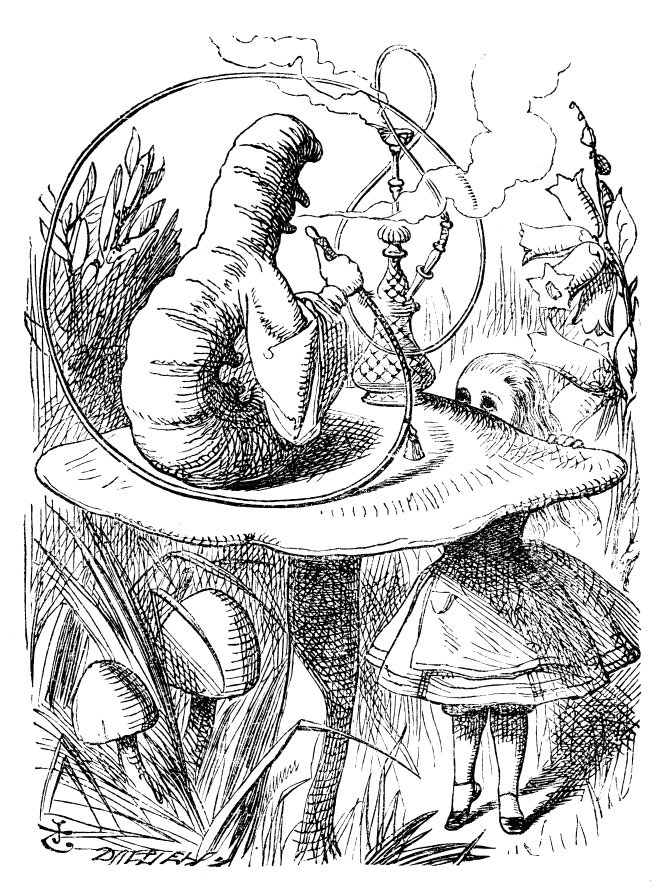
Burton’s versions of childhood stories would likely have been my preferred fare had they been available when I was young. Eerie without the overt horror of an R rating, the vision is one of a world where uncertainty reigns supreme. Then came the hookah-smoking caterpillar. It has been a few years since I’ve read the book, but I don’t recall the larval character as having a name. Linda Woolverton, the screenwriter, presumably gave him the name Absalom. Supposing this to be nothing more than the reassignment of a fated biblical name associated with failed attempts at kingship, I simply let the reference pass. Until the chrysalis scene. There he was, Absalom hanging from a plant, just like David’s son swayed from a tree according to 2 Samuel. This mysterious scene in the battle of Ephraim Forest had captured my attention before when I wrote an article on Absalom, eventually published in the Journal of Northwest Semitic Languages.

Noticing the strange phrase that Absalom was suspended between heaven and earth, I suspected that this might be a reflex of the ancient morning star (Venus) myth. The story of Athtar, the god who would be king but who must decline the throne, is a brief tale preserved in the Ugaritic Baal Cycle. As I watched the sage caterpillar giving wise advice to a confused Alice, the name Absalom took on new significance for me. I have no way of knowing if the reference was intentional or not, but in a culture deeply suffused by the Bible it would appear to be a logical guess. And if I was correct in my article, I was seeing a cinematographic reference to Athtar as a blue caterpillar last night. Wonderland indeed.

Curiouser and curiouser


Mere Typography

Juxtapositions are important. The way that words are laid out on a page can say as much as the words themselves, as any poet knows. In the light of the ongoing media frenzy over Rev. Terry Jones’ misguided attempt to set everything right with the world – through fire – and a natural attempt to keep related stories together, the New Jersey Star-Ledger ran two stories on page three yesterday that display the deep ambivalence many Americans feel about Islamic culture. At the top of the page the headline reads, “In Florida pastor’s eyes, burning of Quran is an act of war against evil.” At the bottom of the same page runs an article headlined, “Iran: Stoning sentence for adultery under review.” Two or more faces of Islamophobia on the same page.

As remarks made on my previous post on the subject attest, many westerners simply do not understand Islam. This is perhaps to be blamed on the all-too-prevalent attitude that “history is boring.” Have people been asleep for the past thirteen centuries? Islam is much closer in time to the origin of Christianity than it is to us. With concerns of supersessionism and the covert desire to capitalize on one’s religion, Christianity has been content to ignore Islam as long as those in charge have been able to maintain capitalist quo. When forced to face the fact that two major monotheistic religions have designs on the same world, some members of each camp are only too ready to declare those in the other “evil.” An attempt to understand other religions would go a long way toward ending the carnage.

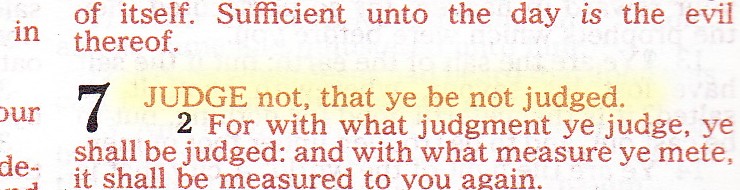
Perhaps the phobia should more properly be labeled religious xenophobia. We dislike those different from us. Rare is the person who, when confronted with a contrarian, will attempt to understand rather than destroy. Students may readily qualify for higher education degrees without ever having to face the question of how to handle different religious outlooks. We would rather pretend that they are not there. The ambivalence shown towards the issues of Islam in the Star-Ledger could just as easily be turned on Christianity, or even Judaism, Hinduism, Buddhism, or Sikhism. Religions are conflicted because people are conflicted. Instead of recriminating, we should all take a long, serious pause in front of a mirror before we start accusing other religions of being evil.

Who said what now?


Disconnect

Religion has a bad name among many intellectuals. Hailing from the misty period of superstition in a “demon haunted world,” religion seems to be a quaint hold-over from less enlightened times. Academics, for whom respectability is everything, generally keep a decorous distance from religion as the intellectually suspect field indulged in by the weak-minded. Then something enormous happens; terrorists, fueled by religious fervor, decide to kill many innocent victims. Or a religious guru leads followers into the jungle where they all commit ritual suicide. Or a group of zealots purchase heavy armaments and stockpile them in a Texas hideout to await the Second Coming. The next autumn the university want ads are filled with openings for specialists in this or that religion. Until the next budget crunch comes along.

An unfortunate aspect of this situation is that many deans and administrators make the equation of the study of religion with the promotion of a religion. Why populate a university faculty with superstitious religious sorts when a good secular economist will bring in more practical, if less transcendent, rewards? How often do administrators survey their religious studies faculty to ensure that level-headed, academic treatment of the subject matter is offered? How can we expect to move ahead if those empowered to assure an educated student clientele continually apply the brakes in religious studies departments?

I am no economist. This much is evident by my pay scale. Nevertheless, each year when I return to the multiple campuses that are my temporary homes, I notice the details. New furniture in classrooms and libraries, freshly painted and redecorated facilities. Often, entirely new buildings that were not there the semester before. There was a day when such things were known as window-dressing. I attended Edinburgh University for my doctorate. There were campus buildings that dated from the late middle ages. Classrooms often had mismatched furniture and blackboards rather than fancy projectors and smart-ports. And the educational experience was authentic. The religion faculty was thriving and universally well regarded. I’m no economist, but with fundamentalists already holding a match to the fuse about to light up a Quran, I have a feeling already of what I’ll be seeing in the want ads of next year’s university hiring season.


Quran 451?

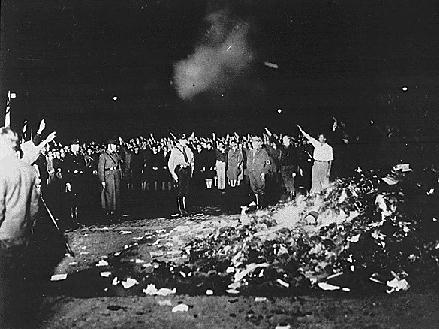
One of the saddest books I remember is Ray Bradbury’s Fahrenheit 451. Any society that burns books has whip-lashed far beyond Fascism into the enemyhood of humanity. Much of ancient culture has been lost through the natural or premeditated destruction of misunderstood “inflammatory” writings and we are much the poorer for it today.

According to an Associated Press story, the ironically named Rev. Terry Jones of the even more ironically named Dove World Outreach Center in Gainesville, Florida, is agitating for a “burn the Quran” day on September 11. Other than momentary, self-righteous catharsis, nothing is to be gained by burning books. The contradictory impulses here lie thick and deep: a Christian clergyman feels insulted by an extremist attack that killed indiscriminately (Muslims and well as Christians, Jews, and Atheists died in the September 11 attacks), bearing the symbol of peace he wishes to declare his personal war, and the follower of the willing victim of Nazareth wears a gun.

Burning books does not solve any problems. Surely Rev. Jones knows that plenty of copies of the Quran abound throughout the world. His action is calculated as a poignant symbol. Is such a symbol anything more than a base expression of outright hatred? When, apart from medieval Christendom, has Christianity insisted that violence is the way forward? All you need is hate? For although the burning of books may not physically harm anyone, the violence in this hatefully symbolic act is the very antithesis of tolerance and understanding that the religious world so desperately needs. Islam has given much to world culture, and we reap the benefits of Muslim scholars and thinkers each day, without any conscious consideration. Rev. Jones needs to read more than just Fahrenheit 451. He must learn truly to read and, like Montag, weep.

Jones' theological comrades


Inception of Theseus

Never the first for new cultural memes, but often among the last, I finally took my family to see Inception over the holiday weekend. The Internet has been buzzing with comments about the movie for the last couple months, so it was difficult not to have preconceived notions of what to expect. Nevertheless, I found the film utterly engrossing. At one point I realized that I hadn’t blinked in so long that my eyes had begun to dry out. Having just finished Mark Danielewski’s House of Leaves at the end of June, and having begun my Mythology class on Friday, the Theseus myth has been on my mind anyway. Inception takes the hero’s journey through the labyrinth of the subconscious.

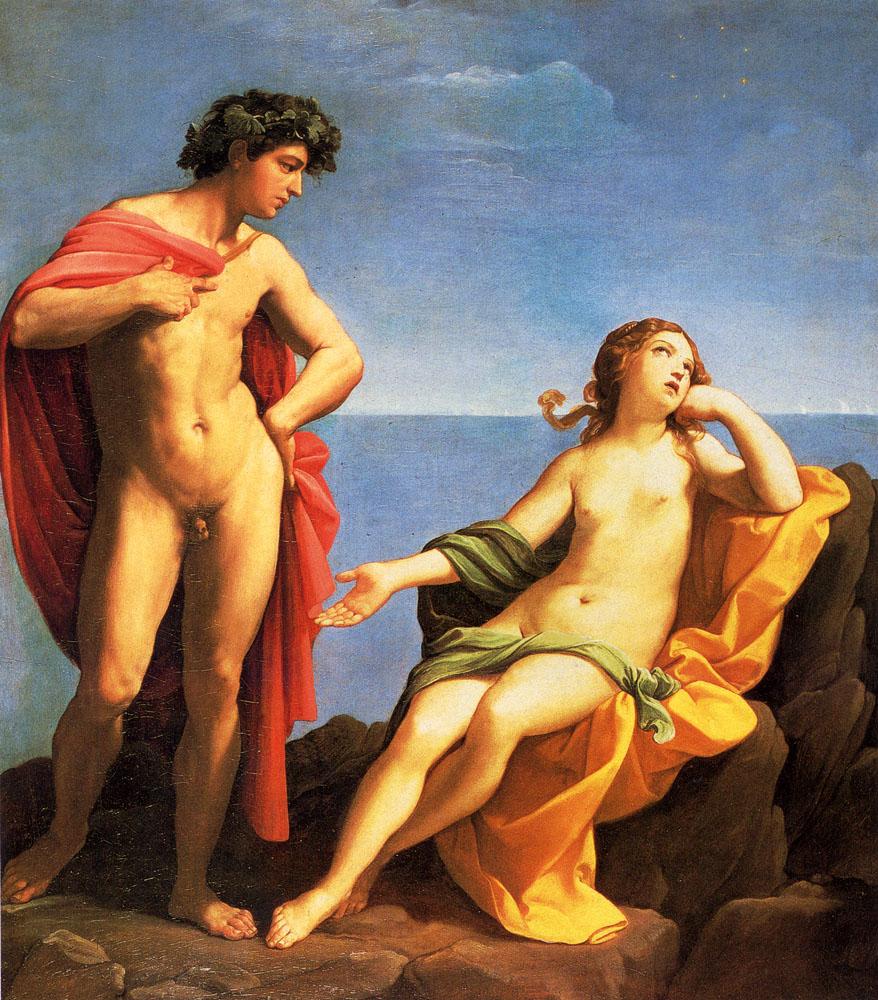
The first hint that Inception was the Theseus story, for me, was the introduction of Ariadne. The daughter of King Minos, Ariadne informs Theseus how to escape the labyrinth, and her first task in Inception is to draw a maze that takes a minute or longer to solve. Dom Cobb, like Theseus, is a deeply flawed hero. Part Theseus, part Daedalus, Cobb has trapped an unlikely Minotaur in the form of Mal, his wife, deep in his subconscious mind. She stalks him in his unsavory work, and when she threatens his very concept of reality, she is slain by Ariadne.

Coupled with classical mythology, the film also raises the unresolved question of the nature of reality. Is conscious existence any more real than the subconscious? This theme was explored in David Cronenberg’s eXistenZ back in 1999 with a similar ending that refuses to answer the question. Both films raise the troubling interference of technology with the most secret of human psychological repositories, the uninhibited subconscious. The closer the Internet comes to a global intelligence, the more the individual mind recoils into its own obscure and unexplored territory. Despite Freud and his disciples, we have not yet even begun to understand our own subconscious minds. Movies like Inception draw on classical sources to help us deal with the Minotaur that surely lurks there.

Ariadne explains her dream to Bacchus


Happy Labors

Labor Day Parade

Just as Memorial Day has become the unofficial start of summer, Labor Day has become its unofficial end. Unlike holidays that commemorate an event, Labor Day was a planned holiday dating from the 1880s. To get a sense for this, think about the past. Just try to imagine yourself as a worker in the 1880s. There were long hours, a workday did not go from 9 to 5, there were no regular vacations, no protection from injury on the job, often hard labor. This was daily life for many people since the Industrial Revolution began. Labor Unions were the result of exploited (overworked and underpaid) workers banding together. If one guy quits, work goes on. If everyone quits, somebody’s got to listen! So groups of workers formed unions to get organized and to begin to bargain for more appropriate working conditions.

Credit for Labor Day goes to either Peter McGuire or Matthew Maquire. Both men were laborers associated with unions: McGuire with the American Federation of Labor (AFL) and Maquire with the Central Labor Union (CLU). Whoever actually first suggested it, Maguire’s CLU was behind the first Labor Day in 1882.

It may seem hard to imagine now, what with all the free time people have to sit in front of the computer or television, that there was a time when a day off work could become a national holiday. But on September 5, 1882, the Central Labor Union held its holiday in New York City – the home of many unions. Less than 10 years later, in 1894, President Grover Cleveland signed in the first Monday in September as a legal holiday. Public support ran high for Labor Day, but some favored a May 1 celebration.

As an observance, Labor Day was simply for the enjoyment of a day off. The holiday has a special poignancy given the persistence of unemployment over the past several years. Although Labor Day has no religious basis, the fact is that many of us have been taught that our self-worth lies in our work, our contribution to the good of the whole. For those of us who have been forced into stints of unemployment, Labor Day seems less a holiday than a reminder of what we lack. Have we evolved a society that has outlived the need for a Labor Day?


Delicate Matters of Faith

Friday’s New Jersey Star-Ledger ran an op-ed piece by Phyllis Zagano entitled “Teaching how, not what, to think.” The essay concerns a tale of two professors, one at the University of Illinois and one at Seton Hall. Both have come under fire for teaching on the issue of gay marriage, one from, one against, a Catholic viewpoint. Zagano’s point of view, evident from her title, is that professors should teach students how to think, but not what to think.

This is one of the most difficult aspects of teaching religious studies. I am in my eighteenth year of teaching in the field. In that time I have taught at both religious and secular schools and, in both settings, presented the material objectively. There are those in both settings who complain. Students at Nashotah House frequently wanted me to bend the Bible to fit conservative Anglo-Catholic teaching. Under immense logical pressure to accept what reason told them of the world, they wanted an authoritative book to back them up in a pre-decided outlook. A theological ace of spades to trump the uncomfortable conclusions of rationality. At the University of Wisconsin Oshkosh and at Rutgers University students frequently want to know my religious outlook so that they might know how to categorize what they are learning: is it sanctioned or is it anathematized? We need to know who you are so we can evaluate your authority in such delicate matters as faith.

I frequently ponder the issues raised by Zagano. I know of no other field of study where the stakes are so high, with the possible exception of political science. Religion is an all-encompassing phenomenon. All of life must conform to religious teaching, often with eternal consequences. It therefore makes an enormous difference what you are being taught. Like Zagano, I try to teach students to think for themselves. Both at the seminary and university I refused to reveal my personal outlook on the issues; I try to kick-start the thinking process. I have paid the price for this in the past, but it is a non-negotiable component of education. If the truth is uncomfortable, it is always possible to let someone else do the thinking for you.


Talking Past Each Other

My first two sections of Mythology class met yesterday, and my post on Stephen Hawking was still fresh in my mind. As predictable as clockwork, religious leaders have begun to respond the Hawking’s new book, not yet released. Theodicy in overdrive.

I am not qualified to assess Hawking’s scientific findings. As much as I daydream about having followed my childhood ambition to be a scientist, I find myself in religionist garb teaching university courses among the humanities. What is ironic is that theologians feel that they have to answer Hawking’s conclusions. An article on CNN has the rebuffs of a number of British clerics, including the Archbishop of Canterbury. The main thrust of their comments is that the God Hawking dismisses had already left the theological classroom (the God-of-the-gaps) while the God the major monotheistic religions serve is less of an explanation of the universe and more of a method of determining what it means. So, I guess, this God of meaning may or may not have created the universe, but let God be God and mathematics and physics be damned.

Unless the theologians are better trained than most, the intricacies of M-theory are far too complex to be understood by workaday religious practitioners. The theory is backed by mathematical formulas that are far more frightening than Tiamat, Ahriman, and Azazel bunched up in a cosmic tag-team match against the nice world theologians have created. For my part, I am happy to let the physicists deal with the numbers and symbol systems while I sit by trying to explain what mythology really is to my undergraduate audiences.

Who's looking down today? Uncle Earl?


God of the Gaps = Poof!

In Stephen Hawking’s new book, The Grand Design, according to MSNBC, he declares that God is not necessary, physically speaking, to get the universe going. The only people who should be surprised here are those who took Hawking’s final lines from A Brief History of Time too literally: “However, if we do discover a complete theory, it should in time be understandable in broad principle by everyone, not just a few scientists. Then we shall all, philosophers, scientists, and just ordinary people, be able to take part in the discussion of the question of why it is that we and the universe exist. If we find the answer to that, it would be the ultimate triumph of human reason – for then we would know the mind of God.” I remember being a bit surprised when I read that the first time.

Whose eyes are watching you?

At some level, it seems, many people took comfort in knowing that one of the greatest scientific minds alive had left a door open for God. The great cosmologist looking through a theoretical telescope and seeing God on the other end looking back. There was a symmetry here, a sense of rightness. Some, to gauge by the reactions reported, feel that Dr. Hawking has betrayed us in stating the obvious. God was never to be found in the petri dish or under the electron microscope. According to the theorists of a theological stripe, God has no quantifiable qualities that might be measured. As the article states, the only God to disappear here was the God-of-the-gaps.

As a young, undergraduate religion major, when I first heard that God-of-the-gaps was bad philosophy/theology, I was a bit surprised. (I spend a lot of time being surprised.) If God has no explanatory value in the real world, whence deity at all? If religious folks behaved better, there might well be cause to suggest that the evidence for God comes in human kindness and charity. Unfortunately, religious folk quite often instigate the hatred and suffering that scars much of human society. No, Stephen Hawking has not killed God, just as Friedrich Nietzsche did not commit deicide in the nineteenth century. If the God-of-the-gaps is gone, nothing of value has been lost. The minds of theological thinkers will only have to be stretched just a bit farther.


Bible, Bible, Who’s Got the Bible?

Rutgers University boasts a truly diverse population. In my fourth year as an adjunct in the Religion Department at the New Brunswick campus, I am continually reminded of the religious and cultural mix of the human race. As I began my twelfth section of Introduction to the Hebrew Bible last night, it occurred to me just how tight a grip Christian-based publishers have on the Bible. I generally spend my first class session on defining the Bible since many students enter such a course (and it is always full) with notions of what the Bible is. In fact, “the Bible” is a difficult document to define.

Binding a book together indicates that what is between the covers belongs together. This is almost a subconscious fact that we pretty much take for granted. If a publisher put all of this in the same place, it must belong together. For the general consumer market, that translates into Bibles that contain the Hebrew Scriptures and the Christian Scriptures. This mix of 66 books satisfies most customers in the United States and Canada, but the Catholic reader expects some 13 additional or expanded books in her or his Bible. Jewish customers expect somewhat less, with 27 books normally in “the Bible” being specifically placed there by a later, revisionist sect. Orthodox Christian Bibles may add or leave out a book or two, depending on the tradition.

The irony of this situation strikes me as we have Bible-thumpers constantly appearing in the news. Their well worn, black leather King James Versions are “the Bible.” For them. Their message to the American public: we must get our lives back in line according to (my interpretation of) this book. What of those in this country who have fewer or more books in their Bibles, or, Yahweh forbid, completely different scriptures? Is there no room in a nation of religious liberty for them? I have a modest proposal. For the politicians who want their Bible to drive our society, stop by my class at Rutgers sometime. I am always glad to see the diversity. And it shouldn’t be too hard to find a section to fit in your schedule – I teach four sections of the class throughout the year, including summer and winter terms.


Natufia to Say

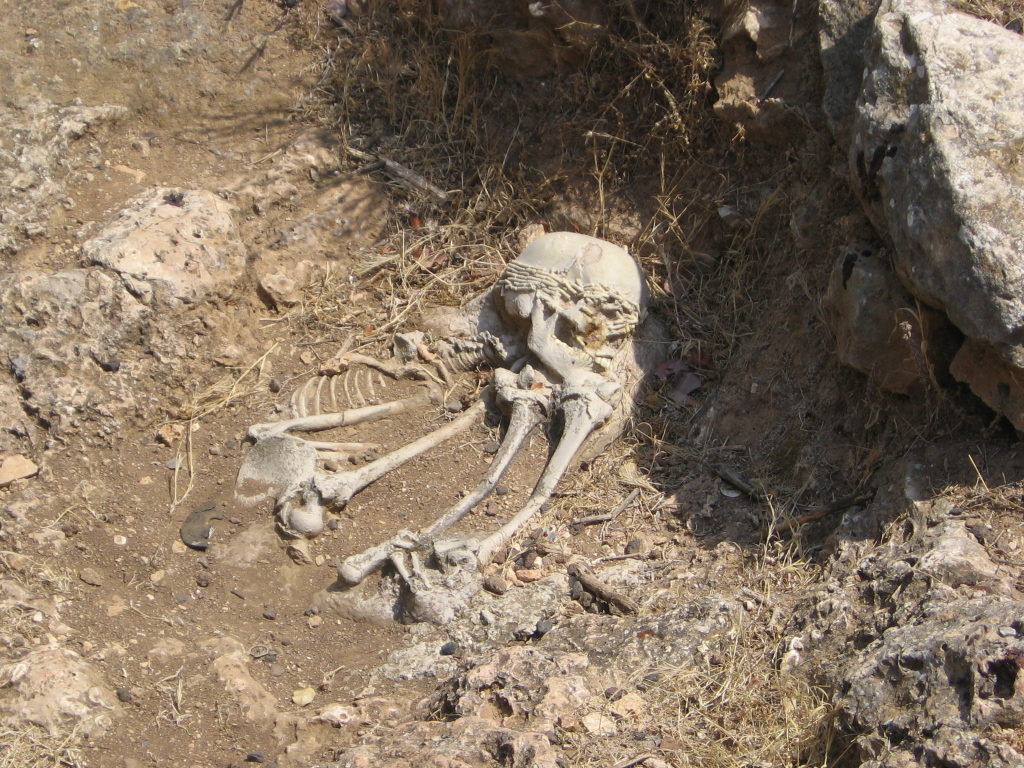
The Natufian culture predated the Israelites by millennia. They were gone by at least 7000 years by the time Israel appeared. The Natufians seem to have been the first permanent residents of a hotly disputed piece of real estate: Israel/Palestine. On Monday MSNBC reported on the archaeological find of a feasting hall among the Natufians. The story reminded my wife of similar stone-age sites that we visited in the Orkney Islands several years ago. What the story reminded me of, however, was the marzeah. The Natufian site features two activities: feasting and burial. The article notes the coincidence of 28 human burials, including one shaman, and the unmistakable signs of feasting. Bring them together and its sounds like marzeah time to me!

Natufian burial, from Wikipedia Commons

The marzeah is an imperfectly understood social institution from the ancient Levant. It is mentioned in the Bible as well as in the Ugaritic texts. Although plausibly reconstructed by modern theorists, we simply do not have a complete record of what the marzeah entailed. Two of the key elements seem to have been feasting and a funerary nature. Monotheistic religions tend to downplay the role of the dead as influential entities since they interfere with a monistic view of the divine. The two Hebrew Bible references (Amos 6.7 and Jeremiah 16.5) do not speak highly of the practice. The Ugaritic material suggests drinking may have been involved as well, further problematizing the ritual.

Now here is where the ambiguity of archaeology is thrown into sharp relief. The fact is we do not know what the Natufians were doing when they buried or feasted at this site. The Hilazon Tachtit Cave does not seem to have been a regular occupation site, and we do not have any reason to connect the burials with the feasting. Beyond a hunch. The hunch is the incredible urge to bring like things together. People excel at pattern-recognition. When I read of funerals and feasting my mind leapt to the marzeah. There seems to be no organic connection between the Natufians and Israelites (or Ugaritians), but the continuity of cultural concepts seems to strong to dismiss. Were ancient people toasting their dead with feasts that were remembered down into the Late Bronze and Iron Ages?