White Christmas Revisited

In the light of yesterday’s post, I’d like to tip my metaphorical hat to Brian Regal of Kean University for a piece he wrote in the New Jersey Star-Ledger. Entitled “The Real Meaning of Christmas,” Regal’s piece shows the striking disconnect that comes between the image of a “Christian” Christmas and the oft-ignored words of Jesus that make him such a great example to follow. We want the image and the affidavit without having to do the hard work of loving those we don’t like. This really seems to be the heart of what was once know as gospel—it’s okay to be who you are (for those of that bent, “who God made you.”) Too often “Christian” has come to mean someone who wears their hair far shorter than Jesus, who shuns those welcomed by Jesus, and who smile far more than Jesus. My Bible says “Jesus wept.” I don’t recall any verses reading, “Jesus put on his ‘I love you’ smile.” Ours is a society that wants it both ways—all for me, but isn’t that what Jesus really wanted? You know, he must’ve smiled a lot.

Regal rightly points out that the majority of Christmas traditions are admittedly pagan, and we are glad to baptize them as long as we don’t have to let the homeless into our churches or admit equal rights to those of all genders, races, and orientations. What seems to be the real desideratum is a “white” Christmas. A white, affluent Christmas. The very idea of the ownership of a holiday characterized by giving is a phenomenon worth serious study. Religion can certainly be used to justify such self-centeredness, but it is condemned by that very same faith. What are people worried about? Christmas has been a commercial holiday essentially from its origins in the modern period. It is one of the few holidays to which nearly everyone looks forward, at least for a break from work or school, if not for a windfall of new stuff.

Privilege as blessing is a perverse theology, as is shown repeatedly in the Bible. Israel’s long line of descent is chosen from the least, the youngest, the meek. Now we are constantly told that God rewards those who are blessed, and that the poor and underprivileged have only themselves to blame. At Christmas time it may be worse than many other seasons of the year. We want not only to keep good cheer, we want to keep a holiday only partially of our own making for ourselves, and then congratulate ourselves on just how good we are. It would seem that the spirit of Christmas might lie, as the pagans said, in giving. I am not a fan of commercialism, as my regular readers know. I can’t help but think that believing one deserves special rewards for righteousness in their own eyes will only have the opposite effect. Remember: he sees you when you’re sleeping, he knows when you’re awake…
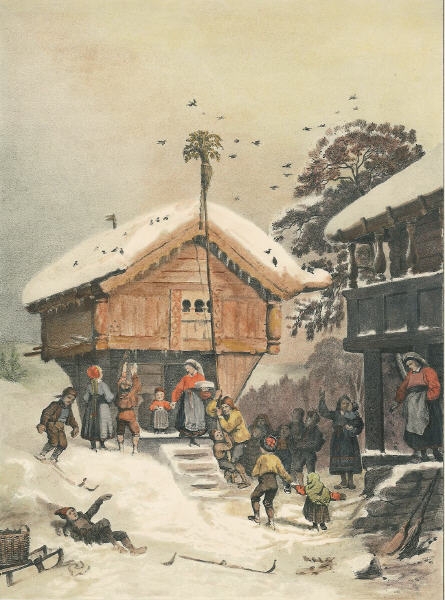
Adolph_Tidemand_Norsk_juleskik


Won’t Someone Think of the Gods?

The annual holiday tradition of fighting over peace on earth has begun. It’s difficult to attribute blame since the “Keep Christ in Christmas” crowd do have a certain historical parsimony about them. Still, it was with tongue frozen in cheek that the Freedom From Religion Foundation put up a billboard in Pitman, New Jersey, with the message “Keep Saturn in Saturnalia.” Won’t someone think of the gods? In just the short span of my lifetime (well, half-a-century is really not that long) many assumptions about American religiosity have come to be questioned. There are those who seriously believe the Greco-Roman gods exist and they do have a right not to have their religion belittled. Those who find all religions laughable, I suppose, have the right to belittle. Some are devoted to Saturn. Others take seriously the Norse gods. Belief is like that—rationality is not a huge part of it.

Megyn Kelly, an anchor on Fox News, boldly declared this past week that Santa is, by dint of historical fact, white. I suspect she wasn’t thinking of Nicholas of Myra, but rather the jolly (white) man with glandular problems and the magical ability to visit every house in the world in a single night. The historical Saint Nicholas was born in Turkey. Kelly also made an unequivocal claim for Jesus’ whiteness, although he was clearly Semitic and historical records about him are extremely dicey. Conservatism, it seems, can only be pushed so far. I tend to think the problem is with making people into gods. Once a person becomes divine, in a monotheistic system—apart from all the theological casuistry than ensues—the nature of godhood is irrevocably associated with one race only. Of course Kelly, and many Fox News fans, have co-opted Christ from Judaism and suppose he was rather Nordic, as an article on CNN’s Belief Blog notes. Kind of like Thor, for what carpenter doesn’t know how to use a hammer?

To keep (white) Christ in (white) Christmas does betray a lack of familiarity with the Christmas story. Apart from angels appearing to some shepherds, the event was obscure—in the part of town across the tracks. Even the wisest men in the world had to stop and ask directions because they couldn’t find the place. The first Christmas, in as far as we can reconstruct it, was a silent affair with only the sounds of birth and the quiet desperation of a working class family far from home. No malls stayed open late that night.

The solstice is literally the darkest day of the year, the time when the slow return to light begins its weary trek over the next six months. We think of the cold, the dark, and hope for peace. No matter the holiday tradition, you’d think that peace would be one thing we could all agree upon. But gods are jealous beings, and, technically, they belong to no human race at all.

O holy night?

O holy night?


Not Knowing

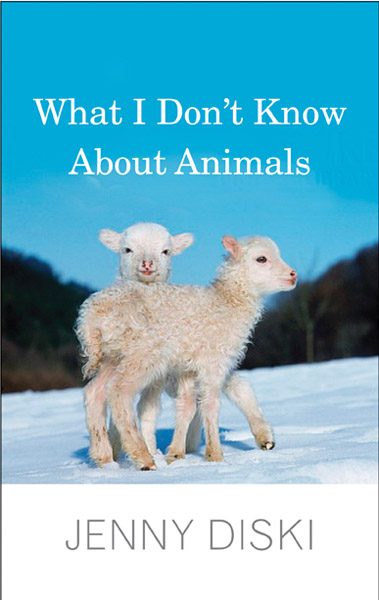
WhatIDontKnowAboutAnimalsBegin with a basic premise: we cannot know what a creature without language thinks. Add in the thoughtful anxieties of a post-domestic writer who knows about animals and you have What I Don’t Know About Animals, by Jenny Diski. Part biography, part science, part philosophy, wholly human. I knew from the day the book was released that I would read it since, like the author, I am one haunted by the relationship between the exploited and the exploiter. Diski’s confessions are difficult to read at times, veiling herself, as she does behind the curtains of one’s most private experiences, but she reveals plenty to those who read on. We can’t know for certain what another person thinks, so how can we know what a sentient animal thinks? Some, following Descartes and Skinner, would declare that animals don’t think, they simply do as programmed. The rest of us know that they are wrong. The evidence accumulates more each year that animals think and feel, but, as Diski repeatedly points out, we need to drive with the brakes on. We can’t get inside them to actually know if human experience corresponds at all with animal experience. We’ve shared the planet for millions of years, but we’ve lost track of our common origins.

As I suspected, the Bible came into the discussion. The book of Genesis lurks in the background of most human-animal rationalizations. The divine division into separate “kinds” must be kept discrete at all times. The problem is, nature won’t always play along with that game. One type slowly morphs into another and some biologists are even questioning the usefulness of “species” at all. Fear of bestiality, as Diski points out, is found already in the Bible. Best to keep everything in its proper pigeon-hole, whether that’s where it belongs or not. Genesis gives us the right to exploit, and so we continue to use animals for our own purposes. Although the feline, it turns out, may have figured out how to set this order on its head. In some cases.

What I Don’t Know About Animals is not a defense of vegetarianism or of radical, thoughtless abandon. Diski writing on spiders will cause many heads to nod in agreement, and her rage against the loss of the common lady-bug struck an amazingly responsive chord with this reader. The lady-bug’s demise came at human tampering, importing asian beetles as pest control—beetles that eventually edged out the harmless lady-bug, replacing the Volkswagen of beetles with a biting, omnivorous, massing pest. In Wisconsin the southern side of our faculty house was literally blanketed with them in the spring. Diski uses the same word I did then: biblical. Swarms seem to be the way that the Almighty has of telling us too much of even a good thing will go bad. Although I couldn’t agree with every statement Diski makes, I have the feeling this is a book I will reread more than once. Wisdom often comes in the form of admitting just how little we know.


Eating Your Prophets

Ezekiel was an odd character, even for a prophet. He’s become a kind of patron saint to ancient astronaut theorists, and his name in fiction often denotes someone slightly off balance. In his defense, he believed that God was demanding his many strange actions. A priest in a period of exile from the “one true temple,” Ezekiel lived an existence as a captive in a foreign land and came to some radical conclusions about the nature of Israel’s god. His visions and actions were considered the original weird, even by his contemporaries. Since Ezekiel believed Babylon would conquer Jerusalem, the people there would have to go on starvation rations. In chapter 4 of his book, Yahweh tells the prophet to try to make a bread out of wheat, barley, beans, lentils, millet, and spelt. This odd mixture is to be eaten in very meager portions to symbolize the coming privation for 390 days (during which time he is to lie on his left side). His bread is to be cooked on dung.

IMG_1156

I eat breakfast around 4 a.m. My bus to the City comes before 6:00 and there are no restrooms on NJ Transit buses. Many New Yorkers eat breakfast in the office, but I’m just too Episcopalian in sensitivity for that to really be an option. I don’t like really sweet cereals, but granolas are often quite sugary unless you want to pay top dollar (and most of my dollars are bottom dollars) for some organic, European blend. Then I spied Ezekiel 4:9. Knowing full well the context of the reference should’ve given me pause, but it was two dollars less a box than some of its competition—downright exilic prices—and my curiosity was roused. What would Ezekiel eat?, I asked myself.

Most people don’t realize that so many of us eat breakfast cereals due to the efforts of our Seventh-Day Adventist friends. Adventists, in addition to being literalistically inclined, advocate healthy living. Will Keith Kellogg, a faithful Adventist, believed that eating cereal for breakfast was healthy and widely promoted the idea through the company he founded to produce cereals. Kelloggs does not produce Ezekiel 4:9. Food for Life, an organic bakery, are the purveyors of this organic breakfast. Their religious convictions, if any, aren’t evident from their website. Just about the time I’m climbing aboard the bus, I know that even as Ezekiel saw the wheel, I’m in for a moving experience. Isaiah-os or Jeremiah Flakes may be difficult to imagine, but with Ezekiel nothing really surprises. Today’s Bible lesson may be as close as the larder shelf. I just skip the cooking on dung part.


Sweet Something

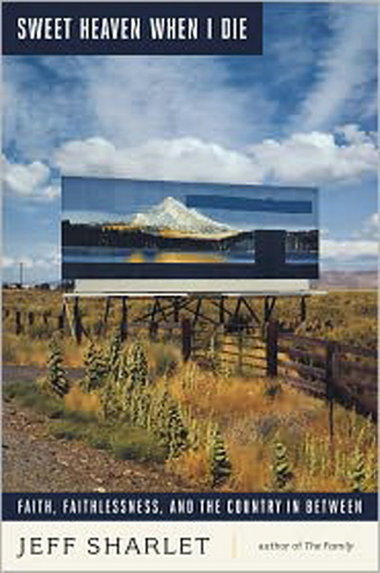
SweetHeavenWhenIDieAs an observer of religion who always struggles to get published, I found a companion soul in Jeff Sharlet’s Sweet Heaven When I Die: Faith, Faithlessness, and the Country In Between. Although the book is a collection of very disparate essays, it shows the subtle faces that religion frequently takes. We’re used to hearing religion described in bombastic terms, but Sharlet is more attuned to its soft rhythms than that. Yes, an essay or two may have a strident believer, but most of the faith found here is so deeply woven into the lives he examines that you might not even notice it was there had Sharlet not already warned you. Here is a man of no particular religious conviction showing us how it is—not judging, not ridiculing, not pandering. Religion, despite the gleeful proclamations of its detractors, is not likely to die out. It is more likely just to go unnoticed.

A number of the essays here gave me pause. In the first Sharlet notes of a friend, “She was fascinated by the thought that God was entitled to kill you at any time.” This friend is, of course, of Christian persuasion. I had never thought of the biblical paradox in that way before—divine entitlement. It is so like Job; the Lord giveth and the Lord taketh away. Christianity, historically, comes with a whole cartload of guilt: not only is God entitled, but we deserve to be killed. The Christianity in which I grew up was explicit about this—we live on borrowed time. As a child I heard more than one evangelist thunder this good news. We really deserve to die. Once we are good and vulnerable, the preacher offers us a way out. Pass around the collection plate. God is entitled; I shall not soon forget that.

Toward the end of the book another of Sharlet’s interviewees declares that doubt is a calling. Again, the professional religionist is stunned. Many religions eschew doubt as somehow evil—wickedly questioning the divine. Doubters, however, seldom cause religious trouble. Those whose convictions lie deep and untested will burst open like a spring-loaded trap at various provocations. Those who survive are left to weep and wonder. The doubter, the friend of Thomas, does not seek to harm, but can’t live without discovering the truth. This is true religion.

There are any number of stories here of persons of various levels of faith conviction. You’ll find few clergy or specialists among them, but you’ll find a book whose honesty cannot be doubted. At points I struggled to find an implicit religious, or faith-based theme. It is there. You just have to listen. And trust that Jeff Sharlet will not lead you astray.


The Importance of Being Published

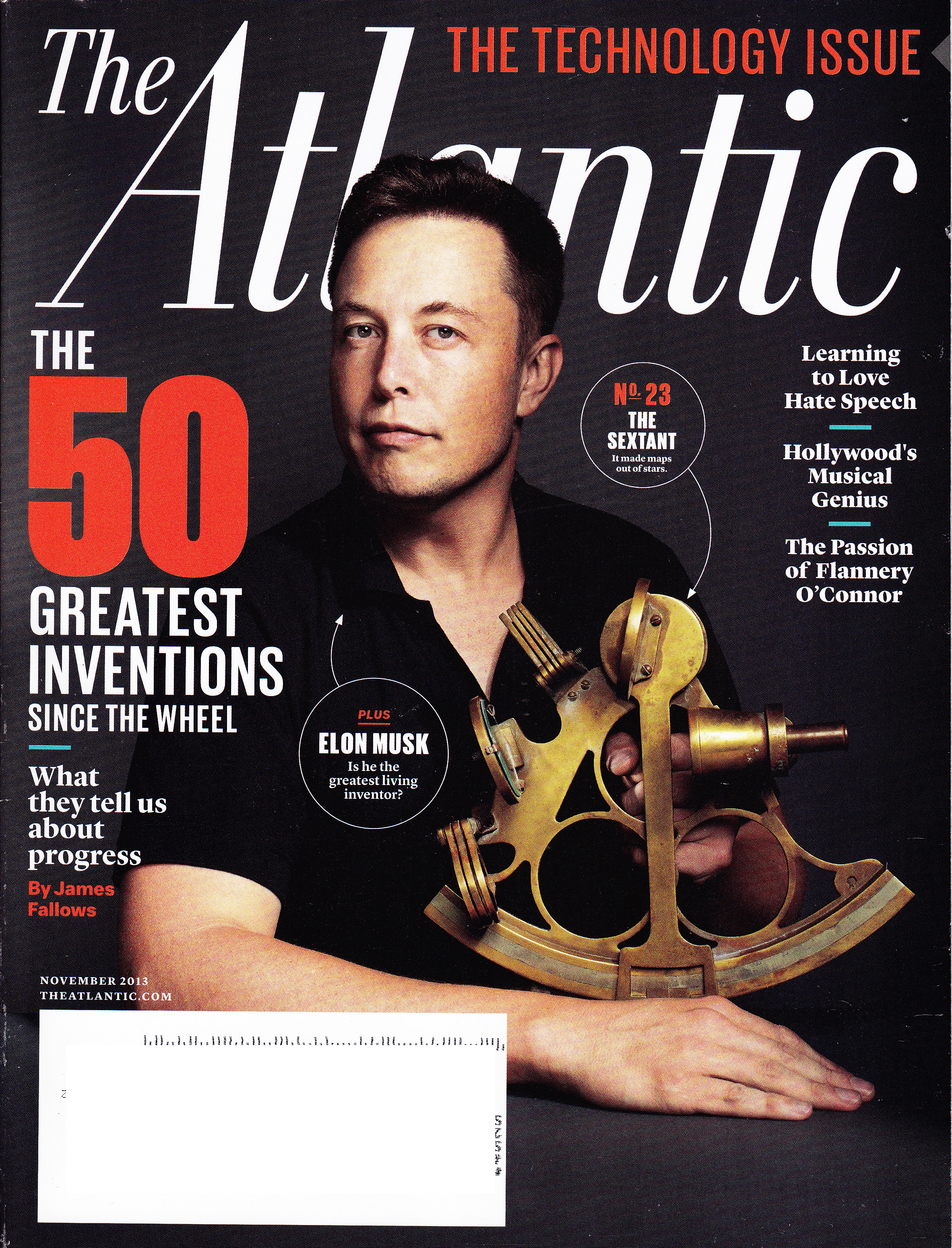
AtlanticThe crowd over at The Atlantic Monthly magazine are a formidable lot. Even with a Ph.D. and a modicum of writing ability, I’ve been frightened off from ever submitting to such an intellectual periodical. These are people whose opinions count. When The Atlantic named, in last month’s issue, the fifty most important inventions since the wheel how could I not peek? Especially when number 39 included a picture I recognized from my childhood in the cradle of the oil industry: Col. Edwin Drake standing outside a fledgling oil derrick in Titusville, Pennsylvania—just the next town up route 8. I felt like I might be somebody, by association. We all know that number one is best, so I wondered, as I flipped through the pages, what the most important invention was, although I suspected I already knew. The printing press, dating back to the 1430s, is certainly a contender, and was Atlantic‘s winner. Those of us historically inclined tend to think in regressions. The internet has forever changed our lives, but what is the internet without reading? (Okay, well, it is lots of funny pictures of cats and pornography, but you still have to be able to type in “cat” or “nude” or whatever, to bring you there.) It took the printing press to catapult reading from the academy to the hearth, and to reach that critical mass so that the Kindle could surpass the printed book.

My interest in studying the Hebrew Bible for a doctorate actually included an ulterior motive. You see, the Bible was among the first books printed. As much as western civilization owes to the New Testament, my regressive thinking insisted that the New Testament was based on the Old. As I learned in seminary, the Old was based on an older, and that on an even older, in a pleasing kind of regression. I ended up in Ugaritic, the earliest known alphabetic language. The alphabet, I might contend, vies with the printing press for most important invention since the wheel. Before the alphabet writing was so cumbersome that only very skilled specialists could read written languages cobbled together from signs that represented letters and symbols and entire words and entire classes of words. But, ah, it was writing! Mesopotamians seem to have brought the idea into existence, specifically, those of ancient southern Mesopotamia that we call the Sumerians, who, incidentally, also invented the wheel.

Those of us in the book industry feel a constant worry in our stomachs when we look at book sales figures. Even in the most highly literate of social periods a very small percentage of people would actually purchase books (especially in the New World). With electronic media, that number has declined alarmingly. Still, the internet—number 9 on The Atlantic list—owes its life to good old paper (number 6) and pen (which failed to make the list at all). And paper wouldn’t have evolved without clay—the very substance of which early written myths claim that humans are made—and stylus. Thoughts locked in our clay heads cry out for expression. Some of us are compelled to put them in the form of written words for others to see. It’s just that we know our place and wouldn’t presume to send them to The Atlantic Monthly, or any other magazine, where they would be certain not to make the cut.


Almost Human?

Last week the New York Times ran a story on the efforts of the Nonhuman Rights Project to have chimpanzees declared “legal persons.” Naturally this has set many legal persons at arms, given the unstated, biblical origin of the concept of human superiority. Without the biblical mandate we simply have to admit that we rule over animals on the basis of “might makes right,” a philosophical concept that never makes it far either in the classroom or the courtroom. We hold animals captive and experiment on them because we can. They can’t speak, can’t register protest, so we assume their silence as complicity and carry on. Research over the past several years, however, has pushed the human-separatists harder and harder. Animals are more like us than we are willing to admit. We acknowledge that we’ve evolved from them, but we suppose that at some point—probably the vocal cords—we surpassed them and therefore if they can’t speak they can’t think and they can’t feel. Even today many people still hold to the biblical orthodoxy that animals are merely here for our enjoyment and exploitation.

Considering how we treat other human beings, this is probably, sadly, no great surprise. In a world where many nations still allow women to be treated as property, putting a chimp in a cage and labeling it “mine” doesn’t appear so odd. Only the most crass of chauvinists would dare say that women are not human, but far too many, based mostly on religious biases, have no problem stating that women are inferior humans. Again, “the Bible tells me so.” This kind of thinking, prevalent even up until the 1950s in “civilized” countries like the United States, has yet to die out fully. What is it about the male psyche that insists on its own superiority? The Bible, it seems, has much for which to answer when found in the hands of men.

What makes us think that we are all evolving toward the “high point” of white males? Some of us in that class know that it is long past time that this glass “ceiling” should have been irreparably shattered. Nonsense, however, has staying power. Some of us even feel inferior just knowing such distinctions were ever made. Not that long ago Africans were said, by some, to be closer to apes than Caucasians. Women were said to be closer to snakes than men. What has been lacking is a sense of balance. Common sense. Genders and races equal but variable. Until that minimum bar is reached, how can it be hoped that fair treatment of nonhuman persons can ever be achieved? Some animals have been taught to read, at least in basic, symbolic ways. They understand that certain symbols stand in for defined rewards. Given time it might even be that this most human of inventions could be shared among nonhuman persons. If they do not learn to read the Bible with more sense than some human persons, however, we face a future of many other layers of distressing oppression.

787px-Chimpanzee_Ham_in_Biopack_Couch_for_MR-2_flight_MSFC-6100114


Making a Monster

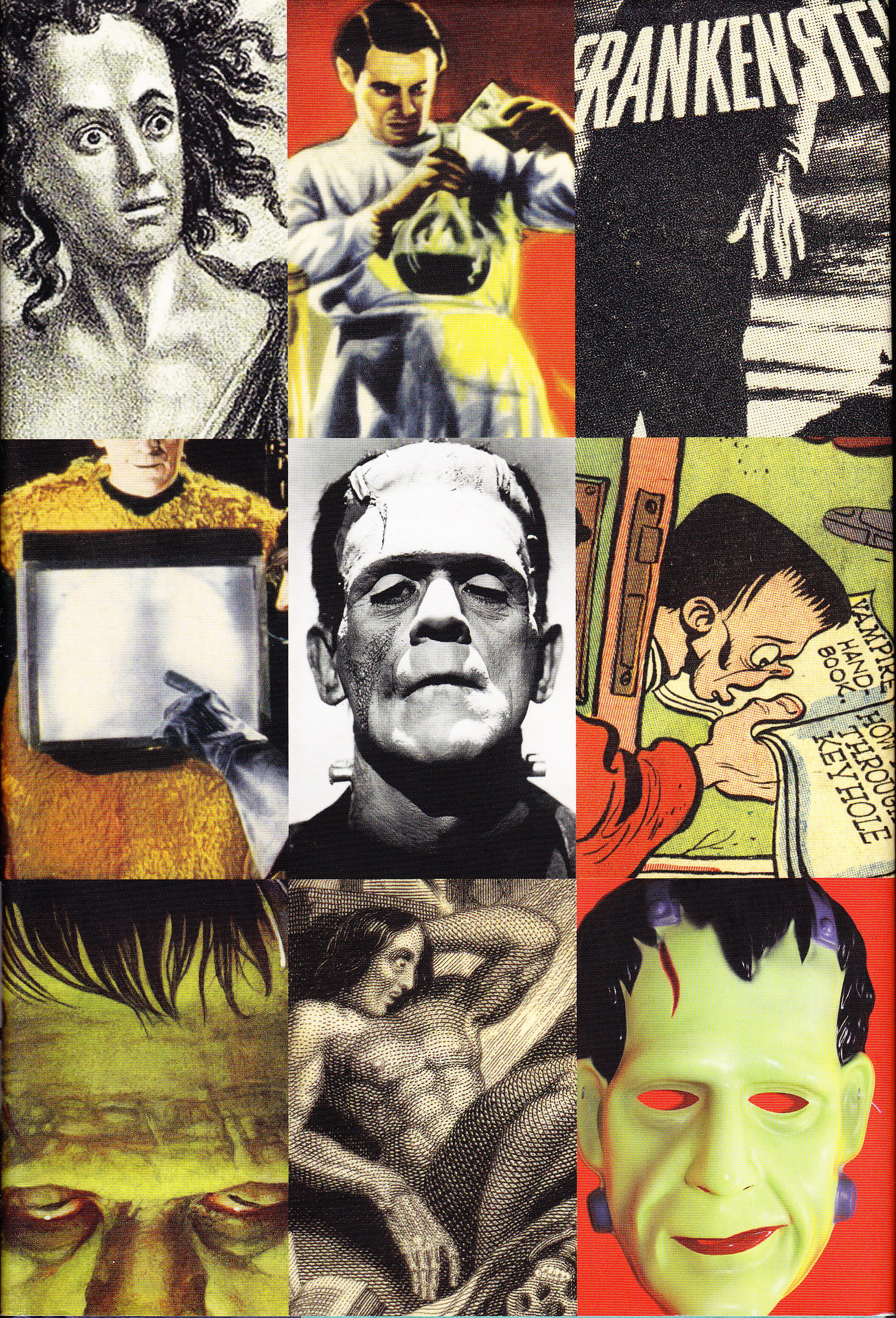
I was maybe six or seven when Frankenstein’s monster charged us. My mother, brothers, and I were part of a small crowd at Niagara Falls, where we had gone to visit relatives, when we found ourselves in the monster’s path. We were among of a knot of tourists, and plate glass separated us from the great roaring beast, posted to draw visitors to one of the many plastic tourist attractions around the famous falls. Each time the monster charged, we all screamed, knowing full well he could never break through that glass. As a member of the Monster Boomer generation (although on the tail end of the boomer part), the monster that disturbed me the most has always been Frankenstein’s monster. I’m not sure whether that was natural squeamishness, or if it was that as children my brothers and I tried to divide things up evenly and I ended up with the vampire while one of my brothers claimed possession of “Frankenstein.” Certainly when I grew old enough to read the book, it only added to my discomfort. The concept of Frankenstein’s monster was old enough to have lost its scary edge, but the story was very sad. The monster was not evil, but lonely.

HitchcockFrank

Sarah Tyler Hitchcock’s Frankenstein: A Cultural History revealed a new angle on the monster. A thoroughly fascinating anthropological approach to one of the more modern constellations in the night-time sky of fear, what became immediately obvious in this book is just how religious a monster Frankenstein’s creature is. Many of us think of “playing God” as a recent phenomenon. Mary Wollstonecraft Godwin (Shelley)’s Frankenstein was published in 1818 with just that concept in mind. Mary Shelley, barely twenty when the book was published, had tapped into one of the most vital of religious topics—what it means to make life. Hitchcock’s treatment of the subject covers the conception of the monster, the book and its history, the plays and movies based on the story, and Frankenstein’s monster’s reception into popular culture. At every step of the way, religious issues are raised. Mary, in her birth of an immaculate creature, gave the world theological conundrums through which we’re still sorting nearly two centuries later.

Often on this blog I maintain that monsters and religion are cut from the same cloth. Hitchcock provides a compendium of supporting evidence in her compelling book. Even down to the contemporary debates of scientists over genetic engineering and cloning, the story of Frankenstein and the overstepping of ethical boundaries comes up again and again in scientific literature. I couldn’t help but to think how this reflects the current acrimony between the materialists and the dualists among the intelligentsia: is the forging ahead with manipulation of life simply an experiment we must undertake or is it really an ethical (read “spiritual”) issue after all? Mary Shelley was not so strident as her erstwhile husband Percy was regarding the necessity of atheism. Her monster seemed to be raising that question in terms profoundly theological for a girl not yet of seminary age. Sarah Tyler Hitchcock has done us a great favor by producing a history that stitches religion, culture, and science together into a beast that we still haven’t learned to control.


Help from Above

Frisbee, like Kleenex and Band-Aid, is a brand name that has become generic. Since at least the time of ancient Greece people have been fascinated with flying discs, and like many kids of my generation I grew up with a Frisbee or two around the house. We didn’t have much money, and in my younger days I remember playing “frisbee” with the lids to large margarine tubs—it’s more difficult to get these to do tricks, but they fly passably well with the right flick of the wrist. When I got to college I started to hear about a new game called “Frisbee golf.” It usually involved a group of friends and their flying discs picking out a target and seeing who could get their Frisbee there in the fewest tosses. Well, college was a couple decades ago (ahem), and who has time for Frisbee in the serious adult world of trying to stay employed? When some friends asked me to join in a game of disc golf over a recent weekend I knew a couple of things had happened. First, Frisbee had been either usurped or commodified to the point that it was either illegal or gouache to use their discs to try to hit “that tree over there,” like the redneck with his shotgun on a Friday night. Second, to play the game you needed to have the right equipment. Out on the course we came across a couple of guys with “golf bags” full of discs that they had to flip through like so many CDs before each toss. I felt woefully amateur. Like golfing in jeans.

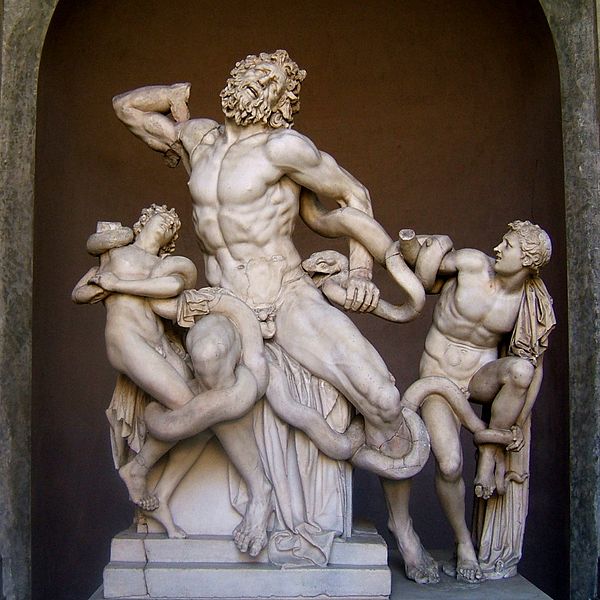
IMG_1140Fortunately my friends had discs. Scientifically engineered discs, no less. Different “Frisbees” (not a technical “Frisbee” among them, not even a Wham-o) with different weights and characteristics made for specific tasks. I thought of the famous sculpture of the discus thrower and wondered what Plato would’ve made of all this. Since we were a large group with limited discs, we each chose one to be “our” disc so that we could follow it. It was either a rare show of masculine aggression or perhaps religious curiosity that drew me to the distance disc called Archangel. Bright orange, the Archangel was emblazoned with an actual heavenly being with his (a masculine angel, this) sword. He wore a vaguely Egyptianizing headdress that brought to mind the plagues of Egypt. The disc was heavy compared to a Frisbee, and had an edge like a, well, a sword. A dull sword of course, maybe wooden as opposed to steel. That disc could fly (although it didn’t improve my score much).

Angels have had a long fascination for us mere mortals. Originally a class of messenger gods in antiquity, monotheism forced them into a subservient role where swiftness was essential. For some, such as the Angel of Death (more likely the source of the imagery behind my Archangel), weaponry was essential. Unlike the Angel of Death my aim wasn’t very accurate. Or maybe that is just like the Angel of Death. No firstborn were slain by an hour’s diversion of tossing some Frisbees around, but my thoughts had been driven back to the biblical origins of my implement. I wondered why there was no archangel of peace. A few days later it was announced that Nelson Mandela had died. My thoughts went to Gandhi. To Siddhartha Gautama. Even to Jesus. Yes, there have been those who’ve insisted on the way of peace. And many differences might be settled by a friendly game of Frisbee golf, minus, of course, the copyright infringement.


Deep Religion

Bosnia-Herzegovina is a nation well acquainted with disruption. The tangled history of the Balkans and the misplaced zealotry of political machinery has left this part of the world to rely on faith more than many others. So when a sinkhole suddenly opened up in Sanica, locals began to look for explanations beyond the scientific. Sinkholes are reminiscent of biblical-type punishment. They are relatively unpredictable even in our high-tech era, and they are just a bit eerie. Fear of falling is, psychologists tell us, one of the deepest phobias embedded from our youngest days. It can translate to acrophobia in some adults, but even those who don’t fear high places still shy away from an abrupt edge that appears below our feet. A story by Amel Emric on NBC narrates the responses of some villagers to the growing pit that is already fifty meters wide by thirty meters deep. The hole appeared under a pond shortly after the death of the owner who claimed that he would take everything when he went. The locals wonder whether he absconded with his pond and took it to the afterlife where, I hear, the fishing is choice.

The beliefs of the average citizen flummox the religious specialists. Perhaps it’s because religions have to struggle so hard for any kind of respectability that folk beliefs are simply labeled “superstitions,” but it is what hoi polloi believe that constitutes the main body of religion. One might counter, “but that’s not what really happened”—surely a ghost did not drain a lake and replace it with a perfectly natural sinkhole. Then again, quantum mechanics also tells us that what looks like reality isn’t really what it appears to be either. It may be that a ghost stealing a lake is a lot more plausible than a scientific explanation sometimes.

In a completely unrelated story, my relatives recently gave me an opinion piece from the Des Moines Register. A reader signed as N. W. Iowa Mystic wrote: “Budgets go astray, schedules get out of kilter, plans fail. Why? They are all graven images and the Second Commandment says, ‘Thou shalt not make unto thee any graven images.’ Laugh if you will, but that explanation is as good as any.” I had to stop to ponder in what way a budget was a graven image (I likely would not recognize an actual budget if I saw one). Or a schedule, or a plan. Who am I to say that they are not, however? My definition of “graven” may not match yours. I might consider the name of Job’s friends common knowledge, but for others they have fallen into that sinkhole of multiple bits of useless information. I’m not laughing at our mystic friend. I’m pretty certain that the earth has some very deep holes lurking just beneath the surface.

Sink hole or graven image?

Sink hole or graven image?


Appreciate Your Job

At a gathering of friends recently, a game of trivia broke out. Well, it was actually planned because we were not using the cards and pie wedges that we grew up with, but were making up our own questions. The submitter of the question was the final arbiter on whether an answer was correct or not. As usual, I probably overthought the process, trying not to make my questions too hard or too easy. Maybe my ideal contestant was a student in one of my intro classes since much of what I submitted was what I covered in my courses. Other questions were drawn from choice bits of this blog (something to which I never subjected my students). In any case, one of my submissions asked for the name of Job’s fourth friend. I was honestly surprised when nobody in the grew knew, or could even name one of poor Job’s friends. My slip of paper went into the unanswered pile in the middle, a stack alarmingly dominated by my own questions. Afterward, the friend who knew me the longest, and who grew up in a church-going family, asked “Did you really think anyone had read the book of Job?” Coming so shortly, as it did, after another friend in a different context had indicated that my interests are arcane, I began to feel my age.

Biblical literacy is a topic for which some scholars actively lobby the reading public. I’m not sure if the entire Bible need be known fully, although my job increasingly relies upon its popularity. Students used to ask if I still found the Bible meaningful, even though I spent my career parsing it apart. The answer is always the same: yes, the Bible is worthy of the attention lavished upon it. It has sections of unsurpassed beauty and even some lessons the world could still stand to learn. It is uneven, however. There are bits that probably should’ve never been canonized. There are moral lows as well as highs. And the book of Job is among the greatest pieces included in it.

On that point I would receive some argumentation, I’m sure. Many people detest the book of Job. The eponymous hero of the book seems almost blasphemous to some, and a complaining ingrate to others. In the course of his suffering four friends stop by. The last one, surely a later addition to the text, toes the party line of orthodoxy that the book severely shreds. Job also contains some of the finest poetry from the ancient world and has given modern English several catchphrases still currently in use. I’ve always felt a kinship with Job. While my lot has not been as pathetic as his, I have had enough set-backs to lend the book a kind of nostalgic patina. Even in their wrongheadedness Job’s friends can spill out poetry. And there is wisdom to be had in that dusty book. In the end I was probably the one who was wrong. There is nothing trivial about the book of Job.

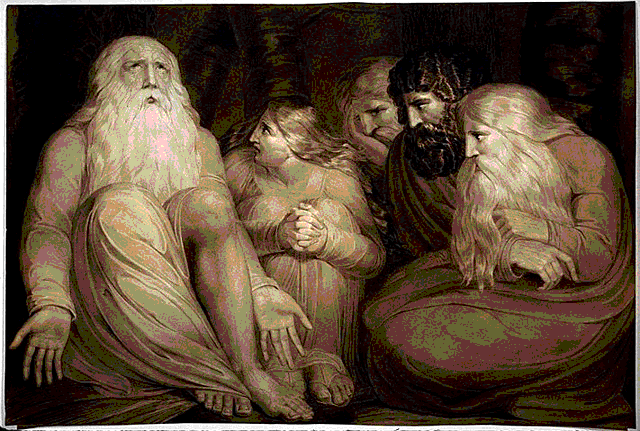
Blake'sJob


Poe Knows

CambridgeEdgarAllanPoeA recent trip to Baltimore prompted me to read Benjamin F. Fisher’s The Cambridge Introduction to Edgar Allan Poe. Well, that and the fact that I had purchased the book from an overstock table on a visit to a local indie bookstore (support your local!). Poe is a difficult writer to get to know. His personal life seems to have been largely an effort to find financial security while he knew his intellect was greater than those who employed him, and yet he was the one left without means. His literary talent, now considered one of the brightest constellations in the American writers’ heavens, was denigrated and demeaned and not fully appreciated until after he died of unknown causes in a city where he no longer lived. There is a profound sadness about Poe, and he seems a tragic figure. I do wonder, however, whether success would have ruined him. The more society woos you, the more you’re willing to lower your standards, I shouldn’t wonder. Not that I would know.

GhostsKnowFisher’s guide is a basic introduction that only toys here and there with Poe’s religious outlook. I’ve not run across much about Poe and religion, but there is a deep spiritual awareness, along with ratiocination, in his tales and poems. I suspect it might go back to the fact that religion and fear are so tightly intertwined. If a religious element is missing, it sometimes leaves a reader hungry. I’d also been reading Ramsey Campbell’s Ghosts Know concurrently with Fisher. This is a novel where a skeptical radio talk-show host takes on a stage psychic to see who really knows who might’ve killed a young girl. As the story unfolds it becomes less and less likely that the psychic is tapping into anything other than individuals’ wish projections.

While I found both of these books interesting, I pondered the fact that Poe referred to the scariest elements in his works as “terror of the soul.” The supernatural in Poe, as Fisher points out, is often really just a projection of an interior state of one of the characters—the eponymous tell-tale heart is guilt breaking through, not an undead heart beating. In an era where belief in the soul is waning, scary books seem less frightening. We’ve been robbed of both the supernatural and the soul, so what is left to fear? If death is only a more profound kind of sleep and morals are only a matter of social convention, then we are truly alone in this vast universe. Of what should we be afraid? Still, when the night stretches on for many long hours this December, I find myself inclined toward Poe and I wonder if ghosts truly do know.


Sunday Best

When my rural, northwestern Pennsylvania shows up in the news, I pay attention. An Associated Press story recently appeared concerning Rev. Chris Terbush of Bradford, Pennsylvania. Inspired by the success of Duck Dynasty (which seems poised to overtake even Apple as the most popular purveyor of popular culture), Rev. Terbush has encouraged his congregation to show up on Sunday mornings in camouflage, ready to go forth and claim dominion over nature once the service is over. I’ve been ambushed by enough clergy that the idea makes me a little nervous, I’ll have to admit. But then again, I know where he’s coming from. I grew up in a town that celebrated the first day of deer season as a public holiday, with schools closed and the hills alive with the sound of muskets. Not being a hunter, I just enjoyed the day off school. This upbringing, however, gave me a profound appreciation for the Jeff Daniels’ movie, Escanaba in da Moonlight. But I digress.

Religious services evolve, just like any other social phenomenon. When I was young, just as the sixties were wresting the color of life from the black-and-white fifties, going to church was a formal event that demanded your “Sunday best.” Only the worst of heathens would show up before the Almighty in anything less than a white shirt and tie, a jacket and uncomfortable shoes. You had to show the divine that you were willing to go that extra mile and implicate that you didn’t intend to have any fun when it was over because the sabbath is a solemn occasion. I remember the weird feeling of walking into church during the weekday wearing jeans for the first time. It felt as if I were dissing the rules of the club. It was an exclusive affair.

The “theology of dress” has become an area of scholarly investigation with the growth of embodiment issues. What we wear says something about our beliefs, and the fact that we wear clothes at all is sometimes even traced back to Genesis 3. The origin of “good clothes,” clearly, was a status issue. Those who could afford to keep some surplus clothes unsullied by labor wished to strut their stuff on occasion. And who better to impress than God? All of this has eroded over the years with many churches as casual as any man cave. Now you can camouflage yourself in church. There may be more going on here than meets the eye, both literally and metaphorically.

What happens in the woods stays in the woods

What happens in the woods stays in the woods


Explained Away

The premise seems sound. Although science tends to indicate that God is not necessary to explain anything, religion itself may still be useful. In a nutshell, that’s the basis of Alain de Button’s TED talk, “Atheism 2.0.” We don’t need to believe in God to find religion a useful paradigm. There’s so much more to being human than being simply analytical. De Button begins from the premise that there is no god, but that religion teaches us many useful lessons. It is a fascinating concept. I’ve had de Button’s book on the topic on my reading list for some months now, but like so many pressed for time, I find it simpler to watch a 20-minute TED talk than to read an entire book. It is refreshing to see someone on TED not simply dismissing religion. My friends in the STEM community often recommend TED talks, and they usually leave me feeling small and insignificant. Now I can at least show my face.

A deep irony pervades this condescension to religion. Scientific study of the past (known by the collective term archaeology) has recently given strong indication that the religious impulse is what led to civilization itself. The mysterious site of Gobekli Tepe, as I’ve mentioned before, seems to reveal that even before high antiquity what drew people together was the emergence of religious belief. Religion leads to culture, and culture leads to science. Science rejects religion and what happens to culture? Just take a look around. I’m still a naive man with working class values. In the course of my business travels I’ve often ended up in what might be considered the sketchiest kinds of neighborhoods. The suburbs keep moving further out. What happens when we run out of space? God only kn— wait, that’s a forbidden premise. Materialism only knows.

De Button’s talk is fascinating in that he doesn’t simply dismiss religion. Like most non-specialists, he focuses on the accidentals that reveal something savvy religionists have always known—there’s a healthy dose of psychology in any religion. Call it neuroscience, or call it truth. Religions have something to teach us. Civilization, it seems, began because of religion. De Button is clearly correct that we need not believe the minutia of religious doctrine to get something out of it. Atheism is not always evil nor is piety always above moral suspicion. Being human, we can’t help but wonder what is really real, however. Religions claim to know, as do some sciences. Little can be said beyond the fact that none of us know. Of course, TED will ask some of us to speak to the issue and the rest of us should just sit still and pay attention. To be noticed is to be an expert.

The eternal struggle (photo credit JuanMa, Wikipedia)

The eternal struggle (photo credit JuanMa, Wikipedia)


Schrödinger’s Luggage

I recently had the misfortune of flying on Delta Airlines. In all honesty I suppose my antipathy to Delta began with a flight on which I was not actually a passenger. A few years ago a news story of a Delta flight navigating to the wrong city created smirks for those who can afford to fly airlines that have better track-finding skills. With all of my flying over the past years, I’ve ended up on Delta a couple of times and my sense of their muddled thinking has only been confirmed. On a recent flight before which we were informed that our boarding would be “expediated” since the captain was late landing his jet at the next gate and would be flying right back to Atlanta whence he’d just arrived, I hoped the navigation would be better than the grammar. Landing in Atlanta for a flight to the thriving metropolis of Allentown, Pennsylvania, the gate agent repeatedly told us that the flight to “Aberdeen” was about ready to board. Several customers had to call out “Allentown” a few times before the agent realized her mistake. My misgivings grew. When I landed in Allentown, my checked bag had decided to take a tour of Detroit. It was late at night and I might have been a bit brusk with the poor, graveyard-shift Delta agent, but he assured me that my bag would be in by noon the next day.

Not a particularly trusting soul any more, I called Delta baggage information the next morning after looking at their website. The website showed the bag sitting just 15 gates from my departing Atlanta flight but then taking off to Detroit. When I called the representative told me that no information was available on my baggage (the artistry of understatement!). I informed her that I had the website up and that it showed my luggage in Detroit, I wanted to know when it would be in Allentown. Her tune changed to indicate, “oh yes, it is in Detroit.” But then, she could neither confirm nor deny that it would be on its scheduled flight. I had already determined to drive back to the airport to collect it. If Delta cannot be trusted to navigate to the right location in the air, then what would be their chances be on the ground in New Jersey? As I kindly suggested to the representative that they hire employees who could read, I couldn’t help but think of Schrödinger’s cat.

Erwin Schrödinger was the physicist who came up with the thought experiment of a cat placed in a box with a deadly substance. Whether the cat is alive or dead is only a matter of speculation without looking in the box, so, in reality, the cat is both alive and dead simultaneously. I’m no physicist, but I thought of Schrödinger’s luggage being both in the cargo hold and not being in the cargo hold at the same time. This was the very mystery of the universe, courtesy of Delta’s ineptitude, being foisted upon my frantic brain. Where was my bag? It was not in my possession, and I had last entrusted it to an airline that thought the best route from the Midwest to Allentown was through Atlanta and then Detroit, but they weren’t really sure if that was the case either. There is a consolation, however. You can get a refund of your twenty-five dollar baggage misplacement fee, in the form of a voucher for your next lost luggage episode on Delta airlines. I’m about ready to crawl into that box with Schrödinger’s kitten and await my fate.

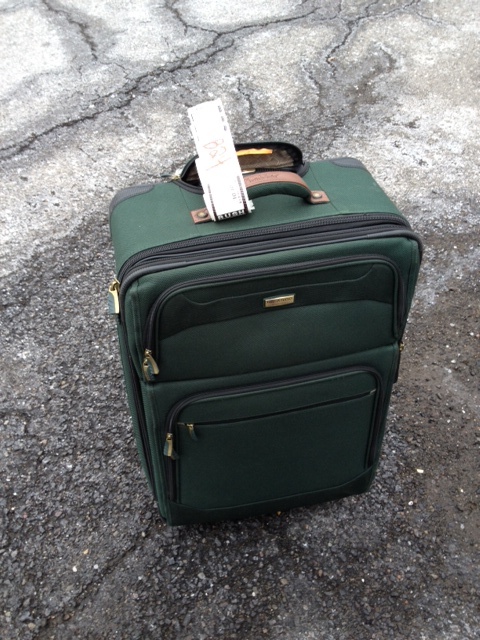
Both here and not here.

Both here and not here.