
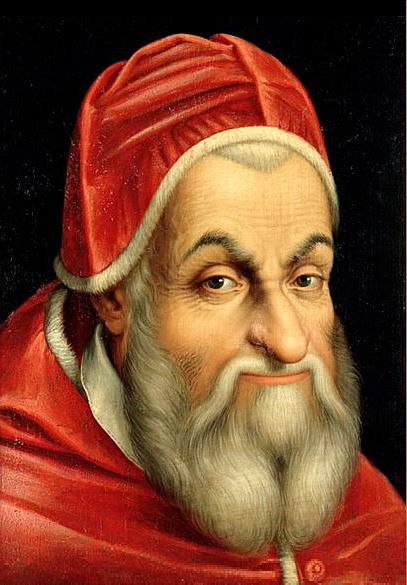
At fives and sixes, the Pope who gave us the devil’s advocate.
Those of us who grew up Protestant often had recourse to only faulty knowledge of Catholicism. We were sometimes taught that it was based on magic, what with the priest speaking in Latin and making mysterious motions with his hands. That meant, for some, that Catholics seemed particularly gullible and would believe things the rest of us wouldn’t. The Catholic Church, however, has often providing its own policing. Not as eager as Pentecostals to accept mundane miracles, when a pareidolia-inspired leakage of water or an anomalous burning of toast occurs, the Catholic Church is quick to debunk claims of miracles just because an underpass stain or a bit of bread looks like a famous religious figure. If you squint enough. The Devil’s advocate was a similar safeguard.
On the opposite side of the equation, I’ve often heard sermons among some evangelical groups claiming that we’re all saints. (Their membership, that is.) Who shouldn’t claim the name when they walk the walk? Many of these saints fail to inspire in the way of those of yore. Some of the beloved cultural heroes that keep coming back in various forms have saintly origins: Santa Claus and Saint Valentine are two that come to mind at this time of year. Some Protestants who may not have been perfect, however, should somehow qualify. Martin Luther King, Jr., another figure of the winter season, by his contributions to justice issues, might be one who would qualify. I’m sure there are many others. The fact is that making a principled stand against the wickedness that sometimes passes for the status quo is difficult and leaves one open to criticism and resentment. A Devil’s advocate might be just what society needs when looking to make saints out of mere mortals.
 Steve A. Wiggins